
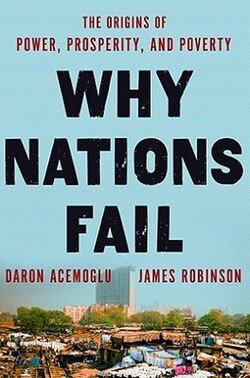
Why Read Why Nations Fail?
Why Nations Fail is the most ambitious and most compelling answer to the most important question in economics — why some nations are rich and others are poor. Published in 2012 by MIT economist Daron Acemoglu and Harvard political scientist James Robinson, it synthesizes two decades of research to make a single, powerful, empirically grounded argument: that the difference between prosperous and failing nations is not geography, culture, religion, or the ignorance of their leaders, but the quality of their political and economic institutions — and specifically, whether those institutions are “inclusive” or “extractive.” Acemoglu was awarded the Nobel Memorial Prize in Economic Sciences in 2024 partly for the research program that produced this book.
The book’s argument is built on a vast comparative historical record — spanning the Roman Empire, the Venetian Republic, colonial Latin America, the Ottoman Empire, the Soviet Union, Botswana, and North and South Korea — that consistently supports the institutional hypothesis while systematically refuting competing explanations. Its central contribution is the distinction between inclusive institutions (which distribute power broadly, protect property rights, and allow a wide range of people to participate in economic life) and extractive institutions (which concentrate power in the hands of a narrow elite and prevent the creative destruction that economic dynamism requires).
The book is simultaneously a work of economic theory, comparative history, and political philosophy — arguing not just that institutions matter but explaining why they are so difficult to change, why good institutions sometimes survive and bad ones persist, and what historical mechanisms set and sustain the institutional path of any given society.
Who Should Read This
A book for anyone seriously interested in why the world is as unequal as it is and what can be done about it — for students of economics, political science, and history who want the most rigorous and comprehensive account of national development; for policy makers and development practitioners who want to understand why foreign aid has such a poor track record. Essential for advanced economics, political science, and development students; international development, finance, and governance professionals; CAT/GRE aspirants needing advanced analytical economics prose; and anyone who has wondered why some countries seem permanently stuck while others transform in a generation.
Key Takeaways from Why Nations Fail
Inclusive institutions — political systems that distribute power broadly and economic systems that protect property rights, enforce contracts, and allow competitive markets — are the primary determinant of long-run national prosperity. They work by creating incentives for productive investment, allowing creative destruction (the displacement of old industries and elites by new ones), and preventing the concentration of power that enables extraction over creation. The prosperity of contemporary Western Europe, North America, and East Asia is primarily an institutional story.
Extractive institutions — political systems that concentrate power in the hands of a narrow elite and economic systems that use that power to extract resources from the majority — can produce short-term growth (the Soviet Union, colonial Latin American plantation economies) but cannot sustain long-run development. They undermine the incentives for broad-based investment and innovation, and prevent the creative destruction that economic dynamism requires. All extractive institutional systems contain the seeds of their own eventual stagnation or collapse.
Critical junctures — historical turning points such as the Black Death, the Atlantic trade opening, or colonization — create windows of opportunity in which institutional paths can shift dramatically. Whether a society moves toward inclusive or extractive institutions at a critical juncture depends on the interaction between the juncture’s specific characteristics and the existing balance of political power. Small differences at critical junctures, interacting with path-dependent institutional development, can produce dramatically different long-run outcomes — explaining why neighboring societies with similar initial conditions can diverge spectacularly over centuries.
Elites who control extractive institutions will resist institutional reforms that would produce broadly shared prosperity — even when those reforms would increase total economic output — because those reforms would also reduce the elite’s political and economic power. This insight explains the persistence of bad institutions: they are not the result of ignorance but of rational calculation. Elites understand exactly what inclusive institutions would mean for their power, and systematically prevent their development.
Key Ideas in Why Nations Fail
The book opens with the story of Nogales — a city divided by the US-Mexico border, with the American side significantly wealthier, healthier, and better governed than the Mexican side, despite sharing the same geography, climate, culture, and originally the same population. The Nogales example is the perfect opening gambit: it eliminates geography, culture, and population as explanatory variables in a single case, forcing the reader to look for an institutional explanation. The answer is the different institutional histories set in motion by British and Spanish colonial powers — differences in institutional design that compounded over centuries into the dramatic present-day divergence.
The geography hypothesis — associated primarily with Jared Diamond’s Guns, Germs, and Steel and Jeffrey Sachs’s tropical disease arguments — holds that the primary determinants of national prosperity are geographic. Acemoglu and Robinson do not deny that geography affects development, but argue that its effects operate through institutions rather than directly. Their most powerful evidence is the “reversal of fortune”: the regions most densely populated and institutionally sophisticated before European colonization (Mexico, Peru, India) are now generally poorer than the sparsely populated and institutionally undeveloped regions (North America, Australia, New Zealand) — the opposite of what a pure geography hypothesis would predict.
The culture hypothesis — associated with Max Weber’s Protestant Ethic thesis and its many descendants — holds that differences in culture, religion, and social norms explain differences in economic development. Acemoglu and Robinson acknowledge that culture matters but argue that it is largely endogenous to institutions: cultures of trust, cooperation, and long-term investment tend to develop where institutions reliably reward cooperation and investment; cultures of corruption, short-termism, and distrust tend to develop where institutions make extraction and predation the rational strategy. Culture is a consequence of institutions rather than an independent cause of development.
The central theoretical contribution is the distinction between inclusive and extractive institutions, and the political economy analysis of why extractive institutions persist. Inclusive economic and political institutions reinforce each other: economic inclusion requires political inclusion to prevent capture of the economic system by political elites, and political inclusion requires economic inclusion to prevent economic inequality from translating into captured political power. This mutual reinforcement explains both the virtuous circles of successful development and the vicious circles of persistent underdevelopment.
Core Frameworks in Why Nations Fail
Acemoglu and Robinson build their argument on six interlocking analytical frameworks that together constitute the most comprehensive institutional theory of national development in the literature.
Inclusive economic institutions allow and encourage broad participation under conditions of secure property rights, contract enforcement, rule of law, competitive markets, and access to education and finance. Extractive economic institutions are structured to extract income and wealth from one subset of society to benefit a narrow elite — plantation systems, forced labour, monopolies, barriers to entry. Inclusive political institutions distribute power broadly with pluralistic systems that constrain executive power; extractive political institutions concentrate power with few constraints. Critically, the two forms reinforce each other in both directions: inclusive institutions create constituencies for their maintenance; extractive institutions give elites the power to prevent their reform.
Inclusive institutions create virtuous circles: they generate broad-based economic growth, which creates a large middle class with a stake in maintaining inclusive institutions, which prevents capture by any single elite, which maintains inclusive institutions. Extractive institutions create vicious circles: they generate growth captured by a narrow elite, which uses that wealth to maintain political power, which maintains extractive institutions, which continue to generate captured growth. This dynamic explains the “iron law of oligarchy” — the tendency of even revolutionary movements with inclusive intentions to reconstitute extractive institutions once they gain power — and why external pressure for reform rarely produces durable change.
Critical junctures are major historical disruptions — the Black Death, the opening of Atlantic trade, the industrial revolution, colonization — that destabilize existing institutional arrangements and create windows for institutional change. Whether a society moves toward inclusive or extractive institutions at a critical juncture depends on the interaction between the juncture’s characteristics and the existing balance of political power. The Black Death moved Western European institutions toward greater inclusivity (by shifting labour markets in favour of workers) but Eastern European institutions toward greater extractivity (as landowners increased coercion to maintain labour supply). The same historical shock, interacting with different existing power balances, produced dramatically different outcomes.
Among regions colonized by European powers, the most densely populated and institutionally sophisticated before colonization (Mexico, Peru, India) are now generally poorer than the sparsely populated, institutionally undeveloped regions (North America, Australia, New Zealand). The geography hypothesis predicts the opposite. The institutional explanation: dense, sophisticated pre-colonial populations were colonized using extractive institutions designed to exploit existing populations; sparse, undeveloped regions were settled with more inclusive institutions designed for permanent European habitation. The reversal of fortune is a predictable consequence of colonial institutional design — and the book’s most powerful evidence that institutions, not geography, determine long-run outcomes.
Elites who control extractive institutions understand — sometimes explicitly, usually implicitly — that inclusive institutional reform would reduce their power and capacity to extract resources. They therefore use their political power to resist reform, capture reform processes, and reconstitute extractive institutions even after apparently successful change. This is not ignorance but rational calculation: the elite’s individual interest in maintaining extraction often outweighs the aggregate social benefit of inclusive development, and the concentration of political power in their hands allows them to act on this calculation. External pressure for reform fails because it does not change the underlying political economy that makes extraction rational for the elite.
Acemoglu, Johnson, and Robinson’s earlier academic research used the mortality rates of European settlers in different colonial territories as an instrument for the type of colonial institutions established. Where European settler mortality was high (due to tropical diseases), Europeans established extractive institutions designed to exploit indigenous populations. Where mortality was low, Europeans established settler colonies with more inclusive institutions. This variation — driven by disease environment rather than by any factor directly affecting modern development — allows causal inference about the relationship between institutions and development that purely correlational analysis cannot provide. It is the book’s methodological foundation.
Core Arguments
Acemoglu and Robinson advance four interlocking arguments that together constitute a complete institutional theory of national prosperity — from the causal primacy of institutions to the policy implications for international development.
The book’s central argument — stated in the first chapter and defended through the entire comparative historical record — is that the quality of political and economic institutions is the primary determinant of long-run national prosperity. This argument is made not just by assertion but through systematic comparison: every major alternative hypothesis (geography, culture, ignorance) is engaged seriously, its evidence evaluated carefully, and its inadequacy demonstrated through specific historical cases. The reversal of fortune, the Korea comparison, the Nogales example, and the colonial institutions analysis all converge on the same conclusion: institutions explain what geography, culture, and ignorance cannot.
One of the book’s most important theoretical contributions is the argument that economic and political institutions cannot be separated — they reinforce each other in both inclusive and extractive directions. You cannot build inclusive economic institutions (competitive markets, secure property rights) without inclusive political institutions (pluralism, rule of law, constraints on executive power) to prevent capture of the economic system by political elites. And you cannot maintain inclusive political institutions without inclusive economic institutions to prevent economic inequality from translating into captured political power. This interdependence explains why piecemeal economic reform without political reform tends to fail — and why the sequencing of institutional development matters enormously for policy.
The book’s most practically important policy implication — and its most direct challenge to the dominant approach of international development organizations — is that foreign aid and technical assistance cannot produce durable development in societies with extractive institutions. The elites who control those institutions will either capture the aid for their own benefit or use it to entrench their power while leaving the underlying institutional structure unchanged. Development requires institutional change, and institutional change requires shifts in the balance of political power — which foreign aid rarely produces and sometimes actively impedes by providing resources that strengthen the extractive elite.
The book directly addresses the “China model” argument — the claim that authoritarian political institutions combined with market economic institutions can produce sustained development. Acemoglu and Robinson acknowledge that extractive political institutions can produce significant growth (the Soviet Union grew rapidly for decades; China has grown rapidly since 1978). But they argue this growth is inherently limited: without inclusive political institutions, there is no mechanism to prevent the elite from eventually capturing economic gains, no protection for the creative destruction that technological change requires, and no guarantee that today’s successful authoritarian state will not become tomorrow’s extractive kleptocracy. The Soviet collapse and the stagnation of Latin American resource exporters are the cautionary historical cases.
Critical Analysis
A balanced assessment of one of the most influential social science books of the past two decades — its substantial intellectual achievements and the genuine limitations that critics have identified.
Acemoglu and Robinson draw on cases from six continents and three thousand years of history — Rome, Venice, Botswana, North Korea, colonial Latin America, the Atlantic slave trade, the industrial revolution — to build an argument that is simultaneously historically specific and theoretically universal. This breadth gives the institutional hypothesis a robustness that case-study-only or regression-only approaches cannot achieve.
The book takes the geography and culture hypotheses seriously, presents their strongest arguments fairly, and refutes them through specific evidence rather than dismissal. This engagement makes the book more persuasive and more intellectually honest than arguments that simply ignore the competition — and produces a more durable contribution to the literature.
The book’s conclusions about foreign aid, technical assistance, and the limits of external intervention have direct practical implications for international development policy — implications that are inconvenient for many development organizations but that are supported by the historical record in ways that alternative frameworks are not.
Critics have argued that “institutions” as defined in the book can become a tautological explanation — wealthy countries have inclusive institutions because they are wealthy, and we know they are inclusive because they are wealthy. Acemoglu and Robinson address this through the settler mortality instrument and the reversal of fortune evidence, but the circularity concern is genuine and the causal identification is not as clean as the book’s confident tone sometimes implies.
The book’s treatment of culture as largely endogenous to institutions is contested by cultural economists and economic sociologists who argue that specific cultural traditions (trust, social capital, long-term orientation) have causal effects on development not fully captured by the institutional framework. The empirical debate about culture and institutions is not as settled as the book suggests.
The book is far more powerful as a diagnostic tool than as a prescriptive guide. It explains brilliantly why extractive institutions persist and why external intervention tends to fail — but is less clear about what, concretely, can be done to move societies from extractive to inclusive institutions. The historical cases of successful institutional transformation are analysed but not systematically distilled into generalizable principles.
Impact & Legacy
An Immediate Intellectual Event: Why Nations Fail was published in March 2012 and became an immediate intellectual event — reviewed prominently by virtually every major publication, debated by economists, political scientists, historians, and development practitioners, and reaching a mass audience that academic work rarely achieves. It spent several months on major bestseller lists, sold over one million copies worldwide, has been translated into over thirty languages, and is now standard reading in university courses on development economics, comparative politics, and economic history across the globe.
The Nobel Prize: In 2024, Daron Acemoglu (along with Simon Johnson and James Robinson) was awarded the Nobel Memorial Prize in Economic Sciences for their research on institutions and prosperity — the research program that Why Nations Fail popularized. The Nobel Committee’s citation explicitly referenced the colonial origins research (the settler mortality paper) and the inclusive-extractive distinction as foundational contributions to understanding the long-run determinants of national prosperity. This recognition confirmed the book’s status not just as a successful popular work but as the public face of a genuinely transformative research program.
Impact Across Fields: In development economics, the book catalyzed a shift in research focus toward political economy and institutional analysis. In international development policy, it provided a rigorous empirical foundation for critiques of aid effectiveness that practitioners had been making for decades but without comparable analytical depth. In political science, its comparative institutional analysis across such a wide range of cases demonstrated the productivity of the institutional approach in ways that influenced the field’s research agenda.
Ongoing Research Program: Acemoglu and Robinson’s subsequent work, The Narrow Corridor: States, Societies, and the Fate of Liberty (2019), extends the institutional framework to examine the conditions under which political liberty can be sustained against both state tyranny and social disorder. This ongoing research program — culminating in the 2024 Nobel Prize — confirms Why Nations Fail as the accessible entry point into one of the most productive and consequential research programs in contemporary social science.
For Exam Preparation: Why Nations Fail is the most analytically demanding economics text on the Readlite list — dense, argument-rich prose that builds complex historical cases for theoretically precise conclusions. Its combination of historical narrative and economic theory, its systematic engagement with competing hypotheses, and its movement between specific cases and general principles all provide direct practice for the analytical reading skills that the most demanding CAT and GRE passages require.
Love This Book? Master Every Book.
Stop struggling with reading comprehension. Our proven system transforms how you read—whether for CAT, GRE, GMAT, SAT, or personal growth.
Best Quotes from Why Nations Fail
Nations fail today because their extractive economic institutions do not create the incentives needed for people to save, invest, and innovate.
Poor countries are poor because those who have power make choices that create poverty. They get it wrong not by mistake or ignorance but by design.
Political power is the essential driver of economic institutions. In the long run, nations that have broadened political power have become more prosperous.
Creative destruction is a powerful force for prosperity, but it is also a force that the powerful will resist, since it threatens their economic and political position.
Countries differ in their economic success because of their different institutions, the rules influencing how the economy works, and the incentives that motivate people.



Test Your Understanding
Think you’ve mastered Why Nations Fail? Challenge yourself with 15 questions on inclusive vs. extractive institutions, critical junctures, the reversal of fortune, elite resistance to reform, and the settler mortality hypothesis. Score 80%+ to prove your mastery.
Why Nations Fail FAQ
What is the difference between inclusive and extractive institutions?
Inclusive economic institutions allow broad participation in economic activity under conditions of secure property rights, reliable contract enforcement, competitive markets, and access to finance and education — creating incentives for productive investment and innovation across the whole population. Extractive economic institutions are organised to extract wealth from the majority for the benefit of a narrow elite — plantation systems, forced labour, monopolies, barriers to competitive entry. Inclusive political institutions distribute power broadly, maintain rule of law, and constrain executive power; extractive political institutions concentrate power in a narrow elite with few constraints. The critical insight is that both types of institutions reinforce themselves: inclusive institutions tend to be self-reinforcing through virtuous circles, and extractive institutions tend to be self-reinforcing through vicious circles.
Why doesn’t foreign aid solve the problem?
Foreign aid fails to produce durable development in countries with extractive institutions for three connected reasons. First, the aid is often captured by the extractive elite, who use it to enrich themselves or entrench their power. Second, aid can reduce the accountability of governments to their populations (if the government doesn’t need taxes, it doesn’t need to respond to the population’s preferences). Third, and most fundamentally, aid addresses the symptoms of extractive institutions (poverty, poor public services, lack of investment) without changing the underlying cause: the institutional structure that makes extraction more rational than productive activity for the elite. Institutional change requires shifts in the balance of political power — which aid, directed through existing governments, rarely produces and sometimes impedes.
What about the “China model” — can authoritarian governments produce sustained development?
Acemoglu and Robinson acknowledge that authoritarian governments with extractive political institutions can produce significant growth — China’s record since 1978 and the earlier Soviet industrialization are both real. But they argue this growth is inherently limited: without inclusive political institutions, there is no reliable mechanism to prevent the ruling elite from eventually turning the economic system toward extraction; no protection for the creative destruction that technological innovation requires (because innovation threatens politically connected incumbents); and no guarantee that the successful authoritarian state of today will not become the kleptocracy of tomorrow. The long-run sustainability of China’s growth under its current political institutions is, in their framework, genuinely in question.
How does Why Nations Fail relate to Guns, Germs, and Steel?
Jared Diamond’s Guns, Germs, and Steel (1997) and Why Nations Fail (2012) are the two most widely read books on the long-run determinants of national prosperity — and they are in direct intellectual tension. Diamond argues that geography — specifically the biological endowments that shaped the development of early civilizations — is the primary determinant of national prosperity, with institutional differences being largely downstream of geographic differences. Acemoglu and Robinson argue that while geography affected early development, it cannot explain the contemporary income distribution, and that institutions are the primary causal variable once critical junctures and path-dependent development are accounted for. Both books should be read together as complementary and competing explanations of the same phenomenon.
What is the “reversal of fortune” and why is it so important?
The reversal of fortune refers to the finding that among the regions colonized by European powers, the regions most densely populated and institutionally sophisticated before colonization (Mexico, Peru, India, parts of Africa) are now generally poorer than the regions most sparsely populated and institutionally undeveloped before colonization (North America, Australia, New Zealand). This is the opposite of what the geography hypothesis predicts. The institutional explanation is that dense, sophisticated pre-colonial populations were colonized using extractive institutions designed to exploit existing populations and resources, while sparse, undeveloped regions were settled using more inclusive institutions designed for permanent European settlement. The reversal of fortune is a predictable consequence of colonial institutional design — and the book’s most powerful evidence that institutions, not geography, determine long-run development outcomes.








