

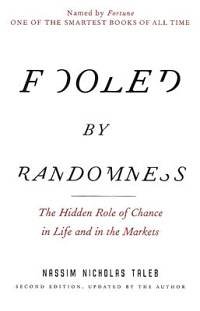
Why Read Fooled by Randomness?
Fooled by Randomness is the most intellectually honest book ever written about success, failure, and the role of chance — a work that permanently changes how you think about the traders, executives, celebrities, and entrepreneurs you admire, about your own successes and failures, and about the relationship between effort and outcome in a world governed by far more randomness than human psychology is wired to acknowledge. Published in 2001 as the first book in Nassim Nicholas Taleb’s Incerto series, it draws on probability theory, evolutionary psychology, and philosophy to make a single, deeply uncomfortable argument: that we systematically mistake luck for skill, survivorship for evidence, and random outcomes for meaningful patterns.
The book grew out of Taleb’s years as a derivatives trader on Wall Street — an environment in which the difference between skillful performance and lucky randomness is genuinely difficult to detect. He observed that the most celebrated traders were often those who had taken on hidden tail risks that had not yet materialized — who would eventually blow up catastrophically but who, in the meantime, appeared to be outperforming because their risk had not yet been revealed.
The book is organized loosely — more essay than treatise — weaving together probability theory, evolutionary psychology, cognitive biases, Stoic philosophy, and financial market observations into a meditation on randomness and luck. It is less technical than its subject matter might suggest and more personal than most finance books: Taleb writes in the first person, shares his own trading experiences, and is as interested in how to live well in a random world as in how to think correctly about it.
Who Should Read This
A book for anyone who has succeeded or failed at something and wondered how much of it was skill and how much was luck — which is everyone. Particularly valuable for professionals in competitive fields where the relationship between skill and outcome is genuinely uncertain. Essential for economics, finance, and probability students; competitive professionals in finance, business, and strategy; CAT/GRE aspirants needing intermediate-level conceptual prose; and anyone willing to confront the uncomfortable possibility that much of what they attribute to skill is partly or largely luck.
Key Takeaways from Fooled by Randomness
Survivorship bias — the systematic error of evaluating performance only from the sample of survivors while ignoring the much larger sample of failures — is the most pervasive and most consequential cognitive distortion in competitive fields. The successful trader, entrepreneur, or author you admire may be genuinely skilled — or may be the lucky survivor of a large cohort of equally skilled people, most of whom failed and whose failures you never observe. Without access to the full sample including the failures, performance attribution is deeply unreliable.
In high-randomness environments, skill is nearly impossible to detect over typical observation periods. A trader with a 55% win rate — genuinely skillful by financial market standards — will show losing years approximately 40% of the time over a single year of observation. Judging performance over one or even several years tells you almost nothing reliable about whether an edge is real. The statistical tests required to distinguish lucky performance from skillful performance are far more demanding than the casual pattern-recognition that humans naturally apply.
The human brain is a narrative-seeking machine — wired to find patterns, construct causal stories, and attribute outcomes to agents and intentions even in genuinely random processes. This narrative fallacy means that random sequences are routinely experienced as meaningful patterns; random successes are routinely attributed to identifiable skills and strategies; and random failures are routinely attributed to identifiable mistakes and character flaws. The story feels true because the brain demands a story — not because the story corresponds to the causal structure of events.
Stoic philosophy — specifically the practices of negative visualization and the dichotomy of control (distinguishing between what is and is not within your control) — provides the most practically effective framework for living well in a world governed by randomness. Virtue (doing the right thing, thinking clearly, preparing carefully) is within your control; outcomes (whether the randomness breaks in your favor) are not. Calibrating self-evaluation to process rather than outcome is both epistemically correct and psychologically sustaining.
Key Ideas in Fooled by Randomness
The book’s central thought experiment is the “Monte Carlo” simulation of alternative histories — the imaginary construction of all the possible paths that could have led to an observed outcome. A trader who has made a great deal of money appears, from the single observed history, to be skillful. But consider the full distribution of possible histories: in a world where a hundred traders all adopt similar risk profiles, some will make money and some will lose it, purely from random variation, even if none has any genuine edge. The few who made money will appear skillful; the many who lost money will have left the industry. Observing only the survivors and attributing their success to skill rather than luck is the survivorship bias error — systematically committed by financial journalists, business school case study writers, and the traders themselves.
The distinction between noise and signal — between the random variation in any time series and the underlying trend or pattern, if any — is the book’s most technically demanding and most practically important concept. In financial markets, the ratio of noise to signal is extraordinarily high at short time scales (daily or monthly fluctuations of any asset are dominated by noise) and lower at long time scales (the multi-decade trend of equity returns reflects something real about economic growth). Investors who monitor their portfolios daily are therefore overwhelmingly observing noise, not signal — and will make systematically worse decisions as a result, because their brains will inevitably interpret noise as meaningful information requiring a response.
The concept of alternative histories — what might have happened but did not — is Taleb’s primary tool for correcting the hindsight bias that makes past events feel inevitable and past successes feel deserved. Every outcome is the realized path through a distribution of possible outcomes; the fact that one path was realized tells us very little about whether it was the most likely, the best prepared for, or the most skillful path. The Russian roulette player who has survived five chambers feels like a skilled survivor — and may have developed an elaborate theory of their own skill at the game. The sixth chamber has not yet spoken.
Taleb’s discussion of asymmetry in outcomes — the phenomenon in which large losses are categorically more consequential than large gains — anticipates the full development of this insight in The Black Swan and Antifragile. In financial markets, strategies that generate small, consistent gains (which feel like skill) while silently accumulating large, infrequent losses (which look like bad luck when they materialize) are common precisely because they look skillful until they don’t. Taleb’s own trading career was organized around the opposite position — accepting small consistent losses to be positioned for large infrequent gains — a strategy that looks like failure most of the time and wins spectacularly the rest.
Core Frameworks in Fooled by Randomness
Taleb builds his argument on six interlocking frameworks that together form a complete toolkit for thinking clearly about luck, skill, and performance in environments dominated by randomness.
In any competitive field with high randomness, many people attempt a strategy and most fail. The survivors — those who succeed or persist long enough to be observed — are the only people we evaluate. If we attribute their success to the skills and strategies we can identify in them, we are systematically biased: we are not observing the relationship between those skills and success in the full population, only in the biased sample of survivors. The “cemetery” of failures — the traders who went bankrupt, the entrepreneurs who shut down, the writers never published — is invisible, and its invisibility makes the apparent correlation between survivors’ characteristics and success look far more meaningful than it is.
Any observed outcome is one path through a distribution of possible outcomes — the path that happened to be realized. Evaluating the skill or quality of a decision by the outcome it produced (outcome bias) ignores this distributional reality: the same decision can produce good outcomes in some possible worlds and bad outcomes in others, and observing only the realized outcome tells us very little about the quality of the decision. By mentally constructing alternative histories — asking “what could have happened but didn’t?” — we can evaluate decisions more accurately by their process quality (was the reasoning sound, the risk appropriately managed?) rather than by their outcome.
In any time series that contains both a genuine trend (signal) and random variation (noise), the ratio of noise to signal varies with the observation frequency — at short time scales, noise dominates; at long time scales, signal emerges. In financial markets, the signal (expected return to equity investment) is swamped by noise (daily, monthly, even annual fluctuations) at short time scales. An investor who checks their portfolio daily observes approximately 97% noise and 3% signal — and will make systematically worse decisions than one who checks quarterly or annually, because their brain interprets the noise as meaningful information requiring a response.
The human brain evolved in an environment where pattern detection and causal attribution were survival-critical skills, and it applies these skills automatically to all perceived sequences, including genuinely random ones. Sequences of coin flips are perceived as containing patterns; sequences of market returns are experienced as reflecting skill and strategy; sequences of successes are attributed to character traits and decisions. This narrative construction is usually the right heuristic in the environments where it evolved — but it produces systematic errors when applied to genuinely random processes. The narrative feels true because it is coherent, not because it corresponds to the causal structure of events.
Stoic philosophy distinguishes rigorously between what is within our control (our own thoughts, decisions, and actions — our “virtue” broadly construed) and what is not (external outcomes, other people’s behavior, the random variation of events). Taleb adopts this framework as the most psychologically sound and epistemically correct response to the reality of randomness. Since outcomes are partly or largely determined by factors outside our control, calibrating self-evaluation to outcomes produces both epistemic error (confusing lucky outcomes with skillful decisions) and psychological harm. Calibrating self-evaluation to process quality is both more accurate and more psychologically sustaining.
A trader who wins 70% of the time but loses far more on each losing trade than they gain on each winning trade has a positive win rate but negative expected value — they will go broke in the long run. Conversely, a trader who loses 70% of the time but gains far more on each win than they lose on each loss has a negative win rate but positive expected value — they will prosper. The human brain naturally focuses on frequency (how often am I right?) rather than magnitude (what is the expected value of my outcomes?), making the first type of trader feel skillful and the second type feel incompetent — even when the economic reality is the exact reverse.
Core Arguments
Taleb advances four interlocking arguments that together constitute a complete account of how randomness is systematically misread as skill — and what the correct response to that reality looks like in practice and in life.
The book’s central empirical argument — grounded in both probability theory and Taleb’s direct observation of financial market participants — is that luck is systematically underestimated in the attribution of success to skill. This underestimation is not a random error but a systematic one, produced by three interlocking cognitive biases: survivorship bias (we observe successful survivors, not the full population of attempters); hindsight bias (past outcomes feel inevitable and attributable to skill once they have occurred); and the narrative fallacy (we construct compelling causal stories around any outcome). The combined effect is that we dramatically overestimate the relationship between skill and success in high-randomness environments — with consequential effects on how we hire, invest, and learn from experience.
One of the book’s most provocative arguments is that in high-randomness environments, the most dangerous people to follow are the consistently successful — not because success is undesirable but because consistency, in a high-noise environment, is statistically more likely to reflect concentrated risk-taking than genuine skill. The trader who has had ten consecutive profitable years may be genuinely skilled — or may have spent a decade taking on risks that had not yet materialized. The survivorship process ensures that the risk-takers who are eventually destroyed are removed from the visible population, leaving behind the consistent winners as apparently the best examples of skill. Following the most consistent winners is therefore systematically riskier than it appears.
The book’s most practically important argument is that in high-randomness environments, performance evaluation should be based on the quality of the decision-making process rather than the quality of the outcomes — because outcomes reflect both process quality and random variation, and the random variation dominates at short time scales. A trader who manages risk carefully, uses sound reasoning, and has a genuine probabilistic edge may show poor results over any given year or several years; a trader who takes on concentrated hidden risks may show excellent results until the risk materializes. Evaluating by outcomes rather than process systematically rewards the second type and penalizes the first — institutionalizing error rather than rewarding genuine skill.
The book’s philosophical conclusion — that Stoic virtue ethics provides the most practically effective framework for living in a random world — is both its most personal and its most ambitious claim. Taleb argues that calibrating behavior to virtue (sound process, honest reasoning, appropriate risk management, equanimity in the face of outcomes outside one’s control) rather than to outcomes is superior not just philosophically but practically: it produces more consistent decision quality across the full distribution of possible worlds, rather than optimizing for performance in the realized world at the cost of catastrophic fragility in other possible worlds. Virtue is what you can control; outcomes are not.
Critical Analysis
A balanced assessment of the most personal and most foundational book in Taleb’s Incerto series — its genuine achievements and the limitations that honest readers should acknowledge.
Unlike most finance and economics books, Fooled by Randomness is genuinely personal — Taleb writes about his own psychological reactions to market volatility, his own failures of rationality, and his own adoption of Stoic practices to manage them. This self-awareness gives the book a quality that purely analytical treatments of randomness lack, and makes its insights feel applicable to the reader’s own life rather than merely informative about financial markets.
Taleb integrates probability theory, evolutionary psychology, cognitive bias research, Stoic philosophy, and financial market observation in a way that is genuinely illuminating rather than merely interdisciplinary. The connections he draws — between survivorship bias in evolution and survivorship bias in financial markets, between Stoic negative visualization and modern scenario analysis — are not forced but genuinely productive.
The book models the epistemic humility it advocates — Taleb is consistently honest about the limits of his own ability to distinguish luck from skill in his own performance, and about the difficulty of applying correct probabilistic reasoning under genuine uncertainty. This intellectual honesty is rare in finance writing and gives the book unusual credibility.
The book’s relatively loose structure — essays rather than chapters, organized thematically rather than argumentatively — results in the central insights (survivorship bias, noise vs. signal, narrative fallacy) being made several times from slightly different angles, with some repetition that tighter editing would have removed. Readers who want the same insights delivered more efficiently may prefer The Black Swan, which develops the same themes with greater conceptual precision.
The book’s primary examples are drawn from derivatives trading and quantitative finance in ways that can make the arguments feel more domain-specific than they actually are. Readers who are not interested in financial markets may need to work harder to translate the arguments to their own contexts, even though the underlying insights are fully general.
The slightly superior tone that becomes more pronounced in Taleb’s later books is already present here — the contempt for those who are “fooled,” the dismissal of the financial media, the implication that the author has seen clearly what others cannot. This tone is occasionally alienating, though in this first book it is considerably more restrained than in Antifragile (B64).
Impact & Legacy
From Self-Published to Landmark: Fooled by Randomness was originally self-published in 2001 and then picked up by a major publisher, eventually selling over one million copies and being translated into more than twenty languages. It was named by Fortune magazine as one of the smartest books of all time and has been widely recommended by investors, academics, and intellectuals as one of the most important books for thinking clearly about financial markets and performance evaluation. It established Taleb’s intellectual reputation and created the audience for The Black Swan (2007) and Antifragile (2012), which developed the same themes with greater scope and ambition.
Impact on Finance and Investment Practice: The book’s impact on professional practice has been quietly significant. Its articulation of survivorship bias, the noise-signal distinction, and the dangers of outcome-based performance evaluation has influenced institutional investors, risk managers, and fund evaluators who want more rigorous frameworks for distinguishing genuine skill from lucky randomness. The specific insight that strategy performance should be evaluated over long periods with appropriate statistical tests — rather than over single years of observation — has influenced how sophisticated institutional investors evaluate managers.
Broader Cultural Impact: The popularization of the insight that successful people in competitive fields may owe more to luck than skill — and that biographies of successful people are deeply unreliable guides to replicable success — has been substantial, feeding into the “hidden role of luck” literature that includes books like Michael Lewis’s The Undoing Project, Malcolm Gladwell’s Outliers, and subsequent social science research on inequality and opportunity. Taleb’s was the clearest and most rigorous early articulation of this insight for a general audience.
Position Within the Incerto Series: Fooled by Randomness is the first and most personal book in Taleb’s Incerto series — the foundation on which The Black Swan (2007), Antifragile (2012, B64), and Skin in the Game (2018) build. It establishes the core insight (randomness is systematically underestimated) and introduces the key concepts (survivorship bias, noise vs. signal, narrative fallacy, Stoic response) that the later books develop with greater theoretical ambition. Reading it first is the natural sequence: the later books make most sense to a reader who has already absorbed the foundational argument of this one.
For Exam Preparation: Fooled by Randomness is excellent intermediate-level reading comprehension practice in conceptual nonfiction at the intersection of probability, psychology, and philosophy. Its movement between abstract concepts and concrete illustrations, its combination of rigorous argument with personal reflection, and its consistent application of probabilistic thinking to intuitive domains all provide direct practice for the analytical reading skills — distinguishing the argument from the example, identifying implicit premises, evaluating evidence — that CAT and GRE passages most rigorously test.
Love This Book? Master Every Book.
Stop struggling with reading comprehension. Our proven system transforms how you read—whether for CAT, GRE, GMAT, SAT, or personal growth.
Best Quotes from Fooled by Randomness
The fact that a broken clock is right twice a day does not make it a good clock. The fact that someone made money does not make them a good investor.
Reality is far more vicious than Russian roulette. First, it delivers the fatal bullet rather infrequently, like a revolver that would have hundreds, even thousands, of chambers instead of six.
Mild success can be explainable by skills and hard work, but wild success is usually attributable to variance and luck.
We are not rational enough to be exposed to the press, and it is not rational to give in to the press. It is not rational to give in to our emotions.
The cemetery of failed persons will be full of people who shared the traits of the lucky few but were less lucky — and, alas, we do not observe the cemetery.
Test Your Understanding
Think you’ve mastered Fooled by Randomness? Challenge yourself with 15 questions on survivorship bias, alternative histories, noise vs. signal, the narrative fallacy, skewness, and the Stoic response to randomness. Score 80%+ to prove your mastery.
Fooled by Randomness FAQ
What is survivorship bias and why does it matter so much?
Survivorship bias is the error of evaluating a population or process only from the sample of survivors — of ignoring the failures, dropouts, and eliminated participants whose outcomes would change the evaluation. It matters because in any competitive field with high randomness, the survivors are not a random sample of the original population: they are systematically the luckiest members of the distribution, plus the genuinely most skillful. If we attribute their success exclusively to the skills and strategies we identify in them, we dramatically overestimate the relationship between those characteristics and success — because we are not observing that relationship in the full population, only in the biased sample of survivors. The practical implication is that biographies of successful people, case studies of successful companies, and performance records of successful managers are all unreliable guides to replicable success unless they explicitly account for survivorship bias.
How can you tell whether someone’s financial success is skill or luck?
Taleb’s answer is that distinguishing skill from luck in financial markets is far harder than commonly assumed, and requires statistical tests that are far more demanding than the pattern-recognition that humans naturally apply. A rough practical guide: the longer the track record, the higher the Sharpe ratio (risk-adjusted return), and the more the performance can be attributed to identifiable, repeatable, non-concentrated strategies, the more likely skill is a significant component. But even a ten-year track record provides limited statistical confidence in a high-noise environment. The most important heuristic is to be deeply suspicious of consistently outstanding performance — because consistency in a high-noise environment is more likely to reflect concentrated risk-taking (that has not yet materialized as loss) than genuine skill.
What is the “noise trader” problem and what does it mean for how we learn from markets?
The noise trader problem is that financial markets are populated by traders who respond to noise (random fluctuations) as if it were signal (meaningful information), generating price movements that cannot be explained by changes in fundamentals. This creates a self-fulfilling dynamic: noise trading produces price changes that look like information to other traders, who respond to them, generating further price changes. The result is markets that are significantly noisier than their information content warrants — and that are systematically more difficult to learn from than they appear, because the apparent patterns and price movements that traders try to interpret are dominated by noise. For investors, the practical implication is to trade less frequently and to base investment decisions on long-horizon signal rather than short-horizon noise.
What is the relationship between Fooled by Randomness and The Black Swan?
The two books address related but distinct aspects of the same broader argument. Fooled by Randomness focuses on the systematic human error of underestimating the role of randomness in observed outcomes — the cognitive and psychological mechanisms (survivorship bias, narrative fallacy, hindsight bias) that make us see skill where there is luck. The Black Swan focuses on a specific type of random event — rare, high-impact, and unpredictable events that fall outside the range captured by normal probability distributions — and on how standard risk models systematically fail to account for them. Fooled by Randomness is about the everyday randomness we misinterpret as skill; The Black Swan is about the extreme randomness we cannot predict or model. Reading Fooled by Randomness first is the natural sequence.
How does Fooled by Randomness fit with Thinking, Fast and Slow and Blink on the Readlite list?
All three books address the systematic errors of intuitive human judgment, but from different angles. Thinking, Fast and Slow (Kahneman) provides the most comprehensive theoretical framework — the System 1/System 2 architecture — within which the specific cognitive biases of Fooled by Randomness (survivorship bias, narrative fallacy, hindsight bias) are special cases. Blink (Gladwell) makes a partially competing argument that rapid intuitive judgment can be accurate in domains of genuine expertise — which Taleb would acknowledge while insisting that financial markets are not such a domain. Fooled by Randomness is the most focused on competitive professional performance under randomness, and the most insistent on the limitations of intuition in that domain. Together the three books constitute the Readlite list’s most complete treatment of the relationship between intuitive judgment, cognitive bias, and the systematic errors that randomness produces.








