

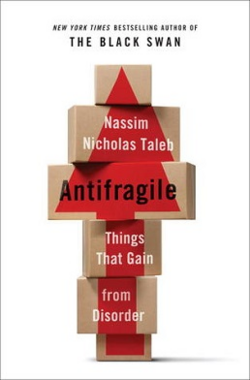
Why Read Antifragile?
Antifragile is the most conceptually original economics and philosophy book of the past two decades — a work that introduces a genuinely new idea, builds a comprehensive framework around it, and applies that framework to domains ranging from evolutionary biology and medicine to finance, urban planning, and the ethics of risk. Published in 2012 as the third book in Nassim Nicholas Taleb’s Incerto series (following Fooled by Randomness and The Black Swan), it is simultaneously his most ambitious work and his most practically valuable — the book in which the descriptive account of how the world actually is (fragile, uncertain, subject to Black Swans) is complemented by the prescriptive account of how to build systems that benefit from that uncertainty rather than being destroyed by it.
The book’s foundational insight is that the English language has a significant gap in its conceptual vocabulary. We have words for things that break under stress (fragile) and for things that resist stress (robust or resilient), but no word for the logical opposite of fragility: the property of getting stronger from stress, disorder, and volatility. Taleb names this property “antifragile” — and argues that it is not only a real and important property but the most important property for understanding how complex systems survive and thrive in an uncertain world.
The argument unfolds across seven Books applying the antifragility framework to progressively broader domains: the fundamental concept; the role of optionality and convexity in creating antifragile systems; the tension between expert-driven interventionism and the bottom-up trial-and-error processes that produce antifragility; the ethics of “skin in the game”; the philosophical roots of the concept; and the practical implications for how to live, invest, and build institutions.
Who Should Read This
A book for intellectually ambitious readers who want a genuinely new conceptual framework for thinking about risk, uncertainty, and resilience — who are not satisfied with conventional risk management approaches and want to understand why apparently stable systems are often fragile. Essential for advanced students of economics, finance, and complex systems; risk management, investment, strategy, medicine, and policy professionals; CAT/GRE aspirants needing advanced conceptual and philosophical prose; and anyone who wants to understand why some systems thrive in turbulent environments while others collapse.
Key Takeaways from Antifragile
Antifragility is the property of systems that gain from stress, disorder, and volatility — the logical opposite of fragility, and something genuinely different from mere robustness or resilience. Muscles that grow stronger from exercise, immune systems that develop through exposure to pathogens, businesses that improve through competitive pressure, and scientific knowledge that advances through falsification are all antifragile. Understanding which of your systems are fragile, robust, or antifragile — and designing them to be more antifragile — is the central practical challenge the book addresses.
Optionality — the possession of options (the right but not the obligation to act) combined with asymmetric payoffs (limited downside, unlimited upside) — is the primary mechanism for building antifragile positions. When you can gain more from good outcomes than you lose from bad ones, you benefit from volatility regardless of its direction. The “barbell” strategy — combining extreme safety in some domains with high-risk, high-reward exposure in others, while eliminating the dangerous middle — is the practical application of this principle to investment, career, and life design.
Naive interventionism — the attempt by experts and planners to suppress the natural volatility of complex systems — typically makes those systems more fragile rather than more stable. By preventing the small stresses and failures that allow antifragile systems to develop adaptive capacity, well-intentioned interventions accumulate hidden fragility that eventually manifests as catastrophic failure. The financial system that is “too big to fail,” the forest where fire is suppressed until catastrophic wildfire becomes inevitable, the child protected from every minor adversity until adulthood overwhelms them — all illustrate the same mechanism.
Skin in the game — the requirement that those who make decisions bear the consequences of those decisions — is both an ethical principle and a practical prerequisite for system resilience. When decision-makers are insulated from downside risk (bankers whose bonuses depend on short-term gains but whose losses are borne by taxpayers; doctors who prescribe treatments whose harms they do not experience), they systematically take risks that are rational for themselves but devastating for the systems they manage. The absence of skin in the game is the primary source of fragility in modern institutional life.
Key Ideas in Antifragile
The book’s opening move is a conceptual one: the identification of a gap in the English language’s vocabulary for describing responses to stress and uncertainty. We have “fragile” (breaks under stress) and “robust” (resists stress without improving), but no word for the property that is the logical antonym of fragility — the property of getting stronger from stress. This is not a trivial observation: the absence of a word for a concept is evidence that the concept has not been clearly articulated. Biological evolution is antifragile; competitive markets are antifragile; scientific knowledge is antifragile. Once named, the concept turns out to be genuinely illuminating across an extraordinary range of domains.
Taleb’s central practical observation is that modern institutions — financial systems, healthcare systems, urban planning, political systems — systematically suppress the natural volatility and stress that would allow antifragile development, and thereby accumulate hidden fragility that eventually manifests as catastrophic failure. The 2008 financial crisis is the paradigm case: decades of apparently successful volatility suppression (the “Great Moderation”) had not eliminated systemic risk but concentrated and amplified it, so that when the suppressed volatility finally erupted it was catastrophic rather than merely damaging. The forest fire management analogy is equally instructive: suppressing small natural fires prevents the forest from developing its natural fire-resistance and accumulates fuel loads that make eventual fires far more destructive.
The concept of the “Procrustean bed” — the mythological villain who stretched or shortened travellers to fit his bed rather than making a bed to fit the travellers — becomes Taleb’s metaphor for the intellectual error of fitting the world to our models rather than fitting our models to the world. Experts who use Gaussian (bell-curve) statistical models for phenomena that have fat-tailed distributions (financial returns, earthquake magnitudes, city sizes) are suppressing the evidence of extreme events that their models cannot accommodate rather than revising their models to accommodate the reality of extremes.
The “triad” of fragile-robust-antifragile is applied throughout the book across a remarkable range of domains: physical objects (wine glasses are fragile; rocks are robust; muscles are antifragile), businesses (restaurants are fragile; utilities are robust; startups with venture capital are antifragile), and social systems (centralized bureaucracies are fragile; decentralized city networks are robust; competitive markets are antifragile). This triadic analysis allows the book’s insights to be applied across an extraordinary range of domains without losing conceptual precision.
Core Frameworks in Antifragile
Taleb builds his argument on six interlocking frameworks that together constitute a comprehensive philosophy of system design under genuine uncertainty — from the foundational triad through to the practitioners’ advantage over theorists.
Fragile systems are harmed by volatility — a wine glass dropped once may break. Robust systems are unaffected — a rock dropped repeatedly is unchanged. Antifragile systems gain from volatility — muscles stressed by exercise grow stronger; absence of stress makes them weaker. The critical insight is that robustness is not the logical opposite of fragility — it is the neutral midpoint. The true opposite of fragility is antifragility, and most natural and biological systems, as well as many economic and social systems, are antifragile rather than merely robust. Designing for antifragility is a fundamentally more ambitious goal than designing for resilience.
An option is the right but not the obligation to do something — it provides exposure to upside without commitment to downside. Optionality creates antifragility when combined with asymmetric payoffs: if you gain more from good outcomes than you lose from bad ones, you benefit from volatility regardless of its direction. The barbell strategy is the practical application: combine extreme safety in some domains (very low-risk assets, stable income) with high-risk, high-reward exposure in others (venture investments, experimental projects), and eliminate the dangerous middle — moderate-risk positions that provide the illusion of safety while exposing you to catastrophic failure. The barbell protects against catastrophe while capturing the upside of volatility.
Iatrogenics — harm caused by the healer — is Taleb’s medical metaphor for the general problem of well-intentioned interventions that make things worse. When a central bank suppresses economic volatility through monetary policy, it accumulates systemic risk that will eventually express itself as financial crisis. When a forest manager suppresses small fires, they accumulate the fuel load for catastrophic wildfire. The intervention removes the stress that would have developed the system’s adaptive capacity, while creating conditions for eventually larger and more damaging failure. The antidote is not no intervention but interventions that add optionality rather than removing it — that make systems more responsive to stress rather than more insulated from it.
Skin in the game means that the person who makes a decision is also exposed to its consequences — positive and negative. A pilot who flies the planes they certify as safe has skin in the game. A banker whose own wealth is at risk in the trades they execute has skin in the game. When decision-makers are insulated from downside risk — when gains from good outcomes are large but losses from bad outcomes are borne by others — they systematically take risks that are rational for themselves but damaging for the systems they manage. The 2008 financial crisis is the paradigm case. The remedy is structural: rebuild institutions so that those who make consequential decisions bear proportionate personal consequences.
Via negativa is the philosophical tradition of describing something by what it is not. In the context of antifragility, it is the principle that most improvements in complex systems come from removing harmful elements rather than adding beneficial ones — that the most effective medical intervention is often to stop a harmful treatment; that the most effective organizational improvement is often to remove a bureaucratic process; that the most effective risk management is often to eliminate sources of fragility rather than add layers of protection. This principle is both practically important and counterintuitive — it challenges the interventionist bias toward action and addition that characterises most institutional management.
A trader who made a fortune trading “green lumber” (which he thought referred to freshly cut lumber but actually referred to lumber painted green) had practical knowledge without theoretical knowledge. Taleb uses this to argue that in complex domains — trading, medicine, engineering — people who understand the mechanisms (theorists, academics) are often less effective practitioners than those who have developed heuristics through direct exposure to the phenomenon. The fragility of systems designed by people with theoretical knowledge but no skin in the game — and the antifragility of systems evolved through trial and error by practitioners who bear the consequences of their decisions — follows directly from this distinction.
Core Arguments
Taleb advances four interlocking arguments that together constitute a comprehensive prescriptive philosophy — from the conceptual gap that has caused systematic intellectual error to the superiority of non-predictive decision-making under genuine uncertainty.
Taleb’s most philosophically ambitious argument is that the absence of the concept “antifragile” from our vocabulary has caused systematic intellectual and policy errors. Because we could only think in terms of fragile vs. robust, we have tried to make systems robust (resistant to stress) when we should have been trying to make them antifragile (benefiting from stress). Central banks have tried to make financial systems robust rather than antifragile; urban planners have tried to make cities robust rather than antifragile; doctors have tried to make patients robust rather than antifragile. In each case, the attempt to suppress volatility has accumulated hidden fragility rather than building genuine resilience. Naming the concept creates the conceptual space to think differently about system design.
The book’s most important empirical claim is that natural and social complex systems develop their adaptive capacity through exposure to stress and volatility — and that protecting them from this exposure makes them weaker rather than stronger. The immune system that has never been exposed to pathogens is dangerously naive; the economy that has never experienced recessions accumulates the malinvestments that eventually require a catastrophic correction; the child who has never experienced adversity lacks the coping capacity to handle adult challenges. The goal of eliminating all volatility from complex systems is not just unachievable but actively harmful — the goal should be to ensure volatility is distributed appropriately: small, frequent stresses that develop adaptive capacity rather than rare, catastrophic failures that destroy it.
The book’s most socially critical argument is that modern institutions — financial systems, healthcare systems, government bureaucracies, academic institutions — have systematically insulated decision-makers from the consequences of their decisions, producing structures that are individually rational (for the decision-makers) but systemically fragile (for everyone else). Bankers, doctors, regulators, academic economists, and political advisers all make decisions whose downside consequences are borne by others while they capture the upside. This is not a moral failing on the part of individuals but a systemic structural problem: when institutions remove skin in the game from those who make consequential decisions, those decisions will be systematically fragile. The remedy is structural: rebuild institutions so that those who make decisions bear proportionate consequences.
In domains of genuine uncertainty (financial markets, complex social systems, technology development), decision strategies that do not depend on accurate predictions of the future are superior to strategies that do. A barbell investment strategy does not require accurate prediction of future market conditions; it simply positions the investor to benefit from volatility regardless of direction. A startup strategy that maintains many small experiments with limited downside does not require accurate prediction of which experiments will succeed; it ensures exposure to the experiments that do succeed. The antifragile approach is not to predict better but to design decisions that benefit from the unpredictability of complex systems — a radical reorientation from the conventional goal of improved forecasting.
Critical Analysis
A balanced assessment of a book that has genuinely expanded the vocabulary of risk and resilience — its real intellectual achievements and the limitations that honest readers should navigate.
The concept of antifragility is genuinely new — not a repackaging of existing ideas but a conceptual contribution that illuminates phenomena across an extraordinary range of domains. Taleb demonstrates the concept’s fertility by applying it productively to biology, medicine, finance, urban planning, political philosophy, and epistemology — each application revealing something genuinely illuminating rather than merely labelling existing knowledge.
Taleb’s twenty years as a derivatives trader before becoming a philosopher of risk give him an unusual combination of practical knowledge and theoretical sophistication. The book’s arguments are grounded in both direct experience of complex systems under stress and serious engagement with mathematics, philosophy, and history — a combination that most risk management books lack.
The skin in the game argument is not just an analytical observation but a moral claim — that insulating decision-makers from the consequences of their decisions is not just systemically dangerous but ethically wrong. This moral seriousness gives the book a normative weight that purely analytical risk management books lack, and makes it a work of philosophy as well as economics.
Taleb’s writing style — intellectually aggressive, contemptuous of “fragilistas” and “IYIs” (Intellectual Yet Idiots — his term for credential-bearing theorists who lack practical wisdom) — can be as alienating as it is stimulating. The substance of his arguments is often strongest when the rhetoric is most restrained; the combativeness occasionally obscures the intellectual content and makes the book harder to read than it needs to be.
At 519 pages, Antifragile covers its core insights several times across its seven Books, with diminishing returns in the later sections. The central argument — antifragility, optionality, skin in the game, via negativa — could be made in 250 pages without losing substantive content. Readers with limited time may find Taleb’s shorter works (The Black Swan, or the companion Incerto volumes) a more efficient introduction.
Taleb makes confident empirical claims about complex systems that are often insightful but sometimes oversimplified. The assertion that all naturally evolved systems are antifragile, for example, ignores the many biological and ecological systems that are genuinely fragile in the face of novel stressors (invasive species, climate change). The concept’s applicability is real but not as universal as the book’s most confident formulations suggest.
Impact & Legacy
Immediate Commercial and Intellectual Success: Antifragile was published in November 2012 and became an immediate bestseller — reaching the top of multiple national bestseller lists, selling over one million copies in its first three years, and being translated into over thirty languages. It was praised by academics, practitioners, and intellectuals across an unusually wide range of disciplines, and its central concept — antifragility — entered the vocabulary of business, technology, public policy, and popular culture with unusual speed for a philosophical neologism.
Impact Across Domains: In technology and venture capital, the antifragility concept reinforced and gave theoretical grounding to existing practices of portfolio diversification, rapid iteration, and failure tolerance — Silicon Valley’s “fail fast” culture has an antifragile logic that the book helped articulate and justify. In risk management and finance, it provided a constructive framework (how to build antifragile positions) to complement the diagnostic framework of The Black Swan (how to recognise and prepare for Black Swan events). In medicine and public health, the iatrogenics argument has been influential in conversations about overmedication, overdiagnosis, and the limits of preventive medicine.
Position Within the Incerto Series: Antifragile is the third book in Taleb’s Incerto series — preceded by Fooled by Randomness (2001) and The Black Swan (2007), and followed by Skin in the Game (2018), which develops the ethical argument of the present book into a more comprehensive moral philosophy. Together the four books constitute the most ambitious and most original contribution to the philosophy of uncertainty and risk in popular nonfiction — a project that addresses the same fundamental problem (how should humans think and act under genuine uncertainty?) from multiple angles, building toward the comprehensive framework of which Antifragile is the constructive centrepiece.
Where It Fits in the Readlite Sequence: Within the Readlite economics series, Antifragile occupies a unique position as the most philosophically ambitious text — the book that moves beyond descriptive economics into prescriptive philosophy. It complements Why Nations Fail (B63) by providing a micro-level framework (how individual systems should be designed) alongside Acemoglu and Robinson’s macro-level framework (how national institutions should be structured). And it engages directly with the problem of human misperception of risk that runs through the Readlite behavioural economics books — while Kahneman shows how humans systematically misperceive probability, Taleb shows how to design systems that remain robust even when humans are predictably bad at understanding uncertainty.
For Exam Preparation: Antifragile is the most conceptually demanding text in the Readlite economics series. Its combination of philosophical argument, historical analysis, mathematical intuition, and practical application — all expressed in prose that is simultaneously accessible and demanding — provides direct practice for the analytical reading skills that the most challenging CAT and GRE passages require. The core concepts (antifragility, optionality, convexity, skin in the game, via negativa) are directly relevant to exam passages on risk, complex systems, and decision-making under uncertainty.
Love This Book? Master Every Book.
Stop struggling with reading comprehension. Our proven system transforms how you read—whether for CAT, GRE, GMAT, SAT, or personal growth.
Best Quotes from Antifragile
Wind extinguishes a candle and energizes fire. Likewise with randomness, uncertainty, chaos: you want to use them, not hide from them. You want to be the fire and wish for the wind.
The resilient resists shocks and stays the same; the antifragile gets better.
Antifragility is beyond resilience or robustness. The resilient resists shocks and stays the same; the antifragile gets better and better.
If you see fraud and do not say fraud, you are a fraud.
The problem with experts is that they do not know what they do not know.
Test Your Understanding
Think you’ve mastered Antifragile? Challenge yourself with 15 questions on the fragile-robust-antifragile triad, the barbell strategy, naive interventionism, skin in the game, and via negativa. Score 80%+ to prove your mastery.
Antifragile FAQ
What exactly is “antifragile”? Is it just another word for resilient?
No — antifragility and resilience are fundamentally different properties. Resilience (robustness) means returning to the original state after a shock — the resilient system is unchanged by stress. Antifragility means improving beyond the original state after a shock — the antifragile system is made better by stress, up to a point. A rubber ball is resilient: it bounces back to its original shape after compression. A muscle is antifragile: it grows stronger after the micro-damage of exercise. Taleb’s point is that the logical opposite of fragility is not resilience (which is merely neutral) but antifragility — and that designing for antifragility is a fundamentally different and more ambitious goal than designing for resilience.
What is the “barbell strategy” and how do I apply it?
The barbell strategy combines extreme safety at one end of the risk spectrum with high-risk, high-reward exposure at the other, while deliberately avoiding the dangerous middle (moderate risk that appears safe but is actually fragile). In investment terms, a barbell might mean holding 85–90% of assets in extremely safe instruments (government bonds, cash) and 10–15% in high-risk, high-potential-reward investments (venture capital, out-of-the-money options), while avoiding moderate-risk “balanced” portfolios that provide the illusion of safety while exposing you to catastrophic loss. The same principle applies to careers (very stable primary income + experimental side projects), business models (core reliable revenue + high-risk innovation investments), and time management (protected deep work time + exploratory unfocused time). The barbell is antifragile because the safe portion protects against catastrophe while the risky portion ensures exposure to unexpected upside.
What is “skin in the game” and why does Taleb consider it so important?
Skin in the game is the requirement that decision-makers bear proportionate consequences — positive and negative — of their decisions. Taleb considers it important for two reasons: first, it is an ethical principle (it is wrong to impose risks on others that you do not bear yourself); second, it is a practical prerequisite for system resilience (systems in which decision-makers are insulated from downside risk systematically generate fragile decisions that are individually rational but collectively catastrophic). The 2008 financial crisis is his paradigm case: bankers who received large bonuses from short-term trading profits but bore no personal losses when those profits evaporated had incentive structures that were systemically fragile. The remedy is not regulatory oversight (which is itself managed by people without skin in the game) but structural: rebuilding institutions so that those who make consequential decisions for others also bear proportionate personal consequences.
How does Antifragile relate to The Black Swan?
The Black Swan (2007) is primarily diagnostic — it describes the phenomenon of rare, high-impact, unpredictable events, explains why standard risk models systematically underestimate them, and argues that the appropriate response to genuine uncertainty is to prepare for unexpected events rather than to predict them. Antifragile (2012) is primarily prescriptive — it provides the constructive framework for building systems that benefit from uncertainty rather than being destroyed by it. The two books are complementary: The Black Swan establishes the problem (the world is more uncertain and more subject to extreme events than our models acknowledge); Antifragile provides the solution (design systems with optionality, maintain skin in the game, use via negativa, pursue the barbell strategy). Reading The Black Swan before Antifragile provides important context, but Antifragile is the more constructive and ultimately more useful of the two.
How does Antifragile fit within the broader Readlite economics list?
Within the Readlite economics series, Antifragile occupies a unique position as the most philosophically ambitious text — the book that moves beyond descriptive economics into prescriptive philosophy. It complements Why Nations Fail (B63) by providing a micro-level framework (how individual systems should be designed) alongside Acemoglu and Robinson’s macro-level framework (how national institutions should be structured). It extends The Wealth of Nations (B62) by providing a modern philosophical framework for thinking about the role of volatility and competition in generating adaptive economic systems. And it addresses a complementary problem to the behavioural economics books in the series: while Kahneman shows how humans systematically misperceive probability and risk, Taleb shows how to design systems that remain robust even when humans are predictably bad at understanding uncertainty.








