
Why Read The Black Swan?
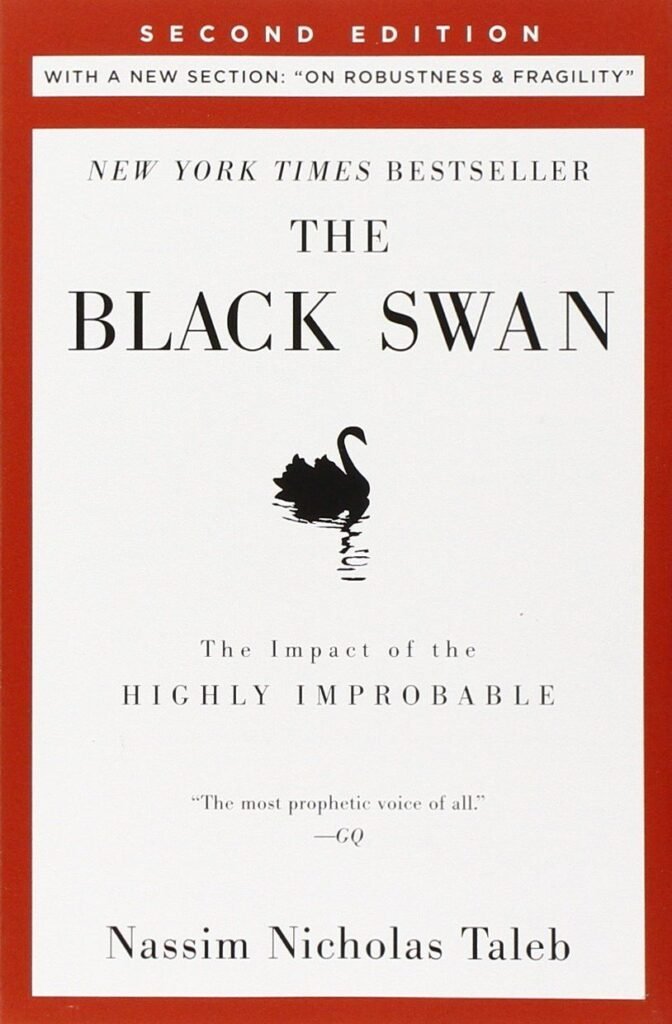
The Black Swan is one of the most intellectually disruptive books of the 21st century. Nassim Nicholas Taleb — options trader, philosopher, and professional contrarian — argues that the most consequential events in history are precisely those that our best models, our most sophisticated forecasters, and our most confident experts failed to predict. And that the failure is not accidental but systematic, hardwired into how human minds and institutions process uncertainty.
The central metaphor comes from the old European belief that all swans were white — a belief held with complete confidence until Dutch explorers reached Australia in 1697 and encountered black swans. No amount of observation of white swans could ever prove the rule; a single black swan demolished it. Taleb uses this image to represent the class of events that are outliers (outside normal expectation), carry extreme impact, and are retrospectively explained as if they were predictable all along. The 2008 financial crisis, 9/11, the rise of the internet, the First World War — all Black Swans, all “obvious in hindsight.”
The book operates simultaneously as epistemology, probability theory, market philosophy, and savage cultural criticism. Taleb attacks — with considerable personal relish — the financial industry’s risk models, academic economics, the pundit class, and the entire enterprise of expert prediction in domains he calls “Extremistan” (where outcomes follow power laws and a single event can dominate all others). For competitive exam aspirants, the book is both demanding and rewarding: its argumentative density, use of probability concepts, and sustained polemic against conventional wisdom mirror the most challenging RC and critical reasoning passages at the highest exam levels.
Who Should Read This
The Black Swan is essential reading for anyone working in or thinking about finance, risk, policy, or any field where uncertainty governs outcomes — which, Taleb argues, is nearly every field that matters. It rewards readers who are comfortable with intellectual provocation and willing to have their mental models seriously challenged. Particularly valuable for CAT/GRE/GMAT Advanced and Master level aspirants, economics and finance students, and MBA candidates preparing for analytical discussions about risk, markets, and decision-making under uncertainty.
Key Takeaways from The Black Swan
A Black Swan is an event with three properties: it lies outside the realm of regular expectations, it carries extreme impact, and — after the fact — human nature makes us concoct explanations that make it appear predictable. The tragedy is not that these events happen but that we systematically fail to account for them in our planning, models, and risk management.
Most of what matters in life follows power law distributions (Extremistan), not the bell curve (Mediocristan). In Extremistan, a single observation can dominate all others — one bestselling book dwarfs the sales of a thousand average books. Most statistical tools, built for Mediocristan, are dangerously wrong when applied to Extremistan variables like wealth, markets, and social trends.
We suffer from the Narrative Fallacy — a deep human need to construct coherent stories from sequences of events, imposing causality and meaning on what was largely random. This story-making instinct was evolutionarily useful but is epistemologically catastrophic: it makes the past seem more predictable than it was, leading to dangerous overconfidence in our ability to forecast the future.
The appropriate response to a Black Swan world is not better prediction but robustness and asymmetric positioning. Taleb’s “barbell strategy” calls for extreme caution in most domains (to survive negative Black Swans) combined with aggressive exposure to upside in a few (to benefit from positive ones). The goal is to build systems that survive and benefit from unpredictability.
Key Ideas in The Black Swan
Taleb opens by establishing the epistemological core of the book: the problem of induction. We generalize from observations to rules — all observed swans are white, therefore all swans are white — but this logic is structurally broken. No number of confirming instances can prove a universal rule, while a single disconfirming instance destroys it. This is not merely a philosophical puzzle; it is the operating condition of anyone trying to understand markets, history, or complex systems. Our confidence in our models is almost always greater than the evidence warrants.
The book’s analytical center is the distinction between Mediocristan and Extremistan — Taleb’s names for two different kinds of domains governed by different statistical laws. Mediocristan covers variables like height, weight, and caloric intake, where individual observations are bounded and the bell curve applies. Extremistan covers variables like wealth, book sales, city populations, and market returns, where extreme events are not merely possible but inevitable and dominant. The catastrophic error of modern finance — and much of social science — is applying Gaussian (bell curve) models to Extremistan variables, systematically underestimating the probability and impact of extreme events.
The Narrative Fallacy and Confirmation Bias are the psychological engines that make this error persistent. Humans are story-seeking creatures who unconsciously filter evidence to fit pre-existing narratives and retroactively construct explanations for random events. Financial analysts, geopolitical forecasters, and economic modelers are not simply bad at prediction — they are systematically overconfident in a way that their track records, carefully examined, expose but their professional incentives never punish. Taleb draws on Philip Tetlock’s landmark study of expert forecasters to demonstrate that pundits’ predictions are barely better than chance — yet their confidence and their fees remain undiminished.
The book’s final and most constructive section introduces the concept of robustness and the barbell strategy. Since we cannot predict Black Swans, we should structure our lives, portfolios, and organizations to survive negative ones and benefit from positive ones. This means avoiding moderate risks (which lull us into false security) in favor of a barbell: maximum safety in most areas, maximum exposure to positive optionality in a few. Be hyperconservative with your savings; be a venture capitalist with your career experiments. Avoid fragility; seek what Taleb would later call antifragility — the property of gaining from disorder.
Core Frameworks
Taleb introduces a set of original frameworks that together constitute a new vocabulary for thinking about uncertainty, risk, and the limits of knowledge.
A Black Swan has three properties — it is an outlier beyond normal expectation, it carries extreme impact, and it is retrospectively rationalized as predictable. The triad is important because each property individually could describe a merely unusual event; together, they identify the specific class of events that our risk models, forecasting systems, and narrative instincts systematically fail to handle.
In Mediocristan (height, weight, blood pressure), the bell curve applies, extreme values are rare and bounded, and averages are meaningful. In Extremistan (wealth, book sales, market returns), power laws apply, extreme values are common and unbounded, and averages are meaningless. Applying Mediocristan tools to Extremistan domains — as modern finance routinely does — produces catastrophic underestimation of real risk.
Our brains compress sequences of events into causal stories, reducing complexity to a manageable narrative. This feels like understanding but is actually confabulation — we impose meaning on randomness, mistake correlation for causation, and remember the hits while forgetting the misses. The result: our explanations of past events give us far less predictive power over future events than we believe.
From “ludus” (game), this describes the mistake of using the structured randomness of games (dice, cards, roulette) as a model for the unstructured randomness of real life. In a casino, the rules are known and probabilities are fixed. In financial markets or epidemiology, the rules can change, unknown unknowns dominate, and the very act of modeling can change the system being modeled.
Rather than seeking moderate risk (which creates fragility to unexpected extremes), Taleb recommends extreme bimodality: maximum safety in most domains (never risk what you cannot afford to lose), combined with aggressive exposure to positive optionality in a few (small bets on high-upside, limited-downside opportunities). This structure ensures survival of negative Black Swans while preserving the ability to benefit from positive ones.
We see the winners — the successful entrepreneurs, the profitable traders, the published authors — but not the vastly larger population of equally talented people who attempted the same things and failed. This “silent evidence” from the graveyard of failures makes success look more skill-driven and less luck-driven than it actually is, producing systematic overconfidence in fields where randomness dominates.
Core Arguments
Taleb builds a sustained, evidence-driven case that our confidence in prediction is a systematic illusion — and that the appropriate response is intellectual humility, not better models.
In Extremistan domains — finance, geopolitics, economics, social trends — expert forecasters perform barely better than random chance over time, and far worse than they claim. Drawing on Philip Tetlock’s 20-year study of expert predictions, Taleb argues that the entire forecasting industry is a social performance that creates the illusion of knowledge while providing almost none. The appropriate response is not to find better forecasters but to build systems that do not depend on accurate forecasting.
Modern financial risk management — Value at Risk, portfolio optimization, derivatives pricing — is built on Gaussian statistics that assume returns are normally distributed. Taleb argues that this assumption is empirically false for financial markets and that the systematic underestimation of tail risk it produces is not a bug but a feature of models designed to be tractable rather than accurate. The 2008 financial crisis, arriving one year after the book’s publication, provided the most dramatic possible empirical confirmation.
Conventional history — and conventional social science — treats the past as a sequence of gradual, predictable developments occasionally interrupted by crises. Taleb inverts this: the outliers, the Black Swans, the unpredicted ruptures are not interruptions to the normal flow of history but its primary drivers. The First World War, the internet, the fall of the Soviet Union, the rise of Google — none was predicted by the experts whose job was to predict such things, yet each reorganized the world more thoroughly than decades of gradual development.
The book’s deepest argument is epistemological: the appropriate response to living in a complex, nonlinear, Black Swan-prone world is radical intellectual humility about what we can know and predict. This is not defeatism — Taleb is explicit that we can act effectively under uncertainty — but it requires abandoning the false comfort of models that feel precise and adopting instead frameworks (robustness, optionality, redundancy) that perform well precisely because they do not depend on accurate prediction.
Critical Analysis
A balanced assessment of a landmark but polarizing work — examining its genuine intellectual achievements alongside its notable limitations.
The book’s central argument — that financial models systematically underestimate tail risk — was confirmed dramatically by the 2008 global financial crisis, one year after publication, giving Taleb’s ideas a real-world validation that most theoretical works never receive.
Terms like Black Swan, Mediocristan, Extremistan, the Narrative Fallacy, and the Ludic Fallacy have genuinely entered intellectual vocabulary — the book created new frameworks for thinking about uncertainty that filled a real gap in popular and professional discourse.
Taleb attacks — by name, with considerable relish — the most powerful and prestigious institutions in finance and economics, making arguments that his professional standing gave him unique credibility to make and that most writers would avoid.
Taleb’s prose is frequently contemptuous, dismissive, and self-congratulatory in ways that alienate readers who might otherwise be persuaded — the substance of the arguments deserves a more disciplined vehicle than the author’s ego sometimes provides.
The book is far stronger at diagnosis than prescription. The barbell strategy and robustness framework are introduced but not developed with the rigor that the analytical sections bring to the critique of conventional models.
Critics have noted that Taleb applies his framework selectively — choosing examples where randomness dominates while downplaying domains where expertise and preparation genuinely do produce reliable prediction, creating a somewhat one-sided picture of human knowledge.
Legacy & Cultural Impact
From Provocation to Prophecy: The Black Swan was published in April 2007 and became a global bestseller almost immediately, but its true moment arrived in September 2008 when Lehman Brothers collapsed and the global financial system entered its worst crisis since 1929. Overnight, the book transformed from an interesting provocation into what seemed like prophecy. It was re-read by regulators, studied by risk managers, and cited by politicians trying to explain how their best models had failed so completely. Taleb became one of the most influential public intellectuals of the decade.
A New Vocabulary for Risk: The book’s conceptual vocabulary has been absorbed into mainstream discourse across multiple fields. “Black Swan” is now used routinely by journalists, executives, and policymakers to describe low-probability, high-impact events — though Taleb himself has complained that the term is often misapplied to events that were actually predictable (which he calls “gray swans”). The distinction between Mediocristan and Extremistan has influenced how statisticians and social scientists think about when their standard tools apply. The concept of tail risk has become central to post-crisis financial regulation.
Relevance for Exam Aspirants: For competitive exam aspirants, The Black Swan represents a specific and valuable challenge. Its arguments about probability, statistical distributions, and the limits of expert knowledge appear regularly in CAT, GRE, and GMAT reading comprehension and critical reasoning passages. Familiarity with Taleb’s framework — the bell curve vs. power laws, the narrative fallacy, the difference between risk and uncertainty — provides direct preparation for these passages. More broadly, the book models the kind of sustained, evidence-based intellectual argument at high density that distinguishes top scorers in verbal sections from average ones.
Love This Book? Master Every Book.
Stop struggling with reading comprehension. Our proven system transforms how you read—whether for CAT, GRE, GMAT, SAT, or personal growth.
Best Quotes from The Black Swan
The inability to predict outliers implies the inability to predict the course of history.
What is surprising is not the magnitude of our forecast errors, but our absence of awareness of it.
Missing a train is only painful if you run after it. Likewise, not matching the idea of success others expect from you is only painful if that is what you are seeking.
Half of the time I am a hyperskeptic; the other half I hold certainties — I know exactly which half.
The problem with experts is that they do not know what they do not know.
Test Your Understanding
Think you’ve mastered The Black Swan? Challenge yourself with 15 questions on Taleb’s frameworks, probability concepts, and core arguments. Score 80%+ to prove your mastery.
The Black Swan FAQ
What is The Black Swan about?
The Black Swan argues that the most consequential events in history — financial crashes, technological revolutions, geopolitical ruptures — are precisely those that our best models and most confident experts fail to predict. Taleb calls these Black Swan events, distinguishes the statistical environments where they dominate (Extremistan), and argues that our systematic overconfidence in prediction models makes us dangerously fragile to them. The book is simultaneously a work of probability theory, epistemology, and cultural criticism.
How difficult is The Black Swan to read?
It is rated Advanced — the conceptual material is demanding, involving probability theory, philosophy of knowledge, and financial mathematics, though Taleb explains all concepts clearly without requiring a technical background. The main challenge is the argumentative density and the author’s tendency to pursue tangents. Readers comfortable with analytical non-fiction and abstract reasoning will find it manageable and rewarding.
What are the key concepts in The Black Swan?
The book’s central concepts are the Black Swan triad (outlier, extreme impact, retrospective predictability), the Mediocristan/Extremistan distinction, the Narrative Fallacy, the Ludic Fallacy, Silent Evidence and survivorship bias, the problem of induction, and the Barbell Strategy for surviving and benefiting in an uncertain world.
What is the difference between Mediocristan and Extremistan?
Mediocristan describes domains where outcomes are governed by the bell curve — individual values are bounded, averages are meaningful, and extreme events are rare. Extremistan describes domains where outcomes follow power laws — individual events can be extreme and unbounded, averages are meaningless, and a single observation can dominate the entire dataset. Wealth, book sales, casualties in wars, and financial returns are all Extremistan variables, which is why applying standard statistical tools to them produces systematic underestimation of real risk.
Why is The Black Swan still relevant today?
Because the conditions that make Black Swans possible — complex interconnected systems, overconfident models, the narrative fallacy, and the systematic underrepresentation of tail risk — have not changed, and in many domains have intensified. Climate change, pandemic risk, AI disruption, and geopolitical instability are all domains where Taleb’s framework is directly applicable. The book remains the most rigorous and accessible account of why our confidence in our ability to manage risk is so often misplaced.








