
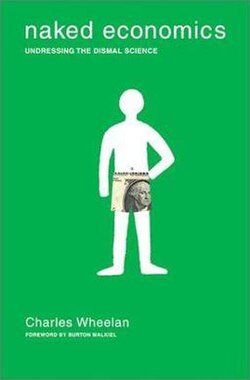
Why Read Naked Economics?
Naked Economics is the best introductory economics book ever written for a general audience — a comprehensive, witty, politically balanced tour through the foundational concepts of economics that assumes no prior knowledge and leaves the reader with a genuine understanding of how markets work, why governments intervene (and when they should), what central banks actually do, and why some nations are wealthy and others are poor. Charles Wheelan — a University of Chicago economics PhD, former correspondent for The Economist, and public policy professor at Dartmouth — writes with the rare ability to make technical concepts accessible without sacrificing their substance.
Published in 2002 and updated in subsequent editions, Naked Economics covers the full terrain of introductory economics — microeconomics and macroeconomics, domestic policy and international trade, monetary policy and development economics — in a single readable volume. Unlike textbooks, Wheelan grounds every concept in a concrete example drawn from real policy debates, historical episodes, and everyday life.
The book is deliberately and consistently politically balanced in a way that is rare in popular economics writing. Wheelan presents the genuine strengths and genuine limitations of both market mechanisms and government intervention, refusing the ideological shortcuts (markets are always right; government is always necessary) that make other popular economics books less useful as thinking tools. The writing is consistently engaging — Wheelan has a gift for the well-chosen analogy that makes abstract concepts suddenly obvious.
Who Should Read This
This is the book for anyone who wants to understand economics and does not know where to start — the student who has never studied economics, the professional who needs to follow economic news, the voter who wants to evaluate policy arguments more intelligently. The ideal first economics book before Freakonomics or The Armchair Economist. Essential for economics beginners; non-economists in policy, journalism, finance, and business; CAT/GRE aspirants; and anyone who wants to understand what economists mean when they talk about GDP, inflation, comparative advantage, and externalities.
Key Takeaways from Naked Economics
Markets work because prices convey information — the collective result of millions of individual decisions — enabling coordination that no central planner could achieve. No single person knows how to make a pencil from scratch, yet pencils are produced efficiently by the millions because the price system coordinates every specialist’s contribution without any of them needing to understand the whole picture. This insight — associated with Hayek and Leonard Read’s “I, Pencil” essay — is the foundational argument for market economies.
Government has a genuine and important economic role — not because markets are bad but because markets fail in specific, identifiable ways. The four main market failures are: externalities (costs or benefits that spill over to third parties); public goods (non-excludable and non-rival, so markets undersupply them); information asymmetry (one party knows more than the other); and market power (monopoly produces prices above competitive levels). Understanding these failures is the foundation of intelligent economic policy thinking.
Comparative advantage — the principle that gains from trade arise from relative differences in productivity, not absolute differences — is the most counterintuitive and most important insight in international economics. A country benefits from trading even with countries absolutely less productive at everything, because specialization allows total output to be higher than any country could achieve alone. This is the foundational argument for free trade and the most powerful rebuttal to protectionism.
Economic growth is driven primarily by improvements in human capital (education, health, skills), physical capital, and institutions (the legal, political, and social rules that enable productive activity). The most important lesson of development economics is that institutions matter more than geography, resources, or aid: countries with secure property rights, reliable contracts, and honest government consistently outperform countries with similar endowments but weaker institutions.
Key Ideas in Naked Economics
The book opens with the pencil — the insight that no single person could make a pencil from scratch, yet pencils are produced by the millions at trivial cost. This establishes the book’s foundational argument: that the price system is a remarkable coordination mechanism enabling extraordinarily complex economic activity without anyone planning or directing the whole process. The market’s ability to coordinate the knowledge of millions of dispersed individuals — each acting on their own local information about prices, preferences, and opportunities — is, as Hayek argued, its defining advantage over any centrally planned alternative.
The market failures chapters are the book’s most practically important for policy-literate readers. Wheelan’s treatment of externalities is particularly clear: because transacting parties do not bear the full cost (or capture the full benefit) of their actions, they will engage in too much activity that generates negative externalities (pollution, congestion, noise) and too little of the activity that generates positive externalities (education, vaccination, basic research). The market failure framework provides the conceptual foundation for evaluating whether any specific government intervention is likely to improve or worsen outcomes — a question that requires empirical judgment, not ideological commitment.
The financial markets chapters explain, with unusual clarity and balance, how capital markets work, why they are valuable, and how they can fail. The chapter on the Federal Reserve — its history, its tools (open market operations, the discount rate, reserve requirements), and its dual mandate (price stability and maximum employment) — is the most accessible account of central banking for non-economists available in popular literature. Subsequent editions address the 2008 financial crisis’s lessons, but the foundational explanations remain as clear and useful as ever.
The development economics chapters draw on Wheelan’s experience as a correspondent in South Asia and Africa to ground the abstract question of why some nations are rich and others poor in concrete historical and policy analysis. His treatment of the role of institutions — property rights, contract enforcement, rule of law, honest government — draws on the same insights that Acemoglu and Robinson would develop more comprehensively in Why Nations Fail (2012), and provides the most accessible introduction to the most important debate in development economics.
Core Frameworks in Naked Economics
Wheelan organises the book around six foundational frameworks that together constitute a complete map of economic thinking — from the logic of prices to the mysteries of development.
Prices emerge from voluntary decisions of buyers and sellers and convey, in a single number, the relative scarcity and value of every good and service. A rising price signals increasing scarcity, inducing conservation and increased production — without any individual needing to know why it has risen. This spontaneous coordination (Hayek’s “extended order”) enables complex activity like global smartphone supply chains and international commodity markets without any central plan or directing intelligence. When prices are controlled or suppressed, this information is lost.
Four main categories of market failure justify government intervention: (1) Externalities — costs (negative) or benefits (positive) that spill over to third parties, producing over- or under-provision; (2) Public goods — non-excludable and non-rival, so free-riding makes market provision chronically insufficient; (3) Information asymmetry — producing adverse selection (bad risks drive out good in insurance) and moral hazard (reduced care when costs are borne by others); (4) Market power — monopoly prices above competitive levels. The framework asks: is the proposed intervention likely to produce better outcomes than the unaided market?
Every economic institution — tax policy, social insurance, professional licensing, corporate governance — creates incentive structures that shape behavior in ways that may or may not align with the institution’s stated purpose. The most effective institutions create incentives for individuals to pursue their own interests in ways that also serve the collective interest (Adam Smith’s “invisible hand”). Human capital — the knowledge, skills, and health embodied in individuals — is the primary determinant of both individual earning capacity and national productivity, generating compounding returns that physical capital cannot match.
The gains from exchange and specialization arise from relative differences in opportunity cost, not absolute differences in productivity. If Country A is better than Country B at producing both cars and wheat, but relatively better at cars, both countries are better off if A specializes in cars and B in wheat and they trade — because total output of both goods is higher than if each tries to produce both. The intuition that “we should only import from countries better at making things” is the most common error in popular trade policy discussion, and comparative advantage is its direct rebuttal.
Central banks manage the money supply and interest rates to achieve price stability and maximum sustainable employment. The Federal Reserve’s primary tool is open market operations — buying or selling government bonds to expand or contract the money supply, raising or lowering interest rates, stimulating or cooling economic activity. Wheelan explains the transmission mechanism (how rate changes flow through to investment, consumption, and employment), the trade-off between inflation and unemployment (the Phillips curve), and why central bank independence from political control is essential to making unpopular but necessary decisions.
The competing explanations for cross-country income differences are geography (disease burden, navigable rivers, agricultural productivity), culture (trust, work ethic, social capital), natural resources (the “resource curse”), and institutions (property rights, contract enforcement, rule of law, accountable government). The strongest evidence supports institutions as the primary determinant: countries with secure property rights and reliable legal systems consistently develop faster than those with similar endowments but weaker institutions — previewing Acemoglu and Robinson’s argument in Why Nations Fail.
Core Arguments
Wheelan advances four interlocking arguments that together define a balanced, empirically grounded approach to economic policy thinking — defending markets where they work and government where markets fail, without ideological predetermination.
Wheelan’s foundational argument is simultaneously a defence of market economies and an honest acknowledgment of their limitations. Markets — coordinated through the price system — are the most effective known mechanism for allocating resources, creating productive incentives, and enabling the innovation and growth that have transformed living standards over the past two centuries. But they fail in specific, identifiable ways (externalities, public goods, information asymmetry, market power), and these failures provide both the justification for and the limits of government economic intervention. The question is never “markets or government?” but “given this specific market failure, is the proposed intervention likely to produce better outcomes than the unaided market?”
The book’s most practically important lesson is that well-intentioned policies that create perverse incentives will produce outcomes worse than their designers intended — and sometimes worse than no intervention at all. Rent control suppresses the housing supply it intends to protect tenants’ access to. Agricultural price supports produce surpluses that must be expensively stored or destroyed. Drug prohibition increases the profitability of drug dealing and the violence associated with it. The incentive effects of a policy — how it changes the behavior of the people it affects — must be analysed carefully before the policy is adopted, not attributed to bad faith after it produces unexpected results.
The development economics chapters build a consistent argument that the primary determinant of long-run economic development is the quality of institutions — the legal, political, and social rules governing how economic activity is organised, how property rights are secured, and how disputes are resolved. Geography matters, but poor countries with good institutions (Singapore, South Korea, Botswana) have consistently developed faster than poor countries with better geographic endowments but weaker institutions. The most valuable development assistance is institutional rather than financial — because institutional reform requires sustained political change that foreign aid cannot substitute for.
Wheelan’s treatment of international trade is among the book’s most balanced sections. Comparative advantage establishes that free trade increases total output and makes both trading countries better off on average. But the distributional consequences within each country are uneven: workers in import-competing industries lose while workers in export industries and consumers of imports gain. These distributional consequences are real and deserve policy attention — but they are an argument for better redistribution and adjustment assistance, not for protectionism, which sacrifices total efficiency to protect specific losers. This distinction between the efficiency argument for free trade and the distributional argument for adjustment policy is one of the most practically important conceptual distinctions in economics.
Critical Analysis
A balanced assessment of the book’s substantial achievements and its most significant limitations.
Wheelan’s consistent willingness to present both the genuine insights of market economics and the genuine case for government intervention — without resolving every question with an ideologically predetermined answer — makes this the most politically balanced popular economics book available. This balance is not false evenhandedness but a genuine reflection of the state of economic knowledge: some questions have relatively clear answers (comparative advantage is real; price controls create shortages) and some do not (the optimal level of redistribution; the right trade-off between inflation and unemployment).
Naked Economics is the only popular economics book that covers the full terrain of both microeconomics and macroeconomics, international trade, financial markets, and development economics in a single readable volume. This breadth makes it uniquely valuable as a first economics book — it provides the conceptual map that allows subsequent, more specialised reading to be placed in context.
Wheelan has a gift for the analogy that makes a technical concept suddenly obvious — adverse selection through the used car market, moral hazard through health insurance, comparative advantage through a doctor-typist trade-off. These analogies are not dumbed-down simplifications but genuinely illuminating tools that make the logic of each concept vivid and memorable without distorting it.
The book’s comprehensiveness is bought at the cost of depth — each concept gets enough treatment to be understood and applied at a basic level, but not enough to handle the complications and qualifications that arise in serious policy analysis. Readers who want depth in any specific area will need to follow up with more specialised books: Freakonomics for applied microeconomics, Why Nations Fail for development, Thinking, Fast and Slow for behavioral economics.
The financial markets and Federal Reserve chapters, written before the 2008 financial crisis, present a somewhat more optimistic picture of financial market efficiency than the crisis retrospectively supports. Updated editions address some of these issues, but readers should be aware that the pre-crisis intellectual consensus on financial markets has shifted significantly since 2002.
Most of Wheelan’s concrete examples are drawn from US policy and US institutional history — which is natural given his background and limiting for non-American readers who want their economic understanding connected to their own policy context. The conceptual framework is universal; the illustrative examples are not.
Impact & Legacy
Sustained Reach: Naked Economics was published in 2002 and has remained continuously in print across multiple editions (most recently updated in 2019), selling over half a million copies and being adopted as a supplementary text in economics courses at dozens of universities and in economics journalism and policy training programs worldwide. It is consistently recommended by economics teachers, policy professionals, and journalists as the single best starting point for economic literacy — the book to read before Freakonomics, before the textbook, and before the financial news makes sense.
Impact on Economics Education: The book’s impact on economics education has been quiet but significant. By demonstrating that economic concepts can be explained accessibly without sacrificing substance, it helped shift the expectations of both students and teachers about what introductory economics writing can accomplish. The Naked series — extended with Naked Statistics (2013) and Naked Money (2016) — has become a reference brand for accessible, substantive introductory social science writing in a format that serious learners trust.
Wheelan’s Subsequent Career: Wheelan’s career in public policy — he ran for US Congress in 2014 as an independent candidate and has been a prominent advocate for ranked-choice voting and political reform — reflects the same commitment to political balance and empirical reasoning that characterises the book. His experience in policy and journalism, combined with rigorous academic training at Chicago, gives him a perspective that is both technically grounded and practically aware.
The Readlite Sequence: Within the Readlite economics cluster, Naked Economics occupies the essential first position. Its sixteen chapters provide the complete conceptual map — price system, market failures, incentives, human capital, comparative advantage, monetary policy, development institutions — that makes every subsequent economics book on the list more intelligible. The recommended reading sequence is: Naked Economics first, then Freakonomics (B59) for applied microeconomics, then The Armchair Economist (B60) for logical rigor, and finally Why Nations Fail for the most important question in development economics.
For Exam Preparation: Naked Economics is the most comprehensive elementary-level economics reading comprehension resource on the Readlite list. Its consistent structure — introduce concept, explain mechanism, illustrate with concrete case, address misconceptions — mirrors precisely the structure of economics and social science passages in CAT and GRE examinations. The core vocabulary (GDP, inflation, comparative advantage, externalities, monetary policy, human capital, institutions) is directly tested in competitive examinations, and the book provides both the definitions and the contextual understanding that allows these concepts to be applied in unfamiliar contexts.
Love This Book? Master Every Book.
Stop struggling with reading comprehension. Our proven system transforms how you read—whether for CAT, GRE, GMAT, SAT, or personal growth.
Best Quotes from Naked Economics
Markets work. They are brutal and impersonal, but they are remarkably good at getting the right goods and services to the right people at the right time.
The essence of economics is to acknowledge scarcity and then figure out how individuals and societies make trade-offs in dealing with it.
Government can’t create wealth, but it can create the conditions that allow wealth to be created — or destroy them.
Trade is not a zero-sum game. When two parties exchange voluntarily, both are better off — otherwise the trade wouldn’t take place.
Institutions matter more than geography, resources, or culture in explaining why some countries are rich and others poor.


Test Your Understanding
Think you’ve mastered Naked Economics? Challenge yourself with 15 questions on market failures, comparative advantage, monetary policy, development institutions, and the price system. Score 80%+ to prove your mastery.
Naked Economics FAQ
Do I need any background in economics to read this book?
None whatsoever — Naked Economics is explicitly designed for readers with no prior economics training. It assumes only the ability to follow a logical argument and the willingness to engage with concepts like opportunity cost, comparative advantage, and externalities on their own terms. Wheelan explains every technical concept from scratch, grounds every explanation in concrete examples, and avoids the mathematical formalism that makes standard economics textbooks inaccessible to non-specialists. It is the book that economics teachers most commonly recommend to students who ask “what should I read before the course?”
What is the difference between microeconomics and macroeconomics, and does the book cover both?
Microeconomics studies the behavior of individual agents — households, firms, and markets — addressing questions like: how do prices emerge, how do firms decide how much to produce, what happens when markets fail? Macroeconomics studies the economy as a whole — aggregate output, employment, inflation, growth — and the policies that affect these aggregate outcomes: monetary policy (central bank management of money supply and interest rates) and fiscal policy (government spending and taxation). Naked Economics covers both, which is what makes it unique among popular economics books: most popular economics writing covers either micro or macro but not both in a single accessible volume.
What are externalities and why do they matter for policy?
An externality is a cost or benefit that falls on people not party to a transaction — a spillover effect that the transacting parties do not bear or capture. Negative externalities are costs imposed on third parties: pollution from a factory; traffic congestion generated by each additional driver. Positive externalities are benefits that accrue to third parties: the herd immunity generated by vaccination; the knowledge spillovers from basic research. Negative externalities cause overproduction (the producer doesn’t bear the full cost), and positive externalities cause underproduction (the producer doesn’t capture the full benefit). Government intervention — pollution taxes, vaccination subsidies, public funding of basic research — is justified when the externality is large enough that the intervention cost is smaller than the market failure it corrects.
What does the book say about why some countries are rich and others poor?
Wheelan presents institutions as the primary determinant of long-run economic development, drawing on the work of economists including Daron Acemoglu, Douglass North, and Jeffrey Sachs. Countries with secure property rights, reliable contract enforcement, rule of law, and honest, capable government consistently develop faster and achieve higher income levels than countries with similar geographic and resource endowments but weaker institutions. Geography matters — tropical disease burden, lack of navigable rivers, and distance from markets all present genuine challenges — but the evidence strongly suggests that institutional quality is the more powerful determinant. This conclusion is developed much more comprehensively in Why Nations Fail (Acemoglu and Robinson, 2012).
How does Naked Economics fit with the other economics books on the Readlite list?
Naked Economics is the ideal first economics book on the Readlite list — it provides the conceptual foundation that makes all subsequent economics reading more intelligible. Freakonomics (B59) is more focused on applied microeconomics with specific empirical findings; The Armchair Economist (B60) is more demanding in logical rigor and more provocative in its conclusions. The recommended reading sequence is: Naked Economics first (for the complete conceptual map), then Freakonomics (for applied microeconomics), then The Armchair Economist (for logical rigor), and finally Why Nations Fail (for the most important question in development economics).








