
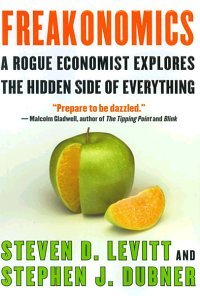
Why Read Freakonomics?
Freakonomics is the book that single-handedly made economics cool — a fizzing, provocative, endlessly surprising collaboration between a University of Chicago economist and a New York Times journalist that asked a simple question: what happens when you apply the tools of rigorous economic analysis to questions that economists are not supposed to ask? Published in 2005, it sold over four million copies in its first year, spent two years on the New York Times bestseller list, and made “thinking like an economist” — asking uncomfortable questions about incentives, information, and causation — part of mainstream intellectual life.
Freakonomics has no unifying theory — its authors say so explicitly and proudly. What it has instead is a method: the willingness to ask any question, however uncomfortable, and to follow the data wherever it leads. Steven Levitt — described by academic peers as the most creative economist of his generation — brings analytical rigor (regression analysis, natural experiments, careful causal inference); Stephen Dubner brings the narrative skill to make statistical findings vivid, human, and funny.
The book’s chapters address a deliberately heterogeneous set of questions: Why do drug dealers live with their mothers? What do schoolteachers and sumo wrestlers have in common? How much do parents really matter? What caused the dramatic drop in US crime in the 1990s? Each is approached with the same method — strip away the conventional wisdom, identify the real incentives, find the right data, follow the causal chain — and each produces an answer that is simultaneously surprising and, once explained, obvious.
Who Should Read This
This is a book for anyone who enjoys having their assumptions challenged by data — who wants to see what happens when careful analysis is applied to questions that conventional wisdom handles with clichés. An ideal introduction to economic thinking for readers who have never studied economics. Essential for economics and social science students; business, policy, and analytical professionals; CAT/GRE aspirants; and anyone who has suspected that the conventional explanation for something important was probably wrong.
Key Takeaways from Freakonomics
Incentives are the cornerstone of modern life — understanding what people actually respond to (rather than what they say they respond to) explains an extraordinary range of human behavior. Levitt and Dubner identify three types: economic (financial reward or punishment), social (the desire for approval or fear of shame), and moral (the internal sense of right and wrong). When these incentives conflict, it is usually the economic incentive that wins — even among people who would vigorously deny it.
Conventional wisdom is often wrong — not because people are stupid but because it serves social and political functions (maintaining consensus, signaling group membership) that have nothing to do with accuracy. The most dangerous conventional wisdom is the kind that is emotionally satisfying, morally comfortable, and politically useful — because it is the least likely to be tested against data.
The most important distinction in causal analysis is between correlation and causation — and the most consistent finding in social science is that the two are routinely confused, with consequential results. Economic tools — natural experiments, instrumental variables, regression discontinuity — exist precisely to make this distinction, and Freakonomics demonstrates their application in accessible, non-technical terms.
Information asymmetry — the condition in which one party has substantially more relevant information than the other — is the most pervasive form of power in modern economic life. Real estate agents, insurance companies, and professionals of all kinds exploit these asymmetries routinely, and the internet’s gradual erosion of them is one of the most consequential economic developments of the past three decades.
Key Ideas in Freakonomics
The book opens with a provocation: there is no unifying theme. Levitt and Dubner explicitly resist the expectation that a book about economics should be about the economy — prices, interest rates, growth, trade. Economics, they argue, is not a subject matter but a set of tools: a way of thinking about the world distinguished by its commitment to measuring what actually happens rather than what should happen, to identifying genuine causal relationships rather than plausible stories, and to following the data regardless of where it leads. The right questions are wherever the conventional wisdom is most confident and least tested.
The book’s most technically ambitious chapter analyses the 1990s US crime drop — one of the most debated social science questions of the past thirty years. Crime fell dramatically and unexpectedly, producing a wave of confident explanations: better policing, stricter sentencing, demographic change, economic growth. Levitt’s analysis — controlling carefully for each of these factors — concluded that none of them fully explains the timing and magnitude of the drop. His most powerful single factor: the legalization of abortion following Roe v. Wade in 1973. The first cohort of children not born to mothers who did not want them came of age in the early 1990s, producing a generation with lower rates of the risk factors (poverty, unstable family environment, unwanted childhood) that most strongly predict criminal behavior.
This finding is the book’s most controversial claim and its most instructive illustration of method. Levitt and Dubner present it with deliberate care, distinguishing clearly between the causal claim (abortion legalization reduced crime by reducing the birth rate among high-risk groups) and any normative implications (which are contested and not the authors’ concern). The distinction between positive analysis (what is) and normative analysis (what should be) is itself one of the book’s most important methodological lessons.
The chapter on information asymmetry uses the real estate agent as its central case study — demonstrating that agents who sell clients’ homes quickly for a slightly lower price earn approximately the same commission as those who hold out for a higher price, but save substantial time. Levitt’s analysis of agents’ behavior when selling their own homes (they hold out longer and sell for more) is the cleanest possible illustration of how incentive misalignment corrupts professional advice.
Core Frameworks in Freakonomics
Levitt and Dubner build their analyses around six interlocking frameworks — each a lens through which the hidden side of human behavior becomes visible.
Three types of incentives govern behavior: economic (money and material reward), social (approval, shame, reputation), and moral (conscience and internalized values). These often pull in different directions — and when they do, the economic incentive typically wins. Understanding which incentive dominates in a given context — and when the incentive structure creates perverse or unexpected behavior — is the beginning of genuinely understanding human action.
Information asymmetry exists when one party has substantially more relevant information than the other — and can exploit that advantage at the other party’s expense. Classic cases: insurance, used cars, and professional services. The Ku Klux Klan’s power rested substantially on the secrecy of its membership and rituals — which was destroyed when a journalist broadcast them on radio. Online markets have dramatically reduced information asymmetries across entire industries.
Conventional wisdom is not primarily a cognitive phenomenon but a social one: it represents the views most comfortable, most politically useful, and most widely endorsed — regardless of empirical accuracy. It persists because it has not been tested: the social and emotional costs of challenging it typically exceed the individual benefits of doing so. The economist’s method is valuable precisely because it is indifferent to the social costs of the answer.
The most common error in social science reporting is confusing correlation with causation. The fact that two variables move together tells us nothing about whether one causes the other; both could be caused by a third variable. Economists address this using natural experiments — situations in which some external event has randomly assigned people to different conditions. The Roe v. Wade analysis is a natural experiment: the timing of the crime drop, mapped against the first post-legalization generation reaching crime-prone age, enables causal inference that correlation analysis cannot provide.
The subtitle “a rogue economist explores the hidden side of everything” captures the book’s methodological claim: the most interesting questions are the ones that conventional disciplines refuse to ask — because they are politically uncomfortable, morally ambiguous, or outside traditional boundaries. Economics, as Levitt and Dubner practice it, has no such boundaries: the method applies wherever people respond to incentives and wherever causal claims can be tested against data.
Using California birth records linked to economic and educational outcomes, Levitt found that children’s names are strongly correlated with socioeconomic outcomes. But the causal analysis reveals the name is not the cause — it is a signal of parental socioeconomic status, which is the actual causal variable. Changing a child’s name will not change their economic outcomes; the correlation reflects existing social inequality, not an independent naming effect. A masterclass in causal thinking applied to a domain where correlation is most commonly confused for causation.
Core Arguments
Levitt and Dubner advance four interlocking arguments that together reframe economics as a universal analytical method and challenge the most comfortable assumptions of popular social science.
The book’s foundational methodological argument is that economics is not the study of the economy but a set of analytical tools applicable to any domain where people make choices, respond to incentives, and transact information. This demarcation challenge was not new in 2005 — Gary Becker had been applying economic tools to marriage, crime, and discrimination since the 1960s — but Freakonomics brought it to a mass audience with unusual vividness and verve, helping generate the “economics imperialism” of the 2000s and 2010s in which economic methods were applied to politics, sociology, history, and psychology.
Professionals — doctors, lawyers, real estate agents, financial advisers — routinely exploit information asymmetries in ways that serve the professional’s interests rather than the client’s. This is not usually a moral failing but an incentive structure problem: the professional’s compensation is typically tied to outcomes (transactions completed, treatments administered, cases filed) that are only imperfectly aligned with the client’s interests. The solution is not moral exhortation but incentive redesign and information disclosure — which is why professional licensing, disclosure requirements, and transparent pricing all reduce (though do not eliminate) the exploitation of information asymmetry.
Using data from a US Department of Education study of school achievement, the book produces one of its most emotionally provocative conclusions: most of what parents actively do (the books they read, the museums they visit, the sports teams they join) has a measurable but modest effect on children’s outcomes, while what parents are (their education level, socioeconomic status, age at first birth, linguistic environment at home) has a much larger and more durable effect. This challenges the parenting advice industry’s central premise while offering a more uncomfortable but more empirically grounded alternative: the circumstances into which children are born matter more than the specific practices their parents adopt.
Levitt’s crime-abortion hypothesis is the book’s most controversial and most instructive argument. The claim is precise and causal: the reduction in the birth rate among women in high-risk circumstances that followed Roe v. Wade produced a generation with lower rates of the specific risk factors — poverty, unstable family environment, unwanted childhood — that most strongly predict criminal behavior. The finding is supported by a natural experiment (states that legalized abortion before Roe showed earlier crime drops than those that did not) and multiple subsequent replications. It remains contested on both methodological grounds and because of its uncomfortable normative implications, but it stands as the clearest example of what following data wherever it leads can produce.
Critical Analysis
A balanced assessment of the book’s genuine achievements and its most significant intellectual limitations.
The Levitt-Dubner collaboration is the book’s greatest asset — Levitt brings genuine analytical rigor and original research findings that no journalist could produce alone; Dubner brings narrative skill, wit, and accessibility that no academic economist could achieve alone. The resulting book has a distinctive voice — curious, irreverent, genuinely funny — that makes demanding analytical content feel effortlessly readable.
The book does not merely argue that economic thinking is valuable — it demonstrates it, chapter by chapter, through specific analyses that produce specific surprising findings. The reader comes away not with an abstract appreciation of the method but with the experience of having watched it work on questions they actually cared about.
The crime-abortion chapter is the clearest example: Levitt and Dubner present the finding, acknowledge its discomfort, carefully distinguish the positive claim from normative implications, and engage seriously with methodological objections. This is model intellectual honesty applied to a genuinely difficult and politically charged empirical finding.
The original Donohue-Levitt paper has faced significant methodological challenges — including a widely cited critique by economists John Joyce and Christopher Foote who identified a coding error and argued the corrected analysis does not support the original finding with the same strength. Levitt and Donohue have responded and maintained the core finding, but the controversy is genuine and unresolved. The book presents the thesis with more confidence than the contested academic record fully supports.
The book’s chapters vary significantly in analytical rigor — the crime analysis is the most technically careful, while the naming chapter and parenting chapter rely on correlational analysis that is more vulnerable to the confounding problems the book elsewhere warns against. The uneven application of the method’s own standards is the book’s most significant intellectual inconsistency.
By covering so many unrelated topics, the book achieves accessibility at the cost of depth — none of the analyses is as comprehensive or as carefully qualified as the underlying academic research. Readers who want the full scholarly treatment of any specific finding will need to go beyond Freakonomics to the primary research.
Impact & Legacy
Commercial Reach: Freakonomics was published in April 2005 and became one of the most commercially successful popular social science books of the decade — selling over four million copies in its first year, spending 87 weeks on the New York Times bestseller list, and being translated into 35 languages. It generated a sequel (SuperFreakonomics, 2009), a documentary film, the long-running Freakonomics Radio podcast, and a multi-platform media franchise that has made Levitt and Dubner two of the most recognizable voices in popular economic writing.
Democratising Economic Thinking: The book’s cultural impact on how economics is perceived has been enormous and largely positive. Before Freakonomics, popular economic writing was predominantly about the economy — monetary policy, trade, growth, recession. After it, a generation of popular science writers applied economic tools to politics, culture, psychology, and social behavior, producing a wave of books that substantially widened public engagement with social science methodology. The franchise effectively democratized the idea that data-driven analysis could be applied to any question.
The Credibility Revolution: In academic economics, Levitt’s work — of which Freakonomics is a popularization — contributed to the “credibility revolution” in empirical economics: the shift toward natural experiments, instrumental variables, and other methods for establishing causal claims that transformed the field from the 1990s onward. The book made this methodological shift visible to a popular audience in a way no academic publication could, and its consistent emphasis on the correlation-causation distinction has had a genuine educational effect on how readers evaluate empirical claims.
A Double-Edged Legacy: The democratisation had both positive effects (more rigorous popular discourse) and negative ones (the proliferation of overconfident data journalism that mistakes correlation for causation in exactly the ways the book warns against). The “pop economics” genre it spawned has produced work of widely varying quality, and the Freakonomics brand’s irreverent tone has sometimes been imitated without the underlying analytical rigor. The distinction between Freakonomics at its best — careful causal inference from natural experiments — and the genre it inspired at its worst — confident storytelling from convenient correlations — is itself a useful lesson in the book’s central message.
For Exam Preparation: Freakonomics is excellent intermediate-level reading comprehension practice in social science nonfiction. Its consistent movement between data analysis and narrative interpretation, its habit of presenting surprising findings and then explaining the causal reasoning that produces them, and its demonstration of the correlation-causation distinction in multiple accessible contexts all provide direct practice for the analytical reading skills — inference, identification of argument, evaluation of evidence — that CAT and GRE passages most rigorously test.
Love This Book? Master Every Book.
Stop struggling with reading comprehension. Our proven system transforms how you read—whether for CAT, GRE, GMAT, SAT, or personal growth.
Best Quotes from Freakonomics
Morality, it could be argued, represents the way that people would like the world to work — whereas economics represents how it actually does work.
An expert is a person who knows a great deal about a particular topic, but often has the incentive to use their knowledge to serve their own interests over yours.
Knowing what to measure and how to measure it makes a complicated world much less so.
The conventional wisdom is often wrong. And a fact, once discovered, changes everything.
If morality represents how we would like the world to work, then economics shows how it actually does work.
Test Your Understanding
Think you’ve mastered Freakonomics? Challenge yourself with 15 questions on incentives, information asymmetry, the crime-abortion hypothesis, and the correlation-causation distinction. Score 80%+ to prove your mastery.
Freakonomics FAQ
What is Freakonomics actually about?
Freakonomics has no single subject — by design. Its subject is a method: the application of economic tools (incentive analysis, causal inference, natural experiments) to questions that are not conventionally economic. The book’s chapters address why drug dealers live with their mothers, what schoolteachers and sumo wrestlers have in common (cheating), what the Roe v. Wade decision has to do with the 1990s crime drop, how much parents really matter, and what a child’s name tells us about their future economic prospects. These topics are connected not by subject matter but by the method applied to them — and the consistent finding that data produces answers more interesting and more uncomfortable than conventional wisdom.
What is the book’s most controversial claim?
The most controversial claim is the abortion-crime hypothesis: that the legalization of abortion following Roe v. Wade in 1973 was a significant cause of the dramatic decline in US crime rates in the 1990s, because it reduced the birth rate among women whose children would have faced the highest risk factors for criminal behavior. The claim is a positive (factual) one about causation, not a normative claim about whether abortion is right or wrong. It has been both supported by subsequent research and challenged on methodological grounds. The controversy is itself instructive: it illustrates the difficulty of causal inference in social science and the tendency of people to evaluate empirical claims through the lens of their moral and political commitments.
What is information asymmetry and why does it matter?
Information asymmetry is the condition in which one party to a transaction has substantially more relevant information than the other, and can exploit this advantage at the other party’s expense. The book’s most vivid illustration is the real estate agent: Levitt’s analysis shows that when agents sell their own homes, they hold out longer and sell for significantly more than when selling clients’ homes — because their time cost of waiting is higher when working on commission. The practical implication is that professional advice should always be evaluated with awareness of the professional’s incentive structure, which often diverges from the client’s interests in predictable ways.
Is Freakonomics reliable? Should I trust its findings?
The book should be read critically — as its authors would want. Some findings (the real estate agent analysis, the drug dealer economics, the sumo wrestling analysis) rest on solid empirical work that has held up well. Others (the crime-abortion hypothesis, some parenting findings) are more contested, with subsequent research complicating the original claims. The book’s own consistent message — challenge conventional wisdom, follow the data, distinguish correlation from causation — is the best guide to reading it: apply the book’s standards to its own claims. Where the data analysis is most careful, the findings are most reliable; where it relies more on correlation, more caution is warranted.
How does Freakonomics compare to Thinking, Fast and Slow and Predictably Irrational?
All three books challenge rational-agent models of human behavior and use empirical evidence to reveal the hidden mechanisms that actually drive decision-making. Thinking, Fast and Slow provides the fullest theoretical framework for understanding cognitive bias — it is the most comprehensive and most rigorous of the three. Predictably Irrational focuses specifically on systematic deviations from rationality in economic and consumer contexts through elegant lab experiments. Freakonomics is the most methodologically diverse — using natural experiments, regression analysis, and field data — and the most deliberately counterintuitive and entertaining. Together they constitute the best introduction to empirical social science: Kahneman for cognitive architecture, Ariely for consumer irrationality, Levitt and Dubner for the application of economic methods to social questions.








