

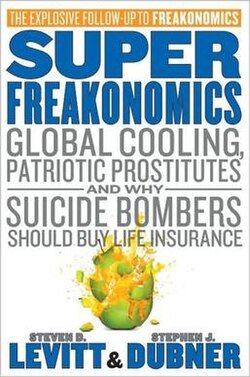
Why Read SuperFreakonomics?
SuperFreakonomics is a worthy sequel that matches its predecessor in surprise and surpasses it in ambition — a book that takes the Freakonomics method (apply economic tools to questions nobody asked economics to answer, follow the data wherever it leads) to new domains and pushes the analysis further than the original was willing to go. Published in 2009, four years after Freakonomics, it draws on new research by Levitt and his collaborators to cover topics as diverse as the economics of street prostitution, the psychology of altruism, the unintended consequences of safety improvements, and the prospects for geoengineering as a response to climate change — arriving at conclusions that generated more controversy per page than almost any economics book published in the decade.
The book covers five main topics across six chapters: the changing economics of street prostitution in Chicago; why people behave altruistically (and why the standard economic model fails to predict when they do); the unintended consequences of safety improvements; the application of data analysis to counterterrorism; and a long, contentious final chapter on climate change that argues for geoengineering solutions over carbon reduction strategies. Each chapter applies the same method as Freakonomics: strip away the conventional wisdom, identify the real incentives and data, and follow the causal chain to its conclusion.
The book is simultaneously Levitt and Dubner at their most technically sophisticated and their most provocative. Its virtues and its limitations are both magnified relative to the original — the altruism research is more rigorous, and the climate chapter is more contentious. Readers who engage with the full argument — including its controversy — come away with a sharper understanding of what economic cost-benefit analysis can and cannot responsibly claim.
Who Should Read This
A book for readers who have already encountered Freakonomics — who want more of the same method applied to new, more provocative questions, and who are comfortable with analysis that generates controversy by following data and logic rather than received opinion. Not the right starting point for economics beginners (Naked Economics or Freakonomics itself are better first choices). Essential for intermediate economics students and professionals; Freakonomics readers seeking the sequel; CAT/GRE aspirants building intermediate economics reading comprehension; and anyone who wants a readable, data-driven engagement with questions ranging from altruism research to climate geoengineering.
Key Takeaways from SuperFreakonomics
Cheap, high-leverage technological solutions — “simple fixes” that address the symptoms of a problem without requiring massive behavioral change — may be more practically effective than comprehensive solutions requiring global coordination. The climate chapter’s argument for stratospheric sulphur injection as a cheaper alternative to carbon reduction is the book’s most controversial application, but the underlying principle — that cheap, targeted interventions with direct causal pathways often outperform expensive, diffuse, coordination-intensive alternatives — is one of the most important in applied economics.
Altruism is more situationally determined than stable-trait accounts suggest. The conditions that produce apparently altruistic behavior are often more consistent with strategic self-interest, social pressure, or situational cues than with genuine concern for others’ welfare. Field experiments reveal that what looks like altruism is highly responsive to small changes in the decision environment — anonymity, observability, framing — in ways inconsistent with stable altruistic preferences but consistent with social image management and situational signaling.
The unintended consequences of safety interventions extend across the full system of risks. Drunk walking turns out to be statistically more dangerous per mile than drunk driving — not an argument for drunk driving, but a demonstration of the Peltzman-style principle that safety analysis must be conducted across the full system, not just at the point of the intervention. Changing one risk parameter changes the others; ignoring those compensating changes produces systematically optimistic impact estimates.
The history of medical progress is full of simple, cheap interventions that were resisted by the medical establishment for years — not because they were wrong but because they challenged established practices and professional interests. Ignaz Semmelweis’s hand-washing discovery is the paradigm case: a correct, cheap, high-leverage solution that met institutional resistance because its adoption required acknowledging that existing practices were wrong. The pattern has direct implications for evaluating current medical and scientific consensus.
Key Ideas in SuperFreakonomics
The book opens with a comparative analysis of street prostitution in Chicago — specifically, how the economics of the market have changed over the past century as the relative scarcity of women willing to provide sexual services has shifted. Levitt and collaborator Sudhir Venkatesh’s field research (Venkatesh embedded himself in Chicago street communities for years) provides unusually rich data on a market typically invisible to economic analysis. The chapter’s most striking finding is that pimps, despite their predatory reputation, provide genuine economic services to the prostitutes who work with them — increasing their prices, reducing their exposure to violence, and improving their negotiating position with clients — in ways that make the net effect of pimping on workers’ welfare ambiguous rather than straightforwardly negative.
The altruism chapter is the book’s most academically rigorous and most directly relevant to behavioral economics. Levitt and John List’s field experiments — which took the laboratory “dictator game” research on charitable giving out of the laboratory and into real-world settings (door-to-door fundraising, grocery store charitable giving booths) — found that much of the apparent altruism observed in laboratory settings evaporates in field settings where social observation conditions differ. People give more when they are observed, more when they have already been “caught” not giving, and less when they can avoid the solicitation entirely. The implication is that much of what looks like altruistic preference is actually social image management.
The chapter on simple fixes for big problems is the book’s most intellectually ambitious and its most contentious. The central argument — that cheap, high-leverage technological interventions should be preferred to expensive, coordination-intensive behavioral change programs — is illustrated through several cases (improved hand-washing compliance, cheaper alternatives to airbags) before arriving at the climate chapter’s main argument: that stratospheric sulphur injection, which could cool the planet by mimicking the effect of a large volcanic eruption at a cost of a few hundred million dollars, is a more practical and immediate response to climate change than the multi-trillion-dollar carbon reduction programs being pursued by international agreements.
The climate chapter generated the book’s most intense controversy — a sustained public argument with climate scientists (including Ken Caldeira, who was quoted approvingly in the book but objected to the framing) about whether the geoengineering option should be taken seriously as an alternative to carbon reduction or only as a last-resort supplement. The controversy reveals a tension at the heart of the Freakonomics method: rigorous economic analysis of technological costs and feasibility is genuinely valuable input to climate policy, but Levitt and Dubner’s framing — which was seen as dismissing the severity of climate change and the urgency of carbon reduction — was criticized as going beyond what the analysis supports.
Core Frameworks in SuperFreakonomics
Levitt and Dubner build their argument across six interlocking analytical frameworks — from the systematic undervaluation of simple fixes to the economic fingerprints of terrorism financing — each demonstrating the same core method applied to a different domain.
Simple fixes work by identifying the specific mechanism that produces the problem and intervening directly at that mechanism, rather than trying to change the broader system of behaviors and incentives. Hand-washing prevents hospital infection by interrupting the specific transmission pathway; stratospheric sulphur injection prevents warming by increasing planetary albedo. In each case, the fix addresses the specific physical mechanism at low cost rather than requiring comprehensive behavioral change across millions of actors. The resistance to simple fixes — despite often superior cost-effectiveness — reflects cognitive biases (solutions should be proportionate to problems), political incentives (comprehensive solutions generate more policy activity), and professional interests (people who benefit from comprehensive solutions resist cheap alternatives).
Laboratory experiments on altruism find substantial evidence of apparently genuine prosocial preferences — people give away money, punish defectors at personal cost, and contribute to public goods even when it is individually irrational to do so. Field experiments — moving the same basic incentive structures into real-world settings — find that much of this apparent altruism depends critically on conditions artificially produced in the laboratory: the inability to avoid the situation and the high visibility of one’s decision. In field settings where avoidance is possible and social observability is lower, much of the apparent altruism disappears. The implication is that prosocial behavior is substantially driven by social image management rather than genuine other-regarding preferences.
The Peltzman effect — the finding that safety interventions change the marginal cost of risky behavior, inducing compensating behavioral changes — extends beyond the original car safety research to any domain where risk is managed. The drunk walking vs. drunk driving analysis is the book’s most counterintuitive application: if the purpose of anti-drunk-driving campaigns is to reduce total alcohol-related traffic fatalities, the relevant comparison is between the risk per mile of drunk driving and the risk per mile of the alternative. The conclusion (that per-mile, drunk walking is more dangerous than drunk driving) does not translate into a recommendation for drunk driving — but it illustrates that safety analysis conducted only at the point of the intervention will produce systematically incorrect conclusions if it ignores how changing one risk parameter affects the others.
Street prostitution is an underground market with severe information asymmetry: clients cannot easily verify service quality or disease risk before transacting; workers cannot easily verify payment reliability or safety before providing services. The analysis of how pimps, territorial control, and reputation mechanisms develop to address these asymmetries in the absence of legal enforcement illustrates the general principle that information asymmetry is a fundamental economic problem that market participants will develop institutional responses to — legal or not. The chapter also documents how internet-based platforms (Craigslist, in the research period) affected the market by reducing information asymmetry and shifting market power toward workers — consistent with the broader economic analysis of how digital platforms affect information-intensive markets.
The chapter evaluates stratospheric aerosol injection (pumping sulphur dioxide into the stratosphere to increase planetary albedo and reduce surface temperatures) as a potential climate intervention. The cost analysis — roughly $250 million per year for a system capable of counteracting the warming effect of doubled CO₂ — is compared to the multi-trillion-dollar cost of comprehensive carbon reduction sufficient to achieve the same temperature effect. The analysis argues that the cost differential is so large that geoengineering merits serious research investment and policy consideration. The controversy was not primarily about the cost analysis (broadly accepted) but about the framing — whether presenting geoengineering as a cheap alternative to carbon reduction implied that the urgency of carbon reduction should be reduced.
Levitt collaborated with bank analyst Ian Horsley to develop a statistical model for identifying terrorist financing patterns in banking data. The model identified specific behavioral signatures — patterns of cash deposits and withdrawals, account dormancy and activation patterns, the timing and sequencing of transactions — that distinguish terrorist financing from normal financial behavior with reasonable reliability. The chapter illustrates both the potential of data analysis for counterterrorism and its limitations: the model identifies statistical patterns associated with terrorist financing but cannot identify specific individuals with certainty, and its practical utility depends entirely on how the identified accounts are investigated and acted upon.
Core Arguments
Levitt and Dubner advance four interlocking arguments that together constitute a complete statement of the Freakonomics method applied at its most ambitious — from the universality of economic analysis to the necessity of tracking unintended consequences across the full system.
The book’s opening argument — implicit in the choice of prostitution as the first chapter’s subject — is that the taboo nature of a market does not exempt it from economic analysis, and that understanding how illegal and stigmatized markets work is both intellectually important and practically valuable. The economics of street prostitution — supply and demand, information asymmetry, price discrimination, the role of intermediaries — are the same economics that govern legal service markets, and understanding them provides both insights into the specific market and demonstrations of economic principles that generalize. This argument is continuous with Freakonomics’ insistence that economic tools apply wherever people respond to incentives — including and especially in domains where conventional analysis fears to go.
The altruism chapter’s central argument — that much of the prosocial behavior documented in laboratory experiments reflects social image management rather than genuine other-regarding preferences — is one of the book’s most important contributions to behavioral economics. The practical implication is significant: if prosocial behavior is primarily driven by social observability rather than genuine preference, then making prosocial behavior observable (public pledge cards, visible charity donations, social norm messaging) is a far more effective intervention than appealing to people’s genuine concern for others. This insight has been widely applied in public health campaigns, charitable fundraising, and environmental behavior programs.
The climate chapter’s central argument — that stratospheric geoengineering deserves serious consideration as a climate intervention because its cost-effectiveness dwarfs that of carbon reduction programs — is simultaneously the book’s most important and most contested contribution. The argument is not that climate change is not serious (the book explicitly acknowledges its seriousness) but that the relative costs and benefits of different interventions should be evaluated honestly, and that cheap technological interventions are systematically undervalued relative to expensive behavioral and regulatory programs. The criticism this argument received — that it framed a dangerous distraction from necessary carbon reduction as a serious alternative — illustrates the tension between rigorous cost-benefit analysis and the political context in which climate policy is made.
The book’s methodological argument — stated most dramatically in the drunk walking chapter but present throughout — is that policy analysis must track the consequences of an intervention across the full system of incentives and behaviors it affects, not just at the point of direct impact. Reducing drunk driving may increase drunk walking; reducing one source of hospital infection may increase another; improving car safety may increase pedestrian risk. Each observation demonstrates the same analytical principle: the system responds to interventions in ways that may partially or fully offset the intended benefit, and ignoring these responses produces systematically optimistic impact estimates. This methodological principle is the most broadly applicable argument in the book.
Critical Analysis
A balanced assessment of a sequel that is more technically ambitious than the original — its real intellectual achievements and the limitations that the climate chapter’s controversy most clearly exposes.
SuperFreakonomics is more technically ambitious than Freakonomics — the altruism research draws on genuine field experimental methodology; the climate chapter engages seriously with climate science and geoengineering feasibility; the terrorism financing chapter describes actual data analysis methodology. This greater technical depth gives the arguments more substance than the lighter touch of the original.
The book’s most controversial chapter exemplifies the Freakonomics method at its most courageous: following the economic analysis of costs and benefits regardless of the political and emotional context of the topic. Whether or not one agrees with the conclusions, the willingness to apply rigorous cost-benefit analysis to politically sensitive territory is intellectually valuable — and modeling the distinction between what the analysis supports and what politics prefers is itself an important lesson.
The altruism chapter’s synthesis of laboratory and field experiment research on prosocial behavior is one of the most accessible accounts of this important research program in popular literature. The distinction between genuine altruistic preference and social image management is both intellectually significant and practically actionable — and has influenced how practitioners design charitable giving campaigns, public health interventions, and environmental behavior programs.
The book’s most sustained criticism — from climate scientists, environmental advocates, and many economists — is that the climate chapter presents a misleading picture of the consensus on geoengineering and carbon reduction, and that its framing (geoengineering as a cheap alternative) was irresponsible given the political context of climate policy. Even readers who agree with the cost-benefit analysis may find the framing went beyond what the analysis supports. This is the clearest case in the Freakonomics series of the method’s overextension producing a conclusion that is technically defensible but practically misleading.
The Freakonomics franchise’s appeal rested heavily on the novelty of the method — seeing economic analysis applied to unexpected domains for the first time. By the sequel, the method is familiar, and the surprise of individual findings is reduced. The book is still good, but it cannot replicate the fresh surprise of the original. Individual chapters must stand more fully on their analytical merits without the novelty premium the original enjoyed.
The chapter on drunk walking vs. drunk driving — while correctly illustrating the risk compensation principle — overstates the strength of its data and the confidence of its conclusion. The comparison of per-mile fatality rates across drunk walking and drunk driving involves methodological choices that significantly affect the result, and the chapter presents the finding with more confidence than the underlying data supports. It is the book’s clearest example of the Freakonomics method’s tendency toward overconfident conclusions.
Impact & Legacy
Immediate Commercial Success and Controversy: SuperFreakonomics was published in October 2009 and debuted at number one on the New York Times bestseller list, eventually selling over two million copies and being translated into more than thirty languages. It received considerable media attention — both positive (praise for the altruism research and the climate cost-benefit analysis) and sharply negative (intense criticism of the climate chapter from environmental advocates and climate scientists). The climate controversy generated more public debate about the book than any single chapter in the Freakonomics franchise had previously produced, with responses published in Nature, by climate scientists quoted in the book, and across the environmental blog ecosystem.
Contribution to Behavioral Economics: The book’s contribution to behavioral economics — particularly the field experiment research on altruism — has had lasting influence. John List’s work on field experiments (extensively drawn on in the altruism chapter) has become one of the most important research programs in applied behavioral economics, and the insight that prosocial behavior is substantially driven by social observability rather than stable preferences has been widely applied in program design and policy. The distinction between laboratory and field experimental results — and the importance of replication in real-world conditions — has become a central methodological concern in behavioral economics partly because of the attention SuperFreakonomics gave to List’s work.
The Geoengineering Argument in Retrospect: The geoengineering argument, which was the book’s most controversial contribution, has aged in complex ways. The scientific and policy conversations about stratospheric aerosol injection have advanced considerably since 2009 — it is now a more mainstream topic in climate science, though still contentious — and some of the book’s analysis has been vindicated by subsequent research. At the same time, the concerns of the book’s critics (that presenting geoengineering as a cheap alternative to carbon reduction would reduce the urgency of emissions reduction) have also been partially vindicated by how the argument has been used in climate sceptic discourse.
Position Within the Readlite Economics Series: Within the Readlite economics series, SuperFreakonomics sits naturally alongside Freakonomics (B59) as the applied microeconomics pair — both books demonstrate the application of economic tools to unexpected social questions through data analysis and incentive analysis. The Armchair Economist (B60) provides the more rigorous logical framework that underlies the method; Naked Economics (B61) provides the comprehensive conceptual foundation; and Why Nations Fail (B63) and The Wealth of Nations (B62) address the macro-level institutional and historical questions that neither Freakonomics book engages. The recommended reading sequence for the applied economics books specifically is Naked Economics (foundation) → Freakonomics (applied micro) → SuperFreakonomics (more advanced applied micro) → The Armchair Economist (logical rigor).
For Exam Preparation: SuperFreakonomics is excellent intermediate-level reading comprehension practice in applied economics nonfiction. Its combination of field experimental research, cost-benefit analysis, and case study application mirrors the structure of economics and social science passages in CAT and GRE examinations, and its movement between technical analysis and accessible narrative provides direct practice for the skill of tracking argument across different registers of prose.
Love This Book? Master Every Book.
Stop struggling with reading comprehension. Our proven system transforms how you read—whether for CAT, GRE, GMAT, SAT, or personal growth.
Best Quotes from SuperFreakonomics
People respond to incentives. The rest is commentary.
The global-warming solutions that have been offered are global in scale, long in timeline, and expensive. These facts alone make them almost impossible to implement.
The story of Ignaz Semmelweis is a reminder that the people who stand to gain the most from new ideas are often the ones most resistant to them.
We tend to find cheap, simple solutions objectionable on their face. They seem to be the kind of thing that couldn’t possibly work — because if they worked, surely someone would have thought of them already.
People are people, and they respond to incentives. They can nearly always be manipulated — for good or ill — if you find the right levers.
Test Your Understanding
Think you’ve mastered SuperFreakonomics? Challenge yourself with 15 questions on simple fixes, the field experiment altruism research, the Peltzman effect, geoengineering cost-benefit analysis, and unintended consequences. Score 80%+ to prove your mastery.
SuperFreakonomics FAQ
Do I need to read Freakonomics before SuperFreakonomics?
Reading Freakonomics first is recommended but not strictly necessary. SuperFreakonomics applies the same method — economic analysis of unexpected questions, following data and incentives regardless of conventional wisdom — and reading Freakonomics first makes the method and its characteristic strengths and limitations familiar before encountering the sequel’s more technically demanding and more controversial applications. Readers who have already read Freakonomics will recognize the method immediately and be able to evaluate the sequel’s arguments with appropriate context. The recommended reading order on the Readlite list is Freakonomics (B59) before SuperFreakonomics (B66).
What is the geoengineering argument and is it convincing?
The geoengineering argument has two components: a cost-benefit analysis showing that stratospheric aerosol injection is dramatically cheaper than comprehensive carbon reduction programs for achieving equivalent temperature effects; and a policy argument that this cost differential warrants serious research and policy consideration. The cost-benefit analysis is broadly accepted — the cost estimates are in the right range and the comparison is methodologically sound. The policy argument is more contested: while few climate scientists now dispute that geoengineering merits research, many argue that the book’s framing — which appeared to present geoengineering as an alternative to carbon reduction rather than a potential supplement — was misleading. The honest assessment is that the economic analysis is solid, the policy framing was overclaiming, and the subsequent climate science conversation has moved toward taking geoengineering seriously while insisting on the continued urgency of emissions reduction.
What is the altruism research and what does it tell us?
The altruism research — primarily drawn from John List’s field experiments — found that much of the apparently genuine altruistic preference documented in laboratory experiments does not replicate in field settings where the decision environment differs in key ways: specifically, where avoidance of the situation is possible, where social observability is lower, and where the request is encountered unexpectedly. People who cannot avoid a charity solicitation give significantly more than people who can; people who are observed while making giving decisions give significantly more than people who are not. The implication is that prosocial behavior is substantially driven by social image management — how one appears to others — rather than stable altruistic preference. Practically, this means that making charitable giving socially visible and difficult to avoid is far more effective than appealing to people’s genuine concern for beneficiaries.
How does SuperFreakonomics compare to Freakonomics?
SuperFreakonomics is more technically ambitious and more controversial than Freakonomics, but less surprising and less narratively compelling. The original had the advantage of introducing a method that was genuinely novel to its audience — the surprise of seeing economic analysis applied to drug dealing, cheating teachers, and the 1990s crime drop was a significant part of its appeal. The sequel cannot replicate this novelty, and its individual chapters must stand more fully on their own analytical merits. On those merits, the altruism chapter is stronger than most of Freakonomics’ chapters; the climate chapter is weaker in its framing than most; and the prostitution and terrorism financing chapters are comparable in quality. Overall, the sequel is the better book for readers who want technical depth; the original is the better book for readers who want maximum narrative impact and accessible surprise.
How does SuperFreakonomics fit in the broader Readlite economics series?
Within the Readlite economics series, SuperFreakonomics sits naturally alongside Freakonomics (B59) as the applied microeconomics pair — both books demonstrate the application of economic tools to unexpected social questions through data analysis and incentive analysis. The Armchair Economist (B60) provides the more rigorous logical framework that underlies the method; Naked Economics (B61) provides the comprehensive conceptual foundation; and Why Nations Fail (B63) and The Wealth of Nations (B62) address the macro-level institutional and historical questions that neither Freakonomics book engages. The recommended reading sequence for the applied economics books specifically is Naked Economics (foundation) → Freakonomics (applied micro) → SuperFreakonomics (more advanced applied micro) → The Armchair Economist (logical rigor).








