

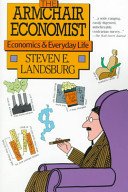
Why Read The Armchair Economist?
The Armchair Economist is the original “economics of everything” book — the lean, intellectually uncompromising 1993 predecessor to the Freakonomics franchise that demonstrated, a full twelve years before Levitt and Dubner, that economic logic applied to everyday questions produces insights that are simultaneously surprising, counterintuitive, and — once explained — obviously correct. Steven Landsburg is a mathematician turned economist at the University of Rochester whose writing combines the precision of mathematical logic with an almost mischievous pleasure in following an argument wherever it leads, regardless of whether the destination is comfortable.
Where Freakonomics built its appeal on data and narrative, The Armchair Economist builds its appeal on pure logic. Landsburg’s method is Socratic: he begins with a puzzle — Why do popcorn prices at movie theatres seem so high? Do seatbelt laws save lives? Should we recycle? — and then applies the tools of economic reasoning (opportunity cost, equilibrium analysis, marginal thinking, the price system) to arrive at answers that consistently violate conventional intuition.
Each chapter is short, self-contained, and structured as an argument rather than a survey — Landsburg builds to a conclusion, defends it against objections, and leaves the reader either persuaded or productively unsettled. The writing is crisp, witty, and entirely devoid of the hedging that academic economists deploy when they want to avoid controversy. Landsburg says what he means and means what he says.
Who Should Read This
This is a book for readers who want economic thinking at its most rigorous and most provocative — who want to see what pure economic logic can do when applied without qualification to real questions. Ideal for students who have enjoyed Freakonomics and want something sharper and more demanding. Essential for economics and business students developing economic intuition; policy, strategy, and finance professionals; CAT/GRE aspirants seeking argument-dense intermediate prose; and anyone willing to follow an argument to its logical conclusion even when it is uncomfortable.
Key Takeaways from The Armchair Economist
Prices convey information — and when prices are distorted, suppressed, or replaced by non-price rationing, the information is lost and resource allocation gets worse, often dramatically so. Movie theatre popcorn is expensive not because owners are greedy but because it is a mechanism for price-discriminating between customers who value the experience differently — allowing lower ticket prices as a result. Understanding prices as information rather than as costs is the foundational economic insight.
Safety regulations can reduce total safety — one of the most consistently counterintuitive findings of economic analysis. Seat belt laws reduce the consequences of driving accidents, which changes the marginal cost of risky driving and induces some drivers to drive more recklessly — partially or fully offsetting the direct safety benefit. This “Peltzman effect” is not an argument against seat belts but a demonstration that incentive effects must be tracked through the full system, not just the immediate intervention.
Recycling is not obviously good for the environment — whether it is beneficial depends entirely on whether the recycled material’s production process is more or less resource-intensive than the virgin material’s, and this varies by material in ways conventional wisdom ignores. The economic approach to environmental questions — evaluating policies by actual consequences rather than conformity to environmental sentiment — is both more rigorous and more productive than treating recycling as intrinsically virtuous.
Opportunity cost — the value of the best alternative foregone — is the most important and most consistently misunderstood concept in economics. When a business owner calculates profit, they typically omit the opportunity cost of their own time and capital. When a government calculates program costs, it omits the opportunity cost of resources diverted from their best alternative use. Every economic analysis that ignores opportunity cost is incomplete — and most popular economic reasoning ignores it.
Key Ideas in The Armchair Economist
The book’s most foundational claim is that economic thinking is not a body of knowledge about the economy but a habit of mind applicable to any question involving human choice, resource allocation, and the unintended consequences of well-intentioned interventions. The armchair economist does not need data, surveys, or field research — they need only the logical tools of economics (opportunity cost, marginal analysis, equilibrium, the price system) applied with sufficient rigor and the willingness to follow the argument to its conclusion.
The movie popcorn puzzle — why does popcorn cost so much at movie theatres when it costs so little at grocery stores? — is Landsburg’s opening gambit and his purest demonstration of the method. The naive answer is that theatre owners are exploiting a captive audience. The economic answer is that the theatre is using differential popcorn pricing as a mechanism for charging heavy consumers more for the overall movie-going experience — a form of price discrimination that actually benefits consumers on average, because it allows lower base ticket prices than would otherwise be possible.
The chapters on safety regulation are the book’s most intellectually demanding. The Peltzman effect — the observation that safety interventions can induce compensating behavioral changes that offset their direct benefits — is one of the most important findings in regulatory economics and one of the most consistently ignored in policy debates. Landsburg’s treatment of seat belt laws, FDA approval delays, and environmental regulation all apply the same logic: interventions change incentives, changed incentives change behavior, and the net effect must be evaluated across the full system, not just at the point of direct impact.
The chapter on recycling is Landsburg at his most provocative: he argues that recycling paper may actually be bad for forests, because the demand for paper provides the economic incentive to plant and maintain forest plantations — and reduced paper demand reduces this incentive. The argument is not that recycling is always bad but that the question of whether recycling is environmentally beneficial is an empirical question about comparative resource intensities and land-use economics, not a moral question that can be settled by the intuition that recycling is virtuous.
Core Frameworks in The Armchair Economist
Landsburg’s analyses are built on six interlocking frameworks — the foundational logical tools of economic reasoning applied to questions where conventional intuition consistently goes wrong.
Prices in a free market aggregate information from millions of individuals about their preferences, constraints, and opportunities — information no central planner could collect or process. A rising price signals increasing scarcity, inducing conservation and increased production without any individual needing to know why. When prices are controlled, subsidized, or replaced by non-price rationing, this information is suppressed and allocation reflects political influence rather than economic value. Landsburg applies this to rent control, agricultural price supports, minimum wages, and other interventions — consistently finding that second-order information effects undermine first-order intentions.
The opportunity cost of any choice is the value of the best alternative foregone. When a business owner works in their own business, their opportunity cost is the wage they could have earned elsewhere — omitting this produces a systematic overestimate of profitability. When a government builds a road, the opportunity cost includes not just the budget cost but the value of everything the tax revenue could alternatively have funded. When a student attends university, the opportunity cost includes the income foregone during years of study. Economic analysis that ignores opportunity cost is incomplete — which means most popular economic reasoning is incomplete.
Economic decisions are always made at the margin: not “should I ever drive?” but “should I drive one more mile?” — not “is health care valuable?” but “is this additional treatment worth its cost?” Marginal analysis reveals insights that total or average analysis obscures. The marginal cost of an additional airline seat is far below average cost, which is why airlines price last-minute seats below average cost without losing money. The marginal cost of teaching one more student in a lecture hall is approximately zero — making average-cost tuition pricing an economic distortion unrelated to marginal educational cost.
Sam Peltzman’s 1975 study of US auto safety regulation found that mandatory safety equipment reduced driver fatalities per accident but increased pedestrian fatalities and total accidents — because reduced injury severity per accident induced drivers to drive faster and more aggressively. The net effect on total deaths was approximately zero. Landsburg uses this as a paradigm case: every safety, health, or environmental regulation that reduces the cost of risky behavior will induce some compensating increase in that behavior. The size of the offset varies, but ignoring the incentive effect systematically overestimates intervention benefits.
When a seller charges a single price, some buyers who would have valued the product above its cost but below its price do not purchase — producing a deadweight loss. Price discrimination — charging each buyer closer to their individual willingness to pay — can eliminate this deadweight loss. The movie theatre popcorn example is the book’s central illustration: pricing popcorn high effectively charges heavy consumers more for the total experience, allowing a lower base ticket price that brings in more consumers. Airline pricing, pharmaceutical pricing, and many other familiar practices reflect the same efficiency logic.
Comparative advantage is the principle that gains from exchange arise from relative differences in productivity, not absolute differences. If person A is better than person B at both cooking and accounting, but relatively better at accounting, both are better off if A specializes in accounting and B in cooking — even though A is absolutely better at both. This principle, which underlies the entire theory of international trade, is routinely violated by policy arguments for self-sufficiency, protectionism, and domestic production mandates. Understanding it is the prerequisite for evaluating any argument about trade, specialization, or outsourcing.
Core Arguments
Landsburg advances four interlocking arguments that together constitute a comprehensive case for economic reasoning as the most reliable guide to the actual consequences of human choices and policy interventions.
Landsburg’s foundational argument — demonstrated rather than merely stated throughout the book — is that the tools of economic reasoning (opportunity cost, marginal analysis, equilibrium, price signals) apply wherever human beings make choices under constraints. This is not a claim that everything is about money or that human beings are purely self-interested calculating machines; it is a claim that the logical structure of constrained optimization — the need to make trade-offs under scarcity — is universal, and that ignoring this structure leads to systematically wrong conclusions about the effects of policies and institutions.
The Peltzman effect is the paradigm case for the book’s most important analytical principle: the full consequences of any policy must be traced through the system of incentives it creates, not just the direct effect at the point of intervention. This produces the book’s most counterintuitive findings — seat belt laws can reduce total safety, FDA drug approval delays cost lives, recycling paper may harm forests — and it is both the most demanding and the most valuable habit of mind that economic reasoning develops. Every policy argument that stops at the direct effect and ignores the incentive effects is incomplete. Most policy arguments stop at the direct effect.
Landsburg is more willing than most popular economics writers to defend market outcomes against both left-wing critiques (markets are exploitative) and right-wing ones (markets are morally deficient). His analysis consistently finds that price mechanisms, even in apparently dysfunctional forms (high popcorn prices, scalping, price gouging during emergencies), are doing something useful — conveying information, allocating resources, solving coordination problems — that proposed alternatives (price controls, redistribution, rationing) do worse. This is not an argument for laissez-faire in all circumstances but a demand that alternatives be evaluated by the same standards as the markets they propose to replace.
The chapters on recycling, pollution, and environmental regulation make a consistent argument: environmental questions are empirical questions about the actual consequences of policies, not moral questions that can be settled by the intensity of environmental sentiment. Whether recycling paper is good for forests, whether pollution permits are better than pollution taxes, whether preserving old-growth forest is worth its economic cost — all require careful analysis of actual trade-offs, not declarations of environmental virtue. Landsburg is not anti-environmental but anti-sentimental: he wants environmental policies evaluated by their actual effects, not their symbolic conformity to environmentalist values.
Critical Analysis
A balanced assessment of the book’s distinctive intellectual strengths and its most significant limitations.
Landsburg’s arguments are models of logical precision — each chapter builds to a specific conclusion that follows necessarily from clearly stated and honestly defended premises. This is economics as it should be taught: as a discipline of rigorous thinking rather than a collection of empirical findings. Readers encounter not just conclusions but the structure of the reasoning that produces them.
Landsburg follows his arguments wherever they lead, without the hedging and qualification that academic caution and political sensitivity typically impose. This intellectual courage produces conclusions that are genuinely surprising and genuinely informative — and occasionally wrong, but wrong in ways that are instructive rather than evasive. The reader is never left with the feeling that the author has pulled his punches.
The prose is among the best in popular economics — crisp, funny, free of jargon, and entirely free of the condescending over-explanation that mars many popular science books. Landsburg respects his reader’s intelligence in a way that is itself a pleasure to encounter, and the wit of the writing makes the logical rigour feel like entertainment rather than work.
Landsburg’s economic reasoning consistently arrives at libertarian-friendly conclusions — in favour of markets, against regulation, skeptical of redistribution — which reflects both genuine insights and a selection bias in which questions are asked and which complications are foregrounded. Readers across the political spectrum will find individual analyses illuminating, but readers who expect economic reasoning to be politically neutral will be unsettled by the consistency of the book’s political direction.
The book’s strength — logical precision — is also its limitation. Real-world economic questions involve empirical complications (externalities harder to price than the book acknowledges, distributional effects that matter more than the analysis admits, information asymmetries that markets handle poorly) that the armchair method sometimes brushes past. The analyses are valid given their premises, but the premises sometimes exclude complications that materially affect the conclusions.
Published in 1993, The Armchair Economist predates many empirical developments in economics — the credibility revolution, the behavioral turn, the explosion of natural experiment methodology — that have transformed the field since its publication. Its method (logical deduction from first principles) is timeless, but its engagement with empirical evidence is thinner than subsequent popular economics writing, and some policy examples feel dated.
Impact & Legacy
The Economists’ Favourite: The Armchair Economist was published in 1993 and has never become a mass-market bestseller in the Freakonomics sense — it lacks the narrative drive and data-richness that made that franchise accessible to non-economists. What it has done, steadily and quietly over three decades, is become the favourite economics book of economists: the text they recommend to people who want to understand how economists actually think, rather than what economists actually study. It has sold several hundred thousand copies across multiple editions and is consistently ranked among the best introductions to economic reasoning for a general audience.
The Unacknowledged Predecessor: Its influence on subsequent popular economics writing is significant and somewhat unacknowledged. The Freakonomics franchise draws on the same methodological philosophy — apply economic reasoning to unexpected questions, follow the argument regardless of conventional wisdom — but wraps it in narrative and data in ways that made it commercially transformative. Landsburg’s book is the purer, more demanding version of the same project: economics as a habit of mind rather than economics as a set of empirical findings.
Impact on Economics Education: In economics education, The Armchair Economist has been influential as an undergraduate supplement — a book that shows students what economic thinking actually looks like when applied outside the textbook, before they have developed enough technical facility to read academic research. Its consistent demonstration that economic logic produces surprising insights from simple premises has been effective at communicating why economics is a valuable discipline to students who are skeptical of its relevance.
Landsburg’s Continued Influence: Landsburg’s subsequent books — Fair Play (1997), the deliberately provocatively titled More Sex Is Safer Sex (2007), The Big Questions (2009), and Can You Outsmart an Economist? (2018) — have continued the same project with the same uncompromising logical approach. His blog (The Big Questions) applies the same method to current events, politics, and mathematics, maintaining a readership among economists and economically literate general readers who value rigour over reassurance.
For Exam Preparation: The Armchair Economist is excellent intermediate-level reading comprehension practice in the most demanding mode: argument-dense prose that builds logical cases from stated premises to surprising conclusions. The CAT and GRE’s most challenging reading comprehension passages require precisely this kind of careful tracking of argumentative structure — identifying premises, following logical chains, evaluating the validity of conclusions. Landsburg’s writing provides direct practice for this skill in an accessible but demanding register.
Love This Book? Master Every Book.
Stop struggling with reading comprehension. Our proven system transforms how you read—whether for CAT, GRE, GMAT, SAT, or personal growth.
Best Quotes from The Armchair Economist
The first lesson of economics is scarcity: there is never enough of anything to fully satisfy all those who want it. The first lesson of politics is to disregard the first lesson of economics.
People respond to incentives. Everything else in economics is elaboration.
An economist is someone who knows the price of everything and the value of nothing — except that’s backwards. The whole point of economics is to figure out the value of things that don’t have obvious prices.
The right question is never “what are the benefits of this policy?” The right question is always “what are the costs and benefits of this policy compared to all available alternatives?”
Recycling may be the most wasteful activity in modern life — a sacred ritual of atonement that does little for the environment but makes participants feel good about themselves.
Test Your Understanding
Think you’ve mastered The Armchair Economist? Challenge yourself with 15 questions on opportunity cost, marginal analysis, the Peltzman effect, price discrimination, and comparative advantage. Score 80%+ to prove your mastery.
The Armchair Economist FAQ
What makes this book different from Freakonomics?
Both books apply economic thinking to unexpected everyday questions, but they differ significantly in method and tone. Freakonomics (2005) is built primarily on empirical data — regression analyses, natural experiments, and large datasets — and delivered through narrative storytelling. The Armchair Economist (1993) is built primarily on logical reasoning from first principles — Landsburg applies economic theory (opportunity cost, marginal analysis, equilibrium) to puzzles and follows the argument without necessarily consulting data. Freakonomics is more accessible, more narrative, and more empirically grounded; The Armchair Economist is more rigorous, more demanding, and more willing to arrive at politically uncomfortable conclusions. For readers who want to understand economic reasoning rather than economic findings, Landsburg is the better choice.
Why does Landsburg argue that seat belt laws might not save lives?
The argument is an application of the Peltzman effect — the economic principle that safety interventions change the marginal cost of risky behavior, which induces compensating behavioral changes. Seat belts reduce the cost of risky driving (by reducing injury severity in accidents), which induces some drivers to drive faster, more aggressively, or with less care. Sam Peltzman’s original 1975 research found approximately zero net effect on driver deaths, with an increase in pedestrian deaths. Subsequent research has complicated this finding — most studies find a positive net effect from seat belt laws — but the principle (safety interventions change incentives, and changed incentives change behavior) remains valid and important. The argument is not that seat belts are useless but that the full incentive effects must be analysed rather than assuming the direct benefit is the whole story.
Is Landsburg’s argument about recycling correct?
The recycling argument is more nuanced than its provocative summary suggests. Landsburg’s core point — that whether recycling is environmentally beneficial depends on the comparative resource intensities of recycled vs. virgin material production, and that this is an empirical question rather than a moral one — is correct and important. The specific claim about paper recycling and forests rests on the economic incentive argument: paper demand provides the economic incentive to plant and maintain commercial forests, and reduced paper demand reduces this incentive. Whether this effect is large enough to make paper recycling harmful to forests overall is a genuine empirical question with a contested answer. The book’s value here is not in providing the definitive answer but in establishing the right question: what are the actual environmental consequences, analysed through the full system of incentives?
Who is this book best suited for?
The Armchair Economist is best suited for readers who want to understand economic reasoning at its most rigorous and most provocative — who want to see what pure economic logic can do when applied without qualification. It is ideal for economics students who want to see textbook concepts (opportunity cost, marginal analysis, price theory) applied to real questions; for readers who found Freakonomics engaging and want something more demanding; and for intellectually adventurous general readers who enjoy following arguments to logical conclusions even when uncomfortable. It is not ideal for readers who want empirical data to accompany the arguments, or for readers who find consistent libertarian-leaning conclusions off-putting.
How does The Armchair Economist fit within the broader economics reading on the Readlite list?
Within the Readlite economics cluster, The Armchair Economist occupies a distinctive position as the most logically rigorous and most theory-driven. Freakonomics (B59) is more empirical, more narrative, and more data-dependent. The Armchair Economist is the purest expression of “thinking like an economist” — of applying first-principles reasoning to questions where conventional intuition is unreliable. For readers who want to understand the logical foundations of economic reasoning before engaging with its empirical applications, it is the ideal starting point. For those who have read Freakonomics first, it is the ideal deepening of the same methodological project.








