
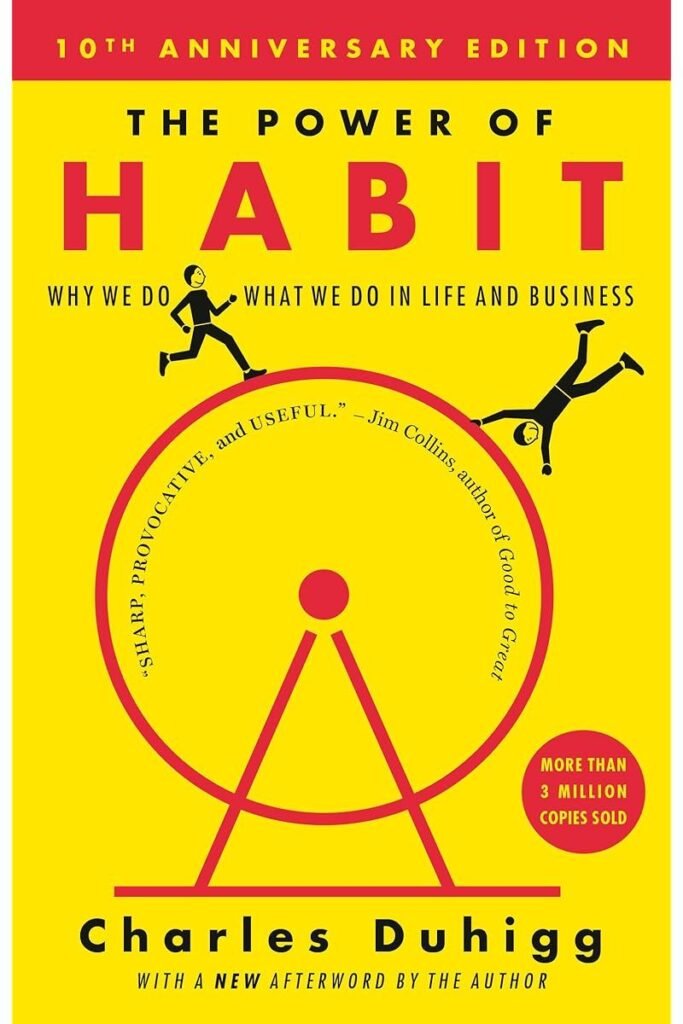
Why Read The Power of Habit?
The Power of Habit is one of the most practically consequential popular science books of the past two decades — a rigorously reported, narratively compelling account of the neuroscience and psychology of habit that has genuinely changed the way millions of people understand and manage their own behavior. Charles Duhigg, a Pulitzer Prize-winning journalist, spent years reporting on habit research across neuroscience, psychology, and organizational behavior to produce a book that is simultaneously a gripping read and an actionable framework.
The book is organized in three parts. The first — on individual habits — introduces the habit loop (cue, routine, reward), explains the neuroscience of how habits are encoded in the basal ganglia, and provides the core framework for understanding and changing individual behavior. The second — on organizational habits — examines how companies, hospitals, and other institutions are governed by collective habits and routines, and how keystone habits and organizational crises can be leverage points for transformation. The third — on societal habits — examines how social movements gain momentum by exploiting the same habit structures that govern individual behavior.
Each section is built around compelling case studies — Eugene Pauly, whose habit loop survived intact even after the rest of his memory was destroyed; Paul O’Neill’s transformation of Alcoa’s culture through a single keystone habit; the Montgomery Bus Boycott’s exploitation of Rosa Parks’s social connections; Michael Phelps’s ritualized pre-race habits — that give the abstract neuroscience and psychology a vivid, human texture. Duhigg’s journalistic skill makes this one of the most readable accounts of behavioral science for a general audience.
Who Should Read This
This is a book for anyone who has tried to change a habit and struggled — who has started and abandoned exercise programs, dietary regimes, and productivity systems and wants to understand why. It is equally valuable for managers and organizational leaders who want to understand how culture is built and changed, and for students of social movements. Essential for students of psychology, organizational behavior, and public health; professionals managing behavioral change; CAT/GRE aspirants; and anyone who has wondered why they keep doing things they have decided to stop doing.
Key Takeaways from The Power of Habit
The habit loop — cue, routine, reward — is the neurological structure underlying every habit. You cannot extinguish a habit by willpower alone, but you can replace the routine while keeping the cue and the reward. This is the Golden Rule of habit change.
Keystone habits — habits with disproportionate effects on other behaviors — are the highest-leverage target for change. Exercise is the canonical keystone habit: establishing it tends to improve eating, sleep, and financial behavior without any explicit intention to change these domains.
Habit change requires belief — specifically, the belief that change is possible. Groups such as Alcoholics Anonymous meetings, workout partners, and religious communities are uniquely powerful because they provide the social support that makes this belief sustainable under stress.
Organizations are governed by institutional habits that operate below the level of conscious management. Changing organizational culture means identifying the cue, routine, and reward of specific institutional habits and deliberately substituting new routines — not merely announcing new values.
Key Ideas in The Power of Habit
The book’s foundational scientific claim is that habits are encoded in the basal ganglia — a primitive structure at the base of the brain that operates largely independently of the cortical regions associated with deliberate thought and decision-making. Eugene Pauly, a man who lost virtually all new memory formation due to viral encephalitis, could still navigate his neighborhood, eat his lunch, and find his way back to his room — because his basal ganglia retained the habit loops that governed these behaviors even after his hippocampus was destroyed. This neurological dissociation demonstrates that habits operate outside and below the level of conscious awareness, which is why willpower alone is insufficient for habit change.
The habit loop — cue, routine, reward — is the three-part structure that all habits share. The cue is the trigger that initiates the habitual behavior: a time of day, a location, an emotional state, the presence of other people, or an immediately preceding action. The routine is the behavior itself. The reward is the outcome that satisfies the craving the cue has activated. Crucially, the craving — the anticipation of the reward that the cue triggers — is what drives the habit loop: the habit persists not because the routine is pleasant in itself but because the craving for the reward makes its absence feel like deprivation.
The Golden Rule of Habit Change — keep the cue and the reward, change the routine — is the book’s most practically important claim. Because the habit loop is neurologically permanent, attempts to eliminate a habit by willpower alone typically fail when stress or circumstance reactivates the cue-craving association. The more effective approach is to identify the cue and the reward and to design a new routine that delivers the same reward in response to the same cue.
The concept of keystone habits — habits that have disproportionate positive effects on other habits and behaviors — is the book’s most actionable framework for individuals. Some habits, when established, create conditions (better sleep, higher self-efficacy, improved mood) that make other positive behaviors more likely — without any explicit intention to change those other behaviors. The strategic identification of keystone habits allows individuals to achieve cascading behavioral change from a single, focused intervention.
Core Frameworks in The Power of Habit
Duhigg builds his argument around six interlocking frameworks that operate at the individual, organizational, and societal levels.
The three-part neurological structure underlying all habits. The cue triggers the routine automatically; the reward reinforces the association. Understanding which cue drives which routine for which reward is the analytical prerequisite for changing any habit.
Neurological activity peaks at the cue, not the reward — the craving drives the loop before the reward arrives. This explains why recovered addicts remain vulnerable and why addressing the craving, not just the behavior, is what makes change durable.
Keep the cue and the reward; change only the routine. The habit loop is neurologically permanent, so effective change requires substituting a new routine within the existing structure rather than attempting to eliminate the loop by willpower or avoidance.
Some habits produce cascading positive effects on other behaviors without explicit intention. Exercise improves sleep, mood, and self-efficacy simultaneously. Identifying the right keystone habit allows disproportionate behavioral change from a single, focused intervention.
Organizations are governed by collective habits — stable truces between competing power centers. These can only be changed at moments of crisis or through deliberate leadership, by identifying and substituting specific routines rather than announcing new values.
Successful social movements share a pattern: tight friendship networks mobilize initial response; extended community ties spread the movement; leaders give participants new habits and new identities that sustain commitment through extended adversity.
Core Arguments
Duhigg advances four interlocking arguments across the book’s three sections.
Once a habit is neurologically encoded in the basal ganglia, the pathway persists indefinitely — which is why willpower alone fails under stress. Effective habit change requires not the elimination of the neural pathway but the substitution of a new routine within the existing loop, working with the neurology rather than against it.
Successful long-term habit change requires the belief that change is possible — specifically, the belief that one can disrupt the habit loop under stress. Duhigg’s analysis of Alcoholics Anonymous suggests its power lies not in its twelve steps but in its social structure, which sustains belief in change when individual confidence falters. Groups are powerful for habit change because they create and maintain this belief.
Organizational culture is not an abstract set of values but a concrete system of institutional habits that govern how work is done and decisions are made. Changing culture requires identifying and deliberately substituting specific routines — not announcing new values. Paul O’Neill’s transformation of Alcoa through a single safety-focused keystone habit is the book’s primary illustration of this principle in action.
The Montgomery Bus Boycott succeeded not primarily because of Rosa Parks’s act of resistance but because of the specific social structure that transformed a local incident into a movement: tight friendship networks mobilized the initial response, extended community ties spread the boycott, and movement leaders gave participants new habits and identities that sustained commitment across fourteen months of adversity.
Critical Analysis
A balanced assessment of the book’s strengths and limitations.
Duhigg’s background as a journalist allows him to build compelling narratives around scientific concepts — the Eugene Pauly story, the Alcoa transformation, the Montgomery Bus Boycott analysis — that make the science vivid and memorable. The book is genuinely hard to put down, an unusual quality for behavioral science nonfiction.
Organizing the book into individual, organizational, and societal habit change is intellectually ambitious — it demonstrates that the same underlying structure operates across radically different scales and contexts, giving the habit loop framework a generative power that single-domain accounts cannot achieve.
The book’s appendix — a step-by-step guide to applying the habit framework to any specific habit — is one of the most useful sections of any popular psychology book, operationalizing the theory in an immediately applicable form.
Duhigg’s journalistic instinct for narrative occasionally leads him to extend case studies beyond what the evidence supports. The Montgomery Bus Boycott analysis, in particular, has been criticized by historians who argue that the social movement framework oversimplifies a complex historical process.
The individual habit section rests on solid neuroscience research; the organizational and societal sections rely more heavily on case study analysis and less on experimental evidence. The frameworks in these sections are plausible and useful but less empirically grounded than the first section’s neuroscience.
James Clear’s Atomic Habits covers overlapping territory with greater practical specificity and more accessible prose. Readers focused solely on personal habit change may find that book more immediately actionable, while readers seeking scientific depth and organizational applications should prioritize this one.
Impact & Legacy
Commercial and Academic Reach: The Power of Habit debuted on the New York Times bestseller list in February 2012 and remained on it for over three years, selling over three million copies in its first five years. Translated into over thirty languages, it is regularly assigned in business schools, public health programs, organizational behavior courses, and management training programs worldwide. It is frequently cited alongside Influence and Thinking, Fast and Slow as one of the foundational texts of applied behavioral science for a general audience.
Cross-Domain Influence: In public health, it has shaped behavior change interventions by providing a framework that is both scientifically grounded and practically applicable. In organizational development, the keystone habit concept and institutional habits framework have been widely adopted by consultants and executives seeking to understand and change culture. In personal productivity, the habit loop has become a standard framework alongside the concepts from Atomic Habits and the flow state research of Flow — the three together constituting the most widely used behavioral framework in contemporary self-improvement culture.
The “Habit Turn” in Popular Culture: The book contributed to the widespread adoption of habit as the primary lens through which people understand and attempt to change their behavior. This cultural shift has had both positive effects — more deliberate and scientifically grounded approaches to behavioral change — and negative ones, including the oversimplification of complex psychological and social phenomena into the habit loop framework, and the reduction of addiction, trauma, and social disadvantage to “bad habits” amenable to straightforward cue-routine-reward analysis.
For Exam Preparation: The Power of Habit is excellent intermediate-level reading comprehension practice in behavioral science nonfiction. Its combination of narrative case studies and scientific frameworks, its movement across three levels of analysis, and its habit of drawing general conclusions from specific examples provide direct practice for the analytical reading skills — inference, identifying the relationship between example and principle, understanding argumentative structure — that CAT and GRE passages most rigorously test.
Love This Book? Master Every Book.
Stop struggling with reading comprehension. Our proven system transforms how you read—whether for CAT, GRE, GMAT, SAT, or personal growth.
Best Quotes from The Power of Habit
This is the real power of habit: the insight that your habits are what you choose them to be.
Change might not be fast and it isn’t always easy. But with time and effort, almost any habit can be reshaped.
Champions don’t do extraordinary things. They do ordinary things, but they do them without thinking, too fast for the other team to react. They follow the habits they’ve learned.
Habits, scientists say, emerge because the brain is constantly looking for ways to save effort. Left to its own devices, the brain will try to make almost any routine into a habit.
You have to actually believe, in the deepest sense, that things can get better. The difference between who I am and who I want to be is what I do.

Test Your Understanding
Think you’ve mastered The Power of Habit? Challenge yourself with 15 questions on the habit loop, key frameworks, and core arguments. Score 80%+ to prove your mastery.
The Power of Habit FAQ
What is the “habit loop”?
The habit loop is the three-part neurological structure that underlies every habit: a cue that triggers the behavior, a routine that constitutes the behavior, and a reward that reinforces the cue-routine association. This structure is encoded in the basal ganglia — a primitive brain structure that operates largely independently of conscious awareness — which is why habits feel automatic and why willpower alone is insufficient to change them. Understanding the specific cue, routine, and reward of any particular habit is the first step toward changing it.
What is the “Golden Rule of Habit Change”?
The Golden Rule of Habit Change is Duhigg’s practical framework for changing any habit: keep the cue and the reward, change the routine. Because the neurological pathway of a habit persists even when the habit is dormant, attempts to eliminate a habit by willpower typically fail when stress reactivates the cue-craving association. The more effective approach is to identify the specific cue and the specific reward, then design a new routine that delivers the same reward in response to the same cue. The craving remains; only the behavior changes.
What is a keystone habit and how do I identify mine?
A keystone habit is a habit that, when established, produces cascading positive effects on other habits and behaviors without any explicit intention to change those behaviors. Exercise is the most widely studied keystone habit: people who establish a consistent exercise routine tend spontaneously to eat more healthily, sleep better, and manage money more carefully. To identify a potential keystone habit, look for behaviors that require consistent scheduling and deliberate effort, produce immediate positive effects on mood or energy, and seem to make other positive behaviors easier or more likely.
How does The Power of Habit apply to organizations?
The book’s organizational section argues that companies and institutions are governed by institutional habits — patterns of behavior that emerge not from deliberate planning but from accumulated decisions and power negotiations. Changing them requires the same approach as changing individual habits: identifying the cue, the routine, and the reward of the specific institutional habit you want to change, and substituting a new routine. Paul O’Neill’s transformation of Alcoa is the primary case study: by focusing on a single keystone habit (worker safety), he triggered cascading cultural transformation across the entire organization.
How does The Power of Habit compare to Atomic Habits?
Both books address habit change and share the core insight that habits are best changed by working with rather than against their underlying structure. The Power of Habit provides richer scientific and historical context — the neuroscience of the basal ganglia, the institutional habits framework, the social movement analysis — and a broader three-level analysis (individual, organizational, societal). Atomic Habits provides more granular practical guidance and is more immediately actionable for personal behavioral change. For scientific depth and organizational applications, The Power of Habit is the better choice; for step-by-step personal habit change guidance, Atomic Habits is more directly useful.








