

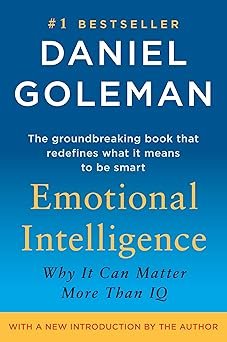
Why Read Emotional Intelligence?
Emotional Intelligence is one of the most influential psychology books of the past thirty years — a landmark work that introduced the concept of emotional intelligence (EQ) to a mass audience, challenged the dominant assumption that IQ is the primary determinant of human success, and permanently changed how educators, employers, therapists, and parents think about what matters most in human development. Published in 1995, Daniel Goleman’s synthesis of two decades of neuroscience and psychology research spent over 80 weeks on the New York Times bestseller list and sold more than five million copies.
Goleman, a science journalist with a Harvard doctorate in psychology, built his argument on the foundational research of psychologists Peter Salovey and John Mayer, who coined the term “emotional intelligence” in 1990, and on Howard Gardner’s theory of multiple intelligences. But where Salovey and Mayer had introduced EQ as a technical psychological construct, Goleman transformed it into a popular framework by connecting it to neuroscience, developmental psychology, and the practical domains — school performance, career success, relationship quality, mental and physical health — where its effects were most visible.
The book is organized in five parts: the brain basis of emotional intelligence; self-knowledge and self-regulation; motivation; empathy; and social skill. Each part draws on neuroscience research (particularly on the amygdala and its role in emotional “hijacking”), developmental psychology, and case studies from schools, workplaces, and clinical settings to build a comprehensive account of what emotional intelligence is, how it develops, and what difference it makes. The final section on emotional literacy programs in schools anticipates the social-emotional learning (SEL) movement that would transform education in subsequent decades.
Who Should Read This
This is a book for anyone who wants to understand why some people navigate relationships, adversity, and complex social environments more effectively than others — and what can be done to develop these capacities. Ideal for parents, educators, managers, and organizational leaders. Essential for students of psychology and organizational behavior; educators, parents, and coaches; HR professionals; CAT/GRE aspirants who need intermediate-level scientific nonfiction RC practice; and anyone who has wondered why intelligence alone is insufficient for a good life.
Key Takeaways from Emotional Intelligence
The amygdala can “hijack” the rational brain in moments of intense emotion, triggering responses that bypass deliberate reasoning entirely. Self-awareness — recognizing your emotional states as they arise — is the first and most fundamental EQ competency, because you cannot manage emotions you do not understand.
IQ accounts for at most 20% of the variance in life success. The remaining factors include emotional and social competencies — self-regulation, motivation, empathy, social skill — that consistently distinguish high achievers from average performers in the complex, relational domains that constitute most of adult life.
Empathy is both the most interpersonally powerful and the most developmentally sensitive EQ competency. It develops primarily in early childhood through attuned caregiving, and its absence underlies a wide range of social difficulties. Organizations that develop empathy across their leadership generate the psychological safety and trust that are prerequisites for high performance.
Unlike IQ, emotional intelligence is not fixed — it can be learned, developed, and improved throughout life. The competencies of EQ (self-awareness, self-regulation, motivation, empathy, social skill) can be cultivated through deliberate practice, skilled coaching, and the right educational environments, making EQ development a genuine and achievable goal.
Key Ideas in Emotional Intelligence
The book opens with a neurological foundation that distinguishes it from purely behavioral accounts of emotional intelligence. Goleman’s account of the “emotional brain” — drawing primarily on the neuroscience of the amygdala and its relationship to the prefrontal cortex — explains why emotions can override rational thought so completely and so rapidly. The amygdala processes emotionally salient stimuli and can trigger a full-blown emotional response before the prefrontal cortex has had time to evaluate the situation. This “amygdala hijack” is the neural basis of emotional dysregulation: the experience of being “taken over” by rage, fear, or grief in ways that seem, retrospectively, disproportionate.
Self-awareness — the ability to recognize one’s own emotional states as they arise, and to understand the patterns of emotional response that characterize one’s personality — is the foundational EQ competency from which all others derive. People who lack self-awareness are genuinely impaired in their ability to navigate relationships, make sound decisions, and regulate their behavior under stress — not because they lack cognitive intelligence but because they cannot perceive the emotional information that is shaping their judgments and actions.
The concept of “flow” — borrowed directly from Csikszentmihalyi’s research — appears in Goleman’s account of motivation as the optimal state for learning and performance: the state of complete absorption in a challenging task, in which performance is highest and experience most positive. Goleman connects flow to emotional regulation, arguing that the emotional conditions that enable flow — curiosity, engagement, the absence of debilitating anxiety — are themselves EQ competencies that can be cultivated.
Empathy is developed across multiple chapters and at multiple levels: basic emotional recognition (reading facial expressions and body language), perspective-taking (understanding the cognitive and emotional perspective of another person), and compassionate response (being moved to appropriate action by another’s distress). Goleman’s discussion of the neuroscience of empathy — including early research on mirror neurons and the developmental psychology of attunement — gives scientific foundation to what is often treated as a purely moral or interpersonal quality.
Core Frameworks in Emotional Intelligence
Goleman builds his argument around six interlocking frameworks spanning neuroscience, developmental psychology, and organizational behavior.
The amygdala can trigger a full emotional response — physiological arousal, hormonal change, behavioral impulses — before the prefrontal cortex has assessed the situation. This “low road” of emotional processing is the mechanism behind road rage, emotional meltdowns, and the disproportionate responses that characterize low emotional intelligence.
Self-awareness, managing emotions, motivating oneself, empathy, and handling relationships. These five domains build on each other: self-awareness underpins emotion management; emotion management enables self-motivation; empathy extends awareness to others; and social skill applies EQ in the service of relationships.
LeDoux’s neuroscience describes two pathways: the fast “low road” (thalamus to amygdala) and the slower “high road” (thalamus to cortex to amygdala). Emotional intelligence consists partly in the prefrontal cortex’s ability to modulate amygdala activity — recognizing the emotional response as it arises before acting on it.
Four-year-olds who could wait for a second marshmallow showed dramatically better outcomes in adolescence and adulthood: higher SAT scores, better social competence, and lower rates of drug abuse. The ability to delay gratification is a measurable behavioral manifestation of emotional regulation that predicts life outcomes independently of IQ.
Goleman argues that emotional competencies are as teachable as reading literacy. Programs such as the Self Science curriculum demonstrate significant effects on children’s self-regulation, empathy, and social competence. His advocacy helped catalyze the social-emotional learning (SEL) movement, now operating in thousands of schools worldwide.
Competency research shows that EQ competencies distinguish star performers from average performers more consistently than cognitive or technical skills, particularly in leadership roles. Organizations that develop EQ across their leadership generate higher psychological safety, more effective collaboration, better talent retention, and stronger performance on complex tasks.
Core Arguments
Goleman advances four interlocking arguments that together challenge the primacy of IQ in understanding human potential.
Goleman’s most central argument is that IQ accounts for at most 20% of the variance in life success outcomes. The evidence he marshals includes longitudinal studies of highly intelligent people who underachieve, competency research showing that EQ competencies distinguish high performers more consistently than cognitive measures, and developmental research showing that emotional regulation in early childhood predicts outcomes decades later. The emotional and social competencies of EQ are among the strongest predictors of success in the complex, relational domains that constitute most of adult life.
The rational, deliberate self that we identify with our “mind” is not the dominant system governing our behavior. The emotional brain — faster, more automatic, and more powerful than the prefrontal cortex in the moment of emotional activation — shapes our perceptions, judgments, memories, and social responses in ways that proceed largely outside conscious awareness. This argument is continuous with Kahneman’s System 1/System 2 framework but focuses specifically on the emotional dimensions of automatic processing.
Against the implicit fatalism of the IQ paradigm, Goleman argues that EQ competencies are both developmentally shaped (by early caregiving, educational environments, and life experience) and trainable throughout life. This argument has two implications: it gives parents and educators a consequential role in developing the foundations of EQ, and it gives adults genuine agency over their EQ development through deliberate practice, coaching, and emotionally intelligent habits. EQ is not destiny.
The book’s clinical sections argue that emotional dysregulation — the inability to recognize, tolerate, and manage emotional states appropriately — is the common mechanism underlying a wide range of individual and social pathologies. The person who cannot manage anger becomes aggressive; the person who cannot manage anxiety becomes avoidant; the person who cannot empathize exploits others. Developing emotional intelligence is therefore not merely a performance enhancement but a prerequisite for the kind of emotional life that makes genuine human flourishing possible.
Critical Analysis
A balanced assessment of the book’s genuine contributions and well-documented limitations.
Goleman’s account of the amygdala and the neural basis of self-regulation gives EQ a scientific grounding that purely behavioral accounts lack — it explains why emotional competencies matter at the level of brain architecture, not just behavior, and why developing them requires sustained practice rather than intellectual understanding alone.
The book covers EQ from infancy through old age, from individual development through organizational effectiveness, from neuroscience through educational program design — a breadth that gives the framework genuine generative power and makes it valuable to readers across a wide range of professional and personal contexts.
Goleman’s skill as a science journalist allows him to synthesize neuroscience, developmental psychology, clinical psychology, and organizational behavior in ways that specialist researchers cannot — identifying the common thread of emotional intelligence running through research programs that had not previously been connected.
The psychometric status of emotional intelligence — whether it is a genuine form of intelligence or a repackaging of existing personality constructs — remains contested among researchers. Salovey and Mayer, who coined the term, have argued that Goleman’s popular version significantly overstates both the theoretical coherence and the predictive power of EQ relative to established personality measures.
Goleman’s claim that EQ accounts for much of the variance in life success after controlling for IQ has been criticized by psychologists as a significant overstatement. The evidence that EQ, as a measurable construct, predicts outcomes independently of personality and IQ after rigorous statistical controls is considerably weaker than the book suggests.
Published in 1995, the book draws on research that predates significant developments in both neuroscience (the mirror neuron research cited has been substantially complicated) and psychology (the replication crisis has affected some studies cited). The core arguments remain valuable, but specific empirical claims should be read with awareness of subsequent research.
Impact & Legacy
Commercial and Cultural Reach: Emotional Intelligence spent over 80 weeks on the New York Times bestseller list after its September 1995 publication, selling more than five million copies in its first ten years and eventually over 15 million copies across more than 40 languages. Time magazine’s 1995 cover story on EQ — timed with the book’s publication — launched a cultural conversation about intelligence, success, and emotional development that has not yet concluded.
The Social-Emotional Learning Movement: In education, the book provided the intellectual foundation for the SEL movement — now one of the most extensively researched educational interventions in the world, with a robust evidence base supporting its effects on academic achievement, behavior, and long-term outcomes. The Collaborative for Academic, Social, and Emotional Learning (CASEL), which Goleman helped found, has grown into a major force in educational policy, with SEL programs now operating in thousands of schools across the United States and globally.
Organizational and Leadership Development: The EQ concept has had a direct impact on how organizations hire, develop, and assess leaders. The concept of emotional intelligence as a leadership competency — developed further in Working with Emotional Intelligence (1998) and Primal Leadership (2002) — is now standard in leadership development curricula, executive coaching, and organizational assessment. Multi-rater emotional competency assessments have been used by thousands of organizations worldwide.
A Commercial Ecosystem and Its Limits: The EQ concept has also generated a significant commercial ecosystem — assessment instruments, coaching programs, and self-help literature — that extends well beyond the research base that supports it. This has produced both genuine value (more emotionally aware leaders, better school environments) and significant distortion (oversimplified assessments, inflated claims, and the commodification of a psychological construct that was originally more nuanced). The academic status of EQ remains more contested than its popular success suggests.
For Exam Preparation: Emotional Intelligence is excellent intermediate-level reading comprehension practice in psychological science nonfiction. Its combination of neuroscience, developmental psychology, clinical case studies, and organizational applications mirrors the multi-disciplinary structure of the most demanding science passages in CAT and GRE examinations. The core concepts — the amygdala hijack, the five EQ domains, the marshmallow test, emotional literacy — are directly relevant to exam passages on psychology, education, and organizational behavior.
Love This Book? Master Every Book.
Stop struggling with reading comprehension. Our proven system transforms how you read—whether for CAT, GRE, GMAT, SAT, or personal growth.
Best Quotes from Emotional Intelligence
In a very real sense we have two minds, one that thinks and one that feels.
If your emotional abilities aren’t in hand, if you don’t have self-awareness, if you are not able to manage your distressing emotions, if you can’t have empathy and have effective relationships, then no matter how smart you are, you are not going to get very far.
The brightest among us can founder on the shoals of unbridled passions and unruly impulses; people with high IQs can be stunningly poor pilots of their private lives.
Much evidence testifies that people who are emotionally adept — who know and manage their own feelings well, and who read and deal effectively with other people’s feelings — are at an advantage in any domain of life.
Empathy requires paying attention, it requires being present, it requires listening. It requires us to suspend our own agenda long enough to truly receive another human being.

Test Your Understanding
Think you’ve mastered Emotional Intelligence? Challenge yourself with 15 questions on the amygdala hijack, the five EQ domains, and Goleman’s core arguments. Score 80%+ to prove your mastery.
Emotional Intelligence FAQ
What is emotional intelligence and how is it different from IQ?
Emotional intelligence (EQ) is the capacity to recognize, understand, manage, and effectively use emotions — both one’s own and others’. It encompasses five domains: self-awareness, emotion management, self-motivation, empathy, and social skill. IQ measures cognitive ability — the capacity for abstract reasoning, verbal comprehension, and quantitative analysis. Goleman’s argument is that while IQ predicts performance in cognitively demanding academic and professional tasks, the emotional and social competencies of EQ are stronger predictors of success in the complex, relational, and ambiguous domains that constitute most of adult life.
What is an “amygdala hijack”?
The amygdala hijack is Goleman’s term for the neurological event in which the amygdala — the brain’s emotional alarm system — triggers a full emotional response before the prefrontal cortex has had time to assess the situation. Because the amygdala receives sensory information faster than the cortex, it can initiate hormonal changes, physiological arousal, and behavioral impulses in response to a perceived threat before rational evaluation has occurred. This produces the experience of being “taken over” by an emotion — acting in rage or fear in ways that seem disproportionate in retrospect. The amygdala hijack is the neural basis of emotional dysregulation, and developing the ability to recognize and modulate it is the core practical challenge of emotional intelligence.
What is the marshmallow test and what does it tell us?
Walter Mischel’s Stanford marshmallow experiment offered four-year-old children a choice: eat one marshmallow now, or wait fifteen minutes and receive two. Children who could delay gratification showed dramatically better outcomes at follow-up: higher SAT scores, better social competence, lower rates of substance abuse, and stronger ability to cope with stress in adolescence and adulthood. Goleman uses this experiment as the clearest empirical demonstration that the ability to regulate impulses — a core EQ competency — predicts life outcomes independently of IQ. Subsequent research has complicated the original finding (showing that trust in the experimenter partly accounts for performance), but the core relationship between early self-regulation and later outcomes remains robust.
Is emotional intelligence a scientifically valid concept?
The scientific status of EQ is more contested than Goleman’s confident popular account suggests. Peter Salovey and John Mayer — the psychologists who coined the term — have argued that Goleman’s popular version overstates both the theoretical coherence and the predictive power of EQ relative to established personality measures. The specific claim that EQ accounts for a large portion of the variance in life success after controlling for IQ is not as robustly supported as the book suggests. What remains well-established is that the competencies Goleman describes — self-awareness, emotional regulation, empathy, social skill — are genuinely important for relational, leadership, and life outcomes.
How does Emotional Intelligence relate to other psychology books?
Thinking, Fast and Slow (Kahneman) provides the broader cognitive architecture — System 1 and System 2 — within which Goleman’s emotional brain/rational brain distinction sits. Influence (Cialdini) documents how emotional states shape behavior below the level of rational deliberation. Flow (Csikszentmihalyi) addresses the optimal emotional conditions for peak performance that Goleman’s EQ framework helps explain. Mindset (Dweck) addresses the motivational and self-regulatory dimensions that overlap significantly with Goleman’s self-motivation domain. Together these books constitute the most comprehensive account of the psychological foundations of human effectiveness.








