
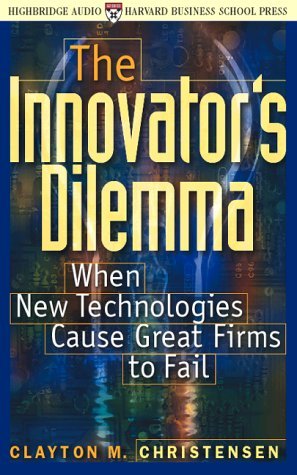
Why Read The Innovator’s Dilemma?
The Innovator’s Dilemma poses one of the most uncomfortable questions in business: why do well-managed, customer-focused, financially disciplined companies get blindsided and eventually destroyed by new entrants with inferior products? Clayton Christensen’s answer — that the very management practices that make companies excellent at sustaining innovation make them structurally incapable of responding to disruptive innovation — is one of the genuinely original ideas in the history of business thinking. It did not merely describe a phenomenon; it gave the business world a new vocabulary for understanding why success is so often the precondition for failure.
Published in 1997, the book draws on exhaustive research across the hard disk drive industry, steel mini-mills, mechanical excavators, and retail discount chains to develop and test a single theory: that disruptive technologies follow a predictable pattern — they enter markets at the low end, serving customers who are over-served or entirely unserved by existing players, they improve faster than customer needs require, and they eventually move upmarket to displace the incumbents who dismissed them. The incumbents are not defeated because they are poorly managed. They are defeated because their rational, customer-driven management processes systematically direct investment away from the very markets where disruption begins.
Christensen’s contribution is not merely descriptive. By identifying the mechanism of disruption — the processes, values, and resource allocation systems that make incumbents blind to disruptive threats — he provides a framework that both explains past collapses and allows companies to anticipate future ones. The book is simultaneously a theory of business failure, a diagnostic tool for identifying vulnerability, and a prescription for building structures capable of responding to disruption before it is too late.
Who Should Read This
This is essential reading for anyone serious about business strategy, technology management, or the dynamics of competitive markets. MBA candidates will find it indispensable — the innovator’s dilemma is one of the most frequently referenced frameworks in strategy courses, case discussions, and admissions interviews. Beyond exam preparation, it is required reading for strategists, product managers, investors, and any founder who wants to understand both how to disrupt incumbents and how to avoid being disrupted themselves.
Key Takeaways from The Innovator’s Dilemma
Doing everything right is not sufficient protection against disruption — it can be the cause of it. Established companies fail not because they ignore their customers or stop innovating, but because they listen too carefully to their existing customers and innovate too narrowly in the directions those customers request. This is the dilemma: the management practices that produce excellence in the present systematically undermine survival in the future.
Disruptive technologies do not begin by being better — they begin by being cheaper, simpler, and sufficient for a market that incumbents have abandoned or never noticed. The disruption happens gradually, then suddenly: the new entrant improves its product faster than the market’s needs advance, eventually crossing the threshold where good enough becomes better than the incumbent’s over-engineered solution, at a fraction of the price.
Organisations are systems of values that determine which opportunities get resources and which get ignored. A company built around serving high-margin customers cannot redirect those resources toward low-margin, low-demand markets, no matter how clearly the threat is understood intellectually. The solution is not better decision-making within the existing organisation — it is a separate organisation with different values.
Markets for disruptive technologies cannot be researched into existence — they must be discovered through action. Because disruptive technologies initially serve markets that do not yet exist, conventional market research produces unreliable guidance. The appropriate response is not analysis but small, fast, affordable experiments — treating each foray into an emerging market as a learning exercise rather than a commitment to a plan.
Key Ideas in The Innovator’s Dilemma
Christensen’s book is built around a single, rigorously developed distinction — the difference between sustaining innovation and disruptive innovation — and the asymmetric competitive dynamics that follow from it. Sustaining innovations improve existing products along the dimensions that existing customers value: faster processors, higher resolution screens, more fuel-efficient engines. Disruptive innovations initially perform worse on those established dimensions but introduce a different value proposition — cheaper, simpler, more convenient, accessible to a new class of users — that the existing market has no immediate use for.
The hard disk drive industry is Christensen’s primary laboratory. Between 1976 and 1995, the industry cycled through six major architectural transitions — from 14-inch drives to 8-inch to 5.25-inch to 3.5-inch and smaller — and in every transition, the established leader of the previous architecture failed to lead the next. The pattern was consistent and devastating: the new, smaller drive initially offered less storage capacity than the market required. The established players’ customers had no use for it. Their engineers built prototypes, showed them to customers, received negative feedback, and rationally redirected their resources toward sustaining innovations their existing customers were requesting. The rational, customer-driven decision was the wrong decision. Every time.
The mechanism of failure is what Christensen calls the resource allocation process: the systems by which companies decide where to direct their engineering talent, their capital, and their management attention. In well-managed companies, these systems are highly efficient at directing resources toward the highest-value opportunities — which means toward existing customers with established needs and measurable demand. Disruptive markets, by definition, are small, uncertain, and populated by customers who do not yet exist in sufficient numbers to register as important. The resource allocation process is not broken when it ignores disruptive opportunities; it is working exactly as designed. That is the dilemma.
Christensen’s prescription is structural rather than behavioural: the solution to the innovator’s dilemma is not to make existing organisations better at evaluating disruptive opportunities. It is to create separate organisations — with different cost structures, different values, different customer bases, and different measures of success — that can pursue disruptive opportunities without being evaluated against the performance metrics of the mainstream business. The newspaper industry’s attempt to respond to online news is the classic example: every newspaper that tried to run a digital operation as a subsidiary of its print operation found the digital unit consistently defunded, because the print operation’s financial metrics made digital revenues look trivial by comparison.
Case Studies in The Innovator’s Dilemma
Christensen grounds every claim in industry-level historical data. These five case studies — spanning hard drives, steel, excavators, retail, and computing — provide the empirical foundation for the theory of disruptive innovation.
In every transition to a smaller drive architecture over two decades, the leader of the previous generation failed to lead the next — despite having the engineering capability and financial resources to do so. The consistent pattern across six disruption cycles established that the failure was systemic, not circumstantial, making this industry the clearest available laboratory for isolating the mechanism of disruption from all other variables.
Minimills initially produced only rebar — the lowest-quality, lowest-margin steel product — a market the integrated mills were happy to abandon. As minimill technology improved, they moved progressively upmarket through angle iron, structural steel, and finally sheet steel. Each time they moved up, the integrated mills retreated further up-market until there was nowhere left to retreat. Their rational, margin-driven decisions led them step by step into an increasingly indefensible position.
Hydraulic excavators initially could not dig as deep or handle the bucket capacities that established contractors required. Established manufacturers therefore ignored them. Small new entrants built the hydraulic market from the bottom up — residential contractors, small utility work — and improved rapidly. By the time the capability gap closed, the new entrants owned the market. The established manufacturers’ rational dismissal of the inferior new technology was fatal.
Discount retailers initially served a customer segment — budget-conscious consumers buying basic goods — that department stores viewed as unprofitable and undesirable. Department stores saw no reason to compete for customers they did not want. Over time, as discount retailers improved their operations and expanded their merchandise range, they progressively moved upmarket until they were competing directly for the customers department stores had always valued. By then, department stores had neither the cost structure nor the operational model to compete.
Early personal computers were dismissed by minicomputer manufacturers as toys — underpowered, limited in memory, incapable of running serious applications. Their existing customers confirmed this assessment. The PC found its initial market among hobbyists and small businesses that minicomputer companies had never served. By the time it had sufficient capability to replace minicomputers for enterprise applications, the minicomputer industry had been effectively destroyed. Digital Equipment Corporation — arguably the finest minicomputer company in history — failed to make the transition despite having every resource required to do so.
Core Arguments
Christensen advances four interconnected arguments — about the rationality trap, the performance trajectory mismatch, the structural constraints of cost and values, and the limits of conventional planning — each with direct implications for how incumbents and disruptors should act.
The book’s central argument is that the failure of established companies to respond to disruption is not a management failure — it is a management success applied in the wrong direction. Rational managers, listening to their best customers and allocating resources to their highest-return opportunities, consistently make decisions that are correct by every conventional metric and catastrophically wrong in historical perspective. Christensen’s argument is not that managers should become irrational; it is that the definition of rational must expand to include the recognition of disruptive threats that conventional financial metrics cannot see.
Disruptive technologies improve faster than customer needs advance — and this mismatch is what eventually makes the disruptive technology “good enough” to replace the incumbent’s product. The incumbent’s product keeps improving along dimensions customers value but are already satisfied with; the disruptive product improves along dimensions customers will eventually need. The crossing point — where good enough becomes better-than — arrives faster than incumbents anticipate and is nearly impossible to see from inside the existing business model.
Established companies cannot simply decide to pursue disruptive opportunities — their cost structures and values make such pursuit structurally unprofitable. A company built to deliver 40% gross margins cannot profitably serve a market that will initially yield 15%, regardless of its strategic intentions. The organisation’s values — the implicit standards by which investment proposals are evaluated — systematically filter out disruptive opportunities because those opportunities look, by established metrics, like poor investments. This is why structural separation, rather than internal strategy adjustment, is Christensen’s prescribed solution.
Because the markets for disruptive technologies do not yet exist when the technology first appears, the conventional planning process — which requires market size estimates, competitive analysis, and financial projections — is useless and misleading. Christensen argues for discovery-driven planning: treating early forays into disruptive markets as experiments designed to generate learning rather than as commitments to a plan. The objective is not to execute a strategy but to discover what the strategy should be — through small, fast, affordable actions that generate real market data rather than projected spreadsheet data.
Critical Analysis
A balanced assessment examining the book’s exceptional empirical rigour and mechanistic depth alongside its industry selection bias, conceptual inflation, and incumbent-centric perspective.
The book’s theory is built on systematic historical research across multiple industries, not on anecdote or selective case studies. The hard disk drive data in particular is exhaustive — Christensen tracked every entrant and exit over two decades — which gives the theory a predictive credibility that most business books cannot claim. The pattern is too consistent across too many industries to be dismissed as coincidence.
Most business books describe patterns of success or failure without explaining the mechanism that produces them. Christensen goes further: he identifies the specific processes (resource allocation), values (margin requirements), and structures (organisational incentives) that make disruption not merely possible but predictable. This mechanistic specificity is what allows the theory to be applied prospectively, not just retrospectively.
Unlike many analytical business books that diagnose without prescribing, Christensen offers specific, actionable recommendations — create separate organisations, use discovery-driven planning, match the disruptive opportunity to an organisation whose size makes it meaningful. These prescriptions are not always easy to execute, but they are specific enough to be attempted.
The book’s most powerful evidence comes from capital goods industries — disk drives, excavators, steel — where technological performance trajectories are measurable and market transitions are relatively discrete. The theory is less clean when applied to industries with more complex value propositions, network effects, or platform dynamics. Christensen’s subsequent attempts to apply the framework to healthcare and education generated considerably more controversy than the original book’s industrial applications.
The word “disruption” — directly traceable to Christensen — has been so thoroughly absorbed into business vocabulary that it is now applied to virtually any competitive threat, whether or not it follows the specific pattern Christensen identified. Jill Lepore’s 2014 New Yorker critique argued that Christensen’s theory cherry-picks its confirming cases and ignores disconfirming ones, and remains the most serious challenge to the framework’s empirical claims.
The book is written almost entirely from the perspective of the established incumbent trying to avoid being disrupted. It gives considerably less attention to the perspective of the disruptor — how to identify and pursue a disruptive strategy from the new entrant’s position — which limits its utility for founders and entrepreneurs relative to its utility for established company strategists.
Literary & Cultural Impact
Slow Start, Massive Retrospective Validation: The Innovator’s Dilemma was published in 1997 to an initially modest reception. Its influence grew through the early 2000s as the dot-com boom and bust produced a wave of high-profile cases that appeared to confirm Christensen’s predictions: Kodak, Blockbuster, Nokia, BlackBerry, Borders — the list of once-dominant companies undone by disruption they saw coming and failed to respond to became, in retrospect, an extended empirical vindication of the book’s framework.
Most Influential Management Book of Its Era: By the time it was named the most influential management book of its era by the Economist and Forbes, Christensen had become arguably the most cited academic in the history of business education. Andy Grove of Intel called it the most important book he had ever read about business. Steve Jobs cited it as a formative influence. Jeff Bezos is reported to have required Amazon executives to read it. The concept of disruptive innovation entered not just business vocabulary but political and cultural discourse — “disruption” became the defining aspiration of the Silicon Valley technology culture of the 2000s and 2010s.
A Framework That Spawned a Field: The book spawned a substantial academic and practitioner literature. Christensen himself followed it with The Innovator’s Solution (2003), The Innovator’s Prescription (2009), and The Innovator’s DNA (2011). The 2014 critique by historian Jill Lepore in The New Yorker — which argued that Christensen’s historical cases were selectively presented and that the theory had become a self-serving ideology of Silicon Valley disruption culture — generated significant debate and remains the most serious challenge to the framework’s empirical claims.
Acute Relevance in the Indian Context: The disruption of traditional retail by e-commerce, of incumbent telecom operators by Jio’s entry at radically lower price points, of conventional banking by fintech platforms, and of established education providers by ed-tech platforms — each follows the Christensen pattern with sufficient fidelity to make the framework genuinely predictive rather than merely retrospectively applicable. For any Indian entrepreneur or strategist seeking to understand either how to attack an incumbent or how to defend against attack, The Innovator’s Dilemma is not optional reading — it is the prerequisite.
Love This Book? Master Every Book.
Stop struggling with reading comprehension. Our proven system transforms how you read—whether for CAT, GRE, GMAT, SAT, or personal growth.
Best Quotes from The Innovator’s Dilemma
The logical, competent decisions of management that are critical to the success of their companies are also the reason why they lose their positions of leadership.
Disruptive technologies typically enable new markets to emerge.
The capabilities of most companies are far more specialised and context-specific than most managers are inclined to believe.
It is not always right to listen to your customers. It is not always right to invest in higher-performance, higher-margin products. And it is not always right to aggressively pursue larger markets at the expense of smaller ones.
The very mechanism that helps sustaining innovations — listening to good customers — is precisely what makes it so difficult to develop the capability to respond to disruptive innovations.
Test Your Understanding
Think you’ve mastered The Innovator’s Dilemma? Challenge yourself with 15 questions on sustaining vs. disruptive innovation, the resource allocation trap, Christensen’s case studies, and his structural prescription. Score 80%+ to prove your mastery.
The Innovator’s Dilemma FAQ
What is The Innovator’s Dilemma about?
It explains why well-managed, market-leading companies consistently fail to respond to disruptive technologies — not because of poor management, but because their rational, customer-driven management processes systematically direct resources away from the small, low-margin markets where disruption begins. The book identifies the mechanism of this failure across multiple industries and proposes structural solutions for companies trying to avoid it.
Is it useful for MBA and CAT preparation?
Indispensable. Disruptive innovation is one of the most frequently tested concepts in MBA strategy courses, case competitions, and admissions interviews. Understanding the difference between sustaining and disruptive innovation, the mechanism of the resource allocation trap, and Christensen’s structural prescription at depth — rather than at the level of the buzzword — is a significant competitive advantage in any MBA selection process. The Jio and Amazon India disruptions provide immediately applicable Indian case studies.
What is the difference between sustaining and disruptive innovation?
Sustaining innovations improve existing products along dimensions that existing customers already value — better, faster, more capable versions of what already exists. Disruptive innovations initially perform worse on established dimensions but offer a different value proposition — cheaper, simpler, more accessible — that established customers have no use for but new or under-served customers find sufficient. The critical distinction is not the technology itself but the market trajectory: sustaining innovations serve existing markets better; disruptive innovations create new markets or reshape existing ones from the bottom up.
What is Christensen’s solution to the innovator’s dilemma?
Structural separation: create an independent organisation — with its own cost structure, values, customer base, and performance metrics — to pursue disruptive opportunities. This organisation must be protected from the resource allocation processes of the mainstream business, which would defund it before it can develop. Additionally, use discovery-driven planning rather than conventional market analysis, since the markets for disruptive technologies do not yet exist in measurable form when the technology first appears.
Is the theory still valid in the age of platform businesses and AI?
The core insight — that incumbent processes, values, and cost structures create systematic blindness to disruptive threats — remains valid and has been confirmed repeatedly in the platform era. However, Christensen’s framework was developed primarily for capital goods industries, and its application to platform businesses, network-effect-driven markets, and AI-enabled disruption requires significant adaptation. The mechanism is correct; the specific predictions become less reliable as the complexity of the competitive dynamics increases. The book should be read as a foundational framework to be extended, not as a universal prediction engine.








