

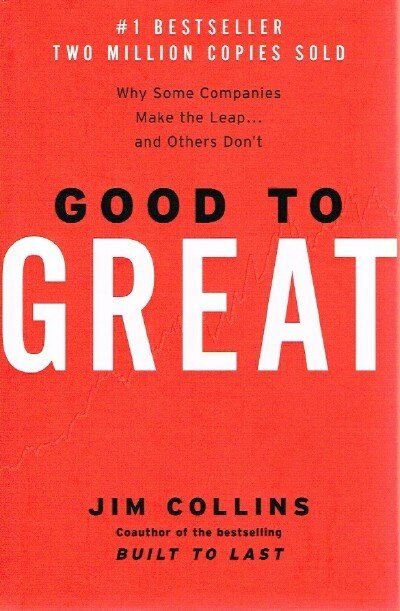
Why Read Good to Great?
Good to Great: Why Some Companies Make the Leap… and Others Don’t is the most widely read and most cited piece of original management research ever published — a systematic, five-year study of eleven companies that made the sustained transition from good performance to greatness, compared carefully against eleven comparison companies with similar opportunities but different outcomes. It produced frameworks — Level 5 Leadership, the Hedgehog Concept, the Flywheel — that have become standard vocabulary in business leadership globally. Published in 2001 and having sold over four million copies, it remains the most consequential business book of the 21st century.
Collins and his research team identified eleven companies that met a specific performance criterion: delivering cumulative stock returns at least three times the general market over fifteen years. Each was matched with a comparison company that had similar opportunities and resources but did not make the sustained transition to greatness. The research method was deliberately empirical — the team analysed over 6,000 articles, conducted 87 interviews with company executives, and built a statistical database of company characteristics to identify the patterns that distinguished the good-to-great companies from their comparisons.
The findings are organised around seven concepts: Level 5 Leadership, First Who Then What, Confronting the Brutal Facts, the Hedgehog Concept, a Culture of Discipline, Technology Accelerators, and the Flywheel and Doom Loop. Each concept is illustrated with specific case studies from the eleven companies and their comparisons — and each challenges at least one piece of conventional management wisdom.
Who Should Read This
This is a book for anyone in a leadership position — in a company, a non-profit, a government agency, or any organised institution — who wants to understand the specific organisational and leadership characteristics that distinguish genuinely great organisations from merely good ones. Essential for business leaders and managers at all levels who want empirically grounded frameworks rather than anecdotal advice, MBA students and business school graduates building their conceptual toolkit, CAT/GRE aspirants who need intermediate-level business management prose, and entrepreneurs and founders who want to understand what distinguishes sustainable organisations from those that peak and decline.
Key Takeaways from Good to Great
The Hedgehog Concept — the intersection of what you are deeply passionate about, what you can be the best in the world at, and what drives your economic engine — is the strategic clarity that distinguishes good-to-great companies from their comparisons. Great companies do not pursue diversification for its own sake; they find the one thing they can be truly great at and focus on it relentlessly. The hedgehog, which knows one big thing deeply, consistently beats the fox, which knows many things but nothing deeply.
Level 5 Leadership — the specific leadership profile of executives who led good-to-great transitions — is the book’s most counterintuitive finding. Level 5 leaders are not the charismatic, celebrity CEOs that popular business culture celebrates; they are humble about their own role (attributing success to their team), fiercely ambitious for the organisation’s success (not their own fame), and absolutely determined and professionally disciplined. Every good-to-great transition in the study was led by a Level 5 leader.
The Flywheel — the image of sustained momentum built through consistent effort in one direction — captures how good-to-great transitions actually happen. There is no single defining moment, no miracle launch, no one heroic decision: there is the consistent pushing of a heavy flywheel in the same direction, with each turn building on the last, until momentum takes over. The “Doom Loop” is the opposite — always lurching in new directions, searching for instant transformation, never building the cumulative momentum that actual greatness requires.
Getting the right people on the bus — before deciding where the bus is going — is more important than having the right strategy. The good-to-great companies did not start with a vision and find people to implement it; they assembled a team of the right people and then worked out what to do with them. This inverts the standard management advice about the primacy of vision and strategy: people quality is the precondition, not the implementation mechanism, for everything else.
Key Ideas in Good to Great
The research methodology is one of the book’s most important features. Collins and his team were deliberately trying to avoid the common failure of business books — selecting successful companies and constructing post-hoc narratives about what made them successful, without controlling for comparable companies that had the same apparent characteristics but failed. The research design instead identified companies meeting a specific performance criterion, matched each with comparison companies, and then looked for systematic differences between the two groups. This methodology does not eliminate all selection and attribution biases, but it is significantly more rigorous than most business book research.
The Level 5 Leadership chapters are the book’s most practically important and most counterintuitive. Collins expected the research to confirm the conventional wisdom about visionary, charismatic leadership; instead, it found that leaders who produced sustained great performance were consistently characterised by the combination of personal humility (deflecting credit, attributing success to colleagues) and professional will (absolute determination that the organisation would achieve greatness). Collins connects this profile to character rather than style: Level 5 leadership is not about appearing humble or appearing determined but about genuinely being both, in a combination that creates organisations focused on performance rather than the CEO’s ego.
The Hedgehog Concept is developed from Isaiah Berlin’s famous essay on Tolstoy — the distinction between the fox, who knows many things, and the hedgehog, who knows one big thing. Collins applies this to corporate strategy: great companies find the intersection of three questions (what can we be the best in the world at, what are we deeply passionate about, and what drives our economic engine) and focus single-mindedly on that intersection. Circuit City focused single-mindedly on being the best at selling major-ticket consumer electronics with associated financing; Walgreens focused on convenient drugstores at high-traffic intersections; Wells Fargo focused on running a bank as efficiently as possible rather than competing on size with larger institutions.
The Flywheel metaphor is the book’s most useful image for understanding how good-to-great transitions actually unfold. The flywheel is massive — requiring enormous effort to get moving — but as it turns it builds momentum, and each additional turn takes less effort than the last. Good-to-great transitions look dramatic from the outside (the overnight success, the sudden breakthrough) but are built from the inside through years of consistent, aligned effort. The Doom Loop describes the opposite: companies that respond to disappointing results by lurching in new directions, repeatedly searching for the transformative event or the magic leader that will produce instant results, and in the process preventing the accumulation of momentum that actual sustained greatness requires.
Core Frameworks in Good to Great
Collins distilled five years of research into six interlocking frameworks — each challenging a piece of conventional management wisdom and each grounded in the systematic comparison of good-to-great companies with their matched counterparts.
Core Arguments
Collins advances four interconnected arguments — each challenging a piece of conventional business wisdom and each grounded in the systematic comparison of eleven good-to-great companies with eleven matched counterparts.
The book’s most fundamental argument — running throughout every framework — is that sustained organisational greatness is not the product of a single dramatic decision, a visionary leader’s moment of inspiration, or a revolutionary technology; it is the product of cumulative, aligned, disciplined effort applied consistently over time in one direction. This argument directly challenges the “great man” theory of corporate success (which attributes company performance to the CEO’s personality) and the “breakthrough event” theory (which looks for the defining decision that turned the company around). The flywheel metaphor makes this argument most explicitly: sustained greatness looks dramatic from the outside because the cumulative momentum becomes self-reinforcing, but from the inside it was always the product of consistent discipline.
The Level 5 Leadership finding is the book’s most counterintuitive and most practically consequential argument: the leadership profile that produces sustained great performance is the opposite of what business culture typically values and celebrates. The celebrity CEO — charismatic, visionary, public-facing, building an organisation around their own personality — is associated in the research with comparison companies, not with good-to-great companies. The leaders who produced sustained greatness were consistently characterised by personal humility and professional determination — not self-promotion and inspiration. This challenges both the media’s preference for dramatic leadership narratives and boards’ tendency to hire for charisma and public presence.
The “First Who, Then What” framework makes a specific and important argument about the relationship between people and strategy: the right people, when assembled, will figure out the right strategy, and wrong people will implement even the right strategy badly. This inverts the standard MBA framework (strategy first, then structure, then staffing) and argues that the most important managerial work is assembling a team of self-disciplined, honest, intellectually rigorous people, after which most other management problems become tractable. The argument has practical implications for hiring (prioritise character and intellectual rigour over specific domain expertise), for firing (wrong people on the bus is a more fundamental problem than any strategic question), and for the sequence of leadership priorities in a turnaround situation.
The Stockdale Paradox is the book’s most philosophically profound argument: the ability to confront the most uncomfortable facts about one’s situation and the absolute faith that one will ultimately prevail are not in tension but mutually reinforcing. Optimists who focus on a positive vision without confronting the brutal facts are destroyed when reality fails to cooperate with their timeline. Pessimists who confront the brutal facts without maintaining faith are paralysed by what they see. Only the Stockdale combination — clear-eyed realism about the current situation and unshakeable conviction about the ultimate outcome — produces the sustained performance that the research identifies with greatness.
Critical Analysis
A balanced assessment examining the book’s unusually rigorous methodology and memorable frameworks alongside the performance failures of some study companies and the well-documented limitations of its research design.
For a business book, Good to Great applies unusually rigorous empirical standards — a pre-defined criterion for “greatness,” a matched-pair comparison methodology, quantitative data analysis, and the discipline of following the evidence rather than confirming pre-existing assumptions. The Level 5 Leadership finding — which contradicted Collins’s own expectations — is the clearest evidence that the methodology was genuinely empirical rather than confirmation-seeking.
The Hedgehog Concept, Level 5 Leadership, the Flywheel, the Doom Loop, and “First Who, Then What” have entered the standard vocabulary of management thinking in a way that few business book concepts achieve. Their memorability is not accidental — Collins chose metaphors (the hedgehog, the flywheel, the bus) that are both precise and vivid.
The book’s most valuable findings are the ones that challenge conventional wisdom — particularly Level 5 Leadership and “First Who, Then What.” Business culture’s preference for charismatic leaders and strategy-first management is deeply ingrained; the empirical challenge to these preferences is both intellectually honest and practically important.
In the years following publication, several good-to-great companies — most notably Circuit City (bankrupt 2008) and Fannie Mae (government conservatorship 2008) — experienced significant failures. Collins addressed this directly in How the Mighty Fall (2009). The failure does not invalidate the frameworks as descriptions of a specific period of performance, but it complicates the causal claims and confirms that the factors producing greatness over a fifteen-year period are not guaranteed to produce it indefinitely.
Statistician Jerker Denrell and others have noted that studies selecting companies based on past performance are subject to survivorship bias — the systematic overrepresentation of companies that were lucky as well as good. If luck plays a larger role in corporate performance than the research acknowledges, the frameworks identified as “causes” of greatness may partly be correlates of luck rather than independent drivers of performance.
The study was conducted on a specific set of large American public companies over a specific historical period (transitions made primarily in the 1970s–1990s). The generalisability of the findings to different sizes of organisation, different sectors, different national business cultures, and different historical periods is not established by the research. Their applicability should be tested rather than assumed.
Literary & Cultural Impact
Dominant Commercial and Academic Success: Good to Great was published in October 2001 and became the most commercially successful business book of its decade — selling over four million copies, being translated into 35 languages, and remaining on business bestseller lists for years after publication. It is the most cited business book in management education and the most frequently referenced in executive leadership programmes globally. Its frameworks — particularly Level 5 Leadership and the Hedgehog Concept — are standard vocabulary in business schools, executive education programmes, and boardrooms around the world.
Influence Beyond Business: Collins published Good to Great and the Social Sectors (2005), a monograph applying the frameworks to non-profits and government organisations, and the Level 5 Leadership, Hedgehog Concept, and Flywheel frameworks have been applied in military organisations, educational institutions, hospital systems, and government agencies across multiple countries. The frameworks proved sufficiently general to be useful beyond the specific corporate contexts from which they were derived.
Intellectual Honesty About Limits: The book’s subsequent legacy has been complicated by the performance of some of its subject companies, which generated serious academic critique of the methodology. Collins engaged honestly with this critique — How the Mighty Fall (2009) is partly a response to the failure of companies that Good to Great had identified as great, developing a framework for understanding the specific stages by which great companies decline. This intellectual honesty distinguishes Collins’s work from much of the business book genre.
For Exam Preparation: Good to Great is excellent intermediate-level reading comprehension in business management prose. Its consistent movement between specific empirical findings and general conceptual frameworks, its habit of illustrating abstract principles with specific corporate case studies, and its argumentative structure — systematic research findings organised into memorable frameworks — all mirror the structure of the most demanding CAT and GRE business and management reading comprehension passages.
Love This Book? Master Every Book.
Stop struggling with reading comprehension. Our proven system transforms how you read—whether for CAT, GRE, GMAT, SAT, or personal growth.
Best Quotes from Good to Great
Good is the enemy of great. And that is one of the key reasons why we have so little that becomes great.
The good-to-great leaders never wanted to become larger-than-life heroes. They never aspired to be put on a pedestal or become unreachable icons. They were seemingly ordinary people quietly producing extraordinary results.
You must maintain unwavering faith that you can and will prevail in the end, regardless of the difficulties, and at the same time, have the discipline to confront the most brutal facts of your current reality.
Those who built the good-to-great companies were, to one degree or another, hedgehogs. They used their hedgehog nature to drive toward what we came to call a Hedgehog Concept for their companies.
First who, then what. Get the right people on the bus, the wrong people off the bus, and the right people in the right seats — and then figure out where to drive it.
Test Your Understanding
Think you’ve mastered Good to Great? Challenge yourself with 15 questions on Level 5 Leadership, the Hedgehog Concept, First Who Then What, the Stockdale Paradox, and the Flywheel. Score 80%+ to prove your mastery.
Good to Great FAQ
How was “greatness” defined in the research and is it a valid definition?
Collins defined a good-to-great company as one that delivered cumulative stock returns exceeding the general stock market by a factor of at least three over a fifteen-year period. This is a rigorous and objective criterion — based on actual financial performance measured over a sustained period rather than reputation or the researcher’s judgment. Its limitations are also clear: it measures only publicly traded companies, only financial performance (not employee welfare, environmental impact, or social value), and only performance over a specific historical window. A company that met the criterion for fifteen years might fail in the sixteenth, as several study companies subsequently did. Readers who use the frameworks should understand that they were derived from this specific definition of greatness, and that their applicability to definitions of excellence that extend beyond sustained stock market outperformance requires additional consideration.
Is Level 5 Leadership something you can develop, or is it a personality trait?
Collins explicitly addresses this question in the book, and his answer is careful: he does not know. The research identified Level 5 leaders as a common characteristic of good-to-great transitions, but it did not study how those leaders developed their Level 5 characteristics — whether they were born with the relevant combination of humility and determination, developed it through specific experiences (Collins notes that several Level 5 leaders had experienced serious personal hardship), or whether it can be deliberately cultivated. Collins suggests that the first step is the discipline to confront the question honestly: to ask whether you are genuinely motivated by the organisation’s success (Level 5) or by your own advancement and recognition (not Level 5). He is clear that Level 5 is not about appearing humble but about genuinely being humble — which means that performance coaching aimed at cultivating only the appearance of Level 5 leadership misses the point entirely.
What is the Hedgehog Concept and how do you find yours?
The Hedgehog Concept is the strategic clarity that sits at the intersection of three questions: What can you (or your organisation) be the best in the world at? What are you deeply passionate about? What drives your economic engine? The concept is not derived by answering each question independently and then finding the overlap — it emerges through an iterative process of honest reflection, data gathering, and debate. Collins recommends establishing a “council” — a diverse group of people with relevant perspectives — that meets regularly to debate the three questions with the discipline of confronting uncomfortable facts. The Hedgehog Concept is not discovered in a single meeting; it typically takes years of honest iteration. The key discipline is the willingness to accept what the evidence says you can be truly great at, rather than what you wish you could be great at.
Why did some of the “great” companies subsequently fail?
Several of the eleven companies — particularly Circuit City (bankrupt 2008) and Fannie Mae (government conservatorship 2008) — subsequently failed or experienced serious difficulties. Collins addressed this directly in How the Mighty Fall (2009), which identified five stages of decline: hubris born of success (complacency following sustained great performance), undisciplined pursuit of more (expansion beyond what the Hedgehog Concept supports), denial of risk and peril (failure to confront brutal facts about deteriorating position), grasping for salvation (the Doom Loop pattern of lurching to new strategies), and capitulation to irrelevance or death. Collins argues that these companies subsequently failed when they violated the principles in Good to Great — a coherent response, though one that confirms the frameworks are descriptive of a specific period of performance rather than guaranteed predictors of permanent success.
How does Good to Great relate to Built to Last and The Innovator’s Dilemma on the Readlite list?
The three books address the question of sustained organisational excellence from complementary angles. Built to Last (Collins and Porras, 1994) studied visionary companies that had sustained greatness for decades and identified core ideology — core values plus purpose — as the distinguishing feature; it is the predecessor to Good to Great and is best read alongside it. Good to Great studied the transition from good to sustained great performance, identifying the specific leadership and organisational practices that enabled the transition. The Innovator’s Dilemma (Christensen) studies why great companies fail — specifically, why the practices that make companies great at sustaining their current business systematically make them bad at responding to disruptive innovations. The three books together provide the most complete picture of organisational excellence and its limits: what produces it (Good to Great), what sustains it for decades (Built to Last), and what destroys even excellent companies when technology and markets change (The Innovator’s Dilemma).








