

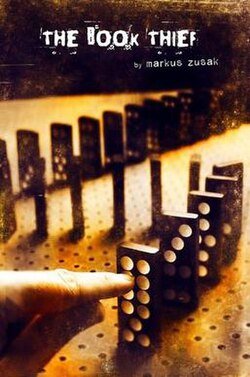
Why Read The Book Thief?
The Book Thief accomplishes something that should be impossible: it tells a story set in Nazi Germany, narrated by Death, about characters the reader knows will mostly not survive — and makes it one of the most life-affirming novels of the past two decades. Markus Zusak’s achievement is not optimism in the face of horror; it is something more demanding. He argues, with extraordinary formal precision, that words and stories are not an escape from the world’s violence but the only instrument capable of measuring its full cost — and occasionally, of surviving it.
Set in the fictional Munich suburb of Molching from 1939 to 1943, the novel follows Liesel Meminger, a nine-year-old girl sent to live with Hans and Rosa Hubermann after her mother surrenders her children to foster placement. Her younger brother dies on the train journey. At his graveside, Liesel steals her first book — The Gravedigger’s Handbook — though she cannot yet read. Hans Hubermann teaches her. And in learning to read, in stealing books from the Nazi mayor’s wife’s library, in writing her own story in a basement during air raids, Liesel discovers that language is not merely a tool for communication but the medium through which human experience becomes coherent, transmissible, and in some sense permanent.
Zusak’s formal invention — Death as narrator — is the novel’s most distinctive structural decision, and it is not merely decorative. Death narrates with a weary, precise compassion that is neither nihilistic nor sentimental. Death notices colour obsessively — the colour of the sky at the moment each person dies — which transforms what might be clinical detachment into a form of mourning. The novel’s narrator is the one entity in the universe that cannot look away from human suffering, which makes it the only appropriate voice for a story set in its time and place.
Who Should Read This
This novel works across a remarkably wide range of readers — it is taught in secondary schools and universities simultaneously. CAT and GRE candidates will find it invaluable for tone, narrative voice, and the analysis of structural experimentation — Death’s narration is precisely the kind of sophisticated narrative technique that high-level RC questions probe. Beyond exam preparation, it is essential for anyone studying World War II literature, the ethics of storytelling under atrocity, or the relationship between language and survival.
Key Takeaways from The Book Thief
Words are the most dangerous and most redemptive technology humans have ever developed. Liesel’s book-stealing is an act of resistance so quiet it goes unnoticed and so profound it outlasts everything else. The same instrument that enables genocide also enables the preservation of what genocide tries to destroy.
Death notices colour — and that noticing is the novel’s argument about the relationship between attention and compassion. To perceive the colour of the sky at the moment a person dies is to insist that each individual death is a specific event in a specific world, not a statistic.
Ordinary decency in extraordinary circumstances is not heroism — it is the basic human minimum, and it is rarer than we pretend. The novel locates its greatest moral courage not in dramatic self-sacrifice but in the quiet, daily maintenance of ordinary human decency in a world that has declared decency optional.
Telling your own story is an act of self-creation, not merely self-expression. By narrating her own experience, Liesel becomes the author of her own life in a context where every external force is working to make her a passive object of history rather than an active subject within it.
The Book Thief Plot Summary
The novel opens with Death announcing that it will tell us a story about a girl — Liesel Meminger — and warning us that it has seen her three times. The first is on a train in January 1939, when her younger brother Werner dies of cold and illness and is buried by the tracks. At the graveside, Liesel picks up a book dropped by one of the gravediggers: The Gravedigger’s Handbook. She cannot read it. She takes it anyway. It is the first of the books she will steal.
Liesel arrives at 33 Himmel Street in Molching to live with Hans and Rosa Hubermann. Hans is a gentle, silver-eyed accordion player who fought in the First World War and feels a specific debt to a Jewish man named Erik Vandenburg who saved his life. Rosa is loud, foul-mouthed, and loving in a manner she would not recognise as loving. Hans discovers that Liesel cannot read and begins teaching her in the basement at night, using The Gravedigger’s Handbook as their text. The basement — cold, painted with words, the space where language and Liesel grow together — becomes the novel’s most charged setting.
Liesel’s world on Himmel Street expands. Rudy Steiner, the boy next door — who covers himself in charcoal to run a race as Jesse Owens — becomes her best friend and a figure of such specific, ungainly tenderness that his fate, foreshadowed by Death early in the novel, becomes one of the most dreaded certainties in contemporary fiction. When the laundry job ends and Ilsa Hermann’s library window is left open, Liesel begins stealing books from the mayor’s wife’s collection.
The novel’s central moral drama begins when Hans Hubermann’s debt to Erik Vandenburg is called in. Erik’s son, Max, arrives at 33 Himmel Street — Jewish, in danger, carrying a copy of Mein Kampf as camouflage. Hans hides him in the basement. Max and Liesel develop one of the novel’s most extraordinary relationships — two people connected by the books they have both been shaped by, in opposite directions. Max makes Liesel two handmade books painted over the pages of Mein Kampf, their words constituting an alternative mythology and a direct answer to what the Nazi regime has done with language.
The war closes in. Hans makes a catastrophic act of ordinary decency — offering bread to a column of Jewish prisoners being marched through Molching — and is conscripted as partial punishment. Max is forced to leave. Air raids become routine. In the novel’s final sequence, an air raid hits Himmel Street while Liesel is in the basement writing her book. Everyone she loves on that street — Rudy, Hans, Rosa — is killed. She is pulled from the rubble holding her manuscript. She has lost everything. Her book survives.
Death closes the novel in the present, returning Liesel’s book to her after her death as an old woman in Sydney, Australia — telling us she lived a full life, had a family, and never forgot any of them. The final image is Death with the book, confessing what it cannot say to anyone: that it is haunted by humans.
The Book Thief Characters
Each character is rendered with granular specificity — small lives that accumulate into the novel’s full emotional weight.
Fierce, loyal, and physically courageous in a way that is never romanticised. She arrives barely literate and leaves as someone who has understood that language is both the wound and the suture. Her book is the novel’s proof of everything Zusak wants to argue.
The novel’s portrait of ordinary decency — a man who keeps his promises, and in a world where promise-keeping has become quietly revolutionary, that is everything. He teaches Liesel to read, hides Max, and gives bread to a prisoner. Each act is small. Together they constitute a life.
The novel’s comic-tender surprise — a woman whose vocabulary of affection consists largely of insults, who loves with a ferocity she would never name as love. When Hans is conscripted and Rosa begins sleeping with his accordion, the image requires no commentary.
Liesel’s intellectual companion — the character who understands, as she does, that words are the primary arena in which this war is being fought. His handmade books painted over Mein Kampf are acts of creative resistance that constitute the most direct possible answer to what the Nazi regime has done with language.
The novel’s most deliberately heartbreaking creation — so vivid and specifically himself that Death’s early foreshadowing of his fate becomes one of the novel’s most unbearable structural choices. He asks for a kiss she never gives him, and dies in an air raid at fourteen.
Neither evil nor indifferent but exhausted and compassionate in a way it can barely articulate. Its fixation on colour, its direct addresses to the reader, its habit of revealing outcomes before they occur — all arguments that attention is a form of mourning and the only appropriate narrator for the twentieth century’s violence is the one entity that witnessed all of it without rest.
Major Themes
Zusak’s themes are delivered through structure as much as content — the form of the novel enacts its argument about what narrative does.
Language is not neutral — it is the primary arena in which the struggle between dehumanisation and humanisation is conducted. Nazi Germany is a regime built on words: on the reduction of Jewish people to categories and the burning of books that contain alternative ways of seeing. Against this, Liesel’s book-stealing and Max’s word-painting are acts of linguistic resistance — using the same instrument the regime has weaponised to preserve what it is trying to destroy.
Death’s narration is Zusak’s formal argument against the abstraction of mass casualty. The novel insists on the specificity of each death — its colour, its location, the particular person it collects. The Holocaust killed tens of millions; the temptation of that scale is abstraction. This novel refuses abstraction, insisting that every death on Himmel Street belongs to a specific person in a specific moment in a specific coloured sky.
Hans Hubermann’s moral choices are not heroic in any dramatic sense — they are simply what a person of basic decency does when confronted with specific situations. The novel argues that this is enough, and more than enough, in a world where it has become genuinely rare. It does not ask for extraordinary courage; it asks for the maintenance of ordinary human obligation when that maintenance has become dangerous.
Liesel’s book — written in the basement during air raids, found in the rubble by Death, carried across decades — is the novel’s image of what storytelling does in extremity. It does not save Liesel from loss. What it does is make the loss coherent, transmissible, and in some sense permanent: it converts experience into language, language into form, form into something that can be held and carried and given to others.
Critical Analysis
A balanced assessment examining both the novel’s formal achievements and its genuine limitations.
The decision to use Death as narrator is not a gimmick — it is the novel’s most sophisticated formal choice. Its compassion, its exhaustion, and its fixation on colour constitute an entire philosophy of attention and mourning impossible to replicate in any human first-person voice.
Death’s habit of announcing deaths before they occur is not a spoiler but a structural argument: that knowing an outcome in advance changes how we attend to what precedes it. The foreknowledge intensifies rather than diminishes the emotional impact of each scene — counterintuitive and correct.
Zusak renders Himmel Street — its smells, its neighbours, its specific poverty and warmth — with such granular precision that its destruction in the air raid feels not like a narrative event but like an actual loss. The novel earns its devastation through hundreds of pages of accumulated specific life.
At 552 pages, the novel is longer than its narrative demands, and there are sections — particularly in the middle third — where the pace slackens and the accumulation of detail tips from specific into exhaustive.
The narration is not always consistent — at times philosophically dense and tonally precise, at others it tips into whimsy or over-explanation. The direct addresses to the reader occasionally feel didactic in ways that undercut the subtlety of the novel’s underlying arguments.
The novel operates very close to the border of sentimentality — Rudy’s ungiven kiss, Hans’s silver eyes, Rosa’s secret tenderness — and the accusation is not entirely unfair. The novel’s emotional generosity occasionally tips from earned feeling into arranged feeling.
Literary & Cultural Impact
From Young Adult Label to Literary Canon: The Book Thief was published in Australia in 2005 and initially marketed as a young adult novel — a categorisation that both describes and undersells it. It became an international bestseller and has since sold over sixteen million copies in more than forty languages. It spent more than a decade on the New York Times bestseller list and has been cited by educators as one of the most effective literary introductions to the Holocaust for younger readers.
Crossing Generations: Adult literary critics initially gave it less attention than its formal ambition warranted. That engagement came eventually, as the novel’s readership proved to be genuinely cross-generational. University courses on World War II literature, Holocaust studies, and narrative theory began teaching it alongside Night, Maus, and Sophie’s Choice as a significant contribution to the literature of atrocity.
The 2013 Film Adaptation: A film directed by Brian Percival, with Geoffrey Rush and Emily Watson as the Hubermanns and the voice of Roger Allam as Death, was received respectfully but was generally agreed to have lost the novel’s most distinctive formal quality — the narrative voice that is also its philosophical argument. The disparity is itself a commentary on what the novel argues: that some things only language can do.
Zusak’s Broader Significance: He took a subject — the Holocaust — in which the moral and emotional coordinates are well established and found an approach genuinely new: a narrator who is neither victim nor perpetrator nor bystander, whose compassion is pre-ideological, whose attention constitutes a form of justice unavailable in courtrooms or history books. That Death is haunted by humans — the novel’s closing statement — is Zusak’s most precise and most moving inversion: it is not humans who should be terrified of Death, but Death that cannot escape the terror and beauty of what humans do to each other and for each other in the brief interval they occupy.
Love This Book? Master Every Book.
Stop struggling with reading comprehension. Our proven system transforms how you read—whether for CAT, GRE, GMAT, SAT, or personal growth.
Best Quotes from The Book Thief
I am haunted by humans.
The only thing worse than a boy who hates you: a boy that loves you.
She was a girl with a mountain to climb. But so are we all, I’m afraid.
He was the crazy one who had painted himself black and defeated the world. She was the book thief without the words. Trust me, though, the words were on their way, and when they arrived, Liesel would hold them in her hands like the clouds, and she would wring them out like the rain.
Even death has a heart.

Test Your Understanding
Think you’ve mastered The Book Thief? Challenge yourself with 15 questions on themes, characters, and key takeaways. Score 80%+ to prove your mastery.
The Book Thief FAQ
What is The Book Thief about?
It follows Liesel Meminger, a nine-year-old girl living with foster parents in Nazi Germany from 1939 to 1943, who learns to read and develops a compulsive relationship with books — stealing them from a bonfire, from the mayor’s wife’s library, and eventually writing her own. It is narrated by Death, which gives it a distinctive double register: an intimate story of one girl’s life on one street, embedded in the full weight of everything Death is witnessing simultaneously across the war.
Is The Book Thief useful for competitive exam preparation like CAT or GRE?
Very much so. The novel’s most significant contribution to RC preparation is its formal sophistication: Death’s narration — including its direct addresses to the reader, its foreshadowing, and its shifts between intimate and panoramic perspective — is precisely the kind of complex narrative voice that high-level RC questions probe. Questions about narrative distance, the relationship between narrator and story, and the function of structural choices are all richly available in this text.
What are the main themes in The Book Thief?
The central themes are the power and danger of words as both instruments of dehumanisation and tools of resistance, the refusal of abstraction in the face of mass death, ordinary decency as the only available form of heroism in extreme circumstances, and storytelling as both survival mechanism and act of legacy. These themes are delivered through structure as much as through content — the form of the novel enacts its argument about what narrative does.
Why is Death the narrator, and what does that choice mean?
Death is the only entity capable of narrating both the granular specificity of life on Himmel Street and the full scope of the war’s devastation simultaneously. Its compassion — genuine, exhausted, and expressed through its fixation on the colour of the sky at each death — constitutes a form of mourning unavailable to any human narrator. The choice argues that attention is itself a moral act, and that the refusal to abstract human death into statistics requires a perspective that has witnessed every individual death without the protection of ideology or distance.
Why does The Book Thief matter in the context of Holocaust literature?
Most Holocaust literature is narrated from positions of victimhood, witness, or perpetration — each of which carries its own moral and perspectival constraints. Death as narrator occupies none of these positions: it is outside ideology, outside grief, outside guilt, and therefore capable of a form of attention that is purely compassionate without being partisan. This makes The Book Thief formally unique in Holocaust literature and allows it to make arguments about language, attention, and ordinary decency that would be harder to make from inside any human position.








