
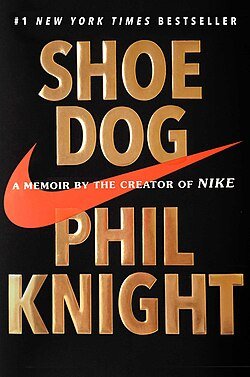
Why Read Shoe Dog?
Shoe Dog is the rarest kind of business memoir: one written by a founder who has nothing left to prove and therefore nothing left to hide. Phil Knight did not write a victory lap. He wrote a confession — of fear, of near-failure, of decisions made on instinct and desperation rather than strategy, of a company that nearly went bankrupt a dozen times before it became one of the most recognised brands in human history. The result is the most honest account of what building a business actually feels like that has ever been written at this level of commercial success.
The memoir covers the years 1962 to 1980 — from Knight’s post-Stanford trip to Japan, where he cold-called the Onitsuka Tiger shoe company on an invented business premise, to Nike’s initial public offering. These are not the triumphant years of Nike’s cultural dominance. They are the years of chronic cash shortage, of borrowing from every available source to fund the next shoe order, of near-bankruptcy from a customs dispute with the US government, of a near-hostile supplier relationship that eventually forced Knight to build his own brand. The business story is genuinely suspenseful — Knight structures it so the reader feels the precariousness of each year’s survival even knowing, of course, that Nike exists.
What distinguishes Shoe Dog from the genre of founder memoirs is Knight’s refusal of the retrospective wisdom that usually makes such books unreadable. He does not translate past confusion into present clarity. He renders 1968 from inside 1968 — the anxiety, the improvisation, the relationships that held the company together when the finances could not. The book’s emotional core is not the business but the people: the band of misfits Knight calls his first employees, each rendered with the specificity of a novelist who has been paying attention for fifty years.
Who Should Read This
This book is essential reading for anyone building, considering building, or studying the building of a business — particularly in an Indian entrepreneurial context where resource constraints, supplier dependencies, and the gap between vision and capital are daily realities. CAT and MBA candidates will find it invaluable for understanding what business school teaches in theory from inside the actual experience. Beyond exam preparation, it is the book most likely to give founders, early-stage entrepreneurs, and anyone navigating uncertainty an honest companion rather than a false map.
Key Takeaways from Shoe Dog
The idea is not the hard part — the cash flow is. Nike nearly died not from bad products or bad strategy but from chronic undercapitalisation. Knight was perpetually borrowing to fund the next inventory order, living one bad month away from default. The most dangerous period of any business is not its infancy but its growth — when demand outpaces the capital available to meet it, and every success creates the next crisis.
The people who join before there is anything to join are the company’s real foundation. Knight’s first hires were not recruited by salary or status — they were recruited by the idea, and they stayed through conditions that would have driven conventionally ambitious people away. A company’s earliest culture is not designed; it is attracted — and what it attracts depends entirely on what the founder genuinely is, not what he presents himself as being.
Brand is not marketing — it is belief. The Nike Swoosh, designed by a graphic arts student for thirty-five dollars, became one of the most recognisable symbols in the world not because of advertising spend but because of the athletes who wore it and meant it. Knight understood instinctively that authenticity in sport cannot be faked — that endorsement works only when the athlete’s relationship with the shoe is real.
Debt is not failure — but the relationship with debt reveals everything about a founder’s risk tolerance and self-knowledge. Knight borrowed continuously, from banks, from his father, from Japanese trading companies. He was not reckless — he was calibrated, borrowing against inventory he was certain would sell. The difference between fatal debt and productive debt is not the amount — it is the quality of the judgment behind it.
Key Ideas in Shoe Dog
Shoe Dog is structured as a linear memoir — each chapter covers a year, from 1962 to 1980 — but its intellectual content accumulates around several ideas that Knight never states as principles but enacts as narrative. The book’s central insight, present on every page without ever being announced, is that building a company of Nike’s eventual scale required Knight to be wrong constantly and to continue anyway — to revise without retreating, to absorb setbacks without reinterpreting them as signals to stop.
The book’s first major idea concerns the relationship between vision and proof. Knight’s initial “Crazy Idea” — that high-quality Japanese athletic shoes could disrupt the American market dominated by Adidas and Puma — was not backed by market research or capital. It was backed by his experience as a runner, his time in Japan, and an instinct about where athletic performance culture was heading. He presented this idea to Onitsuka Tiger in Kobe with invented business cards and a fabricated company name. The Japanese executives, impressed by his confidence and specificity, gave him a distribution deal. Knight’s lesson is not that you should fake it — it is that vision, presented with conviction and specific knowledge, is itself a form of credential.
The book’s second major idea concerns the specific texture of near-failure. Nike was not a company that grew smoothly to success. It was a company that survived, year after year, by finding one more source of capital, one more month of runway, one more relationship that could be leveraged into another order. The customs dispute with the US government — in which the government claimed Nike owed $25 million in unpaid duties, an amount that would have bankrupted the company — is the book’s most dramatic near-death experience. Knight renders these crises without the retrospective calm of someone who always knew it would work out. He renders them as they felt: like the possible end.
The memoir’s third central idea is about the relationship between competition and identity. Knight is a competitive man — he acknowledges this without vanity — and Nike’s early years were driven by a competitive fury directed first at Adidas, then at Onitsuka Tiger when that relationship soured. But Knight is careful to distinguish between competition as motivation and competition as strategy. Nike’s actual advantage was never that it out-competed — it was that it understood its customer, the serious runner, with a depth its competitors did not have, because Knight and his team were that customer.
Key Figures in Shoe Dog
Nike was never a solo endeavour. The people who joined Knight before there was anything conventional to join shaped the company’s character as fundamentally as its founder did.
Knight’s track coach at the University of Oregon and Nike’s co-founder. He took apart shoes the way other men took apart engines, poured rubber into a waffle iron to invent the waffle sole, and believed with absolute conviction that better shoes made better runners. His design philosophy — that the shoe must serve the athlete, not the other way around — became Nike’s founding principle.
Nike’s first full-time hire in 1965, Johnson built the retail presence almost entirely through personal relationships with runners. He also named the company: Knight had been about to go with “Dimension Six” when Johnson woke from a dream with the word Nike — the Greek goddess of victory. His constant, philosophical letters to Knight are the book’s most entertaining thread.
Married Knight in 1968 during the company’s most financially precarious period. She is the book’s most honestly rendered domestic figure — a woman who married a man more devoted to his company than to almost anything else, portrayed with a combination of admiration and guilt that Knight makes no attempt to resolve. The memoir’s emotional honesty about the cost of founder-level obsession on personal relationships is concentrated in her portrayal.
The Japanese trading companies that provided the financing that kept Nike alive through its chronic cash-shortage years. When American banks would not extend credit to support Nike’s growth, Knight turned to the Japanese trading company model — which took a percentage of sales in exchange for financing inventory. This relationship gave Nike the capital runway it needed to survive its critical growth years, and is the book’s most important and least-discussed business lesson.
The Japanese shoe manufacturer whose shoes Knight initially distributed in America under the Blue Ribbon Sports name. The relationship eventually soured when Onitsuka tried to buy out or replace Blue Ribbon Sports — the book’s central business conflict and the catalyst for Nike’s creation as an independent brand. The breakdown of that relationship, which Knight feared would end the company, instead forced the creation of something better.
Nike’s head of marketing in the mid-to-late 1970s and one of the key figures in building the brand’s identity. Strasser represents the transition from survival mode to brand building — the shift from “how do we survive this year” to “what do we stand for.” His marketing instincts, combined with Knight’s product convictions and Bowerman’s design philosophy, produced the brand voice that eventually made Nike culturally dominant.
Core Arguments
Knight makes his arguments through narrative rather than instruction — but four distinct theses run beneath Shoe Dog’s surface, each challenging a comfortable assumption about what building a great company requires.
Knight’s central argument — made through narrative rather than instruction — is that the “Crazy Idea” stage of a business is not a liability to be apologised for but a source of energy that conventional business thinking cannot replicate. The irrationality of early Nike — the borrowed money, the improvised operations, the products made by a coach pouring rubber into a waffle iron — was not a weakness. It was the company’s competitive advantage against larger, more rational, more capitalised competitors who could not move with the same obsessive speed.
Knight never uses the word “strategy” approvingly. What Nike had in its early years was not a strategy — it was a survival instinct, expressed through a series of improvisations that happened to be correct because they were grounded in deep product and customer knowledge. His implicit argument is that for a company in its growth phase, survival is the only strategy that matters — that the objective is to stay alive long enough for the product and the market to find each other, and that elaborate strategic frameworks are most useful to those who can afford to fail.
Bowerman’s design philosophy — that the shoe must serve the athlete, not the other way around — is also Knight’s business philosophy. Nike’s competitive advantage was never distribution, or marketing spend, or manufacturing efficiency. It was that Knight and Bowerman were athletes who understood athletes. Their customer was themselves, and the specificity of that self-knowledge produced products that the running community recognised as different in kind, not just degree. This is Knight’s argument about the importance of founder-customer identity alignment.
The memoir’s most uncomfortable argument is its least explicit: that Knight’s devotion to Nike cost his family in ways he did not fully understand at the time and does not fully resolve in retrospect. His son Matthew drowned in a diving accident in 2004 — a loss Knight describes with a restraint that makes it more devastating than elaboration would. The book does not moralise about the relationship between professional obsession and personal cost, but it does not hide it. Knight presents the trade-offs without advocating for them, which is the memoir’s most honest and most adult quality.
Critical Analysis
A balanced assessment examining the memoir’s remarkable narrative honesty and character rendering alongside its structural gaps and the limits of its self-examination.
Knight writes about failure, fear, and near-bankruptcy with a specificity that is vanishingly rare in founder memoirs. He does not translate past confusion into retrospective wisdom. He renders the 1970s from inside the 1970s, which gives the book an emotional authenticity that makes it genuinely useful rather than merely inspiring.
The portraits of Knight’s early employees — Bowerman, Johnson, Woodell, Strasser — are the work of someone who has been paying close attention to people for decades. Each figure is specific, contradictory, and fully human, transforming what could be a hagiography into something closer to a novel about a company’s early life.
Knight structures the memoir so that each year feels genuinely precarious — the reader knows Nike survives but not how, and the annual near-death experiences are rendered with enough specificity that the suspense is real. This is a difficult narrative trick to pull off across nearly four hundred pages, and Knight manages it.
The memoir ends at Nike’s IPO in 1980 — before the Air Jordan era, before the “Just Do It” campaign, before Nike became the cultural phenomenon most readers associate with the brand. This is Knight’s deliberate choice, but it means the book tells only the survival story and not the dominance story, leaving readers wanting a second volume that does not exist.
The women in Knight’s life — Penny most significantly, but also female employees — are rendered with considerably less interiority than the male figures. Penny is portrayed with evident love and evident guilt, but she remains a supporting character in a story that clearly cost her significantly. The memoir’s male-centricity is characteristic of its era and its industry but is a genuine limitation of its human portrait.
Knight is honest about his financial improvisations, his personal failings, and his fear. He is less honest about Nike’s labour practices in overseas manufacturing — the sweatshop controversies of the 1990s are entirely outside the book’s time frame, but their seeds are visible in the supply chain Knight builds, and the memoir does not examine them. The book’s honesty has limits that tend to coincide with where the story becomes less flattering.
Literary & Cultural Impact
Immediate Critical and Commercial Success: Shoe Dog was published in April 2016 and immediately became one of the most praised business memoirs in recent memory. Warren Buffett called it one of the best business books he had encountered. It debuted at number one on the New York Times bestseller list, sold over three million copies in its first year, and was translated into dozens of languages. Bill Gates listed it among his favourite books of 2016. For a memoir about events that ended in 1980, published by a man in his late seventies, its cultural impact was remarkable.
Redefining the Business Memoir: The book’s reception revealed something about what the business memoir genre had been missing. Most such books are written by consultants or ghostwriters and shaped to inspire and instruct rather than to be true. Shoe Dog was demonstrably written by Knight himself — the voice is too idiosyncratic, the self-criticism too specific, the literary references too personal to be ghostwritten — and its willingness to dwell in failure and confusion rather than rush to insight gave it a credibility that the genre had been largely without.
For Business Education: For educators, the book became an instant teaching resource — not because it contains clear frameworks or actionable advice, but because it contains something more valuable: an honest phenomenology of what early-stage company building actually feels like from inside the founder’s experience. The anxiety, the improvisation, the relationship between vision and desperation, the quality of decisions made without adequate information under time pressure — these cannot be taught from a case study but can be transmitted through a memoir honest enough to render them without retrospective distortion.
Resonance in the Indian Entrepreneurial Context: Knight’s chronic undercapitalisation, his dependence on relationships rather than systems, his navigation of supplier power dynamics, and his construction of a brand from limited marketing resources against established competitors are conditions that Indian founders encounter routinely. The Nike story is not an American story in any parochial sense — it is a story about building something from nothing with inadequate resources and surplus conviction, which is a universal entrepreneurial condition.
Love This Book? Master Every Book.
Stop struggling with reading comprehension. Our proven system transforms how you read—whether for CAT, GRE, GMAT, SAT, or personal growth.
Best Quotes from Shoe Dog
The cowards never started and the weak died along the way. That leaves us, ladies and gentlemen. Us.
Don’t tell people how to do things, tell them what to do and let them surprise you with their results.
I’d tell men and women in their mid-twenties not to settle for a job or a profession or even a career. Seek a calling.
Fear of failure, I thought, will never be our downfall as a company. Not that any of us thought we wouldn’t fail; in fact we had every expectation that we would. But when we did fail, we had faith that we’d do it fast, learn from it, and be better for it.
Life is growth. You grow or you die.
Test Your Understanding
Think you’ve mastered Shoe Dog? Challenge yourself with 15 questions on Nike’s founding story, key figures, business lessons, and what Knight’s memoir reveals about building a company from nothing. Score 80%+ to prove your mastery.
Shoe Dog FAQ
What is Shoe Dog about?
It is Phil Knight’s memoir of the years 1962 to 1980 — from his post-Stanford trip to Japan, where he first conceived the idea of importing Japanese running shoes to America, to Nike’s initial public offering. It covers the founding of Blue Ribbon Sports, the relationship with Onitsuka Tiger, the creation of the Nike brand and the Swoosh, and the chronic near-bankruptcy that characterised every year of the company’s first decade and a half.
Is it useful for MBA and CAT preparation?
Highly so — but not in the way most business books are useful. It does not provide frameworks or principles. It provides something more valuable: an honest phenomenology of early-stage business building that case studies cannot replicate. For MBA interviews and essay questions about entrepreneurship, leadership under uncertainty, and the relationship between vision and execution, Shoe Dog is primary source material of unusual quality. Its prose style — a narrative that moves fluidly between financial crisis, personal reflection, and character study — also provides excellent practice for the reading comprehension demands of CAT and GRE business passages.
What are the main business lessons?
The central lessons are about the relationship between vision and capital in early-stage companies, the importance of product-founder alignment (Knight was his own customer), the specific danger of growth-phase cash flow crises, the construction of company culture through early hires rather than HR processes, and the relationship between competitive obsession and authentic brand building. None of these are stated as lessons — they are enacted as story, which makes them more durable than any list of principles.
Why does the memoir end in 1980, before Nike became famous?
Knight has said he wanted to write about the years that made him who he was — the years of struggle, uncertainty, and survival — rather than the years of success, which he found less interesting and less honest. The book ends at Nike’s IPO because that moment marks the transition from the company’s survival phase to its growth-and-dominance phase, and Knight had no interest in writing a story about winning. He was interested in writing a story about what winning required.
How does Shoe Dog differ from other business memoirs?
Most business memoirs are written from a position of retrospective clarity — the founder, now successful, explains the decisions that led to success in terms that make them appear more deliberate than they were. Shoe Dog is written from inside the uncertainty — Knight renders 1968 as it felt in 1968, not as it looks from 2016. This distinction is what gives the book its unusual emotional authority and makes it genuinely useful rather than merely inspirational.








