
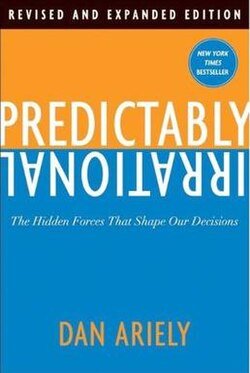
Why Read Predictably Irrational?
Predictably Irrational is the most engaging and most practically useful introduction to behavioral economics ever written for a general audience — a book that systematically dismantles the assumption that human beings make rational economic decisions and replaces it with a richly documented alternative: that our irrationality is not random but patterned, not occasional but consistent, and not beyond understanding but precisely mappable. Dan Ariely writes with the clarity, wit, and genuine curiosity of a scientist who finds human behavior endlessly surprising and endlessly important.
Published in 2008 — the year the global financial crisis revealed with devastating clarity that markets populated by supposedly rational agents could fail catastrophically — Predictably Irrational could not have arrived at a more receptive moment. Ariely’s central thesis is simple and devastating: standard economic theory assumes that humans make decisions by rationally calculating costs and benefits and choosing the option that maximizes their utility. This assumption is empirically false.
The book proceeds through a series of chapters, each devoted to a specific form of predictable irrationality: the relativity of value, the power of free, the cost of social norms versus market norms, the effect of arousal on decision-making, the power of expectations to shape experience, and the tendency to procrastinate. Each chapter follows the same elegant structure: Ariely presents a puzzle about human behavior, describes the experiment he designed to investigate it, presents the results, and draws out the implications. The experiments are models of scientific ingenuity — simple enough to be described in a paragraph, surprising enough to change how the reader understands their own behavior.
Who Should Read This
This is a book for anyone who makes decisions — which is everyone — and particularly for anyone who has wondered why they consistently make the same “irrational” choices despite knowing better. Essential for students of behavioral economics and psychology; CAT/GRE aspirants who need intermediate-level reading comprehension practice in scientific nonfiction; professionals in marketing, finance, policy, and medicine; and anyone curious about why they do what they do.
Key Takeaways from Predictably Irrational
We evaluate everything in relative rather than absolute terms — we don’t know what things are worth in themselves, only what they are worth compared to something else. Marketers, retailers, and politicians routinely exploit this tendency by carefully controlling the comparison sets they offer us, and understanding this is the first step toward making more deliberate choices.
“Free” is not just a very low price — it is a fundamentally different category that triggers irrational decision-making. When something is free, demand increases far beyond what a simple price reduction would predict, because zero cost removes the risk of a bad deal. The power of FREE leads us to make systematically bad choices, and it is one of the most reliably exploited levers in marketing and retail.
Social norms and market norms operate in entirely different psychological registers — and mixing them is destructive in both directions. Money activates market-norm thinking and suppresses social-norm thinking. Once market norms enter a relationship, social norms are difficult to restore — which has profound implications for how organizations compensate employees and how governments design public services.
We systematically underestimate the power of immediate emotion — particularly arousal and present-moment desire — to override our considered, “cold” preferences. This “empathy gap” explains a wide range of behavior from impulse purchases to unsafe sex to failed dietary resolutions, and we dramatically underestimate how much our hot-state preferences diverge from our cold-state preferences.
The Central Ideas of Predictably Irrational
The foundational idea of Predictably Irrational — and of behavioral economics more broadly — is that the standard economic model of the rational agent (homo economicus) is empirically false in specific, measurable, and consistent ways. People do not calculate the absolute value of options and choose the one that maximizes their utility; they evaluate options relationally, emotionally, and contextually, in ways that deviate from rationality in patterned and predictable directions. These deviations are not bugs in human cognition but features — the result of cognitive shortcuts (heuristics) and emotional responses that were adaptive in the evolutionary environments where they developed, but that systematically mislead us in the complex modern environments where we now make decisions.
The book’s first and most important principle is relativity: we know the value of things not in themselves but in relation to other things. When Ariely shows people two options — one clearly inferior (a decoy) to a third option, one roughly equivalent — they reliably choose the option to which the decoy is clearly inferior. The decoy does not add information about the value of the options; it changes the comparison set and thereby changes behavior. This “decoy effect” is one of the most consistently exploited phenomena in marketing, pricing strategy, and political communication, and understanding it is the prerequisite for more deliberate choice.
The distinction between social norms and market norms is one of the book’s most practically important contributions. Human beings operate under two different psychological systems that govern exchange: the social-norm system (relationships, favors, gifts, reciprocity, long-term goodwill) and the market-norm system (prices, wages, fair exchange, contractual obligation). These systems are not compatible — introducing market norms into a social-norm relationship changes it in ways that are difficult to reverse, and the relationship loses the goodwill, flexibility, and mutual commitment that characterize social-norm exchanges.
The chapters on procrastination and self-control identify one of the most practically consequential forms of predictable irrationality: our tendency to prefer immediate rewards over future rewards at rates that are inconsistent with our long-term preferences. Ariely’s research on commitment devices — tools that allow us to pre-commit to our long-term preferences before the moment of temptation arrives — is among the most directly actionable material in the book.
Core Frameworks from Predictably Irrational
Ariely presents six interconnected frameworks, each grounded in experimental evidence, that together map the landscape of human irrationality.
Our first exposure to a price — even an arbitrary one — acts as an “anchor” that influences all subsequent valuations of similar items. Prices are not discovered by rational calculation but shaped by the context of their first presentation. Marketers exploit this by establishing high initial prices before offering discounts that appear substantial relative to the anchor regardless of actual value.
When a product’s price drops to zero, demand increases far beyond what a simple price reduction would predict. The free option eliminates the risk of a bad deal — you can’t overpay for something that costs nothing — which triggers a disproportionate preference that overrides rational value calculation. This is one of the most reliably exploited levers in marketing and retail.
Social norms govern relationships of goodwill and reciprocity; market norms govern fair exchange and contractual obligation. The AARP experiment illustrates the asymmetry: lawyers who refused to help at $30/hour agreed to help for free, because the free option activates social norms while the paid option activates market norms. Once market norms are introduced into a social-norm relationship, they are difficult to remove.
People in “hot” states (emotional arousal, desire, temptation) make choices that diverge substantially from their “cold” state preferences — and they dramatically underestimate how much this divergence will occur. This gap explains a wide range of self-defeating behavior from dietary failures to financial decisions made under market stress to safety commitments overridden in moments of arousal.
People who pay more for a painkiller report greater pain relief than those who pay less for the same drug — not because they are lying but because the expectation of quality actually changes the physiological experience. This expectation effect operates across domains from wine tasting to athletic performance to medical treatment, demonstrating how thoroughly our expectations shape our perceptions.
We consistently prefer immediate rewards over future rewards at rates inconsistent with our long-term preferences. The solution Ariely identifies is the “commitment device” — a tool that allows us to bind our future selves to calm, considered preferences before the hot state arrives. When students are allowed to set their own binding deadlines for assignments, they perform significantly better than when given a single final deadline.
Key Arguments
Ariely builds four interlocking arguments that together challenge the standard economic model of human decision-making and offer a more empirically grounded alternative.
Standard economic theory rests on the assumption that human beings are rational agents who maximize their own utility by calculating costs and benefits and making optimal choices. Ariely’s central argument is that this assumption is not merely an idealization but an empirically false model that leads to systematically wrong predictions and systematically bad policy. If people are predictably irrational — if their choices are shaped by anchors, by social norms, by hot-state emotions, by the power of free — then policies designed on the assumption of rational agency will fail in predictable ways. The financial crisis of 2008 is the most dramatic contemporary evidence for this argument.
The book’s most optimistic and most practically important argument is that our irrationality, while systematic, is predictable — and that what is predictable can be prepared for, designed around, and in some cases corrected. The goal is not to eliminate irrationality (which is impossible — these cognitive patterns are deeply wired) but to understand it well enough to make better decisions despite it. Commitment devices, choice architecture, and the deliberate management of anchors and comparison sets are all tools that allow us to align our moment-to-moment choices with our long-term preferences.
Perhaps the most consistently surprising finding across Ariely’s experiments is that the perceived value of things is not intrinsic but contextual — it depends on what they are being compared to, what price they were first presented at, what category they belong to, and what social norms are operative. This means the same product, service, or experience can be worth radically different amounts depending entirely on how it is framed, compared, and contextualized. For consumers, this is a warning; for marketers, designers, and policymakers, it is an opportunity.
One of the book’s most sobering conclusions is that our irrationality is not only systematic but largely invisible to us — we do not know, in most cases, that we are being influenced by anchors, by the power of free, by social norms, or by hot-state emotions. We believe we are making rational choices based on the intrinsic value of options, when in fact our choices are being determined by contextual factors we are not aware of. The solution is not to distrust all our choices but to develop the kind of structural understanding of our irrationality that allows us to design better choice environments.
Critical Analysis
A balanced assessment examining the genuine achievements of Ariely’s behavioral economics classic alongside its limitations — including important caveats about the book’s author and the replication crisis.
Ariely’s experiments are models of behavioral science methodology — simple, elegant, and designed to isolate specific cognitive mechanisms with minimum confound. His ability to translate rigorous experimental findings into vivid, accessible narratives is the book’s defining intellectual achievement and what distinguishes it from more technically demanding treatments of the same material.
Unlike more theoretical treatments of behavioral economics, Predictably Irrational consistently connects its findings to practical implications for individual decision-making, organizational design, public policy, and marketing. The reader finishes each chapter with a clearer understanding both of how their irrationality works and of what they might do about it.
Ariely brings his own history — he was severely burned as a teenager in an explosion and spent three years in a hospital, during which he began thinking about the irrationalities of medical treatment — to the text in ways that give the science personal stakes and make the writing genuinely warm.
Several of the experiments described in Predictably Irrational have faced scrutiny in the wake of the broader psychology replication crisis. Readers should be aware that specific effect sizes and the universality of some findings have been questioned since the book’s 2008 publication, even where the general direction of the effects remains supported.
Ariely has faced serious allegations of data fabrication in his academic research, with several papers retracted following investigations into their underlying data. While these allegations concern research published separately from this book, they are relevant context for evaluating its experimental claims. The core ideas remain valuable and are supported by research from multiple independent investigators, but critical caution is warranted.
The book is significantly more successful at diagnosing predictable irrationality than at prescribing effective solutions. The chapters on commitment devices and choice architecture gesture toward actionable tools, but the practical guidance is thinner than the diagnostic content, and the book’s optimism about the manageability of irrationality is somewhat undercut by the depth and consistency of the irrationalities it documents.
Cultural & Intellectual Impact
Perfect Timing: Predictably Irrational was published in February 2008 — weeks before the Bear Stearns collapse that presaged the global financial crisis — and its timing gave it a cultural resonance that few popular science books achieve. As the crisis unfolded and it became impossible to pretend that markets populated by rational agents had behaved rationally, Ariely’s book provided a framework for understanding what had happened that was simultaneously scientifically grounded and accessible to a general audience. It became a major bestseller, spent months on the New York Times bestseller list, and has sold over a million copies worldwide.
The Behavioral Economics Wave: The book belongs to the wave of behavioral economics popularizations that transformed public understanding of decision-making in the 2000s and 2010s — a wave that includes Richard Thaler and Cass Sunstein’s Nudge (2008), Daniel Kahneman’s Thinking, Fast and Slow (2011), and Ariely’s own subsequent books. Together these works moved behavioral economics from an academic specialty into the mainstream of policy thinking, giving rise to “nudge units” in governments from the UK to the United States to Australia and transforming how public health interventions, retirement savings programs, and tax compliance systems are designed.
Business and Policy Applications: The book’s frameworks — particularly the relativity of value, the power of free, and the social norm/market norm distinction — have been widely adopted in marketing, pricing strategy, product design, and organizational behavior. The concept of “choice architecture” — designing the context in which choices are made in ways that steer people toward better decisions without restricting their freedom — is now a standard tool in both corporate strategy and public policy.
For Competitive Exam Preparation: Predictably Irrational is excellent intermediate-level reading comprehension practice in scientific nonfiction. Its structure — experiment description, results, implications — mirrors the structure of science passages that appear consistently in CAT and GRE examinations, and its habit of drawing general conclusions from specific experimental findings is precisely the inferential skill those passages test.
Love This Book? Master Every Book.
Stop struggling with reading comprehension. Our proven system transforms how you read—whether for CAT, GRE, GMAT, SAT, or personal growth.
Best Quotes from Predictably Irrational
Humans rarely choose things in absolute terms. We don’t have an internal value meter that tells us how much things are worth. Rather, we focus on the relative advantage of one thing over another, and estimate value accordingly.
The concept of FREE! gives us such an emotional charge that we perceive what is being offered as immensely more valuable than it really is.
When we forget that there is a human being on the other side of the table, business stops working and trust evaporates.
We are pawns in a game whose forces we largely fail to comprehend. We usually think that we are in the driver’s seat, with ultimate control over the decisions we make and the direction our life takes; but, alas, this perception has more to do with our desires — with how we want to view ourselves — than with reality.
The more we have, the more we want. And the only cure is to break the cycle of relativity.

Test Your Understanding
Think you’ve mastered Predictably Irrational? Challenge yourself with 15 questions on anchoring, the power of free, social vs market norms, and Ariely’s key frameworks. Score 80%+ to prove your mastery.
Predictably Irrational FAQ
What is Predictably Irrational about?
Predictably Irrational is a behavioral economics book that systematically documents the ways in which human decision-making deviates from the rational-agent model assumed by standard economic theory. Dan Ariely presents a series of elegant experiments — on the relativity of value, the power of free, the contrast between social and market norms, the effect of arousal on decision-making, the influence of expectations on experience, and the problem of procrastination — to show that human irrationality is not random but patterned, not occasional but consistent, and not beyond understanding but precisely mappable.
What is “anchoring” and why does it matter?
Anchoring is the cognitive tendency to rely heavily on the first piece of information we encounter when making subsequent evaluations. In Ariely’s experiments, exposing people to a random number before asking them to bid on items significantly influences how much they bid — even though the random number has no logical relationship to the item’s value. In practice, this means that the first price you see for a product, the first salary offer in a negotiation, or the first estimate of a project’s cost acts as an anchor that shapes all subsequent thinking about what a “reasonable” value is — regardless of whether the anchor is appropriate.
What is the difference between social norms and market norms?
Social norms govern exchanges in relationships characterized by goodwill, reciprocity, and non-transactional giving. Market norms govern exchanges characterized by prices, wages, contractual obligation, and immediate fair exchange. The critical insight is that these two systems are psychologically incompatible: introducing market norms into a social-norm relationship damages the social relationship, while attempting to activate social norms in a market context without genuine reciprocal commitment produces resentment. The boundary between these systems is delicate and, once crossed, difficult to restore.
Should readers be concerned about the replication crisis and allegations against Ariely?
Yes — with appropriate proportion. The replication crisis in social psychology has raised legitimate questions about the effect sizes and generalizability of some findings in the book, and the allegations of data fabrication against Ariely (which concern research published separately, with at least one paper retracted) are relevant context. However, the core concepts — anchoring, the power of free, social vs market norms, the hot-cold empathy gap — are supported by research from multiple independent investigators. The right response is critical engagement rather than wholesale rejection: take the ideas seriously, understand their basis, and be appropriately skeptical of specific effect sizes and universal claims.
How does Predictably Irrational relate to Thinking, Fast and Slow?
Both books are central works in behavioral economics that document systematic deviations from rational decision-making. Thinking, Fast and Slow (Daniel Kahneman) is more comprehensive, more theoretically grounded, and more demanding — it provides the full conceptual architecture of System 1 and System 2 thinking and covers the complete range of cognitive biases. Predictably Irrational is more focused, more accessible, and more immediately practical — each chapter addresses a specific form of irrationality with a single elegant experiment and clear implications. The recommended reading sequence is Predictably Irrational first and Thinking, Fast and Slow second. Together they constitute the best popular introduction to behavioral economics available.








