

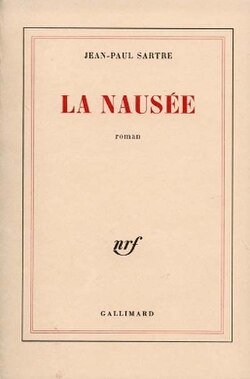
Why Read Nausea?
Nausea is the novel that existentialism needed before it could become a philosophy — the literary experience that makes the abstract arguments of Being and Nothingness physically felt rather than merely intellectually understood. Published in 1938, five years before the philosophical masterwork it anticipates, Nausea is simultaneously Sartre’s finest literary achievement and his most accessible philosophical document — a work in which the horror of contingent existence, the groundlessness of meaning, and the radical freedom of consciousness are not argued for but made viscerally present on the page. No philosophical novel in the 20th century has matched its combination of intellectual precision and physical immediacy.
Antoine Roquentin is a solitary historian living in the fictional French coastal town of Bouville, researching the life of an 18th-century diplomat. He keeps a diary — the novel is presented as his journal — in which he records a disturbing development: things have begun to feel wrong. Objects have started to lose their familiar, reassuring quality of simply being what they are — a door handle, a piece of paper, his own hand — and to reveal instead something unsettling beneath their surfaces: the sheer, naked fact of their existence, stripped of all the meanings and purposes with which human habit has clothed them.
This experience — the Nausea — intensifies steadily across the novel, reaching its crisis in a celebrated scene in a park where Roquentin stares at the root of a chestnut tree and experiences existence itself as a formless, excessive, unjustifiable mass — present without reason, contingent without necessity, absurd. What Sartre achieves through this structure is something no philosophical treatise could: the reader does not merely understand the contingency of existence but feels it, as Roquentin feels it — in the body, as nausea.
Who Should Read This
This is a book for readers who want existentialism from the inside — who want to feel what it means to suddenly perceive existence without the comfortable overlay of habit, purpose, and meaning. It is the ideal preparation for reading Being and Nothingness and the ideal companion to The Stranger. Essential for advanced students of French literature and existentialism; readers who have encountered Sartre’s philosophy and want its literary expression; CAT/GRE aspirants who need practice with the most psychologically intense philosophical fiction; and anyone drawn to novels that treat consciousness itself as their subject matter.
Key Takeaways from Nausea
Existence is contingent — it has no necessity, no reason, no justification. The Nausea is the experience of this contingency stripped of the habitual meanings that normally conceal it: the moment when the familiar becomes strange and objects reveal their bare existence beneath the layer of human purpose and naming. This is not a psychological disorder but a philosophical perception — the most honest relationship to existence the novel presents.
Art — specifically the jazz song “Some of These Days” — offers the only counter-model to contingent existence: the necessary, self-contained perfection of a created thing. The melody exists with an internal logic that brute existence lacks. Sartre uses this to set up the novel’s tentative resolution: Roquentin’s consideration of becoming a writer as a way of creating something beyond contingency.
Bad faith — the flight from the anxiety of existence into the comfortable fiction of fixed identity — is enacted throughout the novel by the citizens of Bouville. Their collective self-satisfaction is the social face of the philosophical evasion that Being and Nothingness would later name and anatomize. Roquentin’s Nausea is, among other things, the inability to share this evasion.
Writing — keeping the journal that constitutes the novel — is itself an attempt to impose necessity on contingent experience: to make something that happened into something that must have happened, by giving it the irreversibility and internal logic of narrative. Roquentin’s ambivalence about his journal anticipates Sartre’s later philosophy of the relationship between consciousness and the narratives it constructs about itself.
Nausea — Plot Summary
Nausea opens with a fictional editor’s note explaining that Roquentin’s journal has been found among his papers and is being published without alteration. From the first diary entry, the tone is one of careful, precise, slightly alarmed attention: Roquentin is noticing that something has changed, but cannot yet name what. Objects seem to have altered their relationship to him — a pebble on the beach, a door handle, a glass of beer — acquiring a quality of sheer, unmediated presence they did not previously possess.
As the diary progresses, the Nausea intensifies. Roquentin’s work on the Marquis de Rollebon — the historical biography that has been his project and his anchor — begins to feel hollow: the past does not yield itself to narrative reconstruction; Rollebon refuses to become a coherent character; history reveals itself as an imposition of meaning on a sequence of contingent events. Roquentin abandons the project with the quiet sense that he has recognized its fundamental dishonesty.
His social world is thin: there is the Self-Taught Man, whose humanist faith Roquentin finds simultaneously touching and philosophically untenable. There is Anny, his former lover, who has organized her entire life around “perfect moments” — and who reveals, when Roquentin travels to Paris to meet her, that she has abandoned this project entirely. Her abandonment mirrors his own, and their meeting confirms that there is no external framework — no relationship, no project, no aesthetic ideal — that can substitute for the philosophical reckoning the Nausea demands.
The novel’s philosophical climax occurs in the public garden, where Roquentin confronts the root of a chestnut tree with a perception that strips away every conventional layer of meaning to reach the sheer, formless, excessive fact of the thing’s existence. The novel closes tentatively — Roquentin prepares to leave Bouville, abandons the Rollebon biography, and allows himself, hearing “Some of These Days” one final time, to consider writing a novel: something that might, like the song, be necessary rather than contingent. It is not a resolution but a possibility, held lightly, without the reassurance that it will be enough.
Nausea — Characters
Each character in Nausea represents a different relationship to existence and its contingency — different strategies for living with, or evading, what Roquentin cannot stop perceiving.
A solitary historian in his thirties, living in Bouville on an inherited income, whose gradual experience of the Nausea constitutes the novel’s entire narrative and philosophical content. Meticulous, honest to the point of ruthlessness, and capable of genuine perceptual precision, he is not a sympathetic character in the conventional sense — but he is a completely credible one, and the reader experiences his philosophical crisis as their own because Sartre renders it with such phenomenological accuracy.
A regular at the Bouville municipal library who is reading every book in the collection in alphabetical order, motivated by a sincere humanist faith in the value of human knowledge and solidarity. The most complex secondary figure in the novel — genuinely decent, genuinely earnest, and committed to a philosophical position (humanist optimism) that Roquentin’s Nausea has made permanently unavailable to him. His eventual humiliation is the novel’s most human and most Sartrean moment.
Roquentin’s former lover, an actress who has organized her entire emotional and aesthetic life around the concept of “perfect moments.” When Roquentin travels to Paris to meet her, he discovers she has abandoned this framework entirely. Her abandonment of her organizing principle mirrors Roquentin’s abandonment of his historical project, and their meeting confirms that there is no external framework that can substitute for the philosophical reckoning the Nausea demands.
The 18th-century diplomat whose biography Roquentin has been researching, and whose function in the novel is gradually revealed as the project through which Roquentin has been avoiding the Nausea rather than engaging with it. Rollebon refuses to cohere into a narrative — the historical documents are contradictory, his motivations opaque. Roquentin’s abandonment of the biography is his acknowledgment that giving meaning to another’s contingent existence cannot substitute for confronting the contingency of his own.
The respectable citizens of Bouville — observed most directly in the town’s portrait gallery, each depicted with the self-satisfied certainty of someone who has fully convinced themselves of their own necessity — function as the collective embodiment of what Sartre would later call bad faith. Their complacent self-assurance and imperviousness to contingency generate both Roquentin’s contempt and his envy, and they give the novel its sharpest social critique.
A real jazz song recorded by Sophie Tucker that Roquentin hears on the café phonograph throughout the novel. The melody exists with an internal necessity that brute existence lacks — each note follows from the last with something approaching inevitability, and unlike the chestnut tree root, it cannot be experienced as excessive or unjustifiable. Sartre uses it to sketch the possibility that art might offer a relationship to existence that is something other than Nausea.
Major Themes
Sartre weaves four interconnected themes through Nausea, each carrying both philosophical precision and visceral emotional weight.
The novel’s central philosophical contribution is its literary rendering of ontological contingency — the fact that things exist without necessity, without justification, without any reason why they should be this way rather than some other way or not at all. The Nausea is what this contingency feels like when the habitual overlay of meaning and purpose is stripped away: an experience of raw, excessive, formless thereness that resists all the categories through which consciousness normally manages its relationship to the world.
The citizens of Bouville represent the social dimension of bad faith — the collective agreement to maintain the fiction that one’s existence is necessary, justified, and fixed. Their portraits in the town gallery, each face expressing the serene self-satisfaction of someone who has fully identified with their social role, are the novel’s most savage satire. Roquentin’s inability to share this reassuring fiction is both the source of his suffering and the condition of his philosophical honesty.
The novel’s tentative conclusion — Roquentin’s consideration of writing a novel as a response to the Nausea — raises the question of whether aesthetic creation can offer a relationship to existence that is something other than brute contingency. The jazz song models the possibility: a created thing that exists with internal necessity. Whether writing a novel can achieve the same effect — whether art can genuinely redeem contingent existence or only provide a temporary stay against its formlessness — the novel refuses to answer definitively.
Roquentin’s isolation — from Rollebon, from Anny, from the Self-Taught Man, from the citizens of Bouville — is not merely social but ontological: consciousness, as Sartre conceives it, is irreducibly alone with its own perceptions, unable to genuinely share them or find confirmation of them in the responses of others. The Nausea is, among other things, a recognition that consciousness cannot escape its own perspective — and cannot find in the social world the meaning that it cannot generate from within itself.
Critical Analysis
A balanced assessment examining the remarkable literary and philosophical achievements of Nausea alongside its genuine limitations as conventional fiction.
Sartre’s ability to render the exact texture of Roquentin’s perceptual experience — the specific quality of the Nausea as it attaches to different objects, in different intensities, at different moments — is the novel’s defining literary achievement, making abstract philosophical concepts physically present to the reader in a way that no philosophical argument can match.
The extended meditation on the chestnut tree root in the public garden is one of the great set-pieces of 20th-century philosophical fiction — a passage in which the argument about contingency and existence achieves both intellectual precision and sensory immediacy simultaneously, demonstrating what literary philosophy can accomplish that neither pure fiction nor pure argument can achieve alone.
The diary structure is not merely a narrative convenience but a philosophically motivated choice — the journal is the form in which a consciousness records its own perceptions in real time, without the retrospective ordering that narrative normally imposes, making it the appropriate vehicle for a novel whose subject is consciousness confronting itself.
By subordinating plot, character development, and dramatic action to phenomenological record, Sartre produces a novel that can feel static and claustrophobic — particularly in its middle sections, where the Nausea intensifies without dramatic escalation and where Roquentin’s social encounters are rendered with deliberate flatness.
The narrator’s consistent contempt for the citizens of Bouville is philosophically motivated but can make him an ungenerous and occasionally tedious companion. The Self-Taught Man’s humiliation scene, while philosophically sharp, reveals a streak of cold cruelty in Roquentin that the novel neither endorses nor fully reckons with.
Roquentin’s tentative consideration of writing a novel is philosophically honest but narratively unsatisfying for readers who need a clearer arc. Like Steppenwolf, the novel ends at a beginning rather than a conclusion — which is the right philosophical choice and the more frustrating literary one.
Literary & Cultural Impact
The Foundation of Existentialism’s Literary Form: Nausea was published in 1938 as Sartre’s debut novel, immediately establishing him as one of the most original voices in French literature. It laid the literary and philosophical foundation for the existentialist movement that would transform European intellectual culture after the Liberation. By the late 1940s, Nausea was retrospectively recognised as the literary statement of the philosophical position that had made Sartre the defining intellectual figure of postwar Paris.
Influence on the Novel: The novel’s influence on subsequent literary fiction has been both direct and diffuse. Albert Camus’s The Stranger (1942) — the other great existentialist novel in French — shares Nausea’s preoccupation with the opacity of existence and the difficulty of meaning. The tradition of the philosophical novel in postwar European literature — including works by Simone de Beauvoir, Michel Butor, Alain Robbe-Grillet, and the Nouveau Roman movement — all engage with the formal and philosophical problems that Nausea crystallized: how to render consciousness in narrative form, how to represent the relationship between perception and meaning.
For Competitive Exam Preparation: Nausea is among the most valuable advanced reading comprehension texts on the Readlite list. Its first-person journal form, its use of precise sensory detail to convey philosophical states, its exploration of the gap between language and experience, and its alternation between concrete observation and philosophical reflection all provide direct practice for the analytical skills — inference, identification of tone, understanding of how form enacts content — that the most demanding GRE and CAT passages test.
Love This Book? Master Every Book.
Stop struggling with reading comprehension. Our proven system transforms how you read—whether for CAT, GRE, GMAT, SAT, or personal growth.
Best Quotes from Nausea
I exist. It is soft, so soft, so slow. And light: it seems as though it suspends in the air. It moves.
Things are entirely what they appear to be and behind them… there is nothing.
Every existing thing is born without reason, prolongs itself out of weakness, and dies by chance.
I am. I am, I exist, I think, therefore I am; I am because I think, why do I think? I don’t want to think any more.
Three o’clock is always too late or too early for anything you want to do.


Test Your Understanding
Think you’ve mastered Nausea? Challenge yourself with 15 questions on contingency, bad faith, the chestnut tree scene, and Sartre’s existentialist vision. Score 80%+ to prove your mastery.
Nausea FAQ
What is Nausea about?
Nausea is the diary of Antoine Roquentin, a solitary historian living in the fictional French town of Bouville, who begins to experience a disturbing perceptual crisis: objects and situations lose their familiar, reassuring quality and reveal instead the sheer, unjustifiable fact of their existence. This experience — the Nausea — intensifies across the novel until its philosophical climax in a park, where Roquentin confronts the root of a chestnut tree and experiences existence itself as formless, excessive, and without necessity. The novel traces both the phenomenology of this crisis and Roquentin’s tentative response to it — the possibility that writing might offer a way of creating necessity in a world of contingency.
What is the “Nausea” in the title?
The Nausea is Sartre’s name for the experience of ontological contingency — the perception of existence stripped of the habitual meanings and purposes with which consciousness normally clothes the world. When Roquentin experiences the Nausea, objects reveal their sheer thereness: they exist without reason, without necessity, without justification, in a way that is formless and excessive. It is not disgust at any particular thing but at existence itself in its naked contingency. Sartre presents this not as a psychological disorder but as a philosophical perception — the most honest relationship to existence available to a consciousness that has refused bad faith.
How does Nausea relate to Being and Nothingness?
Nausea (1938) is the literary expression of philosophical ideas that Sartre developed systematically in Being and Nothingness (1943). The Nausea corresponds to what the philosophical text calls the experience of being-in-itself — the sheer, self-identical existence of things that consciousness (being-for-itself) encounters and cannot absorb into its own framework of meaning. Reading Nausea before Being and Nothingness gives the reader the felt experience of the philosophical concepts; reading Being and Nothingness after Nausea gives the intellectual framework for what the novel rendered viscerally.
What is the significance of the jazz song?
“Some of These Days” — which Roquentin hears repeatedly in the café — functions as the primary symbol of the counter-possibility to contingent existence. The melody exists with an internal necessity that brute existence lacks: each note follows from the previous with something approaching inevitability, and unlike the chestnut tree root, the song cannot be experienced as arbitrary or unjustifiable. Sartre uses this contrast to set up the novel’s tentative resolution: Roquentin’s consideration of writing a novel — creating something that, like the jazz song, would exist with internal necessity — as a possible response to the Nausea.
Is Nausea a good starting point for reading Sartre?
Yes — it is the best starting point, and arguably the best single Sartre text for readers who are not professional philosophers. It renders Sartre’s central philosophical ideas — contingency, bad faith, the nature of consciousness, the absence of inherent meaning — as felt experience rather than argued positions. The recommended reading sequence is: Nausea first, then the short lecture “Existentialism is a Humanism,” then the play No Exit, and finally selected portions of Being and Nothingness for readers who want the full philosophical apparatus.








