
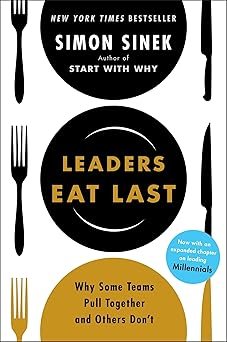
Why Read Leaders Eat Last?
Leaders Eat Last begins with a question Simon Sinek encountered during a conversation with a US Marine Corps general: why do officers eat last in the Marine Corps cafeteria? The answer — that leadership is the willingness to place the needs of others above your own comfort — sounds simple, and is among the most demanding things a human being can consistently practise. Sinek spends the rest of the book building the biological, anthropological, and organisational case for why this seemingly old-fashioned idea is not sentiment but science — and why its abandonment in modern corporate culture is costing organisations precisely the thing they most need: the full, voluntary commitment of the people inside them.
The book’s central argument is that human beings are biologically wired for cooperation in the presence of safety and competition in the presence of threat — and that the primary job of leadership is to create a “Circle of Safety” within which people can focus their energy outward on the real challenges facing the organisation, rather than inward on the internal politics, hierarchical games, and self-protective behaviours that emerge when people do not feel safe.
Sinek grounds this argument in neuroscience — specifically, in four chemicals he identifies as the primary regulators of human behaviour: endorphins, dopamine, serotonin, and oxytocin. The distinction between the “selfish” chemicals (endorphin and dopamine, triggered individually) and the “social” chemicals (serotonin and oxytocin, requiring genuine human relationship) explains why organisations that reward only individual performance metrics while neglecting the social conditions of trust and belonging produce people who are productive in measurable ways and broken in unmeasurable ones.
Who Should Read This
This is essential reading for anyone who manages people, aspires to manage people, or is trying to understand why some teams give everything and others give the minimum required. MBA and CAT candidates will find it invaluable for leadership and organisational behaviour questions — Sinek’s framework for why people follow leaders, what creates genuine commitment versus mere compliance, and the biological basis of trust are all standard territory in MBA interviews. Beyond preparation, it speaks directly to team leaders, HR professionals, founders building culture, and anyone who has wondered why their organisation’s most talented people keep leaving.
Key Takeaways from Leaders Eat Last
The primary job of leadership is not strategy or execution — it is the creation of safety. When people feel genuinely safe within an organisation, they redirect their energy from self-protection to contribution. The Circle of Safety is not a perk; it is the precondition for the voluntary full commitment that high performance requires. Leaders who demand commitment without providing safety are asking for something they have not earned.
Four chemicals — endorphins, dopamine, serotonin, and oxytocin — explain more about organisational dynamics than most management frameworks do. The critical distinction is between chemicals triggered in isolation (endorphin, dopamine) and chemicals that require genuine human relationship (serotonin, oxytocin). Organisations that reward only individual performance metrics while neglecting relationship and belonging optimise for short-term output at the cost of long-term loyalty and trust.
Dopamine is the most dangerous chemical in the modern workplace. Designed by evolution to reward finding food and resources, it produces the satisfaction of hitting targets and achieving measurable goals — and is as addictive as any substance. Organisations built entirely around dopamine-triggering metrics produce people who are driven, anxious, and fundamentally unable to cooperate, because cooperation requires the oxytocin that only trust and genuine relationship produce.
Leaders eating last is not a metaphor — it is a behavioural standard with biological consequences. When leaders visibly sacrifice their own comfort for the people in their care — absorbing pressure from above rather than transmitting it downward, taking responsibility for failures rather than distributing blame — they trigger the serotonin and oxytocin responses that produce genuine loyalty. The title is a prescription for the specific behaviours that build the neurochemical conditions of a high-trust organisation.
Key Ideas in Leaders Eat Last
The book opens with a story Sinek heard from Lieutenant General George Flynn: in the Marine Corps, officers eat last. Not as a rule, but as a practice — an expression of the principle that leadership is the willingness to place the welfare of those in your care above your own comfort. Sinek uses this image throughout the book as the central metaphor for a philosophy of leadership that is simultaneously ancient and urgently counter-cultural in the context of modern corporate management.
The book’s first major idea is the Circle of Safety — the perimeter that effective leaders draw around the people in their organisations, protecting them from external threats and, critically, from internal threats too. Inside the circle, people can be vulnerable, admit mistakes, ask for help, and cooperate fully. Outside are the real dangers: competitors, market disruptions, regulatory threats, technological change. When leaders fail to maintain the circle — when internal threats breach it — people redirect their energy inward, and the organisation loses the cooperative behaviours that performance requires while retaining the competitive behaviours that performance does not.
The neuroscience section is the book’s most distinctive structural contribution. Sinek’s four-chemical framework — endorphins masking physical pain to enable persistence, dopamine rewarding goal achievement to drive productivity, serotonin producing the feelings of status and pride that come from recognition and belonging, and oxytocin generating the deep trust that comes from genuine human relationship — is presented as a practical framework for understanding why specific management practices produce specific organisational outcomes. Its practical utility — as a way of understanding why individual performance incentives alone never produce organisational greatness — is genuine even where the neuroscience is simplified.
The book’s second half turns from diagnosis to prescription. Sinek examines the specific leadership behaviours — consistency, personal sacrifice, genuine investment in individuals’ development, the willingness to absorb blame and distribute credit — that trigger the social chemicals and thereby build the conditions of trust. He also examines the structural conditions that have systematically degraded the Circle of Safety in modern corporations, producing organisations that are financially optimised and humanly hollowed out. The argument is that this trade-off is not merely ethically troubling but operationally self-defeating: organisations that hollow out human trust eventually lose capabilities that financial metrics cannot capture until they are gone.
Core Frameworks in Leaders Eat Last
Sinek builds five interlocking frameworks — grounded in neuroscience, anthropology, and military culture — that together constitute a biological and structural account of why some leaders produce genuine commitment while others produce only compliance.
Core Arguments
Sinek advances four interconnected arguments — about the biological basis of leadership, the cost of short-termism, the hierarchy of leadership responsibility, and the human consequences of organisational scale — each grounded in specific cases and each with direct implications for how organisations should be led.
Sinek’s foundational argument is that effective leadership is not a management philosophy or a communication style — it is a biological practice. The specific behaviours that produce genuine followership — sacrifice, consistency, personal investment, the absorption of pressure rather than its transmission — trigger specific neurochemical responses in the people who experience them. This is not metaphorical. Oxytocin released by genuine human trust is the same molecule regardless of whether it is released by a friend’s loyalty or a manager’s consistent advocacy. The biological foundation of the argument is both its strength and its vulnerability to critique: the neuroscience is simplified, but the practical implications are sound and considerably more actionable than the average management theory.
The book’s most economically relevant argument concerns the systematic destruction of social capital by short-term financial thinking. When companies optimise for quarterly earnings by cutting headcount, offshoring labour, and replacing long-term employment with contractor relationships, they destroy the trust and loyalty that are the preconditions of the discretionary effort and genuine cooperation that produce sustainable competitive advantage. The financial value destroyed is real but not immediately visible in the metrics that short-term financial thinking tracks — it shows up years later as talent attrition, innovation decline, customer experience degradation, and eventual competitive vulnerability. By the time the destruction is visible, its cause has been obscured by years of intervening management decisions.
Sinek argues that leadership comes with a specific hierarchy of responsibility: leaders are responsible first for the people in their care, and the performance those people produce is a consequence of that care, not its precondition. The leader who makes people feel safe and valued before demanding performance will consistently outperform the leader who demands performance as the condition of safety. This inverts the conventional management logic of “prove yourself first, then earn security” — and Sinek grounds the inversion in both the neurochemistry of trust and the historical evidence of high-performing military and organisational units where leaders’ visible sacrifice for their people produced commitment that no incentive structure could replicate.
As organisations grow, leaders become increasingly separated from the people their decisions affect. Sinek’s argument is that this abstraction — the reduction of human beings to data points in a spreadsheet — is not an inevitable consequence of scale but a failure of leadership design. The leaders who maintain genuine human connection at scale — who know their people by name, understand their lives outside work, and are present in ways that their position does not require — produce measurably different organisational cultures than leaders who manage at a hierarchical distance. The biological mechanism is simple: you cannot trigger oxytocin in people you do not actually know. The implication is demanding: scale is not an excuse for abstraction; it is a challenge that leadership must deliberately overcome.
Critical Analysis
A balanced assessment examining the book’s genuine biological grounding and military-corporate bridge alongside its oversimplified neuroscience, underdeveloped prescriptions, and reliance on exceptional rather than typical organisational contexts.
By anchoring leadership philosophy in neuroscience — however simplified — Sinek moves the conversation from preference and style to mechanism and consequence. The four-chemical framework makes previously vague concepts like “trust,” “loyalty,” and “engagement” specific and actionable. Even critics of the simplification acknowledge that the practical implications of the framework are more useful than the average management theory’s.
Sinek’s use of US Marine Corps culture as the primary example of high-trust, high-performance leadership in conditions of genuine adversity is the book’s most effective analytical move. Military units face the most extreme version of the leadership challenge — their members must be willing to risk their lives for each other — and the practices that produce that willingness are a rigorous test of any leadership theory.
The section on why leaders of large organisations make inhuman decisions is one of the most important and least-discussed contributions in the book. The mechanism — that biological empathy requires personal relationship, and that scale systematically destroys personal relationship — is both neuroscientifically grounded and immediately recognisable to anyone who has watched a large organisation make decisions that smaller organisations would not make.
Sinek’s four-chemical framework has been criticised by neuroscientists for reducing extremely complex neurobiological systems to a quartet of molecules with clean, separable functions. The brain does not work as tidily as the framework suggests. The practical implications are defensible; the neuroscience framing overstates its precision and risks misleading readers who take the biology literally.
The book is considerably more compelling in its diagnosis than in its prescription. The advice to “know your people,” “sacrifice for them,” and “eat last” is correct but underdeveloped as practical guidance for leaders operating in complex, scaled organisations with significant structural constraints. The gap between the framework and the implementation is large and largely unfilled.
Sinek’s cases tend toward the military, the heroic, and the inspirational — contexts where leadership failure has immediate, visible, and catastrophic consequences. The translation to a mid-sized technology company, a family-owned business, or a public sector organisation requires more adaptation than the book provides. The principles hold; their application is messier and more context-dependent than the narrative suggests.
Literary & Cultural Impact
Immediate Bestseller, Lasting Adoption: Leaders Eat Last was published in January 2014 and immediately became a bestseller, building on the cultural momentum Sinek had generated with Start with Why and his TED talk. It sold over a million copies in its first year, was translated into more than twenty languages, and became standard reading in corporate leadership development programmes across industries. Several large organisations — including elements of the US military, which found its own culture accurately described in its pages — adopted the Circle of Safety framework as an organisational development tool.
Memeable Concepts, Mixed Implementation: The book’s influence on the conversation about leadership has been substantial but sometimes superficial. The phrase “leaders eat last” entered corporate vocabulary rapidly — appearing in leadership training materials, conference keynotes, and management consultancy frameworks — often without the specific behavioural practices the book recommends. Like Start with Why before it, the concept proved highly memeable and consequently highly susceptible to the kind of performance-without-substance adoption that Sinek himself warns against.
The Right Book at the Right Moment: Published in the aftermath of the 2008 financial crisis — a period when trust in institutions, corporations, and their leaders had reached historic lows — Leaders Eat Last offered a framework that explained, in biological rather than moral terms, why the short-term, self-interested leadership culture that produced the crisis was self-defeating. The argument that treating people as resources rather than human beings is not merely ethically wrong but operationally stupid resonated with a management culture that had been taught to be suspicious of ethical arguments but could be persuaded by mechanistic ones.
The Middle Book of a Trilogy: Sinek’s body of work — Start with Why (2009), Leaders Eat Last (2014), and The Infinite Game (2019) — constitutes the most coherent popular framework for purpose-driven leadership available in the contemporary business literature. Leaders Eat Last is the trilogy’s most practically focused book — the one most concerned with the specific behaviours and structural conditions that make leadership effective at the human level. It is best read after Start with Why and before The Infinite Game, as the middle text that connects organisational purpose to long-term strategic thinking through the human conditions that make both possible.
Love This Book? Master Every Book.
Stop struggling with reading comprehension. Our proven system transforms how you read—whether for CAT, GRE, GMAT, SAT, or personal growth.
Best Quotes from Leaders Eat Last
The true price of leadership is the willingness to place the needs of others above your own. Great leaders truly care about those they are privileged to lead and understand that the true cost of the leadership privilege comes at the expense of self-interest.
When people are financially invested, they want a return. When people are emotionally invested, they want to contribute.
Danger is real, but fear is a choice.
A team is not a group of people who work together. A team is a group of people who trust each other.
The more energy is spent trying to protect oneself from each other, the less energy is left to protect the organisation from the outside.
Test Your Understanding
Think you’ve mastered Leaders Eat Last? Challenge yourself with 15 questions on the Circle of Safety, the four chemicals framework, selfish vs. social chemicals, and why short-termism destroys long-term value. Score 80%+ to prove your mastery.
Leaders Eat Last FAQ
What is Leaders Eat Last about?
It argues that the primary job of leadership is to create a “Circle of Safety” — the conditions under which people feel genuinely safe from internal threats — so that they can direct their full energy toward the real external challenges facing the organisation. The book grounds this argument in neuroscience, using a four-chemical framework (endorphins, dopamine, serotonin, oxytocin) to explain why specific leadership behaviours produce specific organisational outcomes, and examines why modern corporate culture’s emphasis on short-term individual metrics systematically destroys the trust and cooperation that sustained high performance requires.
Is it useful for MBA and CAT preparation?
Very much so, particularly for leadership, organisational behaviour, and human resources questions. The Circle of Safety framework, the four-chemical explanation of trust and motivation, and Sinek’s argument about why short-termism destroys long-term organisational value are all immediately applicable to MBA interview questions about leadership philosophy, team motivation, and corporate culture. The book also pairs well with Start with Why — together they constitute a coherent leadership framework that covers purpose (WHY) and execution (how leaders build the human conditions for that purpose to be realised).
What is the Circle of Safety?
The Circle of Safety is the perimeter that effective leaders draw around the people in their organisations, protecting them from arbitrary internal threats — capricious dismissal, political games, public humiliation, and the exploitation of the vulnerabilities that genuine contribution requires. When the circle holds, people trust the organisation enough to direct their energy outward toward real external challenges. When it breaks down, they redirect energy inward toward self-protection — and the organisation loses the cooperative behaviours that performance depends on.
What are the four chemicals and why do they matter?
The four chemicals are: endorphins (masking physical pain), dopamine (rewarding goal achievement), serotonin (generating status, pride, and belonging), and oxytocin (producing deep trust through genuine human relationship). The critical distinction is between endorphins and dopamine — which can be triggered in isolation — and serotonin and oxytocin — which require genuine human relationship. Organisations that reward only individual achievement (dopamine) while neglecting the social chemicals produce driven, anxious, fundamentally uncooperative people. Organisations that create conditions for all four build the neurochemical foundation of genuine loyalty and sustained high performance.
How does Leaders Eat Last differ from Start with Why?
Start with Why focuses on organisational purpose — why some companies and leaders inspire while others merely manage, and the role of a clear WHY in producing genuine followership. Leaders Eat Last focuses on the human conditions required to realise that purpose — the specific leadership behaviours, neurochemical mechanisms, and structural conditions that produce the trust and safety under which people give their best. Start with Why explains what to stand for; Leaders Eat Last explains how to create the human conditions in which people will stand with you.








