
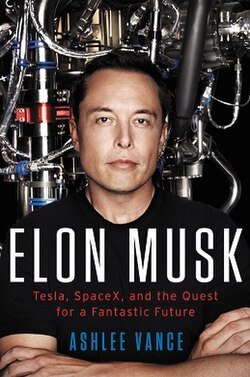
Elon Musk
Watch Prashant Sir break down the key ideas, frameworks, and the central tension at the heart of Isaacson’s landmark biography.
Why Read Elon Musk?
Walter Isaacson spent two years following Elon Musk — attending meetings, observing decisions in real time, interviewing hundreds of people in his orbit — and the biography he produced is the most detailed available account of how one of the most consequential and most contested figures in contemporary business actually operates. It is not a hagiography: Isaacson documents the cruelty, the impulsiveness, and the specific human costs that Musk’s operating style imposes. It is not a takedown: it also documents the genuine engineering achievements and the particular combination of first-principles thinking, pain tolerance, and deadline-driven intensity that has produced things that more conventionally managed organisations could not.
The book covers Musk’s full arc — the brutal childhood in South Africa, the early internet companies (Zip2, X.com/PayPal), the simultaneous near-destruction of both SpaceX and Tesla in 2008, and the acquisition of Twitter/X — with the detail that two years of direct access produces. Isaacson structures the biography around a central tension in Musk’s character: the relationship between the childhood trauma he experienced and the specific management behaviours — the sudden firings, the impossible deadlines, the contempt for conventional accountability — that define his adult professional life.
What distinguishes Isaacson’s biography from all prior Musk literature is the real-time access during a period of maximum turbulence: the Twitter acquisition, the Starship development programme, the Tesla production crises. The reader sees Musk making decisions — not the sanitised retrospective version but the actual decision in the room, with the competing pressures and the specific reasoning visible.
Who Should Read This
This is essential reading for anyone interested in the specific psychology of extreme entrepreneurship and what it actually looks like inside the most demanding company cultures in the world. MBA and CAT candidates will find it invaluable for GD/PI discussions about entrepreneurship, leadership, risk-taking, and the ethics of extreme management. Beyond preparation, it is required reading for entrepreneurs, engineers, investors, and anyone curious about how companies that should have failed multiple times managed not to.
Key Takeaways from Elon Musk
First-principles thinking — starting from fundamental physics rather than industry convention — is Musk’s most distinctive cognitive tool. When told rockets had to cost what they cost, he asked what raw materials cost and why the gap was so large. The question led to reusable rockets — a breakthrough the established industry had decided was impossible, not because it was, but because no one was asking the foundational question.
The “idiot index” — the ratio between component cost and raw material cost — is a practical instrument for finding engineering inefficiency. Musk’s five-step algorithm is not a management philosophy; it is an engineering methodology applied to organisations: question every requirement, delete aggressively, simplify before optimising, accelerate, then automate. The results are frequently brutal and frequently effective.
Impossible deadlines are not merely motivational theatre. The hardest finding about Musk’s methods is that they genuinely change what engineering teams discover is possible by forcing the abandonment of approaches that work adequately and the discovery of approaches that work radically better. The surge eliminates Parkinson’s Law and compresses what would otherwise take years into weeks.
Musk’s virtues and vices are not separable traits. Isaacson’s most important finding is that the genius and the demon are expressions of the same underlying psychological architecture — the dissociation capacity that lets him override human suffering in service of a goal is inseparable from the capacity that produces the extraordinary achievements. This is not exculpatory; it is structural.
Key Ideas in Elon Musk
Isaacson opens with the question that organises the entire biography: is Musk’s management style — which routinely involves sudden mass firings, impossible deadlines, public humiliation of engineers, and contempt for psychological safety frameworks — a necessary feature of his companies’ extraordinary achievements, or is it a costly dysfunction that produced those achievements despite rather than because of its extremity? The book does not definitively answer this question, which is both its most honest quality and the source of most of its critical controversy.
The childhood section is essential context rather than biographical decoration. Musk’s father is described by multiple sources as psychologically cruel in ways that Isaacson argues left specific and traceable marks on Musk’s adult character. The dissociation that allowed a child to survive an abusive environment — the ability to detach from emotional pain, to override the normal human response to suffering — became a professional asset in an adult life requiring extraordinary pain tolerance: the willingness to lose everything in 2008 when both SpaceX and Tesla were simultaneously days from bankruptcy. This is not an exculpatory argument — it is a structural one: the formation that produced the capacity also produced the cruelty.
The SpaceX story — the central and most compelling narrative — is a study in first-principles thinking applied to a domain so captured by institutional convention that the most fundamental questions had stopped being asked. The established aerospace industry had decided that reusable rockets were not viable, that launch costs had an irreducible floor, and that the cadence of launches was necessarily slow. Musk asked why, from the physics up, and found that none of these conclusions followed from fundamental constraints. Falcon 9 and the Starship development programme are the engineering materialisation of this question — and the gap between what SpaceX achieved and what NASA’s contractors were achieving simultaneously, at far greater cost, is the most powerful available evidence for the value of first-principles thinking.
The Tesla story is the book’s most instructive manufacturing narrative. Tesla’s survival of multiple near-death experiences — most dramatically, the “production hell” of the Model 3 ramp in 2018 — is a story about the specific value of the founder’s willingness to sleep on the factory floor and drive convergence between product aspiration and manufacturing reality through direct personal presence. It is also a story about the costs: the human toll on Tesla employees, the careers destroyed under pressure, and the broader question of whether the outcomes could have been achieved with less collateral damage.
Key Frameworks & Methods
Isaacson documents Musk’s operational methods in enough detail to be studied and applied — the most practically useful contribution any business biography has made in years.
Core Arguments
Isaacson builds a portrait organised around four tensions that the biography refuses to resolve — honestly, because they remain unresolved in the subject himself.
Isaacson’s most controversial implicit argument is that some fraction of Musk’s extreme management behaviour is genuinely necessary for the specific achievements his companies have produced — not merely tolerated as a cost but actually functional as a mechanism. The reusable rocket did not emerge from a psychologically safe environment; it emerged from one in which engineers who said it could not be done were replaced by engineers willing to try. The argument is not that cruelty is productive — it is that relentless pressure, applied by someone with sufficient technical knowledge to distinguish genuine constraint from convention, can produce outcomes no other approach would have generated.
The book’s most uncomfortable section concerns what Musk’s methods cost the people who work for him. Isaacson documents engineers whose careers were damaged by sudden public humiliation, employees who developed PTSD-like symptoms after extended surge conditions, and the mass firings that followed the Twitter acquisition. The question the book raises but does not fully answer is: who bears the cost of the extraordinary achievements? The shareholders who benefit from SpaceX’s launch cost reductions did not sleep on the Fremont factory floor. The distribution of the achievement and the distribution of the suffering are not the same.
The book’s most intellectually productive tension concerns the relationship between first-principles thinking and accumulated institutional knowledge. Musk’s approach is extraordinarily powerful when the problem has been poorly framed by convention — when the conventional answer reflects institutional inertia rather than genuine constraint. But institutional knowledge is not always mere convention: it sometimes reflects hard-won understanding of failure modes and second-order consequences that first-principles reasoning from a clean slate cannot anticipate. The Twitter acquisition is the clearest story of what happens when first-principles thinking encounters a domain where the accumulated knowledge it dismisses as convention is actually load-bearing.
Isaacson’s deepest and most contested argument concerns the relationship between Musk’s extraordinary capabilities and his specific personality structure. The dissociation capacity that allows him to override human suffering in the service of a goal is not a separable character defect that could be removed while preserving the capability. It is the same psychological mechanism that allows him to hold a civilisational vision and simultaneously care about a specific manufacturing bottleneck, to absorb the public humiliation of repeated launch failures without losing conviction, and to make decisions under pressure with a speed and clarity that no more normally constituted person could match. This is not a defence of the cruelty; it is a claim about its origin and its inseparability from the capability that accompanies it.
Critical Analysis
A balanced assessment of the most discussed business biography of 2023 — its genuine contributions and the limitations that proximity to a powerful subject inevitably creates.
No previous Musk biography had the access Isaacson had, and no previous moment in Musk’s career was more consequential or revealing. The Twitter acquisition — visible in real time, with the decision-making process documented from inside — is an extraordinary primary source on how one of the most powerful and least predictable people in contemporary capitalism makes decisions under pressure.
Isaacson’s documentation of Musk’s five-step engineering process is one of the most practically useful sections of any business biography published in the decade. It is specific enough to apply, grounded in specific engineering decisions at SpaceX and Tesla, and different enough from conventional project management wisdom to be genuinely instructive.
Isaacson’s connecting of Musk’s childhood formation to his adult management behaviour is more rigorously argued than most business biography’s psychological speculation. He is careful to note where he is interpreting rather than reporting, and the framework he constructs is consistent with observed behaviour across multiple contexts and sources.
The most consistent critical complaint is that Isaacson’s two years of proximity to Musk — with Musk’s cooperation — produced a portrait more sympathetic than a fully independent assessment would have been. Isaacson documents the cruelties and the costs, but critics argue he does so in a framing that ultimately endorses the genius-demon package. The biography is the best available account of Musk; it is not a fully independent one.
Despite being one of the most consequential business decisions of the decade — and one Isaacson observed in real time — the Twitter/X sections are less analytically rigorous than the SpaceX and Tesla sections. The acquisition’s business logic (or its absence), the consequences for Twitter’s users and advertisers, and the question of what it reveals about Musk’s political evolution are all underexplored relative to the access available.
At 688 pages, the book is longer than its intellectual content fully requires. The episodic structure — following Musk through consecutive crises — produces repetition: the pattern of impossible deadline, engineering surge, near-disaster, and eventual success recurs often enough that later instances carry less analytical weight than earlier ones. A more selective biography of 450 pages would have been tighter without losing the essential argument.
Legacy & Cultural Impact
Reception and Sales: Elon Musk was published in September 2023 and immediately became one of the most discussed non-fiction books of the year — debuting at number one on the New York Times bestseller list, selling over a million copies in its first months, and generating critical and journalistic response proportionate to its subject’s cultural centrality. It arrived at a moment when Musk’s public profile was at its most polarised — the Twitter acquisition had divided opinion sharply — and Isaacson’s attempt to produce a portrait that was neither endorsement nor condemnation was received differently by readers arriving with different priors about the subject.
Among Business and Technology Professionals: The reception was generally enthusiastic — the engineering detail, the real-time access to decision-making, and the documentation of the five-step algorithm were widely cited as the most substantive contributions a business biography had made in years. The reception among journalists, Twitter employees, and critics of Musk’s management style was more mixed, with the most consistent criticism being that Isaacson’s framing provided a rationalisation for behaviour that should have been more directly condemned.
Isaacson’s Place in the Genre: His earlier biographies — Steve Jobs (2011), Albert Einstein (2007), Benjamin Franklin (2003), Leonardo da Vinci (2017) — established him as the most prominent practitioner of the “great man biography.” His subjects share a specific profile: transformative creative intelligence, difficult personal relationships, and civilisational ambition. The Musk biography is the first in which the subject was alive and cooperative during the research, which produces both its greatest strength (real-time access) and its greatest limitation (the proximity problem).
Relevance for MBA Candidates: The biography’s most relevant contributions concern the specific management practices — first-principles thinking, the algorithm, the idiot index — documented in enough operational detail to be studied and adapted. The broader question the book raises — about the relationship between exceptional capability and the human cost of its expression, and whether organisations have a responsibility to place limits on management behaviour regardless of achievements — is precisely the kind of question that MBA personal interviews are increasingly designed to probe.
Love This Book? Master Every Book.
Stop struggling with reading comprehension. Our proven system transforms how you read—whether for CAT, GRE, GMAT, SAT, or personal growth.
Best Quotes from Elon Musk
The best parts of engineering are the same as the best parts of being human — the relentless curiosity, the willingness to challenge assumptions, the joy of building something that works.
A maniacal sense of urgency is our operating principle.
The first step is to establish that something is possible; then probability will occur.
I’d rather be optimistic and wrong than pessimistic and right.
When something is important enough, you do it even if the odds are not in your favour.
Test Your Understanding
Think you’ve mastered Elon Musk by Isaacson? Challenge yourself with 15 questions on the algorithm, key frameworks, and core arguments. Score 80%+ to prove your mastery.
Elon Musk FAQ
What is Elon Musk by Walter Isaacson about?
It is a comprehensive biography drawing on two years of direct access during which Isaacson attended meetings, observed decisions in real time, and interviewed hundreds of people in Musk’s professional and personal orbit. It covers Musk’s full arc — childhood in South Africa, early companies, SpaceX and Tesla’s near-deaths and recoveries, and the Twitter acquisition — with particular focus on the specific management methods, psychological formation, and engineering philosophy that produced both his extraordinary achievements and the specific human costs his operating style imposes.
Is it useful for MBA and CAT preparation?
Highly so — particularly for GD/PI discussions about entrepreneurship, leadership, ethics of management, and the relationship between vision and execution. Musk is one of the most directly discussable figures in contemporary business: his methods produce specific, documented outcomes that resist simplification and reward analytical nuance. The ability to discuss first-principles thinking, the algorithm, and the genius-demon inseparability argument in a PI context signals a level of business literacy that most candidates do not bring to the room.
What is first-principles thinking and why does it matter?
First-principles thinking is the practice of starting from the fundamental physical and logical constraints of a problem — rather than from conventional assumptions about what is possible — and reasoning up from there. It matters because most innovation failures are not failures of execution but failures of framing: the problem is being solved in a way that assumes constraints that do not actually exist. Musk’s application to rocket economics — asking what rockets cost at the raw material level and why the gap with finished product cost is so large — produced the reusable rocket and the cost reductions that have transformed the space launch industry.
What is Isaacson’s central argument about Musk’s character?
That Musk’s virtues and vices are expressions of the same underlying psychological architecture, not separable traits that could be surgically partitioned. The dissociation capacity that makes him able to absorb and impose extraordinary suffering in service of a goal — traceable to his childhood formation — is also the capacity that makes him able to hold a civilisational vision and simultaneously obsess over a manufacturing bottleneck, to persist through repeated public failure, and to make high-stakes decisions with a speed and clarity that normally constituted people cannot match. Isaacson documents the cruelties without excusing them but argues that removing them would require removing the capabilities they are inseparable from.
How does Elon Musk compare to Isaacson’s Steve Jobs biography?
Both subjects share transformative creative intelligence, difficult personal relationships, civilisational ambition, and a management style that imposed severe costs on the people around them. The key differences: Jobs was primarily a product designer who operated in a single company; Musk is an engineer simultaneously running multiple companies across civilisationally significant domains. The Musk biography is longer, more operationally detailed, and more ambivalent about its subject — partly because Musk’s operating scale is larger and partly because Isaacson observed Musk in real time rather than retrospectively, which made it harder to impose retrospective narrative resolution on what he saw.








