
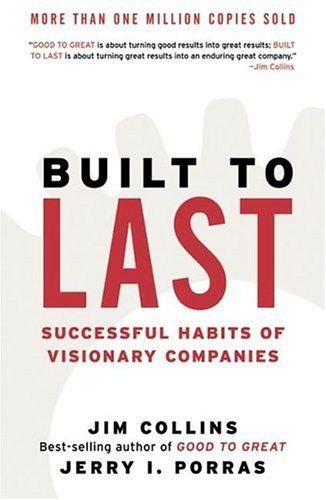
Why Read Built to Last?
Built to Last is one of the most rigorously researched business books ever written — and one of the most counter-intuitive. Collins and Porras spent six years at the Stanford Business School studying eighteen pairs of companies: each pair containing one “visionary company” that had dominated its industry for decades and one strong comparison company that had performed well but not achieved the same enduring greatness. What they found systematically overturned the assumptions that most people bring to thinking about great companies — about the role of great leaders, the necessity of great ideas, and the relationship between profits and purpose.
The book’s research design is its most distinctive feature. Rather than studying successful companies in isolation — which produces hagiography rather than insight — Collins and Porras compared visionary companies against credible peers: 3M against Norton, Hewlett-Packard against Texas Instruments, Johnson & Johnson against Bristol-Myers Squibb, Walmart against Ames Department Stores, Boeing against McDonnell Douglas. The comparison methodology forces the question that matters: not what do great companies do, but what do they do differently from other good companies?
The central finding — that visionary companies are built around core ideology preserved with cult-like intensity while simultaneously stimulating relentless progress and change — challenges both the “visionary leader” myth and the “pure profit motive” assumption. Great companies are not built by charismatic founders with brilliant ideas; they are built by clock-builders who create organisations capable of outlasting any single leader or single product.
Who Should Read This
This is foundational reading for anyone serious about building organisations that outlast their founders, their initial products, and the specific conditions that produced their first success. MBA candidates will find it among the most frequently referenced research studies in strategy and organisational behaviour. Beyond exams, it is essential for founders thinking about institutional design, CEOs managing the tension between preserving culture and driving change, and anyone who has wondered what makes some companies genuinely exceptional over decades rather than years.
Key Takeaways from Built to Last
The goal is not to be a time-teller but a clock-builder. A time-teller is a brilliant leader whose personal vision drives the organisation — but the clock stops when they leave. A clock-builder constructs an organisation so well-designed that it keeps perfect time long after its builder is gone. Visionary companies are built by clock-builders: people who invest in institutional architecture rather than their own indispensability.
The “Tyranny of the OR” is the enemy of greatness — and great companies replace it with the “Genius of the AND.” Conventional management forces choices: stability OR change, ideology OR pragmatism, profits OR purpose. Visionary companies reject these false dichotomies. They preserve their core ideology AND relentlessly drive progress. They are deeply ideological AND intensely commercial. The ability to hold apparent contradictions is not confusion — it is sophistication.
Core ideology must be authentic, not aspirational — and preserved with a rigidity that looks, from outside, almost fanatical. The visionary companies did not have better values than comparison companies; they had values they actually lived. The cult-like preservation of genuine core values — including the willingness to eject people who do not fit — is one of the most consistent patterns among enduring great companies.
Big Hairy Audacious Goals — BHAGs — are not motivational slogans. They are specific, concrete, long-range commitments that galvanise an organisation the way a moon shot galvanised NASA. The critical distinction is between a genuine BHAG — which is clear, compelling, and slightly terrifying — and vague mission statement language that inspires nothing and commits to less. The former produces alignment and energy; the latter produces cynicism.
Key Ideas in Built to Last
The book’s research design establishes its intellectual authority. Collins and Porras began by surveying hundreds of CEOs and business leaders to identify truly visionary companies — organisations that had not merely succeeded but had set the standard for their industries over decades. From this survey they identified eighteen visionary companies and paired each with a strong comparison company in the same industry: a company that had been around equally long, had access to similar resources, and had performed respectably — but had not achieved the same enduring, industry-defining greatness. The six-year study examined these pairs across their entire histories, identifying the patterns that distinguished the visionary companies from their comparisons.
The first and most important finding concerns the myth of the great idea. Visionary companies rarely began with a great idea. Many began with no clear idea at all — or with ideas that failed. 3M began as a failed corundum mine. Sony’s first product was a rice cooker that didn’t work. Hewlett-Packard’s founders had no idea what they were going to build when they started. What distinguished these companies was not the brilliance of their initial concept but the quality of the organisation they built around their eventual idea. Collins and Porras call this the distinction between time-tellers and clock-builders: the former is a leader whose personal vision drives the company; the latter is a leader who builds an institution capable of generating great ideas across generations and leadership transitions.
The second major finding concerns core ideology — the set of core values and core purpose that define what a company fundamentally is and believes, independent of any specific product, market, or strategy. Visionary companies preserved their core ideology with an intensity that looked, from outside, almost cultish. They hired, developed, and promoted people who fit the ideology; they ejected people who did not, regardless of individual competence. This is not about values as marketing — it is about values as operational reality. The comparison companies often had comparable written values; what distinguished the visionary companies was the degree to which those values determined actual behaviour.
The third major finding is the pairing that most surprised researchers: core ideology is preserved absolutely, but everything else changes relentlessly. Visionary companies simultaneously held their core values fixed and drove continuous, aggressive progress in strategy, products, operations, and structure — what Collins and Porras call “Preserve the Core / Stimulate Progress.” This requires the ability to distinguish, precisely and honestly, between what is truly core and what is merely traditional, convenient, or comfortable. Many companies mistake tradition for core — and preserve things that should change while allowing things that should be fixed to drift.
Core Frameworks in Built to Last
Collins and Porras introduce five interlocking frameworks — drawn from their six-year comparative study — that together constitute a blueprint for building organisations designed to last across leadership generations, market cycles, and competitive disruptions.
Core Arguments
Collins and Porras advance four interconnected arguments — about the great idea myth, the discovery of core values, the demands of enduring greatness, and the paradox of change-through-continuity — each derived from the paired-company data and each with direct implications for how organisations should be designed and led.
Collins and Porras’s most counter-intuitive finding is that visionary companies did not succeed because of superior initial concepts. Their argument is not merely descriptive — it is prescriptive: aspiring company-builders should invest their energy in building organisational architecture rather than searching for the perfect idea. The right organisation will generate multiple great ideas over time; the wrong organisation will squander even the best initial idea. This inverts the conventional entrepreneur’s focus from ideation to institution-building — which is a more demanding and more important skill, and one that receives far less attention in startup culture and business education than it deserves.
Visionary companies did not construct their core values through strategic planning processes or values workshops. They discovered them — through honest examination of what they actually believed, how they actually behaved in difficult situations, what they were genuinely unwilling to compromise. The test of a core value is not whether it sounds good in an annual report; it is whether you would maintain it even if it became a competitive disadvantage. This standard eliminates most of what companies call core values, which is precisely the point. The comparison companies in the study often had comparable written values; the visionary companies had values that actually governed decisions — including decisions to sacrifice short-term performance rather than compromise what they fundamentally stood for.
The comparison companies in the study were not failures — they were good companies that made reasonable decisions, served their customers adequately, and generated acceptable returns. The difference between them and the visionary companies was not competence but commitment — to ideology, to BHAGs, to the full demands of the Genius of the AND. Collins and Porras’s most uncomfortable argument is that the reasonable, balanced, professionally managed approach to running a company is exactly what prevents it from becoming great. Greatness requires a level of commitment — to values, to goals, to the clock-building project itself — that looks, from outside, unreasonable. Most companies are not willing to pay this cost, which is why most companies, however well-run, do not achieve enduring greatness.
The book’s most sophisticated argument concerns the relationship between change and continuity. Visionary companies appear paradoxical: they change constantly — products, strategies, structures, even business models — while remaining completely consistent in their core values and purpose. The continuous change is how they remain consistent. A company that clings to its original products and strategies because they were successful in the past is not preserving its core — it is betraying it, because the core was never about specific products but about the values and purpose those products expressed. The discipline is to distinguish between the two with honesty and precision, and to resist the powerful organisational tendency to confuse the familiar with the fundamental.
Critical Analysis
A balanced assessment examining the book’s genuinely rigorous research design and counter-intuitive findings alongside its survivorship bias problem, the subsequent decline of some visionary companies, and its Western corporate context.
The paired-company methodology is the book’s most important intellectual contribution. By comparing visionary companies not against average companies but against strong, established peers in the same industries, Collins and Porras eliminate most obvious confounds — industry tailwinds, first-mover advantages, general economic conditions — and isolate factors genuinely specific to extraordinary companies. No subsequent business book has replicated this research design with comparable rigour.
The book’s most valuable findings run directly against conventional wisdom — that great companies don’t start with great ideas, that charismatic leaders are not essential and can be counterproductive, that profits are a result rather than a purpose. These findings are not merely surprising; they are actionable, because they redirect attention from factors that feel important to factors that actually produce endurance.
The book introduced a cluster of concepts — BHAGs, the Tyranny of the OR, time-tellers vs. clock-builders, Preserve the Core / Stimulate Progress — that became standard vocabulary in strategic management education and practice. This conceptual contribution has outlasted the book’s specific findings and continues to organise discussions of organisational greatness across industries and geographies.
The book studies companies that were already visionary at the time of writing — which means it can identify patterns associated with their success but cannot confirm those patterns caused their success. Many companies that exhibited the same patterns presumably failed, but they are not in the sample. Phil Rosenzweig’s The Halo Effect (2007) is the most thorough critique of this methodological problem.
Several of the book’s visionary companies — including Motorola, Ford, and Sony — subsequently struggled, were disrupted, or declined significantly. This raises the question of whether the conditions producing sustained greatness in the twentieth century’s competitive environment translate to the twenty-first’s. Christensen’s Innovator’s Dilemma offers the most useful complement, explaining how even well-designed great companies can be disrupted.
All eighteen visionary companies in the study are American corporations of a specific historical era. The book makes no claim to universal applicability, but it is regularly cited as universal management wisdom in contexts — Indian family businesses, Asian conglomerates, government enterprises — where its specific findings may not translate without significant adaptation.
Literary & Cultural Impact
Six Years on the Bestseller List: Built to Last was published in 1994 and became one of the most influential business books of the decade — winning the Financial Times and McKinsey Business Book of the Year Award and remaining on the BusinessWeek bestseller list for more than six years. It sold over three million copies, was translated into twenty-nine languages, and established Collins and Porras as two of the most respected management researchers of their generation.
Concepts That Entered Standard Discourse: The book’s conceptual vocabulary entered standard management discourse within a few years of publication. “BHAG” became one of the most used acronyms in strategic planning sessions across industries — sometimes helpfully, often as a label attached to the same vague aspirational language the concept was designed to replace. “Preserve the Core / Stimulate Progress” became a standard framework for managing cultural change. The time-teller / clock-builder distinction became a regular reference point in leadership development and succession planning discussions worldwide.
A Legacy Complicated by Subsequent Events: The book’s long-term legacy is complicated by two developments. First, several of its visionary companies subsequently declined or were disrupted — raising questions about whether the book identified genuinely causal factors or merely correlated attributes of a specific historical moment of American corporate dominance. Second, Collins’s Good to Great (2001) generated even wider readership and somewhat overshadowed Built to Last in popular memory, despite the fact that the earlier book is, in most scholarly assessments, the more rigorous work.
The Methodological Benchmark: For management educators and serious students of organisational design, Built to Last remains foundational precisely because of its methodology. In an era when most business books are built on consulting anecdotes and pattern-matching from a handful of selected examples, Collins and Porras’s systematic comparison of eighteen matched pairs across entire company histories represents a standard of empirical rigour that the genre has rarely approached. Its findings can be debated; its methodology remains the benchmark.
Love This Book? Master Every Book.
Stop struggling with reading comprehension. Our proven system transforms how you read—whether for CAT, GRE, GMAT, SAT, or personal growth.
Best Quotes from Built to Last
The builders of visionary companies were clock builders, not time tellers. They focused primarily on building an organisation rather than on hitting a market just right with a visionary product idea.
A visionary company almost religiously preserves its core ideology. Core values in a visionary company form a rock-solid foundation and do not drift with the trends and fashions of the day.
Visionary companies make some of their best moves by experimentation, trial and error, opportunism, and — quite literally — accident.
The next time you are tempted to describe a successful company as having great leadership, try asking yourself: is it a time teller or a clock builder?
Comfort is not the objective in a visionary company. Indeed, visionary companies install powerful mechanisms to create discomfort — to obliterate complacency — and thereby stimulate change and improvement before the external world demands it.

Test Your Understanding
Think you’ve mastered Built to Last? Challenge yourself with 15 questions on BHAGs, the Genius of the AND, time-tellers vs. clock-builders, and Preserve the Core / Stimulate Progress. Score 80%+ to prove your mastery.
Built to Last FAQ
What is Built to Last about?
It is the result of a six-year research study comparing eighteen “visionary companies” — organisations that had dominated their industries for decades — against eighteen strong comparison companies in the same industries. The book identifies the specific practices and characteristics that distinguished the visionary companies from their well-performing peers, and develops a framework for building organisations designed to last across leadership generations, market cycles, and competitive disruptions.
Is it useful for MBA and CAT preparation?
Highly so. Built to Last is among the most frequently referenced research studies in MBA strategy and organisational behaviour courses. The frameworks — BHAGs, the Tyranny of the OR vs. Genius of the AND, time-tellers vs. clock-builders, Preserve the Core / Stimulate Progress — are standard vocabulary in strategy discussions and case interviews. Understanding the research methodology — particularly why the paired comparison design produces more reliable findings than studying successful companies in isolation — demonstrates methodological sophistication that distinguishes strong candidates.
What is a BHAG and why does it matter?
A Big Hairy Audacious Goal is a specific, concrete, long-range organisational commitment that is unmistakably clear about what success looks like and slightly terrifying in its ambition. It functions not as a motivational slogan but as an organisational focal point — a commitment specific enough to align resource allocation, decision-making, and culture across an entire organisation over years or decades. The distinction between a genuine BHAG and a vague mission statement is the difference between a goal that galvanises and one that is forgotten by the following quarter.
What is the most important difference between visionary companies and their comparison companies?
The most consistent differentiator was the authenticity and intensity with which visionary companies preserved their core ideology. Comparison companies often had comparable written values; what distinguished the visionary companies was that their values determined actual behaviour — hiring, promotion, product decisions, and the willingness to sacrifice short-term performance to maintain long-term integrity. The second most important differentiator was the combination of core preservation and relentless progress — visionary companies did not choose between stability and change but achieved both simultaneously.
How does Built to Last relate to Good to Great?
The two books ask related but distinct questions. Built to Last asks: what distinguishes companies that achieve enduring, industry-defining greatness from companies that merely perform well? Good to Great asks: what distinguishes companies that make the transition from good performance to great performance? Good to Great is more widely read; Built to Last is generally considered the more rigorous research. Together they constitute the most comprehensive available answer to the question of what makes companies exceptional — and they are best read in sequence, with Built to Last first.








