

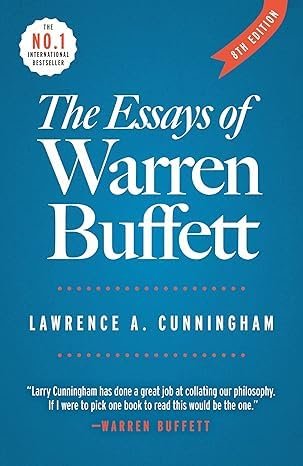
The Essays of Warren Buffett
Watch Prashant Sir break down the economic moat, owner earnings, and why Buffett’s shareholder letters remain the most instructive financial documents produced by any private individual in history.
Why Read The Essays of Warren Buffett?
The Essays of Warren Buffett is not a biography and not a how-to investment manual. It is a thematic compilation of the shareholder letters that Warren Buffett wrote to Berkshire Hathaway’s owners from the 1970s through the 2010s — reorganised by Lawrence Cunningham from chronological correspondence into a coherent intellectual architecture that makes Buffett’s thinking on corporate governance, investment philosophy, financial reporting, and business management available as a unified body of thought. It is the closest thing available to Buffett’s complete philosophy in one volume, and it is more instructive than most of the secondary literature about him because it is in his own voice — the specific combination of clarity, humour, and intellectual precision that makes the annual letters the most widely read financial documents produced by any private individual in history.
The book is organised into sections covering Buffett’s views on corporate governance, finance and investing, common stock, mergers and acquisitions, accounting and taxation, and management principles. Each section draws from relevant letters across decades, allowing the reader to see how Buffett’s thinking developed and remained consistent, and where specific positions evolved in response to experience and changing conditions.
Buffett’s stated aim — to write each letter as though he is writing to a highly intelligent but financially unsophisticated partner — is a model of communication clarity that the essays demonstrate in practice, making them as instructive about business writing as about business itself. The annual letters refuse the obfuscatory language that most corporate communications deploy to obscure rather than illuminate performance.
Who Should Read This
This is essential reading for anyone seriously interested in investing, corporate governance, business valuation, and the intellectual tradition of value investing. CAT and MBA candidates preparing for discussions about capital allocation, corporate governance, and the relationship between shareholder value and long-term corporate health will find in Buffett’s essays both a conceptual framework and a vocabulary more precise than most academic finance texts. Beyond preparation, it belongs on the reading list of every investor, every manager, every board member, and every business student who wants to understand what durable competitive advantage actually means in practice.
Key Takeaways from The Essays of Warren Buffett
The economic moat — the durable competitive advantage that protects a business’s profits from competitive erosion — is the single most important concept in Buffett’s investment framework. A moat can take several forms: brand, cost advantage, network effect, switching cost, or regulatory protection. What all moats share is that they allow a business to earn returns on capital that exceed its cost of capital for an extended period — the specific condition that produces the compounding wealth creation Buffett has spent his career seeking.
The most important financial metric is not earnings per share or revenue growth — it is owner earnings: the cash a business generates that can actually be taken out without diminishing its competitive position. Buffett’s concept of owner earnings distinguishes businesses that report high earnings from businesses that actually generate the cash those earnings imply. The gap between reported earnings and owner earnings is where most investors go wrong.
Mr. Market — Benjamin Graham’s allegorical figure for the stock market — is simultaneously the investor’s best friend and most dangerous adversary. He offers to buy or sell your shares every day at whatever price his mood dictates, which is frequently irrational. The intelligent investor uses Mr. Market’s irrationality as an opportunity rather than a guide — buying when he is depressed, ignoring him when he is manic, never treating market prices as evidence about business value.
Management integrity is not a soft criterion — it is the most important factor in evaluating any investment in a business you do not control. A business with a durable moat and dishonest management will eventually destroy the value its competitive position creates. Buffett’s management evaluation framework — looking for managers who treat shareholder capital as their own, who communicate honestly about failures as well as successes — is the specific due diligence that most investors neglect because it is qualitative rather than quantitative.
Key Ideas in The Essays of Warren Buffett
The essays’ most important structural contribution is their demonstration that investing and managing a business are, at the deepest level, the same activity: both require the accurate assessment of intrinsic value, the rational allocation of capital to its highest-return use, and the specific temperamental qualities — patience, intellectual honesty, the willingness to be different from the consensus — that most people find easier to advocate than to practise. Buffett’s consistent refusal to separate the investor’s perspective from the manager’s perspective is one of the essays’ most instructive qualities, and it is what makes them more useful than either a purely investment-focused or a purely management-focused text.
The corporate governance section is the essays’ most politically significant — and the most continuously relevant to contemporary business conditions. Buffett’s diagnosis of the specific failure modes of corporate boards — the tendency toward groupthink, the reluctance to challenge management, the specific incentive structures that align CEO compensation with short-term stock performance rather than long-term business value creation — was made decades ago and describes conditions that have worsened rather than improved in the intervening period. His model of the ideal board member — someone genuinely independent, genuinely competent in business valuation, and genuinely willing to disagree with management when warranted — remains as aspirational as when he first described it.
The valuation framework is the essays’ most practically instructive section. Buffett’s approach — the discounted cash flow of owner earnings, modified by a margin of safety sufficient to account for the uncertainty inherent in any forecast — is intellectually simple but practically demanding in the specific ways that matter: it requires honest assessment of competitive moats, honest projection of future earnings, and the specific psychological fortitude to act on a valuation that diverges significantly from current market prices. The essays make this framework clear without making it seem easy, which is the honest representation of a method that has produced the best long-term investment track record in history but that most investors who understand it intellectually cannot apply temperamentally.
The accounting and taxation section is the essays’ most technically specific — and the most important for investors who want to understand what financial statements actually reveal and what they systematically obscure. Buffett is particularly acute about the specific ways in which GAAP accounting can produce reported earnings that diverge significantly from economic reality: the expensing of options, the treatment of goodwill, the specific accounting for insurance float, and the ways in which acquisition accounting can manage reported earnings rather than reflect actual economic performance. These sections reward the investment they require with the most precise available account of how to read a financial statement as an investor rather than as an auditor.
Core Frameworks from The Essays of Warren Buffett
Six frameworks run through Buffett’s essays — each developed not as abstract theory but as the distillation of specific investment decisions and their outcomes across six decades of practice.
Core Arguments
Four arguments run through the essays — each directed at a specific inadequacy in how most investors, managers, and boards think about capital allocation, risk, and long-term value creation.
Buffett’s most structurally important argument concerns the specific consequences of the separation between corporate ownership and corporate management. His diagnosis of the specific ways in which this misalignment manifests — CEO compensation that is disconnected from actual value creation, acquisitions made for managerial ego rather than shareholder benefit, the systematic inflation of earnings through accounting choices — is one of the most precise and most unflinching available accounts of how corporate governance actually fails in practice. His proposed remedies — independent boards with genuine authority, long-term incentive compensation tied to actual business performance, transparent financial reporting — are as unimplemented today as when he first proposed them.
One of the essays’ most counter-intuitive arguments is Buffett’s case against excessive diversification for investors who do the work of understanding specific businesses. His argument is that diversification is protection against ignorance: if you genuinely understand a business and are confident in your assessment of its intrinsic value and competitive moat, concentrating your investment in that business is more rational than distributing it across many businesses you understand less well. Academic portfolio theory is correct that diversification reduces volatility; Buffett’s point is that for the investor who has done the work, volatility is not the primary risk — the permanent impairment of capital is — and concentration in genuinely understood, genuinely undervalued businesses reduces the more important risk while increasing the less important one.
The essays’ most continuously relevant argument for contemporary business conditions concerns the specific competitive advantage available to investors and managers willing to think and act on genuinely long-term timeframes. The institutional pressure on most professional investors and public company managers to produce short-term results — quarterly earnings beats, annual returns that compare favourably with benchmarks — systematically biases their capital allocation decisions toward the short-term at the expense of the long-term. Buffett’s willingness to hold businesses indefinitely, to accept short-term underperformance in exchange for long-term compounding, and to make acquisition decisions based on decade-long rather than year-long return expectations constitutes a specific competitive advantage in a market where most participants are systematically short-termist.
One of Buffett’s most consistently made points is the specific economic value of reputation for honesty and fair dealing in business. Buffett’s argument is not primarily ethical — it is economic: a reputation for fair dealing reduces transaction costs, attracts better employees and partners, sustains pricing power in difficult conditions, and compounds over time into a competitive advantage that cannot be acquired quickly regardless of how much capital you invest in its purchase. His account of the specific ways in which Berkshire’s reputation has produced deal flow, acquisition opportunities, and regulatory goodwill is the most practical available demonstration of the economic returns to ethical business practice.
Critical Analysis
A balanced assessment of the most instructive single-volume compilation of investment and management philosophy available — one whose authority derives from the specific fact that its principles have been tested across six decades of practice against actual capital and actual businesses.
The essays preserve the specific quality of Buffett’s prose — plain, precise, frequently funny, and relentlessly honest about the limits of his own knowledge — that makes the annual letters the most widely read financial documents produced by any private individual. The combination of intellectual clarity and human warmth is rare in financial writing and produces a quality of communication that illuminates rather than obscures, which is itself a lesson in how to write about complex topics for a general audience.
The specific value of Cunningham’s compilation is the thematic organisation that transforms the annual letters’ chronological progression into an intellectually coherent body of thought. Reading the letters chronologically reveals how Buffett’s thinking developed; reading the essays thematically reveals the underlying framework that organises the development. Both readings are valuable, and Cunningham’s version enables the second without preventing the first — the letters themselves remain publicly available for chronological reading.
The essays are uniquely credible because they represent not only a coherent investment philosophy but one that has been tested across sixty-plus years of practice against actual capital and actual businesses. Buffett’s recommendations are not derived from theoretical models — they are derived from specific investment decisions, specific business acquisitions, and the specific outcomes those decisions produced. The theory is the distillation of the practice, which gives it an authority that purely academic finance cannot match.
Berkshire Hathaway’s extraordinary long-term performance is exceptional by the standards of all investors — the best long-term investment track record in the history of public markets. The essays describe the philosophy that produced this performance, but the philosophy alone does not account for it — the specific opportunities available to Buffett (the insurance float structure, the regulatory environment of the 1960s–80s, the specific relationships that produced off-market acquisition opportunities) are part of the explanation that the essays’ account of principles cannot fully capture.
The essays describe investment principles that are intellectually clear and practically demanding in ways that make them difficult to replicate for most investors. The circle of competence, the margin of safety, the patience to hold excellent businesses indefinitely — each is simple to understand and requires a specific temperamental formation that most investors, including most professional investors, do not possess and cannot easily develop. The gap between understanding the principles and possessing the temperament to apply them is the specific problem the essays document but cannot resolve.
Several of Buffett’s most important investment insights — the value of concentrated positions in deeply understood businesses, the ability to act decisively when Mr. Market is irrationally pessimistic — are increasingly difficult to apply at the scale Berkshire Hathaway now operates. Buffett himself has acknowledged that Berkshire’s size has reduced its investment returns relative to its earlier decades, and that many of the opportunities that produced its greatest returns are no longer accessible at the scale it must deploy capital. The essays describe a philosophy optimised for a scale of capital smaller than Berkshire currently manages.
Legacy & Cultural Impact
Publication and Adoption: The Essays of Warren Buffett was first published in 1997 and has been through multiple updated editions as Cunningham has incorporated later shareholder letters. It has sold over a million copies, been translated into multiple languages, and become the standard reference for serious students of value investing and corporate governance. It is assigned in MBA programmes at Columbia, Harvard, and other leading business schools, and cited by professional investors across the full spectrum of investment styles as the most instructive single compilation of Buffett’s thinking.
Influence on Business Communication: The annual Berkshire Hathaway shareholder letters that form the essays’ raw material have been freely available on Berkshire’s website for decades, and the practice of reading them has become a standard component of serious investment education. The letters’ influence extends well beyond value investors: Buffett’s plain-English communication standard, his transparent treatment of mistakes alongside successes, and his consistent willingness to say directly what he thinks about corporate governance, financial reporting, and management incentives have established a model of investor communication that has influenced annual reports and shareholder communications across the corporate world.
Impact on Value Investing: The book systematised and made accessible a body of thinking that had previously been available only through the annual letters and through the accounts of students and followers — making the Buffett framework available to a much wider audience than could absorb it from primary sources alone. It contributed directly to the growth of the long-term value investing community that has grown substantially since the book’s first publication, and to the specific revaluation of corporate governance standards that Buffett’s critique of board dysfunction has gradually influenced.
Relevance for Indian Investors and MBA Candidates: Indian equity markets — characterised by a mix of world-class companies with genuine moats and promoter-controlled businesses with significant governance risks — are precisely the environment where the essays’ core lessons are most applicable: the importance of moat identification, the critical role of management integrity assessment, and the specific risk of promoter-controlled businesses where the agency problem is most acute. For Indian MBA students and finance professionals, the essays provide both the conceptual framework for equity analysis and the specific governance criteria that the Indian market’s unique promoter-concentration structure makes particularly important.
Love This Book? Master Every Book.
Stop struggling with reading comprehension. Our proven system transforms how you read—whether for CAT, GRE, GMAT, SAT, or personal growth.
Best Quotes from The Essays of Warren Buffett
It’s far better to buy a wonderful company at a fair price than a fair company at a wonderful price.
Our favourite holding period is forever.
Only when the tide goes out do you discover who’s been swimming naked.
Price is what you pay. Value is what you get.
In the short run, the market is a voting machine but in the long run, it is a weighing machine.
Test Your Understanding
Think you’ve mastered The Essays of Warren Buffett? Challenge yourself with 15 questions on the economic moat, owner earnings, and core frameworks. Score 80%+ to prove your mastery.
The Essays of Warren Buffett FAQ
What is The Essays of Warren Buffett about?
It is a thematic compilation of the annual letters Warren Buffett has written to Berkshire Hathaway shareholders, reorganised by Lawrence Cunningham from chronological correspondence into sections covering corporate governance, investment philosophy, common stock valuation, mergers and acquisitions, accounting, and management principles. It represents the most coherent single-volume presentation of Buffett’s complete investment and management philosophy available, in his own voice and from his own documentation of specific investment decisions and their outcomes.
Is it useful for MBA and CAT preparation?
Directly and specifically — for GD/PI discussions about corporate governance, capital allocation, business valuation, the relationship between short-term and long-term thinking, and the specific failure modes of public company management. The ability to discuss the economic moat, owner earnings, the agency problem, and the margin of safety with the precision the essays provide signals a level of financial literacy that most MBA candidates do not bring to the room. The essays are also the most instructive available model of how to communicate complex financial information in plain English — a transferable skill with direct applications in any business context.
What is the economic moat and why does it matter?
The economic moat is the specific structural feature of a business that protects its profits from competitive erosion over time — what allows it to earn returns on capital that exceed its cost of capital for an extended period. It matters because, in competitive markets, any business earning above-average returns will attract competitors whose entry will eventually erode those returns to normal levels — unless the business has a specific structural barrier (brand, cost advantage, network effect, switching cost, or regulatory protection) that prevents or delays competitive entry. Identifying whether a business has a durable moat — and correctly assessing the moat’s durability over a decade or more — is the single most important judgment in value investing, because it determines whether the current high returns will persist long enough to justify a premium valuation.
What is the difference between reported earnings and owner earnings?
Reported earnings are the bottom-line profit figure that GAAP accounting produces — revenues minus expenses, including depreciation and amortisation. Owner earnings are the cash that can actually be taken out of the business without impairing its competitive position: reported earnings plus depreciation and amortisation minus the capital expenditures required to maintain the business’s current competitive position. The difference matters because many businesses require substantial ongoing capital investment simply to maintain their competitive position — their reported earnings are high but their owner earnings are significantly lower. A business that requires heavy capital reinvestment to stay competitive (airlines, steel mills) has fundamentally worse economics than a business whose competitive position requires minimal maintenance capital (See’s Candies, Coca-Cola), and the gap between reported earnings and owner earnings is the specific measure that reveals this difference.
Should I read the shareholder letters directly or start with this book?
Both, but start with this book. Cunningham’s thematic organisation is the specific intellectual contribution that makes the essays more accessible than the letters alone — it groups Buffett’s thinking by subject rather than by year, which means you encounter the complete argument on each topic (corporate governance, moat identification, accounting, management incentives) in one place rather than scattered across decades of correspondence. Once you have absorbed the framework through the essays, reading the letters chronologically becomes substantially more instructive — you can track how the framework was built, where it was tested, and how specific investments illustrate the principles rather than encountering the principles embedded in the year-by-year context without the framework to organise them. Over sixty years of Berkshire letters are freely available at berkshirehathaway.com and represent one of the most valuable free educational resources in business.








