

Why Read Principles?
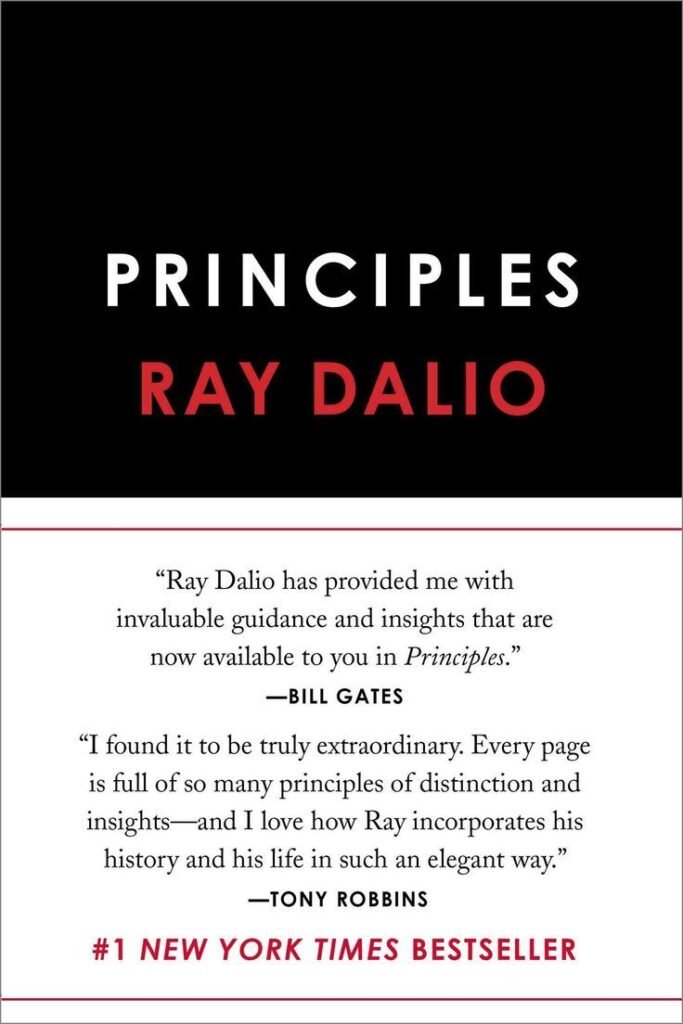
Principles is not a conventional business book. It is Ray Dalio’s attempt to do something genuinely unusual: to make explicit the decision-making frameworks that most successful people keep implicit, to write down the beliefs about reality, human nature, and organisational design that produced Bridgewater Associates — the world’s largest and most consistently successful hedge fund — and to offer them not as inspiration but as a system. The book is demanding, repetitive, and occasionally grandiose. It is also one of the most intellectually serious attempts at codifying a philosophy of effective living that has been published in the business genre.
The book is structured in three parts: a memoir covering Dalio’s life from his Long Island childhood through Bridgewater’s founding and near-collapse in 1982 to his eventual status as one of the world’s wealthiest investors; a section on Life Principles — Dalio’s framework for thinking about reality, decision-making, and personal evolution; and a section on Work Principles — his detailed operating system for building an organisation characterised by what he calls “radical transparency” and “an idea meritocracy.”
Dalio’s central concept — radical transparency — is the book’s most challenging and most discussed idea. At Bridgewater, meetings are recorded, disagreements are made explicit and public, and the most uncomfortable conversations are actively sought rather than avoided. Dalio argues that most organisational dysfunction comes from the gap between what people say publicly and what they believe privately — and that closing that gap, however painful, produces better decisions and stronger institutions than the social politeness that keeps it open.
Who Should Read This
This is essential reading for anyone serious about building organisations, making high-stakes decisions under uncertainty, or developing a systematic approach to self-improvement. MBA candidates will find it invaluable for interview questions about leadership philosophy, organisational culture, and decision-making under uncertainty. Beyond preparation, it is required reading for founders building company culture, investors developing investment frameworks, and any leader who suspects that their organisation’s biggest problems are the ones nobody is saying aloud.
Key Takeaways from Principles
Reality is not your enemy — your resistance to seeing it clearly is. Dalio’s most foundational principle is that embracing reality, however uncomfortable, is the first requirement of effective decision-making. Most people and organisations construct elaborate defences against uncomfortable truths; Dalio argues that the energy spent on those defences is the primary source of preventable failure. Pain plus reflection equals progress — but only if you face the pain directly.
Your biggest enemy in decision-making is not external — it is the specific configuration of your own psychology. Dalio argues that every person has predictable cognitive and emotional blind spots, and that the greatest leverage available to any decision-maker is an accurate understanding of their own weaknesses. A machine that knows its own failure modes can compensate for them; one that does not will be destroyed by them.
Radical transparency is not the same as radical honesty — it is a structural commitment, not a conversational style. Dalio’s transparency operates through systems: recorded meetings, explicit performance metrics, structured disagreement protocols. The point is to design an organisation where the information required for good decisions cannot be suppressed by social hierarchy, ego protection, or institutional politeness.
The most powerful way to improve outcomes is to treat your organisation — and yourself — as a machine that can be designed, observed, diagnosed, and improved. Dalio’s “machine” metaphor is his most distinctive conceptual contribution: the ability to move between operating the machine and observing it from above — shifting from first-person actor to third-person observer of your own behaviour — is the single most leverageable skill in both personal and organisational development.
Key Ideas in Principles
The book’s intellectual architecture rests on a single foundational conviction: that reality operates according to principles, that those principles can be discovered through careful observation and honest reflection, and that once discovered and codified they can be applied systematically to produce better outcomes than intuition, convention, or borrowed wisdom alone. Dalio is making an engineering claim: the world, including human psychology and organisational behaviour, follows patterns, and the person who maps those patterns and builds systems to navigate them will outperform the person who operates from improvisation and gut feeling.
The memoir section establishes the experiential foundation for this claim. In 1982, Dalio predicted a depression that did not materialise, lost everything, had to borrow money from his father, and was forced to let go of all of Bridgewater’s employees. He describes this as the most important experience of his professional life — not because it was painful but because the specific failure it produced forced him to examine exactly what he had done wrong and why his mental model of reality had been so catastrophically incorrect. The principles that eventually built Bridgewater into a $160 billion fund were born directly from that failure — from the discipline of asking “what is true” rather than “what do I want to be true.”
The Life Principles section is organised around what Dalio calls the Five-Step Process: identifying your goals; identifying the problems that stand between you and those goals; diagnosing the root causes of those problems; designing plans to address those root causes; and executing those plans with sufficient discipline to produce change. Dalio’s specific contribution is the emphasis on diagnosis before design: most people skip from problem to plan without understanding what actually produced the problem, which is why most plans fail to solve it.
The Work Principles section operationalises the Life Principles in an organisational context. Dalio’s concept of the idea meritocracy is the central organising principle: an organisation in which the best ideas win regardless of their source, in which authority derives from demonstrated competence rather than hierarchy, and in which the mechanisms for surfacing and evaluating ideas are explicitly designed rather than left to emerge from social dynamics. This requires radical transparency, believability-weighted decision-making, and systematic management of the human tendency toward ego protection — the single most consistent source of dysfunction in organisations built around intelligent, high-performing people.
Core Frameworks in Principles
Dalio builds a genuine system — five interlocking frameworks that together constitute an operating philosophy for personal decision-making, organisational design, and the management of failure and growth.
Core Arguments
Dalio advances four interconnected arguments — about the value of systematising principles, the case for radical transparency, evolution as the operating logic of reality, and the design of the idea meritocracy — each grounded in specific Bridgewater experience and each with direct implications for how organisations and individuals should operate.
Dalio’s foundational argument is that most successful people operate according to principles they have never made explicit — principles that live in their intuitions, their habits, and their automatic responses to situations. Making those principles explicit serves two purposes: it allows you to examine them for consistency and accuracy, identifying where your intuitions are trustworthy and where they are systematically distorted; and it allows you to transmit them to others, building organisations that operate from shared frameworks rather than from the idiosyncratic judgments of individual leaders. The book itself is the argument’s proof of concept — the attempt to make one unusually successful person’s operating system legible, examinable, and transmissible.
Dalio’s most contentious argument is that the social politeness that characterises most organisations — the avoidance of direct criticism, the softening of negative feedback, the silence around uncomfortable truths — is not kindness but a form of collective self-harm. Every uncomfortable truth that goes unsaid is a decision made on incomplete information. Radical transparency does not mean cruelty; it means designing systems in which uncomfortable information cannot be suppressed by social dynamics. The argument is strongest when Dalio grounds it in specific Bridgewater decisions that were better for having been made in the open; it is weakest when it tips into a philosophy of organisational culture that few institutions can or should replicate exactly.
Dalio’s philosophical framework positions evolution — the continuous loop of encountering obstacles, adapting to them, and emerging stronger — as the fundamental operating principle of both biological and human systems. The individual or organisation that treats failure as information rather than verdict will consistently outperform the one that treats failure as threat. This is not optimism; it is a structural claim about the relationship between adversity and adaptation. The specific mechanism — pain triggers reflection, reflection produces better mental models, better mental models produce better decisions — is the engine of everything Dalio recommends, and it applies with equal force to a single bad trade, a career setback, and an organisational culture that has stopped learning.
Dalio argues that the conventional organisational hierarchy — in which authority and information flow along seniority lines — is a profoundly inefficient decision-making structure, because it systematically discounts the ideas of people with relevant knowledge in favour of the opinions of people with institutional power. An idea meritocracy does not eliminate hierarchy — it changes the basis on which authority is assigned. Authority derives from demonstrated competence and track record, not from title or tenure. The practical challenge — which Dalio acknowledges but does not fully resolve — is that designing and maintaining such a system requires enormous organisational investment and depends heavily on the willingness of powerful people to genuinely subject their ideas to challenge from below.
Critical Analysis
A balanced assessment examining the book’s genuine intellectual seriousness and empirical grounding alongside its length problems, the gap between Bridgewater’s described and reported culture, and the context-dependence of its most demanding prescriptions.
The memoir section is one of the most honest accounts of catastrophic professional failure — and the specific cognitive errors that produced it — published by someone of Dalio’s stature. Most business books at this level are written from triumphant retrospection; Dalio’s account of 1982 is written with the specificity of a man who spent decades examining exactly what went wrong and why. This honesty gives the subsequent principles genuine credibility.
Unlike most business books that offer principles as aphorisms, Dalio builds a genuine system — each principle connects to others, the Life Principles provide the philosophical foundation for the Work Principles, and the whole has internal logic. Whether one agrees with the system or not, it is the real thing: a coherent, testable philosophy of decision-making rather than a collection of motivational assertions.
The principles are not theoretical constructions — they are the operational framework of an organisation that produced industry-leading returns across four decades and multiple market cycles. This empirical grounding distinguishes Principles from the genre of business philosophy books that offer wisdom without evidence of application at scale.
At 592 pages, the book is substantially longer than its intellectual content requires. The Work Principles section contains significant repetition — variations of the same core ideas elaborated across hundreds of sub-principles. A disciplined editor would have produced a more effective book at half the length. Many readers find the second half an endurance test rather than an intellectual reward.
Dalio’s principles of radical transparency and meritocracy are presented as universal wisdom, but Bridgewater’s actual culture has been described by former employees and investigative journalists in terms considerably less flattering — including psychological pressure and cult-like conformity requirements. The book does not engage with these accounts, which is its most significant credibility gap.
The principles are presented as universal, but many are most naturally applicable in a specific context: a high-performing, financially sophisticated organisation populated by people who have self-selected into a demanding culture and are compensated at the top of their profession. The radical transparency principle, in particular, is difficult to implement in organisations with power differentials that Bridgewater’s compensation structure neutralises.
Literary & Cultural Impact
Immediate Bestseller, Lasting Influence: Principles was published in September 2017 and immediately became one of the bestselling business books of the decade — debuting at number one on the New York Times bestseller list, selling over three million copies in its first year, and being translated into thirty languages. It confirmed Dalio’s position not merely as one of the world’s most successful investors but as one of its most prominent public philosophers of business.
Language That Entered the Mainstream: The book’s influence on the technology and finance communities was substantial and immediate. Silicon Valley founders and executives widely adopted the language of “radical transparency” and “idea meritocracy” — though critics noted that the adoption was often more verbal than structural, and that calling an organisation an idea meritocracy does not make it one. The principle of believability-weighted decision-making influenced a generation of organisational designers trying to build systems that could aggregate the knowledge of high-performing individuals without being dominated by the loudest or most senior voice.
The Critical Response: The book also generated significant critical response. Investigative reporting on Bridgewater’s actual culture — particularly a 2017 Wall Street Journal investigation — painted a picture of an organisation in which radical transparency sometimes functioned as a tool of management control rather than genuine intellectual openness. The debate between the book’s admirers and critics is itself a productive application of its central principle: what is actually true here, and how do we know?
A Body of Work in Progress: Dalio has subsequently published Principles for Navigating Big Debt Crises (2018) and The Changing World Order (2021) — extensions of his analytical framework into macroeconomic and geopolitical territory. Whether one finds the overall project admirable, useful, or grandiose depends significantly on how much confidence one places in any individual’s ability to codify reality into a set of principles comprehensive enough to be genuinely useful across the full range of situations that reality provides. Principles remains the foundation — the most complete statement of the operating system, and the most honest account of the failures that made it necessary.
Love This Book? Master Every Book.
Stop struggling with reading comprehension. Our proven system transforms how you read—whether for CAT, GRE, GMAT, SAT, or personal growth.
Best Quotes from Principles
Pain plus reflection equals progress.
The biggest threat to good decision-making is harmful emotions, and I’ve learned that most people don’t even know that they are their own worst enemies.
Radical open-mindedness and radical transparency are invaluable for rapid learning and effective change.
If you’re not failing, you’re not pushing your limits, and if you’re not pushing your limits, you’re not maximising your potential.
Everyone has weaknesses and they are generally revealed in the patterns of their mistakes. The fastest path to success starts with knowing what your weaknesses are and staring hard at them.

Test Your Understanding
Think you’ve mastered Principles? Challenge yourself with 15 questions on radical transparency, the Five-Step Process, believability-weighted decision-making, and the idea meritocracy. Score 80%+ to prove your mastery.
Principles FAQ
What is Principles about?
It is Ray Dalio’s codification of the beliefs about reality, decision-making, and organisational design that he used to build and manage Bridgewater Associates. Structured in three parts — a memoir of his career and formative failures, Life Principles for personal decision-making, and Work Principles for organisational design — it argues that making one’s operating principles explicit, examining them rigorously, and applying them systematically produces better outcomes than intuition, convention, or borrowed wisdom alone.
Is it useful for MBA and CAT preparation?
Very much so — particularly for leadership, organisational behaviour, and decision-making questions in interviews and group discussions. Dalio’s frameworks — radical transparency, believability-weighted decision-making, the idea meritocracy, the Five-Step Process — are specific, well-articulated, and immediately applicable to case discussions. The ability to discuss organisational culture through Dalio’s lens, including its criticisms, signals a level of intellectual seriousness that distinguishes strong MBA candidates.
What is radical transparency and does it actually work?
Radical transparency is Dalio’s principle that all relevant information — including performance evaluations, meeting recordings, and disagreements — should be available to all members of an organisation. The argument is that decisions made on complete information are better than decisions made on filtered information. Whether it works depends heavily on context: it appears to have worked at Bridgewater, where culture, compensation, and self-selection created specific conditions for it. Critics and former employees have raised serious questions about whether the reality matched the principle, and the book does not engage with those questions.
What is the most important principle in the book?
“Pain plus reflection equals progress” is the book’s most compact and most universally applicable principle. It encodes the entire learning philosophy: that failure and discomfort are not signals to protect against but information to be extracted through honest reflection. Most people experience the pain but skip the reflection — they protect their ego rather than update their mental model. The entire book is, in some sense, an elaboration of this single principle applied to personal development, decision-making, and organisational design.
How does Principles compare to other business self-help books?
It is considerably more intellectually serious than most of the genre and considerably more demanding to read. Unlike books that offer wisdom as inspirational aphorisms, Dalio builds a genuine system — internally consistent, grounded in specific empirical experience, and specific enough to be tested and challenged. Its limitations — length, repetition, the gap between Bridgewater’s described and reported culture — are real. But as an attempt to make a successful person’s actual operating philosophy explicit and transmissible, it is without close comparison in the business genre.








