
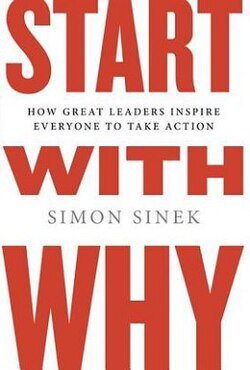
Why Read Start with Why?
Start with Why is built around one of those ideas that feels obvious the moment you encounter it and yet reorganises everything you thought you understood about leadership, marketing, and human motivation. Simon Sinek’s central claim — that inspired leaders and organisations communicate from the inside out, starting with purpose rather than product — is simple enough to state in a sentence and deep enough to spend a career applying. The book is the extended argument for why that sentence is true.
Sinek’s framework, which he calls the Golden Circle, places WHY at the centre, HOW in the middle ring, and WHAT on the outside. Most companies communicate from the outside in — here is what we make, here is how we make it, please buy it. A few exceptional companies and leaders communicate from the inside out — here is what we believe, here is how we live that belief, and what we make is simply the proof of it. The difference in outcomes between these two approaches, Sinek argues, is not marginal — it is the difference between transactions and loyalty, between customers and believers, between managed organisations and inspired movements.
The book draws on neuroscience to ground its argument: the WHY speaks to the limbic brain — the part responsible for emotion, trust, and decision-making — while the WHAT speaks only to the neocortex, the rational brain that can process information but cannot by itself produce commitment. Apple, Martin Luther King, the Wright Brothers — these are Sinek’s primary case studies, and he returns to them throughout with consistent analytical purpose.
Who Should Read This
This is one of the most accessible entry points into serious thinking about leadership, organisational culture, and brand strategy. MBA and CAT candidates will find it particularly valuable for GD/PI preparation — the Golden Circle framework is versatile enough to apply to almost any question about leadership, purpose, or organisational behaviour. Beyond exam preparation, it is essential for entrepreneurs defining their brand positioning, managers trying to build team alignment, and anyone who has ever wondered why some leaders inspire and others merely manage.
Key Takeaways from Start with Why
People do not buy what you do — they buy why you do it. Apple’s customers are not loyal because Apple makes superior computers; they are loyal because Apple stands for challenging the status quo and thinking differently. The product is the proof of the belief, not the belief itself. Competitors can replicate the product far more easily than they can replicate the conviction behind it.
The decision to trust or commit is made in the limbic brain — the part that has no capacity for language. This is why rational arguments, however well constructed, so often fail to produce commitment. You cannot argue someone into believing in you; you can only give them something to believe in. The Golden Circle works because it speaks to the part of the brain that actually makes decisions of loyalty and trust.
The Law of Diffusion of Innovation explains why WHY matters most at the beginning. Innovators and early adopters — the roughly 15–18 percent of any market that adopts first — make decisions based on belief, not evidence. They try new things because of what those things say about who they are, not because of feature comparisons. Crossing the chasm from early adopters to early majority requires clarity of WHY, not improvement of WHAT.
Clarity of WHY must be followed by discipline of HOW and consistency of WHAT — or the WHY becomes empty rhetoric. Sinek is careful to note that knowing your WHY is not sufficient; it must be actively expressed through every decision, every hire, every product, and every communication. The gap between stated purpose and enacted purpose is where organisational trust collapses.
Key Ideas in Start with Why
The book’s central idea is the Golden Circle — three concentric rings labelled, from outside to inside, WHAT, HOW, and WHY. Every organisation knows what it does — the products it sells, the services it offers. Most organisations also know how they do it — the processes, the differentiators, the value propositions. Very few organisations can clearly articulate why they do it — not as a financial goal (profit is a result, not a purpose) but as a belief, a cause, a reason for existing that would remain true even if the product changed entirely.
Sinek’s argument is that inspiration flows from the inside out. Apple does not begin its communications by saying “We make great computers.” It begins, implicitly, with “We believe in challenging the status quo. We believe in thinking differently.” The computer is the current proof of that belief — it could, in principle, be any product. This is why Apple customers buy iPods, iPhones, and Apple TVs with the same loyalty they brought to Macs: they are buying the belief, and the product is incidental to it.
The neuroscience grounding is the book’s most important structural support. The limbic brain — the brain’s older, deeper structures — controls emotion, trust, gut feelings, and decision-making but has no capacity for language. The neocortex controls rational thought and language but is not the primary decision-making structure for choices involving trust and commitment. When a company communicates from the outside in — features, benefits, price — it speaks only to the neocortex. When it communicates from the inside out — belief, purpose, cause — it speaks to the limbic brain, where actual commitment is produced. This is not manipulation; it is alignment with how human beings are biologically constructed to make decisions about trust.
The Law of Diffusion of Innovation — Everett Rogers’s finding that adoption curves follow a bell distribution from innovators through laggards — is Sinek’s second major supporting framework. Innovators and early adopters, who constitute the first 15–18 percent of any market, make decisions based on personal identity and belief alignment rather than evidence and practicality. They are the ones who queue overnight for a new Apple product, not because it is demonstrably superior but because owning it says something true about who they are. The crossing of the tipping point — from early adopters to early majority — happens only when the WHY is clear enough that the early majority can understand, on emotional terms, why the early adopters are so committed. Without clarity of WHY, crossing the chasm is a marketing problem. With it, the crossing becomes organic.
Core Frameworks in Start with Why
Sinek builds his argument around five interlocking frameworks — each explaining a different dimension of why purpose-led communication produces inspiration while product-led communication produces only transactions.
Core Arguments
Sinek advances four interconnected arguments — about the biological basis of trust, the mechanics of loyalty, the WHY vs. HOW split in scaling organisations, and the importance of finding purpose early — each with direct implications for how leaders and brands should communicate.
Sinek’s foundational argument is supported by the Apple case study. Apple and Dell both make computers. Dell is more efficient, has better distribution, and for much of its history has had competitive pricing. Yet Apple inspires a loyalty that Dell has never approached. The difference is not product — it is that Apple’s communications begin with a belief (think differently, challenge the status quo) while Dell’s begin with a product specification. Loyalty is produced when customers see their own values reflected in a brand’s WHY, not when they calculate that the brand’s WHAT is superior.
Sinek’s neuroscience argument — that the limbic brain makes decisions of trust and commitment while the neocortex processes rational information — is the book’s most important structural support and its most contested claim. The argument explains the persistent gap between what people say drives their decisions (rational factors) and what actually drives them (emotional alignment). The implication for leaders is that rational argument alone will never produce genuine followership — it will produce compliance, which is entirely different. Compliance is what you get when people follow because they have to; inspiration is what you get when they follow because they want to.
One of the book’s most effective case studies contrasts the Wright Brothers — bicycle mechanics with limited funding, driven purely by the belief that powered flight would change the world — with Samuel Langley, a well-funded, credentialed academic who pursued flight primarily for the prestige and professional advancement it would bring. Langley had the resources, the connections, and the credentials. The Wright Brothers had the WHY. The argument is that a team motivated by WHY, even with inferior resources, will consistently outperform a well-resourced team motivated primarily by what success will bring them.
Sinek argues that organisations and leaders who lose touch with their WHY — through growth, success, or the gradual replacement of founding culture with professional management — become increasingly dependent on manipulation tactics to sustain their market position. The loss of WHY is not always visible immediately; it often shows up first in employee disengagement, then in brand commoditisation, then in competitive vulnerability. The time to clarify WHY is not when the brand is already struggling but before the organisation has grown large enough to dilute it — because once the HOW people have taken over, the restoration of WHY requires a crisis or a founder’s return.
Critical Analysis
A balanced assessment examining the Golden Circle’s genuine elegance and practical utility alongside its over-reliance on Apple, its limited prescriptive guidance, and its simplified neuroscience.
The Golden Circle is one of the most elegant and genuinely useful frameworks in popular business literature. It is simple enough to explain in ninety seconds and rich enough to generate years of application. Its visual representation — three concentric circles — makes it immediately memorable, which is itself a demonstration of communicating from the inside out.
By anchoring the WHY argument in limbic brain function, Sinek gives his claim a biological foundation that makes it more than a motivational assertion. The distinction between the part of the brain that processes rational information and the part that produces commitment is genuinely illuminating, even if Sinek’s neuroscience is somewhat simplified.
The book draws from business (Apple, Southwest Airlines, Harley-Davidson), social movements (Martin Luther King’s “I Have a Dream” speech), science (the Wright Brothers vs. Langley), and sport — a range that makes the Golden Circle feel like a genuine principle rather than an industry-specific observation.
Apple appears on almost every other page as the primary example of WHY-led communication, which becomes repetitive and raises the question of survivorship bias — we notice Apple’s WHY-led success because Apple succeeded spectacularly, but there are presumably many companies with clear WHYs that failed for other reasons. The book does not engage with this objection.
Sinek’s most common criticism is that identifying a company’s WHY is straightforward when the company is already successful (Apple clearly believes in challenging the status quo), but the book offers limited practical guidance for founders and leaders trying to articulate their WHY before the evidence of success has made it obvious. The framework is more diagnostic than prescriptive.
The limbic brain/neocortex distinction is real but considerably more complex than Sinek presents it. Neuroscientists have critiqued the book for oversimplifying brain function in ways that make the argument more tidy than the science supports. The practical implications of the argument are sound, but readers who pursue the neuroscience further will find a more complicated picture than the book suggests.
Literary & Cultural Impact
One of the Most-Watched TED Talks in History: Start with Why was published in 2009, the same year Sinek delivered what would become one of the most-watched TED talks ever. The eighteen-minute talk — “How Great Leaders Inspire Action” — has been viewed over sixty million times and introduced the Golden Circle to an audience far larger than any book could have reached alone. The talk created the audience; the book gave the audience somewhere to go for depth. Together they constitute one of the most effective idea-distribution strategies in the modern business communication landscape.
Language That Entered the Mainstream: The book’s influence on marketing and brand strategy has been substantial. The language of WHY — “purpose-driven brands,” “mission-led organisations,” “values-first marketing” — entered the mainstream business vocabulary in the decade following publication. Agencies began structuring brand strategy documents around WHY/HOW/WHAT. Business school curricula incorporated the Golden Circle. Leadership development programmes built workshops around finding organisational purpose.
Purpose Washing and the Book’s Confirmation: The book’s limitations have also generated a productive secondary literature. Critics have noted that “purpose washing” — the performance of WHY without the substance — has become its own commercial strategy, producing brands that claim to stand for values they do not actually enact. This critique does not invalidate Sinek’s argument; it confirms it. The difference between authentic WHY and performed WHY is precisely what the book predicts will be visible over time: authentic purpose produces loyalty; performed purpose produces cynicism when the gap between claim and conduct becomes undeniable.
Foundation of a Body of Work: Sinek’s subsequent books — Leaders Eat Last (2014) and The Infinite Game (2019) — extended the WHY argument into organisational culture and long-term competitive thinking respectively, building a body of work that established him as one of the most influential popularisers of leadership thinking of the past two decades. Start with Why remains the foundation and the best of the trilogy.
Love This Book? Master Every Book.
Stop struggling with reading comprehension. Our proven system transforms how you read—whether for CAT, GRE, GMAT, SAT, or personal growth.
Best Quotes from Start with Why
People don’t buy what you do; they buy why you do it. And what you do simply proves what you believe.
The goal is not to do business with everybody who needs what you have. The goal is to do business with people who believe what you believe.
There are only two ways to influence human behavior: you can manipulate it or you can inspire it.
Leadership requires those who lead to forgo all the perks and benefits so that the people in the organisation feel safe and feel they belong.
Working hard for something we don’t care about is called stress. Working hard for something we love is called passion.
Test Your Understanding
Think you’ve mastered Start with Why? Challenge yourself with 15 questions on the Golden Circle, the Law of Diffusion of Innovation, the biological basis of trust, and why purpose drives loyalty while product drives only transactions. Score 80%+ to prove your mastery.
Start with Why FAQ
What is Start with Why about?
It argues that the most inspiring leaders and organisations — Apple, Martin Luther King, the Wright Brothers — communicate from the inside out: they begin with WHY (their belief or purpose), move to HOW (how that belief is enacted), and arrive at WHAT (the product or service) last. Most organisations communicate in the reverse direction, which produces transactions but not loyalty. The book explains why this difference exists, grounds it in neuroscience, and illustrates it through case studies across business, social movements, and science.
Is it useful for MBA and CAT preparation?
Highly so, particularly for GD/PI preparation. The Golden Circle framework is one of the most versatile analytical tools available for discussing leadership, brand strategy, organisational culture, and the difference between management and inspiration — topics that appear consistently in MBA interview and group discussion contexts. The book’s core argument can be applied to almost any business case or leadership question with genuine analytical force.
What is the Golden Circle?
The Golden Circle is Sinek’s central framework — three concentric circles representing WHAT (the outermost ring: products and services), HOW (the middle ring: processes and differentiators), and WHY (the innermost circle: purpose, belief, or cause). Inspired organisations communicate from WHY outward; most organisations communicate from WHAT inward. The direction of communication determines whether the audience feels sold to or called to. It is simple enough to sketch on a napkin and deep enough to structure an entire organisational strategy.
How is Start with Why different from conventional marketing thinking?
Conventional marketing thinking begins with the product — its features, benefits, and price — and works outward toward the customer. Sinek’s framework inverts this: begin with the belief, then demonstrate how the product is the proof of that belief. The practical difference is significant — a product-first brand must continuously justify itself through feature comparison; a belief-first brand creates customers who defend it, advocate for it, and forgive its occasional failures because their loyalty is to the WHY, not to any specific WHAT.
What is the book’s most important practical lesson?
That clarity of purpose is not a communications strategy — it is an organisational filter. When you know your WHY, every decision — who to hire, what products to build, which partnerships to pursue, how to respond to a crisis — becomes faster and more consistent because the standard is clear. The Celery Test is the most compact expression of this: when you know what you stand for, you know immediately what to take and what to leave at the party. Organisations without a clear WHY must evaluate every significant decision from first principles; organisations with one can move with the consistency and speed that clarity of purpose provides.








