

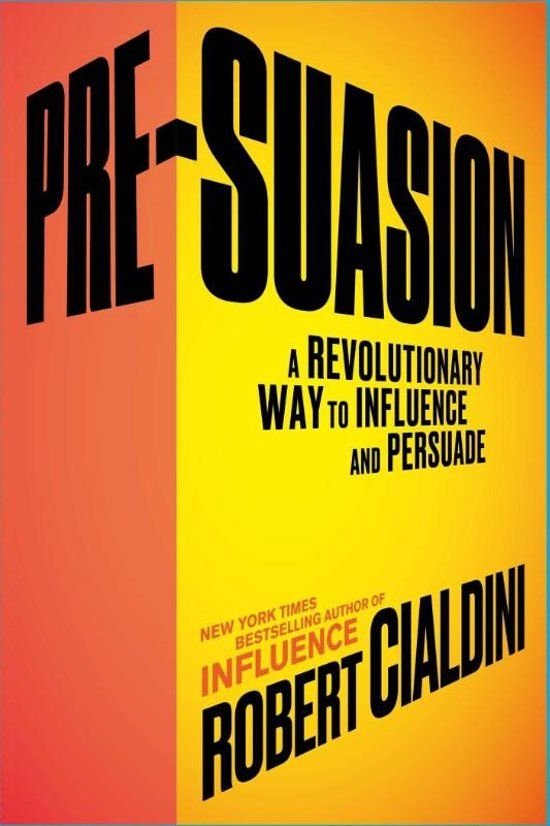
Why Read Pre-Suasion?
Pre-Suasion is the most important development in persuasion science since Influence — a book that extends Cialdini’s foundational framework by shifting focus from the content of a persuasive message to what happens in the moments immediately before it is delivered. Published in 2016, thirty-two years after Influence, it draws on a further generation of social psychology research to make a counterintuitive but empirically grounded argument: that the most skilled persuaders spend less time perfecting their message and more time engineering the psychological state of their audience in the moment before the message arrives. Pre-suasion is the art of the privileged moment.
The book’s central concept is deceptively simple: the psychological state a person is in immediately before receiving a message substantially determines how they respond to it. A person primed to think about safety will evaluate safety features more positively. A person who has just agreed to a small request will be more likely to agree to a larger one. These effects are large, measurable, and systematically exploitable — and they operate entirely outside the awareness of the person being pre-suaded.
Cialdini spent four years undercover in advertising agencies, PR firms, fundraising organizations, and political campaigns to understand how pre-suasion works in practice. What he found was that skilled influence practitioners consistently engage in a two-stage process: first, they capture attention and direct it to specific concepts or associations; then, with those concepts made temporarily salient, they present their message. The message works not because it is intrinsically more compelling but because the audience’s psychological state has been engineered to make it so.
Who Should Read This
This is a book for anyone who has read Influence and wants the next level — who wants to understand not just the mechanisms of persuasion but the temporal architecture of how skilled persuaders deploy them. Essential for students of psychology and communication; marketing, sales, and leadership professionals; CAT/GRE aspirants; and anyone who wants to understand what the most skilled persuaders do before they say a word. Read Influence first.
Key Takeaways from Pre-Suasion
What captures attention in the moment before a message arrives becomes, temporarily, what matters most — the concept primed in the audience’s mind shapes how every subsequent piece of information is processed. Cialdini calls this the “channeled attention” effect: whatever occupies a person’s attention in a privileged moment is perceived as more important and more decision-worthy than it would otherwise be. Pre-suaders exploit this by carefully engineering what their audience is thinking about in the seconds before the persuasive message lands.
Association is the primary mechanism of pre-suasion — connecting your message to concepts, feelings, or identities that already have positive valence makes the message inherit that valence. The images on a fundraising website, the background music in a wine shop, the name of a street — all pre-suade by activating associations that the message then inherits. These effects are large, measurable, and entirely outside the audience’s awareness.
Unity — the sense of shared identity between communicator and audience — is the most powerful pre-suasive force and the seventh principle of influence Cialdini added in the 2021 update of Influence. When people perceive themselves as part of the same group as the person communicating with them, they are dramatically more receptive to that person’s message. “We” is the most powerful pre-suasive word in the language.
The channel of attention is not neutral — it changes the processor as well as the processed. People primed with words associated with rudeness interrupt more frequently. Primed with images of businesspeople, people become more competitive. Primed with images of libraries, people become quieter. Pre-suasion does not merely change what people notice; it temporarily changes who they are.
Key Ideas in Pre-Suasion
The book’s foundational insight emerges from a simple but profound observation about how human attention works: we do not process all available information simultaneously and then choose what to respond to — we process sequentially, and what we are attending to in any given moment shapes everything that follows. When attention is captured by a concept, that concept becomes temporarily more important, more salient, and more decision-relevant than it would otherwise be — regardless of whether it has any logical relationship to the subsequent decision. Pre-suasion is the art of engineering what concept occupies the audience’s attention in the moment before the message arrives.
Cialdini’s fieldwork in advertising agencies is the book’s most vivid source material. He observed that the best creative teams spent at most a quarter of their time perfecting message content — the remaining three-quarters was devoted to finding the right opening image, the right first impression, the right set of associations to activate before the message was delivered. A television advertisement that opened with a cheetah running (speed, grace, power) before showing the car was not merely adding a pleasant image — it was engineering the psychological state in which the car’s speed and handling would be evaluated. The cheetah was not an illustration; it was a pre-suasive instrument.
The scientific foundation of the framework is priming research — decades of experimental findings establishing that: (a) activation of a concept spreads automatically to related concepts (spreading activation); (b) recently and frequently activated concepts are more likely to influence subsequent judgments (accessibility); (c) these effects operate outside conscious awareness; and (d) they produce measurable changes in behavior, not just in reported attitudes. Pre-suasion is the strategic application of priming: deliberately activating the concepts whose spread will make the subsequent message more compelling.
The book extends the pre-suasion framework from the moment before a specific message to the longer-term cultivation of psychological states that make people chronically more receptive to a communicator’s influence. The concept of “unity” — the perception of shared group membership between communicator and audience — is particularly important here: a communicator who has established genuine unity with their audience does not need to engineer a pre-suasive moment before every message, because the shared identity continuously pre-suades the audience toward receptivity.
Core Frameworks in Pre-Suasion
Cialdini organises the pre-suasion argument around six interlocking frameworks — from the foundational mechanics of attention to the ethics of influence.
What people are attending to at a given moment is, temporarily, what matters most — not because of objective importance but because of cognitive accessibility. When a fundraiser’s website opens with a child’s face, subsequent requests for donations to specific identified children are more successful. The image hasn’t changed the message; it has changed the audience’s psychological state. Cialdini calls the window immediately before the message the “privileged moment” — when pre-suasion is most powerful.
Human semantic memory is an associative network: activating one concept automatically spreads activation to related concepts. Priming “fast” activates sleek, efficient, powerful; priming “safe” activates reliable, protective, trustworthy. Pre-suasion exploits this by activating concepts whose associated network contains the attributes the persuader wants applied to their message. French wine sells better with French accordion music playing — not through conscious connection but through automatic conceptual spread.
Unity goes beyond liking: it is not merely that we prefer similar people but that we feel we are the same people — sharing an identity, a “we.” This creates a powerful and durable pre-suasive condition: dramatically more receptivity to messages from people we perceive as part of our own group. Communicators who cultivate genuine unity — through shared experience, honest self-disclosure, and authentic concern for the audience’s welfare — pre-suade continuously, not just in the moment before each message.
Cialdini identifies several categories of openers that capture attention and direct it toward pre-suasive concepts: mystery (an unexplained phenomenon demanding resolution); self-relevance (the audience’s own name or identity); incomplete information (the Zeigarnik effect — unfinished tasks demand cognitive completion); evolutionary salience (sex and threat). The most effective openers capture attention in a way that is conceptually consistent with the pre-suasive content, so the attention itself begins doing pre-suasive work before the explicit message arrives.
Priming effects are temporary — activation fades as time passes and other concepts are activated. A person pre-suaded toward a commitment will return to baseline as the privileged moment recedes. Cialdini addresses this through three durability mechanisms: commitment (a concrete action that anchors a new self-concept); social proof (connecting the person to others who made the same commitment); and identity labeling (“you’re the kind of person who…”), each of which extends the pre-suasive effect beyond the privileged moment.
Cialdini distinguishes between pre-suasion that serves the audience’s genuine interests (a doctor who establishes unity before delivering difficult advice) and pre-suasion that exploits psychological vulnerabilities for the persuader’s benefit at the audience’s expense. The key distinction: does the pre-suasive effect align the audience’s temporary psychological state with their authentic, considered interests — or systematically diverge from them? Understanding pre-suasion is both a tool for ethical communication and a defense against its misuse.
Core Arguments
Cialdini advances four interlocking arguments that together reframe persuasion as a temporal problem — one whose most important work happens before the message arrives.
Pre-Suasion’s central argument challenges the dominant model of persuasion as a content problem. Most communication training and marketing practice focuses on what to say — how to construct the argument, how to frame benefits, how to handle objections. Cialdini’s argument is that this focus is misallocated: the audience’s receptivity to any message is substantially determined before the message arrives, by what they are thinking about and attending to in the privileged moment. The pre-message moment is not the prelude to persuasion; it is its foundation.
One of the book’s most precisely stated theoretical claims is that what captures attention in a given moment is perceived, temporarily, as what matters most — not because of any logical relationship between the attended concept and its importance but because of the cognitive architecture of attention itself. Any communicator who controls what their audience is attending to in the moments before their message controls, to a substantial degree, how important that message will seem. The pre-suader who opens with a safety-related image before presenting a product with excellent safety features has not added information; they have changed what kind of information seems most decision-relevant.
A subtler but important argument is that there is no neutral persuasive environment — every context is continuously pre-suading through the concepts it activates, the associations it primes, and the attention it captures. The background music in a wine shop, the images on a website, the layout of a pension enrollment form — all continuously pre-suade by activating concepts that spread to adjacent decision-relevant concepts in the people exposed to them. The choice is never between pre-suading and not pre-suading but between deliberate and inadvertent pre-suasion.
The book’s most important practical contribution to long-term influence management is the argument that unity — the sense of shared group identity between communicator and audience — creates a durable pre-suasive condition that does not require the continuous re-engineering of privileged moments. A communicator who has cultivated genuine unity pre-suades continuously and does not need to engineer each message separately. This shifts the temporal focus of influence strategy from the immediate (the privileged moment before a specific message) to the relational (the ongoing cultivation of shared identity) — identifying genuine concern, honest self-disclosure, shared experience, and authentic community membership as the foundations of durable influence.
Critical Analysis
A balanced assessment of the book’s genuine intellectual contributions and its most significant limitations.
Pre-Suasion is a genuine intellectual contribution rather than a commercial sequel — it does not re-package the six principles with new examples but introduces a genuinely new framework that extends the Influence architecture in an important direction. The shift from message content to pre-message context is theoretically significant and practically valuable, and the unity principle was subsequently integrated into the revised Influence as its seventh principle.
As in Influence, Cialdini’s years of undercover observation in compliance professions give the book a richness of real-world detail that purely laboratory-based accounts cannot achieve. The advertising agency observations, in particular, provide vivid illustrations of how pre-suasion actually operates in practice rather than in controlled experimental conditions.
The book’s sustained attention to the ethics of pre-suasion — the distinction between legitimate facilitation and exploitative manipulation — reflects Cialdini’s consistent moral concern for the reader’s ability to understand and defend against influence. The section on ethical pre-suasion is among the most practically and philosophically important in either book.
At 432 pages, Pre-Suasion is significantly longer than its core argument requires — the central framework (engineer pre-message attention toward concepts that make your message compelling) can be stated and illustrated in half the space. The book’s later chapters sometimes feel like extended elaboration of a point already made. Influence achieved more with fewer pages.
Like Influence, Pre-Suasion sometimes presents research findings with more confidence than their replication status warrants — several priming studies cited in the book have been subject to replication challenges since its 2016 publication. The core argument is well-supported, but specific effect sizes and the universality of some findings should be treated with appropriate caution.
The book assumes familiarity with the six principles and the conceptual vocabulary of Influence — readers who come to it without this foundation will find the argument harder to follow and the significance of the extension harder to appreciate. It is best read as the second volume of a two-part work rather than as a standalone.
Impact & Legacy
Commercial Debut and Reach: Pre-Suasion was published in September 2016 and debuted at number one on the New York Times, Wall Street Journal, and USA Today bestseller lists simultaneously — an unusual achievement that reflected both the built-in audience of Influence readers and the book’s genuine intellectual novelty. It has sold over one million copies and has been translated into over thirty languages, and is widely used in advanced marketing, sales, and communication training programs as the companion volume to Influence.
Communication and Experience Design: The book’s most significant practical impact has been in communication design — advertising, fundraising, digital interface design, and political communication. The pre-suasion framework has accelerated the move toward “experience design” in marketing and UX: the recognition that every element of the user’s interaction with a product or service, from the opening image to the physical environment of the retail space, is continuously pre-suading the user toward specific psychological states that determine how they respond to the core message.
Integration with Influence: In the 2021 revised edition of Influence, Cialdini incorporated the unity principle — first introduced in Pre-Suasion — as the seventh principle of influence, formally integrating the two books’ frameworks and acknowledging Pre-Suasion’s contribution to the overall persuasion science architecture. Together the two books constitute the most comprehensive popular account of the psychology of persuasion available to a general audience.
Digital Manipulation and Public Awareness: The book also contributed to growing public awareness of the deliberate psychological engineering embedded in digital platforms, advertising, and political communication. Understanding pre-suasion — the deliberate engineering of pre-message psychological states — is increasingly relevant to any informed citizen trying to navigate a media environment designed to influence them. The insight that the environment is always active has been particularly influential in digital product design and in regulatory debates around dark patterns and algorithmic manipulation.
For Exam Preparation: Pre-Suasion is excellent intermediate-level reading comprehension practice in behavioral science and communication. Its combination of experimental research, field observation, and practical application mirrors the structure of the most demanding CAT and GRE science passages, and its conceptual vocabulary — pre-suasion, channeled attention, priming, spreading activation, unity — is directly relevant to exam passages on social psychology, consumer behavior, and communication theory.
Love This Book? Master Every Book.
Stop struggling with reading comprehension. Our proven system transforms how you read—whether for CAT, GRE, GMAT, SAT, or personal growth.
Best Quotes from Pre-Suasion
To get someone’s full attention, make them curious. It’s the best pre-suasive move available.
A pre-suasive communicator sequences things so that the audience is already in the right state of mind when the message arrives.
What we attend to — even fleetingly — can move us. And it can move us without our awareness of the movement.
The best persuaders become the best through pre-suasion — the process of arranging for recipients to be receptive to a message before they encounter it.
Those who are considered “naturals” at influence are, in reality, those who’ve learned to arrange conditions so their message lands perfectly.

Test Your Understanding
Think you’ve mastered Pre-Suasion? Challenge yourself with 15 questions on channeled attention, the privileged moment, spreading activation, unity, and the post-suasion problem. Score 80%+ to prove your mastery.
Pre-Suasion FAQ
What is “pre-suasion” and how is it different from persuasion?
Persuasion involves crafting a message that is intrinsically compelling — constructing an argument, framing benefits, activating the right principles of influence. Pre-suasion involves engineering the psychological state of the audience before the message arrives, so that the audience is already in a receptive state when the message lands. A skilled pre-suader does not deliver a better message; they ensure that the audience encounters the message in a psychological state that makes it seem more important, more relevant, and more worthy of assent. Pre-suasion and persuasion are sequential stages of the same influence process: pre-suasion prepares the ground; persuasion plants the seed.
What is the “privileged moment” and why does it matter?
The privileged moment is Cialdini’s term for the window of time immediately before a persuasive message is delivered, in which pre-suasion is most effective. In this moment, what occupies the audience’s attention is temporarily experienced as most important — a feature of cognitive architecture that the pre-suader can exploit by engineering the right concept into the audience’s attention before the message arrives. The privileged moment matters because the same message delivered to an audience in different psychological states will receive different responses — and the psychological state can be deliberately engineered in the seconds before delivery.
What is the relationship between pre-suasion and the six principles of Influence?
The six principles of Influence (reciprocity, commitment and consistency, social proof, authority, liking, scarcity) and the seventh principle (unity, introduced in Pre-Suasion) describe the psychological mechanisms that make people say yes when a persuasive message activates them. Pre-suasion describes what happens in the moment before any of these principles is activated: the engineering of the psychological state that determines how powerfully each principle will operate. A communicator who pre-suades their audience toward gratitude makes the reciprocity principle more powerful when subsequently invoked. Pre-suasion and the principles are complementary frameworks — pre-suasion prepares the psychological environment in which the principles operate.
Should I read Pre-Suasion before or after Influence?
After — unambiguously. Pre-Suasion assumes familiarity with the six principles and the conceptual vocabulary of Influence, and its central argument (pre-suasion prepares the ground for influence) is most significant to readers who already understand what “influence” means in Cialdini’s technical sense. The recommended reading sequence is Influence first, then Pre-Suasion. Together the two books constitute the most comprehensive account of the psychology of persuasion available to a general audience.
How does Pre-Suasion relate to the broader behavioral science reading list?
Pre-Suasion sits at the intersection of several streams of behavioral science. It extends Influence by shifting from message content to pre-message context. It applies the priming and framing insights of Thinking, Fast and Slow to the specific domain of persuasion. It complements Nudge — which addresses choice architecture — by providing the psychological mechanisms that explain why choice architecture works. And it extends Predictably Irrational by showing how contextual effects that distort judgment can be deliberately engineered rather than merely observed. Together these books form the most complete account of how the environment of a decision shapes the decision itself.








