

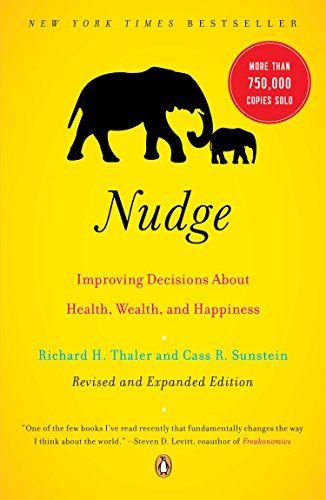
Why Read Nudge?
Nudge is the most policy-consequential popular social science book of the past two decades — a work that introduced the concepts of “choice architecture” and “libertarian paternalism” to a mass audience, shaped public policy from retirement savings to organ donation across dozens of countries, and provided the intellectual foundation for behavioral insights units in governments worldwide. Written by Nobel Prize-winning economist Richard Thaler and legal scholar Cass Sunstein, it is simultaneously a rigorous academic argument about how policy should be designed and an accessible, often witty account of how small environmental changes can dramatically improve human decision-making at scale.
Published in 2008 — the same year as Predictably Irrational and just ahead of the global financial crisis — Nudge builds on the behavioral economics research documented in Ariely’s book and in Kahneman and Tversky’s decades of work, but asks a different question: not why are people irrational, but what should we do about it? The authors’ answer — libertarian paternalism, implemented through choice architecture — is both intellectually elegant and practically revolutionary.
The key insight is that choice environments are never neutral: every cafeteria arrangement, every enrollment form, every retirement savings plan already has a design that influences choices. The only question is whether that design is deliberate and beneficial or accidental and arbitrary. Good choice architecture is designed for HUMANS — the cognitively limited, present-biased, loss-averse people who actually exist — rather than for the idealized rational agents (ECONS) of standard economic theory who never did.
Who Should Read This
This is a book for anyone interested in how policy, design, and institutional structure can improve human well-being — for the policymaker who wants the behavioral foundations of effective policy, for the designer who wants to understand how environment shapes behavior, and for the citizen who wants to understand the behavioral logic behind the policies that shape their choices. Essential for students of policy, law, economics, and behavioral science; professionals in public health, finance, and organizational design; CAT/GRE aspirants; and anyone who wants to understand why choice environment design is one of the most powerful and most underused levers of social change.
Key Takeaways from Nudge
Choice architecture is ubiquitous and inescapable: every menu, form, and institutional arrangement already influences behavior through its structure. The question is never whether to be a choice architect but whether to be a good one. Defaults are among the most powerful tools — because of status quo bias and inertia, the option selected when a person does nothing is disproportionately likely to be chosen regardless of its objective quality.
The Save More Tomorrow program — which automatically increases retirement contributions when employees receive pay raises — is the book’s signature demonstration of choice architecture at its most impactful. By exploiting loss aversion, present bias, and inertia simultaneously, it raised average savings rates from under 4% to over 13% within four years — with no change in financial incentives, no legislative mandate, and no information campaign.
Changing defaults is the most cost-effective policy intervention available in most domains. Countries with opt-out organ donation have dramatically higher donation rates than opt-in countries. No freedom is restricted; the only thing that changes is what happens when people do nothing. The power of the default lies entirely in the behavioral mechanics of inertia, loss aversion, and the implicit endorsement signal the default carries.
Libertarian paternalism resolves the apparent conflict between respecting individual autonomy and promoting individual welfare — but it does not eliminate the ethical responsibilities of the choice architect. Someone must set the default and frame the information. The ethical obligation is to use that influence in the interest of the people making choices, not in the interest of the institution or the third parties who profit from specific choices.
Key Ideas in Nudge
The book opens with a cafeteria thought experiment: a school lunch director discovers that the arrangement of food significantly affects what students eat — items placed at eye level are consumed at much higher rates than items placed in less prominent positions. Whatever arrangement she chooses, she is a choice architect — her arrangement will influence behavior whether she intends it to or not. The question is only whether she will be a deliberate, thoughtful choice architect or an accidental one.
This opening establishes the book’s central insight: choice environments are never neutral. Every arrangement of options, every default setting, every framing of information has effects on what people choose — effects that can be measured, predicted, and deliberately designed for. The behavioral economics research documented in Predictably Irrational and Thinking, Fast and Slow reveals that these effects are large and systematic, which means that choice architecture is a powerful policy tool whose power is largely wasted when deployed accidentally rather than deliberately.
Thaler and Sunstein introduce libertarian paternalism as a “third way” between pure libertarianism (let people choose freely, regardless of outcomes) and traditional paternalism (restrict choices or impose penalties to produce better outcomes). Libertarian paternalism nudges people toward better choices — by setting beneficial defaults, simplifying information, providing feedback, and mapping decisions onto goals — while preserving full freedom to choose differently. The libertarian element is genuine: every nudge can be resisted; no choice is prohibited. The paternalism is equally genuine: the choices people are nudged toward are choices that research suggests are in their interest.
The book’s second major conceptual contribution is the HUMANS vs ECONS distinction. ECONS are the rational agents of standard economic theory: calculating, forward-looking, uninfluenced by irrelevant factors, perfectly self-controlled. HUMANS are the actual people who live in the world: present-biased, loss-averse, subject to status quo bias, influenced by framing and defaults, and reliably limited in their ability to process complex information. Good choice architecture — good policy — is designed for HUMANS, not for ECONS who never existed.
Core Frameworks in Nudge
Thaler and Sunstein build their argument around six interlocking frameworks spanning behavioral economics, political philosophy, and practical policy design.
The practice of deliberately designing environments in which choices are made to promote better outcomes. Encompasses the arrangement of options, the setting of defaults, the framing of information, the complexity of choices, and the feedback provided. Because these factors reliably influence behavior in predictable directions, designing them deliberately is both possible and desirable.
The philosophy that it is legitimate to design choice environments that promote better outcomes — provided all choices remain freely available. Paternalism is justified when nudges steer people toward choices they would make with full information and complete self-control. It is libertarian because every nudge can be resisted by anyone who actively chooses otherwise. No choice is ever prohibited.
Whatever is set as the default is disproportionately likely to be chosen, driven by loss aversion, inertia, and the perception that the default represents an implicit recommendation. Opt-out organ donation dramatically outperforms opt-in not because it forces anyone to donate but because it harnesses status quo bias in a beneficial direction. Changing the default changes behavior at scale, at minimal cost, with no restriction of freedom.
ECONS (the rational agents of standard economic theory) have stable preferences, calculate expected value, and are uninfluenced by framing or defaults. HUMANS (actual people) are present-biased, loss-averse, subject to status quo bias, and limited in their ability to process complex information. Good policy is designed for HUMANS — the people who actually live in the world.
Research on household energy consumption shows people respond far more to information about their use relative to neighbors’ use than to absolute figures or financial costs. A simple smiley or sad face on electricity bills comparing consumption to the neighborhood average produced significant, sustained reductions — no financial incentive required. Good nudges make the consequences of choices immediate, concrete, and personally relevant.
The SMarT program addresses three behavioral barriers to saving simultaneously: present bias (contribution increases are deferred to future pay raises, never reducing current income); loss aversion (contributions come only from raises, never felt as losses); and inertia (automatic enrollment, opt-out only). Average savings rates among participants quadrupled within four years — with no change in incentives, employer contributions, or legislation.
Core Arguments
Thaler and Sunstein advance four interlocking arguments that together make the case for deliberate, beneficial choice architecture as the foundation of effective policy.
Every choice environment has a structure that influences behavior, and that structure is always someone’s design — whether deliberate or accidental. The question is never whether to be a choice architect but whether to do it well. Every retirement form that defaults to zero contribution is a choice architecture decision that reduces savings rates. Every cafeteria that puts dessert first has measurable health consequences. The only realistic alternative to deliberate, beneficial choice architecture is accidental, indifferent choice architecture.
Because nudges work with rather than against the psychological tendencies that drive actual human behavior, they can achieve large behavioral effects at minimal cost, without the political resistance, administrative burden, and freedom-restriction costs of mandates and financial incentives. Opt-out organ donation achieves donation rates of 80–90% versus 15–25% for opt-in — not because it forces anyone to donate but because it harnesses status quo bias in a beneficial direction. The SMarT program produced dramatic savings increases without any change in incentive structures or legislative mandates.
The standard objection to behavioral public policy is that using psychological techniques to steer choices infringes autonomy. Thaler and Sunstein argue that nudges do not restrict choice — they preserve full freedom to choose otherwise. The autonomy that matters — the freedom to choose what one would choose with full information and complete self-control — is actually enhanced by nudges that help HUMANS achieve what their own considered preferences endorse. The choice architect who sets a beneficial default is serving autonomy, not undermining it.
Having argued that libertarian paternalism is legitimate, the authors acknowledge it requires ethical constraints. They propose two: every nudge should be transparent (people should be able to know they are being nudged and how), and every nudge should be designed in the interest of the people being nudged, not the institution deploying it or third parties who profit from specific choices. These constraints provide a framework for distinguishing legitimate nudges from the dark patterns of corporate choice architecture that systematically exploits behavioral biases against users’ interests.
Critical Analysis
A balanced assessment of the book’s genuine intellectual contributions and its most significant limitations.
The book successfully integrates insights from behavioral economics, cognitive psychology, political philosophy, and policy analysis into a coherent, practical framework — a genuinely ambitious synthesis that gives it a depth and range that more narrowly focused behavioral science books lack.
The range and specificity of policy applications documented — retirement savings, organ donation, health care, energy consumption, environmental policy, school choice — demonstrates that choice architecture is a genuinely general tool with applications across virtually every policy domain, not a narrow technique applicable only in specific contexts.
Thaler and Sunstein take the philosophical objections to their argument seriously and engage with them at length. The discussion of libertarian paternalism is a genuine philosophical contribution, not just rhetorical cover for policy advocacy, and the book’s engagement with the ethics of behavioral influence is both rigorous and honest.
Critics from both left and right argue that defaults are so powerful, and behavioral barriers to opting out so substantial, that opt-out systems functionally approximate mandates in their effects. If 90% of people never actively opt out, the practical freedom to do so is meaningful only for the cognitively and motivationally advantaged minority who actually exercise it.
Libertarian paternalism requires someone to determine what choices are in people’s best interests — and this determination is not politically or ethically neutral. The book’s examples tend to be relatively uncontroversial (saving more, donating organs), but the framework is equally applicable to more contested domains where the definition of “better” is politically charged. The book does not fully address this concern.
While the authors acknowledge that choice architecture can be used against people’s interests, their primary focus is on how governments can use it beneficially. The systematic exploitation of behavioral biases by corporations — through dark patterns in digital design, manipulative subscription defaults, and misleading financial product architecture — receives less attention than the scale of the problem warrants.
Impact & Legacy
Government Policy Worldwide: Nudge was published in April 2008 and became one of the most policy-influential books of the decade. Barack Obama cited it as influential in his approach to regulation, and the UK’s Conservative-Liberal Democrat coalition established the Behavioural Insights Team (BIT) — informally known as the “Nudge Unit” — in 2010, the first government unit explicitly dedicated to applying behavioral science to public policy. The BIT has since been replicated in dozens of countries, and its documented work on tax compliance, organ donation, energy efficiency, and healthcare has generated benefits running into the billions of pounds.
Nobel Prize Validation: Richard Thaler’s Nobel Prize in Economics in 2017 was explicitly awarded for his contributions to behavioral economics, of which Nudge was both a culmination and a popularization. The Nobel citation directly referenced mental accounting, the endowment effect, and the design of behavioral interventions — validating the intellectual foundations of the nudge framework at the highest level of academic recognition.
Private Sector and Digital Design: Choice architecture concepts are now standard in pension fund design (automatic enrollment, contribution escalation), health insurance exchange design, financial services regulation, and digital product design. However, the digital domain has also seen the most egregious abuses of behavioral insights against users’ interests. The distinction between beneficial nudges and dark patterns — exploitative choice architecture that steers people toward choices that benefit the designer at the user’s expense — is now a significant concern in digital regulation, particularly in the EU’s Digital Services Act and similar frameworks.
The Behavioral Policy Movement: Nudge established the intellectual foundation for what is now called the “behavioral public policy” movement — the systematic application of behavioral science insights to the design of government programs, regulatory frameworks, and public institutions. This movement has produced a substantial academic literature, multiple dedicated research centers, and a generation of policymakers trained to think about the behavioral consequences of institutional design in ways that were not previously standard.
For Exam Preparation: Nudge is excellent intermediate-level reading comprehension practice in policy-oriented social science. Its combination of behavioral economics, political philosophy, and detailed policy applications provides exactly the kind of multi-disciplinary, analytically demanding prose that the most sophisticated CAT and GRE passages deploy. The core concepts — choice architecture, defaults, libertarian paternalism, HUMANS vs ECONS, the SMarT program — are directly relevant to exam passages on behavioral policy, institutional design, and the relationship between psychology and public welfare.
Love This Book? Master Every Book.
Stop struggling with reading comprehension. Our proven system transforms how you read—whether for CAT, GRE, GMAT, SAT, or personal growth.
Best Quotes from Nudge
A nudge, as we will use the term, is any aspect of the choice architecture that alters people’s behavior in a predictable way without forbidding any options or significantly changing their economic incentives.
If you want to help people achieve their goals, and if you want to do it cheaply, the best policy is often to set the default appropriately.
People can be nudged toward better choices — for themselves and for society — without being coerced or told what to do.
For all their virtues, markets often give consumers too many choices. People can be overwhelmed.
The combination of loss aversion and mindless choosing implies that if an option is designated as the “default,” it will attract a large market share. For this reason, defaults are among the most powerful choice architecture tools.
Test Your Understanding
Think you’ve mastered Nudge? Challenge yourself with 15 questions on choice architecture, libertarian paternalism, defaults, and the SMarT program. Score 80%+ to prove your mastery.
Nudge FAQ
What is a “nudge” and how is it different from a mandate or an incentive?
A nudge is any aspect of choice architecture that predictably alters behavior without forbidding any option or imposing any financial penalty. A mandate forces behavior by making alternatives illegal or penalized. A financial incentive alters behavior by changing the relative cost of options. A nudge alters behavior by changing how options are presented, what the default is, or how information is framed — without restricting any choice or changing any price. Opt-out organ donation is a nudge: it makes donation the default but allows anyone to opt out freely. A mandate for organ donation would be coercive; an incentive would pay donors. The nudge achieves similar outcomes to the mandate in practice, without the restriction of freedom.
What is “libertarian paternalism” and is it a contradiction?
Libertarian paternalism is the philosophy that it is legitimate to design choice environments that nudge people toward better outcomes — provided all choices remain freely available. The “libertarian” element refers to the preservation of full freedom to choose otherwise: no nudge is coercive. The “paternalism” element refers to the deliberate design of nudges to promote outcomes in people’s interest rather than leaving choice architecture to accident or to the interests of commercial designers. Critics argue the “libertarian” element is thin: the practical freedom to resist a powerful default is effectively available only to the cognitively and motivationally advantaged. Defenders argue that choice architecture is always present, and the only question is whether it is designed for or against people’s interests.
Why are defaults so powerful?
Defaults are powerful for several overlapping reasons. Status quo bias means people disproportionately choose whatever has been set as the default, independent of its objective quality. Loss aversion amplifies this: actively opting out of a default feels like giving something up. Inertia means many people simply never get around to making an active choice, so the default wins by default. And the default carries an implicit endorsement signal — people often infer that the choice architect has set it for a reason, and that accepting it is the normal or recommended course. Together, these mechanisms make defaults the most powerful and most cost-effective choice architecture tool available.
What is the Save More Tomorrow (SMarT) program?
The Save More Tomorrow program, developed by Richard Thaler and Shlomo Benartzi, dramatically increased retirement savings among low-income workers by designing around three behavioral barriers simultaneously. Present bias is addressed by deferring contribution increases to future pay raises, so no current income is ever reduced. Loss aversion is addressed by taking contributions only from raises, which are never experienced as current income. Inertia is addressed by enrolling employees automatically with opt-out only. In initial implementations, average savings rates among participants rose from under 4% to over 13% within four years — without any change in financial incentives, employer contributions, or legislative requirements.
How does Nudge relate to Predictably Irrational and Thinking, Fast and Slow?
The three books form the core of the behavioral economics cluster and address the same territory from complementary angles. Predictably Irrational (Ariely) documents the specific forms of systematic irrationality that characterize actual human decision-making. Thinking, Fast and Slow (Kahneman) provides the full theoretical framework that explains why these irrationalities occur. Nudge takes these findings as its starting point and asks the policy question: given that people reliably deviate from rational decision-making in these specific ways, how should institutions be designed to help them achieve better outcomes? The recommended reading sequence is Ariely first, Kahneman second, and Thaler and Sunstein third.








