

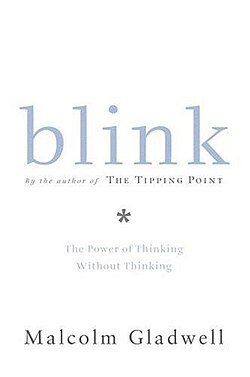
Why Read Blink?
Blink is the most accessible introduction to the psychology of intuitive judgment ever written for a general audience — a book that made millions of people reconsider everything they thought they knew about how good decisions are made, whether more information is always better, and what the unconscious mind actually knows. Published in 2005, it spent over two years on the New York Times bestseller list and permanently changed popular understanding of the relationship between conscious deliberation and unconscious expertise.
Blink is built around a central paradox: that some of our most accurate judgments are made in the first two seconds of exposure — in the “blink” of unconscious processing — while some of our worst decisions are made after extended deliberation with excessive information. Gladwell explores this paradox through a series of compelling case studies: the Getty kouros (a Greek statue that trained curators immediately recognized as fake while scientific tests authenticated it); the marriage researcher John Gottman, who can predict divorce with over 90% accuracy from a three-minute conversation sample; the musician who transformed orchestra auditions by hiding players behind screens; the Warren Harding effect; and the fatal police shooting of Amadou Diallo.
The book’s argument is not simply that intuition is reliable — Gladwell is equally interested in the failures of snap judgment as in its successes. The real question is: under what conditions does thin-slicing produce accurate judgments, and under what conditions does it produce dangerous errors rooted in bias, stress, or the corruption of unconscious associations?
Who Should Read This
This is a book for anyone who has ever trusted or distrusted a gut feeling and wondered whether they were right to — which is everyone. An ideal starting point for readers new to behavioral science who want an engaging, narrative-driven introduction to the psychology of judgment. It pairs naturally with Thinking, Fast and Slow for the full theoretical framework. Essential for psychology and behavioral science beginners; professionals in hiring, medicine, and law enforcement; CAT/GRE aspirants; and anyone curious about the hidden architecture of their own decision-making.
Key Takeaways from Blink
Thin-slicing — the unconscious ability to extract accurate patterns from very small samples of experience — is a genuine cognitive capacity. Expert thin-slicers have trained their unconscious pattern recognition on thousands of examples and can process information faster and more accurately in their domain than any conscious analysis can match. The two seconds of unconscious cognition are not empty — they contain the accumulated learning of years.
More information does not always produce better decisions — beyond a certain threshold, additional information can actively degrade judgment by overwhelming the pattern-recognition mechanisms that produce accurate thin-slicing. The US military’s Millennium Challenge wargame is the book’s most compelling demonstration that decision quality is not proportional to information quantity.
Unconscious associations can corrupt snap judgments in ways that produce systematic bias without any conscious intention to discriminate. The Implicit Association Test reveals that most people carry implicit biases that shape their rapid judgments — including people who consciously endorse egalitarian values. Understanding this is a prerequisite for designing conditions in which bias can be reduced.
Under extreme stress or time pressure, even highly trained experts can experience “mind-blindness” — a dramatic narrowing of perceptual processing that eliminates contextual cues. The Amadou Diallo shooting illustrates how stress degrades thin-slicing capacity. Training must simulate the conditions of actual deployment, not merely the skills of calm performance.
Key Ideas in Blink
Blink opens with the story of the Getty kouros — a Greek marble statue that the J. Paul Getty Museum acquired in 1983 after fourteen months of scientific testing confirmed its authenticity. When the museum began showing the statue to experts, their immediate, intuitive responses were uniformly negative: something was wrong, though no one could articulate what. Subsequent investigation confirmed the statue was a fake. The scientific analysis had authenticated a forgery; the two-second gut reaction of trained curators had been correct. This opening story establishes the book’s central puzzle: why was rapid, unreflective judgment more accurate than extended scientific analysis?
The answer, Gladwell argues, lies in “thin-slicing” — the unconscious ability to extract accurate patterns from very thin slices of experience. The curators had spent careers immersed in genuine Greek sculpture; their unconscious pattern-recognition systems had been trained on thousands of examples and had encoded the subtle regularities that distinguish authentic from inauthentic work — regularities that no explicit analysis had captured because no one had explicitly identified what made genuine Archaic sculptures different from plausible fakes.
John Gottman’s marriage research provides the book’s most remarkable demonstration of thin-slicing. Gottman can predict divorce with over 90% accuracy from a fifteen-minute video sample — and, more remarkably, with above-70% accuracy from a three-minute sample coded for specific emotional markers. Contempt, in particular, is the single most reliable predictor of relationship dissolution. The predictive power of the three-minute slice is a demonstration that the patterns predicting a marriage’s future are present in every interaction — if you know what to look for.
The book’s second major strand examines the failures and corruptions of snap judgment. The Warren Harding effect — the cognitive bias toward tall, conventionally attractive people in leadership selection — is one of the most extensively documented failures: multiple studies confirm that both height and physical attractiveness predict leadership selection independent of actual competence. The Diallo shooting and the research on racial implicit bias extend this analysis to the domain of racial prejudice — demonstrating that unconscious associations can produce lethal errors even in people who consciously reject the values those associations reflect.
Core Frameworks in Blink
Gladwell builds his argument around six interlocking frameworks that together explain when rapid cognition succeeds and when it catastrophically fails.
The unconscious mind processes a thin slice of experience and extracts a pattern-based judgment that may exceed the accuracy of deliberate analysis. Works when the judge has extensive domain experience, the judgment concerns patterns present in thin slices, and the unconscious has not been corrupted by bias or stress.
Drawing on Timothy Wilson’s research, Gladwell describes a cognitive system that processes information rapidly and automatically outside conscious awareness. Not the Freudian unconscious of repressed desires — a genuinely intelligent system that evolved to handle rapid-processing demands, whose outputs often surpass conscious deliberation in domains of deep pattern learning.
Expert thin-slicers are often unable to explain how they know what they know. The art curator can’t articulate what is wrong; the chess grandmaster can’t walk through the calculation. This inability is a structural feature of expert intuition — the patterns encoded are too complex and too fast-processed to be accessible to linear verbal articulation.
Warren Harding became the 29th US President primarily because he looked presidential. The Warren Harding effect is the general phenomenon: unconscious associations between irrelevant characteristics (height, attractiveness, race, gender) and positive evaluations corrupt rapid judgment in hiring, leadership selection, and voting — operating below conscious intention in people who would explicitly reject the values they reflect.
Under acute stress, the autonomic nervous system generates physiological changes — elevated heart rate, perceptual narrowing — that degrade nuanced pattern recognition. At its extreme (heart rate above ~175 bpm), mind-blindness can cause a wallet to be processed as a gun. Experts must be trained for the conditions of deployment, not only for skill performance in calm circumstances.
The framing, context, and incidental information present before a judgment substantially shapes that judgment outside the judger’s awareness. People primed with age-associated words move more slowly; IAT scores shift with momentary exposure to race-associated stimuli. Controlling the context of judgment is one of the primary tools for reducing the corruption of thin-slicing by irrelevant associations.
Core Arguments
Gladwell advances four interlocking arguments that together reframe how we should think about the quality and conditions of human judgment.
Gladwell’s central positive argument is that the two-second judgments of trained unconscious pattern-recognition deserve more trust than the culture of deliberation and extensive information-gathering typically accords them. The Getty kouros story, Gottman’s marriage research, Vic Braden’s tennis ace predictions, and Abbie Conant’s audition performance all provide evidence that thin-slicing in domains of genuine expertise produces judgments that resist or exceed the accuracy of deliberate analysis. The practical implication is not to trust all gut feelings but to understand the conditions under which rapid cognition is reliable — and protect those conditions rather than overriding them with excessive deliberation.
Beyond a certain threshold, additional information actively harms judgment quality. The US military’s Millennium Challenge experiment is the most dramatic demonstration: the “Blue” force, equipped with sophisticated surveillance and decision-support systems, was decisively outperformed by the “Red” force commander Paul Van Riper, who deliberately restricted his information intake and made faster, less deliberate decisions. Information overload obscures the patterns that rapid cognition would otherwise detect. The practical implication is that decision design should focus on identifying which information is genuinely diagnostic and eliminating the rest.
The same rapid cognition that enables expert judgment in domains of genuine expertise also encodes and enacts cultural biases where unconscious associations have been formed by exposure to biased cultural information. The IAT research, the orchestra audition experiments, and the Harding effect all demonstrate that unconscious bias operates in people who consciously reject discriminatory values. The practical implication is to design decision environments that interrupt the automatic enactment of bias — as blind orchestral auditions interrupted gender bias in musician selection — rather than simply exhorting people to be less biased.
The Diallo shooting and the research on mind-blindness lead Gladwell to a structural argument: the conditions under which a judgment is made — the level of stress, available time, quality of framing, presence of priming stimuli — are as important as the expertise of the judger. The most highly trained officer can make lethal errors under conditions of extreme stress that their training did not adequately simulate. Improving judgment quality therefore requires attention to the decision environment as much as to the development of individual expertise.
Critical Analysis
A balanced assessment of the book’s genuine strengths and well-documented limitations.
Gladwell’s ability to make social science research compelling through story is at its peak in Blink. The Getty kouros, the Gottman marriage lab, the blind orchestral auditions, and the Diallo shooting are among the most vivid case studies in popular science writing, making abstract psychological concepts immediately tangible.
Unlike most popular treatments (which either celebrate or dismiss gut feeling), Blink presents a genuinely balanced account — showing both when rapid cognition is reliable and when it catastrophically fails, and attempting to identify the conditions that determine which outcome is likely. This intellectual balance is the book’s most important virtue.
The book’s most lasting practical contribution is the argument that improving judgment quality requires designing better decision environments — blind auditions, structured interviews, debiasing protocols — rather than simply exhorting individuals to be less biased. This systems-level insight has been genuinely influential in organizational design and policy.
Gladwell is a journalist, not a scientist, and his case studies are selected for narrative impact rather than scientific representativeness. Several specific claims in the book — particularly around the IAT’s predictive validity — have been challenged by researchers, and the book’s confident generalizations sometimes outrun the evidence that supports them.
The book tends to identify cases of accurate rapid judgment as examples of expert thin-slicing and inaccurate rapid judgment as examples of corrupted thin-slicing — which risks making the theory unfalsifiable by definition. The criteria for distinguishing “genuine” expert intuition from “corrupted” bias are not always clearly specified.
One of the book’s most important claims — that the IAT reveals biases that predict real-world discriminatory behavior — rests on a research program whose predictive validity has been significantly contested since 2005. The IAT reliably measures something about unconscious associations, but whether those associations predict specific behavioral outcomes as directly as the book implies is considerably more debated than Gladwell’s account suggests.
Impact & Legacy
Commercial and Cultural Reach: Blink was published in January 2005 and became one of the decade’s most commercially successful popular science books — spending over two years on the New York Times bestseller list and selling over three million copies in its first five years. It established Gladwell as the defining voice of popular social science writing and was widely credited with making the concept of “thin-slicing” part of mainstream vocabulary.
Influence on Organizational Design: The book’s argument that more information is not always better, and that structured decision environments can reduce bias more effectively than individual exhortation, influenced thinking in organizational design, hiring practice, and behavioral public policy. The blind audition argument has been applied in hiring (blind résumé review), medical education (anonymous grading), and judicial selection, and has become a foundational argument in behavioral approaches to diversity, equity, and inclusion.
A Double-Edged Impact on Popular Understanding: The book’s impact on popular understanding of intuition was significant and somewhat double-edged. On the positive side, it gave millions of readers a framework for thinking about the reliability and limitations of gut feelings more nuanced than either “always trust your gut” or “always do the analysis.” On the negative side, its accessibility came at the cost of scientific precision — its confident tone created an impression of more solid empirical grounding than the underlying research always supports, and the IAT controversy has revealed that some of the book’s most confident claims are more contested than it acknowledged.
The Gladwell Critique: Blink has also been the focal point of the recurring criticism that Gladwell’s journalism systematically oversimplifies the research it draws on, selects case studies for narrative impact rather than scientific representativeness, and generalizes beyond what the evidence supports. Gladwell acknowledges this tension — between the demands of accessibility and narrative engagement on one hand, and the demands of scientific precision on the other — while maintaining that popular science writing serves a legitimate and valuable function that specialist research cannot fulfill. This debate about the responsibilities of popular science journalism remains unresolved and continues to generate commentary on each new Gladwell book.
For Exam Preparation: Blink is excellent elementary-level reading comprehension practice in behavioral science nonfiction. Its narrative-driven structure — case study followed by research followed by implication — is immediately accessible, and its central concepts (thin-slicing, the adaptive unconscious, the Warren Harding effect, mind-blindness) are directly relevant to exam passages on psychology, judgment, and decision-making.
Love This Book? Master Every Book.
Stop struggling with reading comprehension. Our proven system transforms how you read—whether for CAT, GRE, GMAT, SAT, or personal growth.
Best Quotes from Blink
There can be as much value in the blink of an eye as in months of rational analysis.
The key to good decision making is not knowledge. It is understanding. We are swimming in the former. We are desperately lacking in the latter.
Truly successful decision making relies on a balance between deliberate and instinctive thinking.
We live in a world that assumes that the quality of a decision is directly related to the time and effort that went into making it. We believe that we are always better off gathering as much information as possible and spending as much time as possible in deliberation.
The first task of Blink is to convince you that decisions made very quickly can be every bit as good as decisions made cautiously and deliberately.
Test Your Understanding
Think you’ve mastered Blink? Challenge yourself with 15 questions on thin-slicing, the adaptive unconscious, the Warren Harding effect, and Gladwell’s core arguments. Score 80%+ to prove your mastery.
Blink FAQ
What is “thin-slicing” and why does it sometimes work?
Thin-slicing is the unconscious ability to extract accurate patterns from very small “slices” of experience — a two-second exposure, a brief interaction, a small behavioral sample. It works when the judger has extensive domain-specific experience (the unconscious pattern-recognition system has been trained on many examples), when the judgment concerns patterns that are genuinely present in thin slices, and when the unconscious has not been corrupted by irrelevant associations. The trained art curator who immediately senses a sculpture is wrong, or the marriage researcher who can predict divorce from a three-minute interaction, are both demonstrating thin-slicing under all three favorable conditions.
When does rapid cognition go wrong?
Rapid cognition goes wrong in three main ways: first, when the unconscious has encoded cultural biases that corrupt pattern recognition in socially charged domains (the Warren Harding effect, racial implicit bias); second, when extreme stress or arousal produces “mind-blindness” — a narrowing of perceptual processing that can cause experienced professionals to misread critical contextual cues (the Diallo shooting); third, when excessive information or misleading framing corrupts the unconscious pattern-recognition process before it can operate on genuinely diagnostic signals. Understanding these failure modes is as important as understanding when thin-slicing succeeds.
What is the Implicit Association Test (IAT) and what does it actually measure?
The IAT measures the strength of unconscious associations between social categories (race, gender, age) and evaluative responses (positive/negative) by measuring reaction time differences when category and evaluation pairings are consistent or inconsistent with common cultural associations. The IAT reliably reveals these unconscious association patterns, but its predictive validity for specific real-world discriminatory behaviors has been significantly contested since Gladwell’s 2005 account — the relationship between IAT scores and behavioral outcomes is considerably weaker and more inconsistent than the book implies. The IAT remains a valuable research tool, but its use as a diagnostic of individual bias should be approached with caution.
Does Blink say we should always trust our gut?
No — and this is the most common misreading of the book. Gladwell explicitly argues both for the value of rapid cognition in domains of genuine expertise and for its dangerous failures in conditions of bias, stress, or corrupted framing. The book’s argument is not “trust your gut” but “understand the conditions under which rapid cognition is reliable and design your decision environments accordingly.” The blind orchestral audition is the book’s clearest practical recommendation — not trusting individual intuition but designing a system that removes the specific conditions (seeing the musician’s gender) that corrupt it.
How does Blink relate to Thinking, Fast and Slow?
Blink (2005) and Thinking, Fast and Slow (Kahneman, 2011) address overlapping territory — the relationship between rapid, automatic cognition and slow, deliberate reasoning — but from different angles. Gladwell focuses on intuition through narrative case studies, is more accessible, and makes a broadly positive case for trained rapid cognition while documenting its failure modes. Kahneman provides the full theoretical framework, is more scientifically rigorous, and is considerably more skeptical of intuitive judgment outside narrow domains of genuinely predictive expertise. Blink is the better starting point for readers new to behavioral science; Thinking, Fast and Slow is the more comprehensive and more reliable account. Reading both together gives the most complete picture.








