

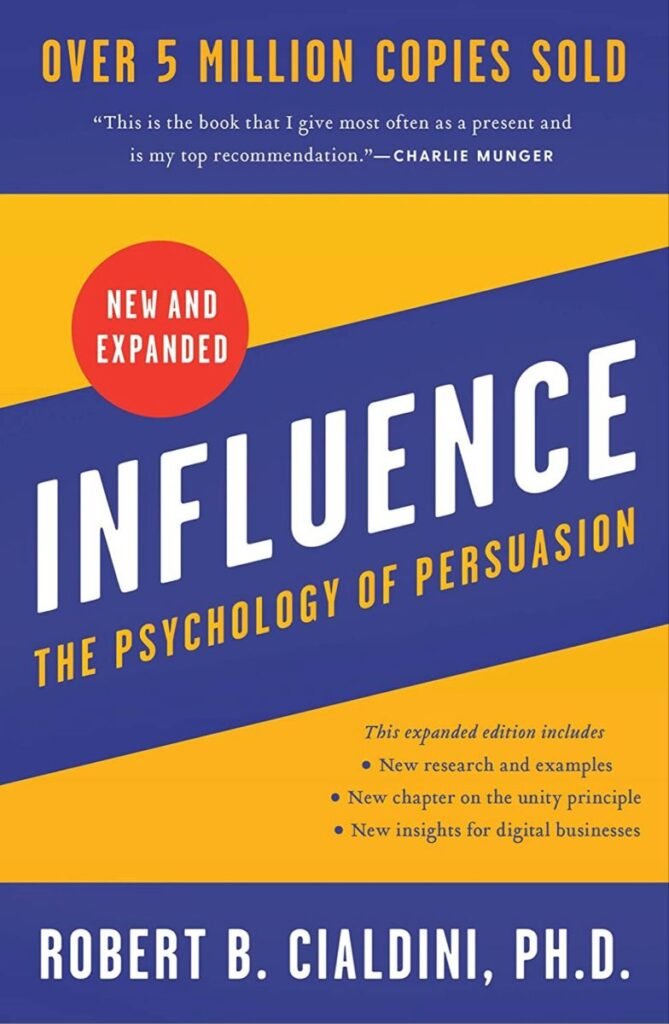
Why Read Influence?
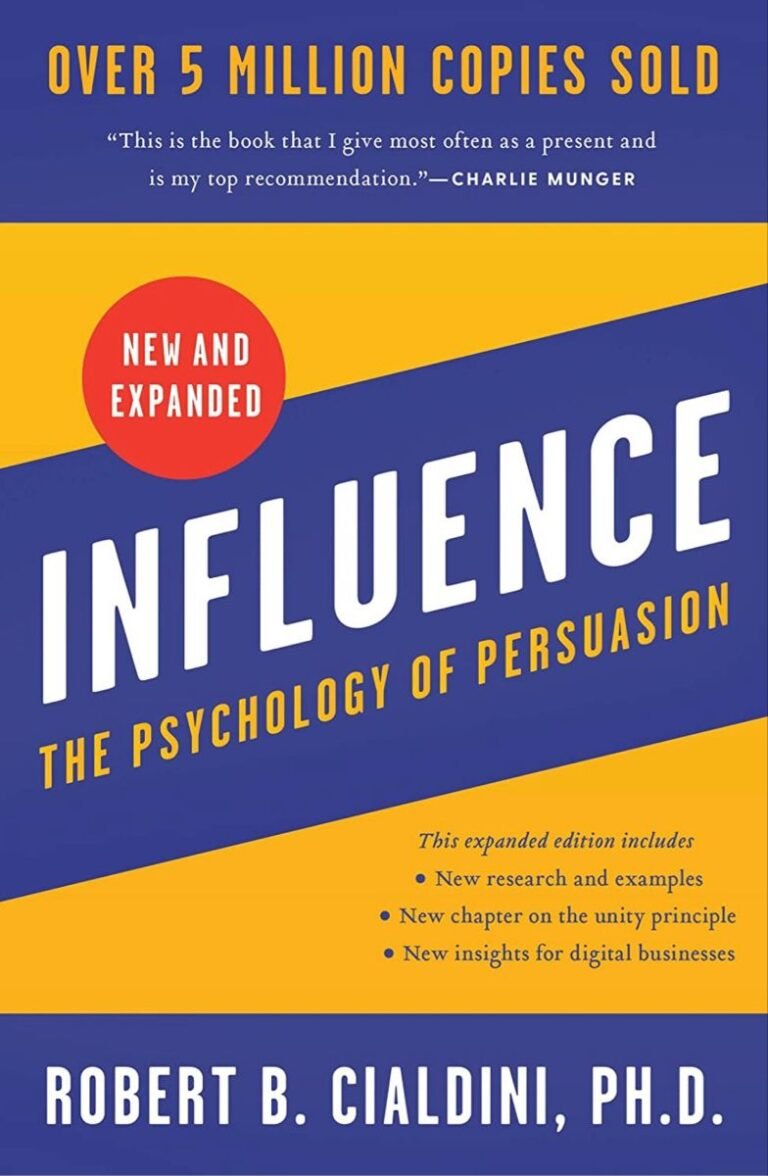
Influence is the most widely read book on the psychology of persuasion ever published — a landmark work that has sold over five million copies, shaped a generation of marketers, negotiators, fundraisers, and salespeople, and given millions of ordinary readers the conceptual tools to recognize and resist the persuasion techniques used on them every day. Robert Cialdini spent years working undercover in sales, fundraising, and advertising organizations to understand how compliance professionals actually get people to say yes — and then spent more years in the laboratory verifying and extending what he found.
Influence identifies six universal principles of persuasion — reciprocity, commitment and consistency, social proof, authority, liking, and scarcity — and documents, through both field observation and laboratory experiment, the mechanisms by which each operates and the conditions under which it is most powerful. Cialdini’s central insight is that these principles are not tricks invented by manipulators but shortcuts built into human psychology — cognitive heuristics that are genuinely useful in navigating a complex world but that can be exploited by anyone who understands them.
The book’s dual purpose — both to explain how persuasion works and to help readers defend against its misuse — gives it a moral seriousness that distinguishes it from purely prescriptive influence manuals. The person who understands the six principles cannot unlearn them: every sales interaction, fundraising appeal, advertising campaign, and political speech becomes readable in a new way.
Who Should Read This
This is a book for anyone who influences or is influenced by others — which is everyone. Essential for students of psychology, marketing, and organizational behavior; professionals across every domain that involves human influence; CAT/GRE aspirants who need intermediate-level reading comprehension in behavioral science; and anyone who wants to understand why they said yes when they meant to say no.
Key Takeaways from Influence
Reciprocity — the deeply wired human obligation to return what has been given — is the most powerful and most universally exploited principle of influence. When someone gives us something, we feel a powerful obligation to give something back — so strong that it can compel us to return favors we never requested, gifts we never wanted, and concessions we never invited. The free sample, the unsolicited gift, the door-to-door charity trinket — all activate reciprocity in ways that produce compliance far exceeding the value of what was given.
Scarcity — the perception that something is rare, dwindling, or exclusively available — dramatically increases its perceived value and our urgency to acquire it, regardless of whether the scarcity is real or manufactured. “Limited time offer,” “only 3 left in stock,” and “exclusive membership” all activate the scarcity principle. The psychological mechanism is loss aversion: we are more motivated by the prospect of losing access to something than by the equivalent prospect of gaining it.
Social proof — the tendency to look to others’ behavior to determine the correct course of action in uncertain situations — is the most pervasive influence principle in the social media age. We assume that if many people are doing something, it is probably the right thing to do. This assumption is systematically exploited through fake reviews, inflated follower counts, laugh tracks, and the deliberate engineering of apparent popularity. Understanding social proof is the first defense against manufactured consensus.
Commitment and consistency — the psychological need to behave in ways consistent with our prior commitments, beliefs, and self-image — is the principle most exploited in cult recruitment, high-pressure sales techniques, and political radicalization. Once we have made a public commitment to a position, we experience powerful internal and social pressure to remain consistent with it, even when new information would rationally warrant a change of position. Small initial commitments lead to larger ones — the foot-in-the-door technique exploits this by securing a small, easy “yes” before requesting the larger compliance.
The Central Ideas of Influence
Influence opens with an observation about the complexity of modern life: the world has become so information-rich and decision-dense that human beings cannot evaluate every choice from scratch. We rely instead on cognitive shortcuts — heuristics — that allow us to make good-enough decisions quickly, based on a limited subset of available information. These shortcuts are not failures of intelligence but adaptations to complexity; the problem is that they can be exploited by anyone who understands them.
The book’s organizing framework is the six principles of influence — universal psychological mechanisms that compliance professionals (salespeople, fundraisers, marketers, negotiators) use deliberately and systematically to generate agreement. Each principle operates as a trigger: when the trigger is activated, a specific cognitive shortcut fires automatically, bypassing deliberate evaluation and producing compliance. The principles are universal not because they are culturally arbitrary but because they are grounded in genuinely useful heuristics — reciprocity tracks real social debt; authority tracks real expertise; social proof tracks real consensus — that can be exploited precisely because they are usually reliable.
Cialdini’s method — spending years undercover in compliance professions before returning to the laboratory — gives the book an unusual combination of fieldwork richness and experimental rigor. His descriptions of how sales trainers actually teach the reciprocity principle, how cult recruiters use commitment and consistency, and how television producers use laugh tracks to exploit social proof are based on direct observation, not theorizing. The laboratory experiments that follow are designed to isolate and test the mechanisms he observed in the field.
The book closes with practical guidance on recognizing and resisting each principle — not by becoming cynical or refusing all compliance (which would be socially and practically unsustainable) but by developing the awareness to distinguish between legitimate use of the principles and their illegitimate exploitation. When a genuine expert provides advice, authority is legitimately operative; when a fake credential is deployed to manufacture the appearance of expertise, authority is being exploited. The distinction requires awareness of the principle and attention to the specific context of its activation.
The Six Principles of Influence
Cialdini’s six universal principles each operate as a psychological trigger — when activated, they bypass deliberate evaluation and produce automatic compliance. Understanding each principle is both an offensive and a defensive tool.
The reciprocity principle is deeply wired — anthropologists have identified it as universal across all human cultures. When someone gives us something — a gift, a favor, a concession — we feel a powerful obligation to give something back, even when the initial gift was uninvited, unwanted, or strategically given. The Hare Krishna Society’s practice of giving flowers before making a donation request, the free supermarket sample, the unsolicited complimentary gift with a direct mail solicitation — all exploit reciprocity to generate compliance far exceeding the cost of the initial gift.
Once we have committed to a position or taken an action — especially publicly — we experience powerful psychological pressure to remain consistent with that commitment. Compliance professionals exploit this by securing a small initial commitment before requesting the larger compliance they actually want — the foot-in-the-door technique. Car dealers use the “low-ball” technique: securing commitment to a purchase at an attractive price before revealing that the price was an error, at which point consistency pressure makes the buyer reluctant to withdraw.
In uncertain situations, we use others’ behavior as evidence of the correct course of action — assuming that if many people are doing something, it is probably right. This heuristic is genuinely useful but can be exploited by manufacturing the appearance of consensus: fake reviews, inflated follower counts, canned applause and laugh tracks, bartenders who salt their tip jars with large bills, and testimonial advertising all activate social proof. The principle is strongest when we are uncertain about the correct action and when the people we observe are similar to us.
We are trained from childhood to defer to legitimate authority — to trust doctors’ prescriptions, lawyers’ advice, and teachers’ instruction. This deference is generally rational but creates vulnerability to the appearance of authority in the absence of its substance. Experiments show that people comply significantly more with requests from people in uniforms, people with titles, and people who carry expensive accessories — regardless of whether these signals correspond to genuine expertise. The “doctor’s” recommendation in television advertising exploits authority even when the “doctor” is an actor.
We prefer to say yes to people we know and like. Compliance professionals engineer liking through: physical attractiveness (we assume attractive people are more competent and trustworthy); similarity (we like people who share our hometown, interests, or values); familiarity (mere exposure increases liking); association (we like people connected to good things); and compliments (flattery works, even when we know it’s insincere). The Tupperware party exploits liking by moving the sales context into the home of a friend — the host becomes the implicit endorser of every product.
The scarcity principle operates through loss aversion (we are more motivated by the prospect of losing access to something than by the equivalent prospect of gaining it) and the inference that scarce things are more valuable. Both mechanisms can be exploited by manufacturing scarcity: “limited time offers” that recur indefinitely, “only 3 left in stock” messages that refresh continuously, and “exclusive membership” appeals all activate scarcity without genuine scarcity. The principle is strongest when scarcity is newly established and when we are in competition with others for the scarce resource.
Core Arguments
Cialdini builds four interconnected arguments that together constitute a complete account of how persuasion operates — and why awareness is the most powerful defense against its misuse.
Cialdini’s foundational argument is that most human compliance — most of the time — is not the product of careful deliberation about the merits of a request but the automatic activation of cognitive shortcuts triggered by specific features of the request or its context. We comply with reciprocity not because we have calculated that returning the favor is in our long-term interest but because the feeling of obligation fires automatically when a gift is received. We comply with authority not because we have evaluated the expert’s credentials but because the symbols of authority trigger deference automatically. This automatic quality is not a failure of rationality but an adaptation to complexity — but it creates systematic vulnerability to exploitation.
A crucial point that distinguishes Influence from simpler manipulation manuals is Cialdini’s insistence that the six principles are powerful precisely because they are usually reliable. Reciprocity usually tracks real social debt; authority usually tracks real expertise; social proof usually aggregates real information about what works; scarcity usually signals real value. The principles are exploitable not because they are irrational shortcuts to bad decisions but because they are rational shortcuts to good decisions that can be gamed by those who understand them. The defense is not to abandon the shortcuts (which would be impossible and counterproductive) but to become aware of when they are being artificially triggered.
Cialdini’s most practically important argument is that the primary defense against the misuse of influence principles is awareness — the ability to recognize when a specific principle is being activated and to ask whether its activation in this context is legitimate or manufactured. When a persuasion attempt makes you feel the obligation of reciprocity, ask whether the initial gift was genuinely given or strategically deployed. When you feel the pull of scarcity, ask whether the scarcity is real or manufactured. When social proof is invoked, ask whether the consensus is genuine or engineered. This interrogative habit does not require cynicism — it requires the specific metacognitive awareness that understanding the principles enables.
One of the book’s most valuable contributions is the documentation of how compliance professionals — sales trainers, cult recruiters, fundraisers, political operatives — deliberately and systematically exploit the six principles. Cialdini’s years of undercover observation give him direct evidence of how these techniques are taught, refined, and deployed in practice, making Influence not just a theoretical account but a field guide to persuasion as actually practiced. This documentation serves both purposes of the book: it helps practitioners understand the principles in action, and it helps everyone else recognize the techniques when they encounter them.
Critical Analysis
A balanced assessment of a book whose practical value and methodological originality are inseparable from the genuine questions raised by its research base and scope.
Cialdini’s combination of years of undercover fieldwork in compliance professions with subsequent laboratory verification is methodologically unusual and gives the book a richness and credibility that purely theoretical or purely experimental accounts cannot achieve. The field observations provide the phenomena to be explained; the laboratory experiments provide the mechanism.
Unlike most academic psychology books, Influence is immediately applicable — readers finish each chapter with a clearer understanding of a specific persuasion technique and specific tools for recognizing and resisting it. The book’s dual purpose (understanding influence and defending against its misuse) makes it genuinely useful in a direct way that most social psychology texts are not.
Cialdini’s consistent attention to the distinction between legitimate and exploitative use of the principles — and his genuine concern for the reader’s ability to defend themselves against manipulation — gives the book a moral dimension that distinguishes it from manipulation manuals. He is teaching readers to be more conscious participants in the persuasion dynamics of everyday life.
The 1984 edition drew on social psychology research that has subsequently faced the replication crisis — several of the specific experiments cited have not replicated reliably under different conditions, and some effect sizes have been revised downward. The 2021 updated edition addresses some of these concerns but the book as a whole reflects the research standards of the 1980s, which were less rigorous than contemporary standards.
The six principles have been so widely adopted in marketing and sales training that they are now often deployed as a checklist rather than understood as part of a coherent psychological account. The oversimplified deployment misses Cialdini’s more nuanced account of the conditions under which each principle is most powerful and the distinctions between legitimate and exploitative use.
The book focuses primarily on one-to-one and one-to-many influence situations — the salesperson and the customer, the fundraiser and the donor. It gives relatively less attention to the complex, multi-directional influence dynamics of organizations, political systems, and social movements, where the six principles interact in ways the book does not fully address.
Real-World Impact
Enduring Commercial Success: Influence was published in 1984 and has been continuously in print ever since, selling over five million copies in its original and subsequent editions. It is the most widely assigned text in marketing and sales training programs worldwide, has been translated into over thirty languages, and is regularly cited by business leaders, investors, and entrepreneurs as one of the most valuable books they have read. Charlie Munger — Warren Buffett’s partner at Berkshire Hathaway — cited it as essential reading and incorporated Cialdini’s framework into his famous “psychology of human misjudgment” lecture.
Across-Domain Cultural Impact: In marketing, Influence gave practitioners a coherent psychological framework for understanding why their techniques worked, accelerating the development of more sophisticated and more deliberately psychological marketing practice. In sales training, it became the foundational text, its six principles entering the standard curriculum worldwide. In negotiation theory, it complemented the interest-based negotiation frameworks of Getting to Yes with a psychological account of the mechanisms that determine whether people say yes at all. In the growing field of persuasion technology — the deliberate design of digital interfaces to maximize engagement and conversion — Cialdini’s principles are foundational, raising significant ethical questions about the systematic deployment of psychological influence at scale.
The 2021 Updated Edition: The updated edition added a seventh principle — unity (the sense of shared identity with the influencer) — and updated the research base to reflect developments in behavioral science since 1984. Cialdini’s subsequent book Pre-Suasion (2016) extends the influence framework by examining how the context established before a persuasion attempt determines how effectively the six principles operate — arguing that what happens immediately before a request is as important as the request itself.
For Competitive Exam Preparation: Influence is excellent intermediate-level reading comprehension practice in behavioral science nonfiction. Its structure — principle identification, mechanism explanation, field example, laboratory evidence, practical implication — mirrors the structure of the science passages that consistently appear in CAT and GRE examinations, and the six principles themselves are directly relevant to exam passages on social psychology, consumer behavior, and organizational dynamics.
Love This Book? Master Every Book.
Stop struggling with reading comprehension. Our proven system transforms how you read—whether for CAT, GRE, GMAT, SAT, or personal growth.
Best Quotes from Influence
A well-known principle of human behavior says that when we ask someone to do us a favor we will be more successful if we provide a reason. People simply like to have reasons for what they do.
The rule says that we should try to repay, in kind, what another person has provided us. If a woman does us a favor, we should do her a favor; if a man sends us a birthday present, we should remember his birthday with a gift.
We view a behavior as more correct in a given situation to the degree that we see others performing it.
The way to love anything is to realize that it might be lost.
The principle of social proof says so. We determine what is correct by finding out what other people think is correct… in general, when we are unsure of ourselves, when the situation is unclear or ambiguous, when uncertainty reigns, we are most likely to look to and accept the actions of others as correct.

Test Your Understanding
Think you’ve mastered Influence? Challenge yourself with 15 questions on the six principles of persuasion, their mechanisms, and how to recognize and resist them. Score 80%+ to prove your mastery.
Influence FAQ
What are the six principles of influence?
Cialdini identifies six universal principles: (1) Reciprocity — we feel obligated to return gifts, favors, and concessions; (2) Commitment and Consistency — we feel pressure to behave consistently with our prior commitments and self-image; (3) Social Proof — we look to others’ behavior to determine the correct course of action in uncertain situations; (4) Authority — we defer to experts, credentials, and the symbols of expertise; (5) Liking — we are more easily persuaded by people we like; and (6) Scarcity — things that are rare or dwindling in availability seem more valuable. A seventh principle — Unity (shared identity with the influencer) — was added in the 2021 updated edition.
What is the “foot-in-the-door” technique?
The foot-in-the-door technique exploits the commitment and consistency principle by securing a small, easy compliance before requesting the larger compliance actually desired. Research consistently shows that people who agree to a small request are significantly more likely to agree to a subsequent larger request than people who receive the larger request alone — even when the two requests are separated in time and context. The mechanism is the change in self-perception: having complied with the small request, the person now sees themselves as someone who complies with such requests, and consistency pressure makes them more likely to comply with subsequent ones. Door-to-door salespeople, political canvassers, and charitable fundraisers all use variants of this technique.
Why is “free” so powerful, and how does it relate to reciprocity?
The power of free in Predictably Irrational (Ariely) and the power of reciprocity in Influence (Cialdini) are related but distinct phenomena. Ariely’s “free” is a pricing effect — zero cost triggers disproportionate demand because it eliminates the risk of a bad deal. Cialdini’s reciprocity is a social obligation effect — receiving something, even for free, creates a felt obligation to give something back. The Hare Krishna flower and the free supermarket sample exploit both mechanisms simultaneously: the free gift activates the pricing effect (it costs nothing to accept) and the reciprocity obligation (having accepted it, you feel you owe something in return). Together, these two phenomena explain why free samples and unsolicited gifts are among the most cost-effective compliance techniques available.
How can I defend myself against these influence techniques?
Cialdini’s primary recommendation is awareness — understanding the six principles well enough to recognize when they are being activated and to ask whether the activation is legitimate or manufactured. Key questions to ask: Is this reciprocity trigger a genuine gift or a strategic manipulation? Is this authority signal based on genuine expertise or manufactured credential? Is this social proof real consensus or engineered appearance? Is this scarcity real or manufactured? The interrogative habit does not require cynicism or universal refusal — genuine gifts deserve genuine reciprocity, genuine experts deserve genuine deference — but it requires the metacognitive awareness that understanding the principles enables. A second defense is to remove oneself from high-pressure compliance situations: walking away allows the automatic triggers to fade and deliberate evaluation to reassert itself.
How does Influence relate to Thinking, Fast and Slow and Predictably Irrational?
All three books address systematic deviations from rational decision-making, but from different angles. Thinking, Fast and Slow (Kahneman) provides the broadest theoretical framework — the System 1/System 2 architecture that explains why cognitive shortcuts operate automatically and why deliberate reflection is effortful and unreliable. Predictably Irrational (Ariely) focuses on specific irrational choices in economic and consumer contexts, documenting the patterns through elegant experiments. Influence focuses specifically on the psychology of compliance — on the mechanisms that make people say yes to requests — with the dual purpose of helping practitioners and protecting ordinary people. Together, the three books constitute the most complete popular account of behavioral science available: Kahneman for the theoretical architecture, Ariely for the consumer and economic applications, and Cialdini for the social influence mechanisms.








