

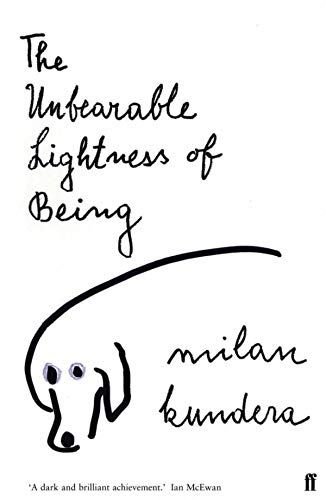
Why Read The Unbearable Lightness of Being?
The Unbearable Lightness of Being is one of the most intellectually seductive novels of the 20th century — a work that dissolves the conventional boundary between the philosophical essay and the literary novel so completely that neither category can contain it. Milan Kundera builds his narrative around a single philosophical opposition — the lightness and the weight of existence — and uses four characters’ intersecting lives in Soviet-occupied Czechoslovakia to test this opposition against every dimension of human experience: love, sex, politics, betrayal, art, and death.
The novel follows Tomáš, a Prague surgeon and compulsive womanizer who falls unexpectedly into deep love with Tereza, a waitress from the provinces. Tereza loves Tomáš with an intensity she experiences as both gift and burden — a weight she cannot shed. Sabina is Tomáš’s most important mistress, a painter who has built her life on the perpetual refusal of kitsch — of false sentiment, of the comfortable and the expected. Franz is Sabina’s Swiss lover, a professor who mistakes his love for a political commitment and eventually dies for an imaginary cause.
Kundera interrupts his narrative repeatedly with philosophical essays on lightness and weight, the eternal return, kitsch, and the nature of love and chance. These interruptions are not distractions from the novel but its central method: he is not a novelist who happens to have philosophical interests but a philosophical essayist who uses the novel form as his most appropriate instrument.
Who Should Read This
This is a book for readers who want a novel that thinks — that uses the resources of fiction not to evade philosophical questions but to pose them in their most human and concrete form. Essential for advanced students of European literature and political history; readers interested in the philosophy of love, chance, and identity; CAT/GRE aspirants who need practice with the most sophisticated hybrid of philosophical argument and literary narrative; and anyone who has wondered whether the fact that we live only once makes life meaningless or precious.
Key Takeaways from The Unbearable Lightness of Being
Lightness — the condition of a life lived once, without eternal return, without necessity — is both the most liberating and the most terrifying aspect of human existence. If nothing in our lives will be repeated, nothing carries absolute weight: our mistakes can be abandoned, our choices revised, our commitments escaped. But this freedom is also weightlessness: without the gravity of repetition, nothing matters absolutely, and the life that is perfectly free is also perfectly without consequence.
The heaviest burden is also, paradoxically, the image of life’s most intense fulfillment. Tereza’s love for Tomáš — which she experiences as a weight she carries constantly — is also the most real thing in her life. Weight is not merely oppression but the experience of mattering: the person or thing that weighs on us is the person or thing we cannot be indifferent to. The novel asks whether a life without weight — without love, without commitment, without the burden of caring — is liveable.
Kitsch — the aesthetic of false emotion, of the beautiful lie, of the sentimental image that denies the complexity and darkness of experience — is Kundera’s term for the fundamental enemy of genuine human life. Political kitsch (the Grand March of History) and personal kitsch (the romantic ideal of pure love) both substitute a comfortable image for difficult reality. Sabina’s lifelong rebellion against kitsch is the novel’s most radical aesthetic and ethical stance.
The relationship between Tereza and her dog Karenin provides the novel’s most quietly devastating meditation on love — an exploration of what genuine, unconditional care looks like in contrast to the complications of human love. Karenin loves with perfect reliability; his illness and death give Tereza a grief that is, paradoxically, cleaner and more bearable than any grief her relationship with Tomáš produces. Kundera uses the dog to ask what it would mean to love a human being with the same quality of attention and acceptance.
The Unbearable Lightness of Being — Plot Summary
The novel opens not with its characters but with a philosophical reflection: Kundera considers Nietzsche’s concept of the eternal return — the hypothesis that everything that has happened will happen again, infinitely — and asks what it would mean if the opposite were true: if everything happens only once, leaving no trace. From this philosophical opening he introduces Tomáš, a Prague surgeon who has been living lightly — a divorced man who carefully maintains the freedom of his bachelor life through a system of erotic friendships that involve no overnight stays and no emotional entanglement.
Tereza’s arrival shatters this system. She comes to Prague on an impulse, falls ill in Tomáš’s city, and ends up in his bed through a series of coincidences so improbable that Tomáš feels they constitute a message — that chance has singled him out to care for her. Despite every rational resistance, he falls in love with her and allows her to stay. Their relationship is the novel’s central emotional drama: Tomáš cannot stop his womanizing, which Tereza experiences as a form of erasure. Tereza cannot stop loving Tomáš despite his infidelities, which she experiences as a weight she cannot put down.
The Soviet invasion of 1968 sends both of them into exile in Zurich, where Sabina — Tomáš’s oldest and most important mistress — introduces them to Franz. Sabina’s relationship with Franz operates as a precise counterpoint to the Tomáš-Tereza dynamic: where Tereza wants weight and permanence, Sabina is constitutionally unable to tolerate them; Franz’s love is revealed to be a projection of his own romantic fantasies rather than a genuine perception of the woman before him. Sabina eventually abandons Franz without warning or explanation — one of her characteristic betrayals.
Tereza eventually returns to Prague alone — the lightness of Zurich proves more unbearable to her than the weight of the occupied city she knows. Tomáš follows her, sacrificing his career (he is forced from surgery to window-washing after refusing to recant a political article) and eventually his city as they move to the countryside. The novel’s final section — in the countryside, with Karenin dying — is its most tender. The ending, when it comes, is delivered with characteristic Kunderian indirection: we learn, retrospectively and elliptically, that Tomáš and Tereza died together in a truck accident, and that this death — this final shared weight — was, in its way, a happiness.
Characters
Each character in The Unbearable Lightness of Being embodies a philosophical position — a distinct way of inhabiting the opposition between lightness and weight — rather than a fully realized psychological individual in the realist tradition.
A Prague surgeon whose entire adult life has been organized around the maintenance of erotic freedom. Tomáš embodies the philosophical position of lightness: he lives without repetition, without weight, without the commitments that might anchor him to necessity. His love for Tereza — which arrives against his will — is the test the novel puts to lightness: what happens to the person committed to freedom when freedom is not enough? His trajectory from surgeon to window-washer to country farmer is both a political story and a philosophical one.
A waitress from the provinces who arrives in Prague on impulse and, through a series of improbable coincidences, becomes Tomáš’s great love and eventually his wife. Tereza embodies the philosophical position of weight: she loves with total commitment, suffers Tomáš’s infidelities as a form of existential assault, and experiences her own body as a source of shame. Her dream life — rendered in vivid, surrealist sequences — is the novel’s most direct access to the unconscious dimensions of the philosophical argument. She is the novel’s most sympathetically rendered character and, Kundera suggests, its moral center.
A Czech painter who has made betrayal her aesthetic and ethical principle — the perpetual refusal of kitsch, of fixed positions, of the comfortable and the expected. Sabina betrays everything she finds herself in: the Communist Party, Swiss respectability, Franz’s romantic love. She is not cynical but genuinely committed to a mode of existence that resists all fixity. Her bowler hat — inherited from her grandfather, worn in her studio while otherwise naked — is the novel’s central symbol: simultaneously meaningful and absurd, personal and theatrical, serious and playful.
A Swiss professor and devoted participant in progressive political causes who falls in love with Sabina and mistakes his love for a genuine connection rather than a projection. Franz wants weight — he wants his life to mean something, to be part of a Grand March of history — but his weight is kitsch: the comfortable sentimentality of someone whose political commitments never cost him anything. His eventual death on a medical relief march to Cambodia — dying for an imaginary cause, killed by a random street mugging — is the novel’s most devastating irony: weight purchased at the ultimate cost, revealed to be hollow.
The dog that Tomáš and Tereza adopt, named after Anna Karenina’s husband in an inversion of the literary reference. Karenin’s love for Tereza is the novel’s model of what Kundera calls the “second species of love” — love without neurosis, without demand, without the anxiety of comparison. His illness and death occupy the novel’s most tender passages; Kundera uses his dying to make explicit the argument about love that the human relationships can only approach obliquely: genuine care is attention without agenda, presence without demand.
Sabina’s bowler hat — inherited from her grandfather, worn during private and erotic moments — is the novel’s most carefully analyzed symbol. It is simultaneously a reminder of her grandfather (weight, memory, the past), a comic prop (lightness, irony, play), a sign of male authority worn by a woman (transgression), and an object whose meaning changes with every new context. Kundera uses it to illustrate that genuine aesthetic objects resist single meanings — they live precisely in the tension between multiple, contradictory resonances.
Major Themes
Kundera weaves four interconnected themes throughout the novel — each illuminating a different dimension of the central opposition between lightness and weight, and each tested against both private life and political history.
The novel’s organizing opposition — lightness (freedom, impermanence, forgetting, the life lived once) versus weight (necessity, repetition, memory, commitment, love) — is developed with sustained philosophical attention across the entire narrative. Neither term is simply positive or negative: lightness can be liberation or emptiness; weight can be meaning or oppression. The central question — which is better, lightness or weight? — is posed in its opening pages and never definitively answered, because Kundera’s argument is that the opposition itself is the permanent condition of human existence, not a problem to be resolved.
Kundera’s concept of kitsch — the aesthetic of false emotion, beautiful lies, and comfortable images that deny the darkness and complexity of actual experience — is among the most original contributions of the novel to philosophical and aesthetic thought. He extends the concept beyond art into politics (the Grand March of History as the supreme political kitsch) and personal life (romantic love as kitsch when it demands that the beloved confirm a fantasy rather than be genuinely seen). Sabina’s lifelong rebellion against kitsch — her need to betray every position she finds herself in — is presented as both aesthetically and ethically necessary, even as its human cost is honestly rendered.
The novel returns repeatedly to the question of how love begins — specifically to the role of chance in its origin — and uses this to examine the relationship between contingency and meaning. Tomáš falls in love with Tereza through a series of improbable coincidences he half-seriously interprets as messages from fate. But Kundera insists that there is no fate — only coincidence, and the meanings we retrospectively impose on it. The novel asks what it means to love someone whose arrival in your life was entirely accidental, and whether love’s contingency diminishes or intensifies its value.
The Prague Spring and Soviet invasion of 1968 are not merely backdrop but structural elements of the novel’s philosophical argument. The political intrudes on the private — Tomáš’s forced resignation from surgery, Tereza’s photographs of the invasion, Sabina’s exile — in ways that test the characters’ philosophical positions against historical necessity. Kundera insists that political kitsch — the Grand March, the noble cause — is as dangerous as personal kitsch, and that the person who has genuinely confronted lightness and weight will be suspicious of any political ideology that offers certainty and belonging at the price of individual complexity.
Critical Analysis
A balanced assessment of a novel whose formal originality and philosophical ambition are inseparable from the genuine tensions they create.
Kundera’s method — interrupting the narrative with philosophical essays, addressing the reader directly, refusing the conventions of psychological realism — creates a form uniquely suited to the novel’s content: a novel about the relationship between ideas and lives requires a form in which the boundary between thinking and living is as permeable as possible.
Kundera’s concept of kitsch — developed in the novel’s central essay sections and enacted through Sabina’s character — is one of the most original and useful ideas in 20th-century aesthetic and political thought, applicable far beyond the novel’s specific historical context.
The passages devoted to Tereza’s relationship with her dog — culminating in his illness and death — are the novel’s most emotionally pure and philosophically precise achievement: an argument about the nature of love rendered entirely through concrete, specific, unsentimental detail.
Kundera’s characters are more fully realized as philosophical positions than as psychologically individuated human beings — readers who want the immersive character identification of conventional literary fiction will find the novel’s deliberate distance and authorial intrusion frustrating.
Kundera’s treatment of Tereza and Sabina — while philosophically serious — has been criticized for rendering female experience primarily through a male philosophical consciousness. Both women are seen more through the theoretical lens of lightness and weight than through their own interiority, which limits the novel’s range of human understanding.
The novel’s political dimension — the Prague Spring, the Soviet invasion, the specific texture of life under Czechoslovak communism — requires some historical knowledge to be fully felt. Readers without this context will understand the plot but miss the weight that specific historical detail gives to abstract philosophical argument.
Literary & Cultural Impact
Immediate International Recognition: The Unbearable Lightness of Being was written in Czech in the early 1980s while Kundera was living in exile in France, published in French translation in 1984, and immediately recognized as a masterwork of European literature. It was an international bestseller — unusual for a work of such philosophical density — and its 1988 film adaptation by Philip Kaufman, starring Daniel Day-Lewis, Juliette Binoche, and Lena Olin, brought it to a mass audience while preserving more of the novel’s philosophical texture than most literary adaptations manage.
The Central European Novel: In literary criticism, the novel established Kundera as the central figure of what critics called the “Central European novel” — a tradition of philosophical fiction emerging from the specific historical experience of countries caught between Soviet power and Western culture, including writers like Josef Škvorecký, Bohumil Hrabal, and György Konrád. In philosophy, the concepts of lightness and weight and the kitsch analysis have been taken up by philosophers working on aesthetics, political philosophy, and the philosophy of love.
Influence on Subsequent Writers: The novel also had an unexpected influence on popular culture: the opposition between lightness and weight became a framework that many readers applied to their own lives. Kundera’s combination of erotic candor, political seriousness, and philosophical accessibility opened a space in literary fiction for the hybrid novel-essay form that has influenced a generation of writers, including Roberto Bolaño, W.G. Sebald, and Zadie Smith, who have each developed their own versions of the form.
For Competitive Exam Preparation: The Unbearable Lightness of Being is among the most valuable advanced texts on the Readlite list. Its alternation between narrative and philosophical essay, its use of characters to embody philosophical positions, its analysis of kitsch as an aesthetic and political concept, and its sustained meditation on the relationship between chance and meaning all provide direct practice for the analytical reading skills — inference, identification of argument, understanding of how structure enacts theme — that the most demanding GRE and CAT passages require.
Love This Book? Master Every Book.
Stop struggling with reading comprehension. Our proven system transforms how you read—whether for CAT, GRE, GMAT, SAT, or personal growth.
Best Quotes from The Unbearable Lightness of Being
The heaviest of burdens is simultaneously an image of life’s most intense fulfillment.
Einmal ist keinmal. What happens but once might as well not have happened at all. If we have only one life to live, we might as well not have lived at all.
Kitsch causes two tears to flow in quick succession. The first tear says: How nice to see children running on the grass! The second tear says: How nice to be moved, together with all mankind, by children running on the grass!
Anyone whose goal is something higher must expect someday to suffer vertigo. What is vertigo? Fear of falling? No, vertigo is something other than fear of falling. It is the voice of the emptiness below us which tempts and lures us, it is the desire to fall, against which, terrified, we defend ourselves.
We can never know what to want, because, living only one life, we can neither compare it with our previous lives nor perfect it in our lives to come.


Test Your Understanding
Think you’ve mastered The Unbearable Lightness of Being? Challenge yourself with 15 questions on lightness vs. weight, kitsch, characters, and Kundera’s philosophical method. Score 80%+ to prove your mastery.
The Unbearable Lightness of Being FAQ
What is The Unbearable Lightness of Being about?
The novel follows four characters — Tomáš, Tereza, Sabina, and Franz — whose lives intersect in Prague in the years around the 1968 Soviet invasion of Czechoslovakia. It uses their intersecting love stories to explore a central philosophical opposition: lightness (freedom, impermanence, living without repetition or necessity) versus weight (commitment, memory, love, the burden of caring). Kundera interrupts the narrative repeatedly with philosophical essays on these themes, making the novel simultaneously a love story, a political novel about life under Soviet occupation, and a sustained philosophical inquiry into the nature of human existence.
What does “the unbearable lightness of being” mean?
The title condenses the novel’s central philosophical argument. “Lightness” refers to the condition of a life lived only once — without eternal return, without necessity — in which nothing has absolute weight because nothing will be repeated. This lightness is simultaneously liberating (we are free, nothing is fixed, everything can be revised) and unbearable (if nothing is repeated, nothing ultimately matters, and the life that is perfectly free is also perfectly without consequence). The novel asks whether we can learn to live with this lightness or whether we are constitutionally drawn to the weight of commitment, love, and necessity that makes lightness bearable.
What is Kundera’s concept of “kitsch”?
Kundera’s concept of kitsch goes far beyond its ordinary meaning of cheap or sentimental art. For Kundera, kitsch is any aesthetic, emotional, or political stance that denies the darkness, complexity, and ambiguity of actual experience by substituting a beautiful, comfortable, emotionally reassuring image. Political kitsch is the Grand March of History — the noble cause that gives participants the warm feeling of collective purpose without requiring them to confront the individual cost of their commitments. Personal kitsch is romantic love conceived as the perfect union of two souls, which requires that the beloved confirm a fantasy rather than be genuinely seen. Sabina’s lifelong rebellion against kitsch — her need to betray every position she finds herself in — is the novel’s most radical ethical stance.
How does the Prague Spring function in the novel?
The 1968 Soviet invasion of Czechoslovakia is not merely historical backdrop but a structural element of the novel’s philosophical argument. It creates the conditions under which the characters’ philosophical positions are tested against genuine historical weight: Tomáš’s lightness is challenged by his refusal to recant a political article (which costs him his career); Tereza’s weight finds expression in her photographs of the invasion; Sabina’s exile gives her freedom a specific political dimension; Franz’s political commitments are revealed as kitsch when he eventually dies for a cause that costs him nothing until it suddenly costs him everything. The political intrudes on the private in ways that make the philosophical abstract concrete.
Is The Unbearable Lightness of Being a love story or a philosophical novel?
Both, inseparably — and this is the point of Kundera’s method. The novel insists that love stories are philosophical arguments conducted in human terms: that Tomáš and Tereza’s relationship is not merely an emotional drama but a living test of the opposition between lightness and weight, that Sabina’s relationship with Franz is not merely an erotic misunderstanding but a concrete demonstration of the gap between kitsch and genuine perception. By refusing to separate the love story from the philosophical argument — by interrupting his narrative with essays and his essays with narrative — Kundera argues that genuine philosophy must be tested against the actual texture of lived experience, and that fiction is the most honest form in which this testing can be conducted.








