

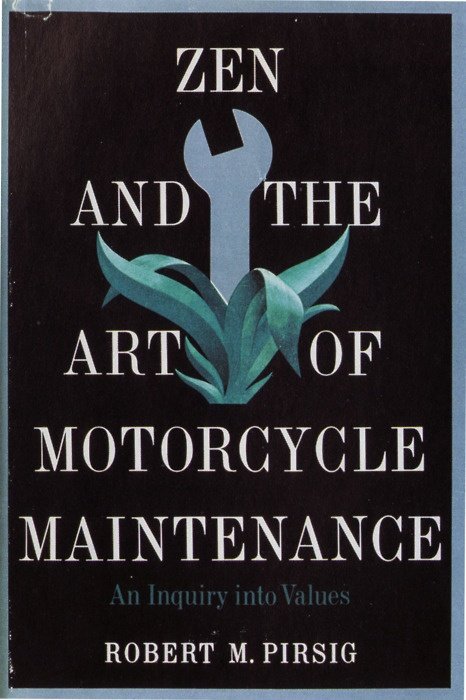
Why Read Zen and the Art of Motorcycle Maintenance?
Zen and the Art of Motorcycle Maintenance is one of the most unlikely philosophical bestsellers in publishing history — a book rejected by 121 publishers before its 1974 release, which then sold five million copies and never went out of print. It is not quite a novel, not quite a memoir, and not quite a work of philosophy — it is all three simultaneously, held together by a motorcycle journey across America and by a philosophical inquiry into the nature of Quality that gradually reveals itself to be a psychological journey into a shattered self. It remains the most widely read work of American philosophical fiction ever written.
The narrator — never named, though clearly a version of Pirsig himself — travels by motorcycle from Minnesota to California with his eleven-year-old son Chris and two friends. The physical journey is described with precise, sensory attention — the roads, the weather, the mechanics of the motorcycle, the towns and landscapes of the American interior. Running alongside it, and increasingly overtaking it, is a sustained philosophical inquiry the narrator calls a “Chautauqua” — on the nature of Quality, the conflict between classical and romantic modes of understanding, and the relationship between technology and human values.
Woven through both is a third thread: the gradual emergence of Phaedrus — the narrator’s former self, a philosophy instructor who pursued Quality with such single-minded intensity that he was committed to a psychiatric institution and subjected to electroconvulsive therapy, effectively destroying his previous personality. The narrator is the man who emerged from that treatment — a different person inhabiting the same body, haunted by the ghost of the self he was. The convergence of these three threads in the novel’s final chapters produces one of the most emotionally charged conclusions in American literary nonfiction.
Who Should Read This
This is a book for readers who want philosophy embedded in lived experience — who want ideas to emerge from the friction of a motorcycle engine, the tension between a father and son, and the landscape of the American West rather than from the abstractions of the seminar room. Essential for advanced students of American literature and philosophy; engineers, technologists, and craftspeople who want their work philosophically grounded; CAT/GRE aspirants who need practice with the most demanding hybrid of philosophical argument and literary narrative; and anyone who has felt the tension between head and heart, analysis and intuition.
Key Takeaways from Zen and the Art of Motorcycle Maintenance
The classical mode of understanding — analysis, logic, system — and the romantic mode — intuition, feeling, aesthetic experience — are not opposites but complementary ways of engaging with the same reality. Quality — what makes both a well-tuned engine and a beautiful poem good — is the underlying reality that both modes are grasping at from different angles.
Quality cannot be defined — but it can be recognised, and its recognition precedes any definition. Pirsig’s most original philosophical move is to argue that Quality exists prior to the subject-object distinction itself — the event of experience before it is divided into the thing experienced and the person experiencing it.
Good work requires “gumption”: the mental and emotional energy that comes from genuine care and sustained attention. The narrator’s meditations on gumption traps — the psychological states (anxiety, boredom, impatience, ego) that drain the energy needed for good work — are among the most practically useful passages in the book.
The relationship between the narrator and his son Chris is the novel’s emotional spine. Chris’s anguish — his sense that something is wrong with his father, that the man riding beside him is not quite the father he needs — drives the personal narrative, and the novel’s resolution requires the narrator to acknowledge the human cost of his philosophical pursuit.
Zen and the Art of Motorcycle Maintenance — Plot Summary
The novel opens in Minnesota on a clear summer morning as the narrator, his son Chris, and their friends John and Sylvia Sutherland set out by motorcycle on a cross-country journey west. From the first pages, Pirsig establishes two contrasting relationships to the motorcycle: the narrator maintains his own machine with careful, methodical attention, while John — a romantic who loves the experience of riding but dislikes the machinery — prefers to take his to a shop. This contrast between classical engagement with technology and the romantic rejection of it is the seed from which the entire philosophical inquiry grows.
As the journey progresses westward through North Dakota, Montana, and into the mountains, the physical narrative alternates with the Chautauqua — the narrator’s philosophical lectures on the history of the Quality concept, the classical-romantic split in human understanding, and the career of Phaedrus. These sections grow longer and more intense as the journey continues, while the physical narrative — campsite conversations, roadside diners, mountain passes, the specific textures of American landscape — provides grounding for ideas that might otherwise become purely abstract.
Phaedrus — the narrator’s former self — emerges gradually through the Chautauqua passages. He was a philosophy and rhetoric instructor who became obsessed with the question of Quality while teaching writing at Montana State University. His pursuit led him to the discovery that Quality could not be defined within the Western philosophical tradition — that it preceded the subject-object distinction on which all Western epistemology rests — and then to the broader hypothesis that Quality might be the fundamental ground of all reality. This pursuit, conducted with increasing single-mindedness and isolation, led to his psychological collapse, his hospitalisation, and the electroconvulsive therapy that destroyed him and produced the narrator.
The journey and the Chautauqua converge in the novel’s final section, above San Francisco, where Chris’s increasing distress forces the narrator into a direct confrontation with what he has avoided: that his son needs Phaedrus, that the pursuit that destroyed one self may need to be reclaimed by the other. The resolution — neither triumphant nor tragic — is an opening, a beginning, a tentative acknowledgment that father and son are still capable of genuine contact.
Zen and the Art of Motorcycle Maintenance — Characters
Each character in the novel embodies a philosophical position as well as a human presence — the cast is small but precisely chosen.
A man in his thirties — never named — who is the post-ECT replacement for Phaedrus, the philosophical self destroyed by psychiatric treatment. Careful, analytical, emotionally contained, and technically competent, he has inherited Phaedrus’s intellectual journey without its passion. His growing confrontation with his former self constitutes the novel’s psychological drama.
Named after the Platonic dialogue on rhetoric and beauty, Phaedrus was the narrator’s previous identity — a passionate, relentless, ultimately self-destructive philosopher who pursued Quality to the edge of madness and beyond. He is the novel’s most compelling presence and its most absent one — experienced only through the flat, careful reconstruction of the man who replaced him.
Eleven years old at the novel’s opening, Chris is the journey’s most vulnerable presence — a child who senses that something is deeply wrong with his father without being able to name it. His need for genuine connection drives the personal narrative, and his distress in the novel’s final section forces the narrator into the confrontation with Phaedrus he has been avoiding. He is the novel’s emotional heart.
The narrator’s travelling companion — a pleasant, cultured man who loves jazz and riding but is viscerally uncomfortable with the technology that makes both possible. John represents the romantic mode in its most sympathetic form: his refusal to learn motorcycle maintenance is the practical manifestation of the classical-romantic split that the novel diagnoses.
John’s wife and travelling companion, who shares his romantic orientation but whose acute intelligence gives her a clearer perception of the narrator’s psychological strangeness. Sylvia functions primarily as a witness — her observations of the narrator’s relationship with Chris, and her growing unease with the journey as it intensifies, register the human cost of the philosophical pursuit on the road.
The narrator’s motorcycle is not merely a vehicle but the novel’s central philosophical prop — the object through which the classical mode of understanding is most directly dramatised. Pirsig uses it as a teaching instrument: the concrete instance through which abstract arguments about Quality and the ethics of care are made tangible and testable. It is also, implicitly, the narrator himself — requiring the same careful, attentive maintenance as the psyche that pilots it.
Major Themes
Pirsig weaves four interconnected themes through the novel, each enriching the others and each carrying both philosophical and personal weight.
The novel’s organising opposition is between two fundamentally different modes of engaging with the world: the classical (analytical, systematic, interested in underlying form and function) and the romantic (immediate, aesthetic, interested in surface appearance and emotional response). Pirsig argues that the modern Western world has entrenched this division to pathological effect — and that motorcycle maintenance is his test case for what a unified engagement might look like.
Quality is not a subjective aesthetic judgment or an objective property of things but the primary empirical reality from which the subject-object distinction itself emerges. Before there is a “perceiver” and a “thing perceived,” there is the event of Quality — the immediate, pre-analytical recognition of excellence. Its implications are radical: Quality is not something we find in reality; it is the reality from which everything else is abstracted.
The novel is a critique of technological alienation — the sense that machines are fundamentally foreign to human experience. Pirsig’s counter-argument is that this alienation is a symptom of the classical-romantic split, and that engagement with technology guided by genuine care and Quality is as humanising and as spiritual as any art form. The mechanic who truly understands the machine they are working on is practising a form of Zen.
The psychological narrative — the haunting of the narrator by Phaedrus, and the gradual convergence of their two incompatible identities — is the novel’s emotional and dramatic core. Phaedrus’s destruction was not a healing but an amputation. The narrator’s journey west is, at its deepest level, a journey toward the reintegration of what was severed — a recovery of passion, commitment, and the willingness to follow ideas to their most uncomfortable conclusions.
Critical Analysis
A balanced assessment examining the remarkable achievements of Pirsig’s hybrid text alongside its genuine structural and philosophical limitations.
Pirsig’s achievement in embedding genuine, sustained philosophical argument within a compelling road narrative — making the ideas emerge from the physical journey and the father-son relationship rather than existing separately — is the book’s defining formal accomplishment and the reason it has reached millions of readers who would never pick up an academic philosophy text.
The narrator’s meditations on the mental states that enable or prevent good work — the taxonomy of gumption traps, the diagnosis of the psychological conditions under which quality work becomes possible — are among the most practically useful philosophical passages in American nonfiction, with direct application to any creative or technical endeavour.
Whatever its limitations as academic philosophy, the argument that Quality is a pre-analytical primary reality — that it precedes the subject-object distinction — is genuinely original and has generated substantial philosophical discussion, including Pirsig’s own extended development of it in his later book Lila (1991).
The Chautauqua sections grow increasingly long and technically demanding as the novel progresses, while the physical narrative and human relationships receive proportionally less attention. Many readers find the balance tips too far toward philosophical exposition in the novel’s final third, with Chris’s distress serving more as an emotional alarm clock than as a fully realised psychological portrait.
Pirsig’s engagement with the Western philosophical tradition — his reading of Plato, his interpretation of the subject-object distinction — has been criticised by professional philosophers as selective and sometimes inaccurate. The book is best read as philosophical provocation rather than as careful scholarly philosophy.
The organising opposition of the novel is a powerful heuristic but a crude one. The tradition of philosophy of science, philosophy of technology, and philosophical aesthetics contains far more nuanced accounts of the relationship between analysis and experience than Pirsig’s binary suggests.
Literary & Cultural Impact
A Publishing Legend: The publishing history of Zen and the Art of Motorcycle Maintenance is itself a text on the nature of Quality: rejected by 121 publishers before William Morrow accepted it in 1974, it became one of the most commercially successful philosophical books in American publishing history, selling over five million copies in its first decade and remaining continuously in print for fifty years. Pirsig received a $3,000 advance; the book eventually generated millions in royalties. It was listed by the Times Literary Supplement as one of the hundred most influential books since the Second World War, and it has been taught in philosophy departments, engineering programs, and creative writing courses with equal success.
Cultural Reach Across Communities: Among general readers, it helped establish the tradition of “philosophical memoir” — the book that pursues genuine ideas through the structure of personal narrative — that runs through Robert Bly, Annie Dillard, and into contemporary narrative nonfiction. Among technologists and engineers, it provided a framework for thinking about the relationship between technical work and human values that remains influential in software development, industrial design, and the maker movement. Among philosophers, it generated a sustained debate that Pirsig extended in Lila: An Inquiry into Morals (1991).
For Competitive Exam Preparation: Zen and the Art of Motorcycle Maintenance is demanding advanced reading comprehension material of unusual richness. Its alternation between physical narrative and philosophical exposition, its use of the specific to illuminate the abstract, its layered psychological narrative, and its exploration of the classical-romantic distinction all provide direct practice for the analytical reading skills — inference, identification of argumentative structure, understanding of how evidence supports claims — that GRE and CAT passages most rigorously test.
Love This Book? Master Every Book.
Stop struggling with reading comprehension. Our proven system transforms how you read—whether for CAT, GRE, GMAT, SAT, or personal growth.
Best Quotes from Zen and the Art of Motorcycle Maintenance
The Buddha, the Godhead, resides quite as comfortably in the circuits of a digital computer or the gears of a cycle transmission as he does at the top of a mountain or in the petals of a flower.
The test of the machine is the satisfaction it gives you. There isn’t any other test. If the machine produces tranquility it’s right. If it disturbs you it’s wrong until either the machine or your mind is changed.
Care and Quality are internal and external aspects of the same thing. A person who sees Quality and feels it as he works is a person who cares.
You want to know how to paint a perfect painting? It’s easy. Make yourself perfect and then just paint naturally.
The only Zen you find on the tops of mountains is the Zen you bring up there.

Test Your Understanding
Think you’ve mastered Zen and the Art of Motorcycle Maintenance? Challenge yourself with 15 questions on Quality, the classical-romantic divide, Phaedrus, and the novel’s key themes. Score 80%+ to prove your mastery.
Zen and the Art of Motorcycle Maintenance FAQ
What is Zen and the Art of Motorcycle Maintenance about?
The novel follows a narrator and his eleven-year-old son Chris on a motorcycle journey from Minnesota to California, accompanied by friends John and Sylvia Sutherland. Woven through the physical journey are philosophical “Chautauquas” — lectures on the nature of Quality, the conflict between classical and romantic modes of understanding, and the history of Western philosophy — and a gradually emerging psychological narrative about Phaedrus, the narrator’s former self, who was destroyed by electroconvulsive therapy after an obsessive philosophical pursuit drove him to a breakdown. The novel is simultaneously a road trip memoir, a philosophical inquiry, and a psychological investigation into a fractured identity.
What is “Quality” in Pirsig’s sense?
Quality — which Pirsig capitalises to signal its status as a philosophical term — is not a subjective aesthetic response or an objective property of things but something that precedes the subject-object distinction itself. Pirsig argues that Quality is the primary empirical fact — the immediate, pre-analytical event of engagement with the world before it is divided into perceiver and perceived. Before you can define what makes a well-maintained motorcycle good, you feel the difference from a poorly maintained one. Quality is this immediate recognition, and Pirsig’s argument is that it is itself the most fundamental thing.
What is the relationship between “Zen” and “Motorcycle Maintenance” in the title?
The title is deliberately paradoxical — joining the spiritual tradition of Zen Buddhism (associated with mindfulness, presence, and the dissolution of subject-object duality) with the mundane technical activity of motorcycle maintenance. The paradox is the book’s argument: that Zen is not confined to meditation halls and mountain monasteries but is available in any activity undertaken with genuine attention and care. The motorcycle maintained with real attention and understanding is as valid a path to quality engagement as any explicitly spiritual practice.
Who is Phaedrus and why does he matter?
Phaedrus — named after the Socratic dialogue on rhetoric and beauty — is the narrator’s former identity: a passionate philosophy instructor who pursued the concept of Quality through the Western philosophical tradition until he concluded that Quality could not be contained within that tradition. This pursuit, conducted with increasing single-mindedness and isolation, led to a psychological breakdown, hospitalisation, and electroconvulsive therapy that effectively destroyed his previous personality. The narrator is the man who emerged from that treatment. The novel’s psychological drama is his gradual recognition that he must reclaim Phaedrus — not the madness, but the passion and quality of commitment — in order to be genuinely present to his son.
Is the philosophical argument in the book academically rigorous?
Not by the standards of professional academic philosophy — Pirsig’s engagement with Plato, Aristotle, and the Western epistemological tradition has been criticised as selective and insufficiently rigorous. The book is best approached not as a contribution to academic philosophy but as philosophical provocation — a sustained, serious engagement with genuinely important questions (what is Quality? what is the relationship between analysis and experience? what does it mean to do good work?) conducted through personal narrative and rhetoric. On those terms, it is one of the most valuable philosophical documents in American literature.








