
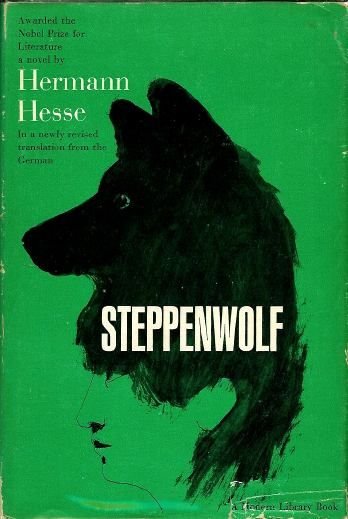
Why Read Steppenwolf?
Steppenwolf is among the most psychologically intense and formally audacious novels of the 20th century — a work that refuses comfortable resolution, dismantles its protagonist’s sense of self systematically and mercilessly, and ultimately proposes that the idea of a unified, coherent identity is itself the disease from which modern Western man suffers. Published in 1927, it was immediately controversial — too nihilistic for some readers, too mystical for others — and it has never stopped generating argument.
Harry Haller is a fifty-year-old intellectual living in a rented room in a German city, estranged from bourgeois society, from human warmth, and increasingly from the will to live. He experiences himself as two irreconcilable beings: Harry the refined, solitary intellectual, and the Steppenwolf — the wolf of the steppes, a wild, instinctual, destructive force he cannot integrate. The novel follows Harry through a series of encounters that progressively dismantle his self-conception — culminating in the Magic Theatre, a hallucinatory sequence in which the divisions of Harry’s self are shown to be not a duality but an infinite multiplicity of selves, none of which constitutes a fixed identity.
The Magic Theatre is one of the most remarkable sustained passages in 20th-century fiction — a proto-surrealist, proto-psychedelic sequence that reads as if Hesse anticipated both Jung’s confrontation with the unconscious and the LSD experiences of the 1960s counter-culture that made the novel a touchstone for that generation.
Who Should Read This
This is a book for readers who are willing to be psychologically discomfited by fiction — who want a novel that does not resolve its contradictions but lives inside them. Essential for advanced students of German literature and European modernism; readers interested in psychology, self-division, and the critique of bourgeois culture; CAT/GRE aspirants who need practice with dense, psychologically layered philosophical fiction; and anyone who has felt themselves to be irreducibly divided against themselves.
Key Takeaways from Steppenwolf
The division Harry experiences — between the civilized intellectual and the wild Steppenwolf — is not a unique pathology but the condition of the modern intellectual who has repressed one dimension of human nature in favour of another. The bourgeois world demands this repression, and the price of civilization’s refinement is the wolves we carry within us — denied, suppressed, and therefore all the more dangerous.
The self is not two but many — not a duality to be resolved but an infinite multiplicity to be acknowledged and inhabited. The Magic Theatre’s fundamental revelation is that Harry’s belief in his dual nature (man and wolf) is itself a simplification. The search for a unified self is not the solution to alienation but its cause.
Mozart and jazz, high art and lowlife pleasure, are not opposites but expressions of the same underlying vitality. Harry’s inability to dance, to enjoy jazz, to take pleasure in the body is not spiritual elevation but a form of impoverishment — and Hermine’s education of Harry in these “lower” pleasures is presented as genuine wisdom.
The Immortals — Mozart, Goethe, and the great artists — laugh at human suffering from a serene distance, and this laughter is not cruelty but wisdom. Harry’s final lesson is the ability to laugh at himself and at the tragic self-importance with which he has invested his own suffering. Humor, in Hesse’s vision, is not a retreat from seriousness but its highest form.
Steppenwolf Plot Summary
The novel arrives in three layers. The outer frame is the preface written by the bourgeois nephew of Harry’s landlady, who found Harry’s manuscript after his sudden departure. The nephew’s perspective — puzzled, slightly disapproving, but more sympathetic than Harry would expect — establishes the novel’s first irony: the bourgeois world Harry despises is capable of perceiving him with more nuance than he perceives it.
The main body is Harry Haller’s manuscript. Harry is fifty, a scholar and intellectual of considerable attainment, living in a furnished room and moving toward suicide with methodical resignation. He has given himself until his fiftieth birthday to decide whether life remains worth living. He experiences himself as divided between two natures that cannot coexist: the cultivated, sensitive man of ideas and the Steppenwolf — raw, lonely, violent — who lurks beneath the civilized surface. He loves Mozart and Goethe; he hates gramophones, nationalism, and the comfortable mediocrity of modern German life.
Into this stasis come three figures who progressively transform Harry’s world. Hermine — a woman Harry meets in a dance hall — recognizes him with uncanny precision, as though she knows him from within. She becomes his teacher in the pleasures he has denied himself. Pablo — the serene, beautiful saxophonist — offers a mode of existence entirely foreign to Harry: effortless, present, untroubled by ideas or guilt, living entirely in sensation and music. Maria, Hermine’s gift to Harry, is his lover, and through her he learns to re-inhabit his body with something approaching joy.
The novel’s climax is the Fancy Dress Ball — a carnival of extraordinary hedonistic excess — followed by Harry’s entry into Pablo’s Magic Theatre: “FOR MADMEN ONLY.” The Magic Theatre is a hallucinatory sequence of rooms, each offering Harry a confrontation with a different dimension of his suppressed self. In the Theatre’s final room, Harry kills Hermine — or the figure he takes to be Hermine — in an act whose meaning the novel deliberately leaves unresolved. Pablo and Mozart appear to judge him: not with condemnation but with the serene, slightly disappointed laughter of those who have understood what Harry has not quite learned. He is sentenced not to death but to life — and to the possibility of laughter.
Steppenwolf Characters
Each figure in Steppenwolf operates simultaneously as a fully realized person and as an aspect of Harry’s inner world — the novel’s deliberate ambiguity about where reality ends and projection begins is philosophically essential.
A fifty-year-old German intellectual of genuine cultivation and profound self-division, whose manuscript constitutes the body of the novel. One of the most fully realized portraits of male intellectual crisis in 20th-century fiction — brilliantly intelligent, emotionally stunted, oscillating between contempt for the bourgeois world and desperate longing for its warmth.
The wolf of the steppes — the raw, instinctual, anti-social force that Harry experiences as his second nature. Not simply the “bad” self to Harry’s “good” intellectual self; a vital dimension of humanity that bourgeois civilization has suppressed, and that Harry has so thoroughly internalized this suppression he cannot access it directly.
The nightlife figure who becomes Harry’s most important teacher — recognizing him completely, guiding him through the pleasures he has denied himself, and demanding from him, as the price of their relationship, that he eventually kill her. Simultaneously a fully realized woman, a projection of Harry’s own anima (his suppressed feminine dimension, in Jungian terms), and possibly a figure from the Magic Theatre rather than from consensual reality.
The saxophone player whose serene, effortlessly present mode of existence is the direct antithesis of Harry’s anguished intellectualism. Pablo never argues, never analyzes, never suffers visibly — he simply lives, with complete absorption in sensation and music. He is the guardian of the Magic Theatre and the figure who offers Harry the key to it: the dissolution of the fixed self into infinite multiplicity.
Hermine’s friend and Harry’s lover, who teaches him to inhabit his body with pleasure and ease — to experience physical closeness without the overlay of guilt, self-consciousness, and intellectualization that has made intimacy impossible for him. Warmly human where Hermine is enigmatic and Pablo is serenely other; her departure without drama is one of the novel’s quietest and most affecting moments.
Mozart appears in the Magic Theatre as a representative of the Immortals — the great artists whose work has transcended their personal suffering and achieved a serene, laughing relationship to human existence. They laugh at Harry’s suffering not with contempt but with the humor of those who have passed through everything he is still trapped in. Mozart’s gentle instruction that Harry learn to laugh at himself is the novel’s closest approach to a resolution.
Major Themes
Hesse weaves several interconnected themes throughout Steppenwolf — each illuminating a different facet of the novel’s central question: what does it mean to be irreconcilably divided, and is wholeness even possible?
Harry Haller embodies a specific crisis — the crisis of the bourgeois intellectual who has achieved cultural refinement at the cost of vitality, who has repressed his instinctual self in service of an ideal of civilization that the First World War has rendered morally bankrupt. Harry’s anguish carries the weight of post-war European disillusionment: the culture that produced Goethe and Mozart also produced the trenches, and the man who has devoted his life to that culture must reckon with this catastrophic contradiction.
The novel’s central philosophical argument — delivered most explicitly in the Treatise on the Steppenwolf, a pamphlet Harry finds that analyzes him from the outside — is that the self is not a unity, not even a duality, but an infinite multiplicity of overlapping, contradictory selves. Harry’s suffering arises not from his division between man and wolf but from his insistence that one of these must win — his inability to acknowledge and inhabit the full spectrum of his contradictory natures.
Harry’s relationship to bourgeois culture — the world of comfortable rooms, potted plants, well-kept staircases, and quiet self-satisfaction — is the novel’s most sustained irony. He despises this world and is simultaneously drawn to it with a longing he cannot admit. Hesse presents the bourgeois world not as simply contemptible but as the indispensable ground against which Harry’s wild nature defines itself — and Harry’s contempt for it as a form of dependency.
The novel’s resolution — such as it is — is not the integration of Harry’s divided selves but the acquisition of the capacity to laugh at their division. The Immortals’ laughter is not the laughter of those who have transcended suffering but of those who can hold suffering and joy simultaneously without being destroyed by either. This synthesis is presented as genuinely difficult, genuinely rare, and only partially achieved by Harry by the novel’s end.
Critical Analysis
A balanced assessment of a novel whose formal audacity and psychological depth are inseparable from its characteristic excesses.
The portrait of Harry Haller — his specific combination of intelligence, self-awareness, emotional limitation, and genuine suffering — is one of the most fully realized depictions of male intellectual crisis in 20th-century fiction, drawing on Hesse’s own psychological work with Jung and giving the novel a clinical precision alongside its romantic excess.
The hallucinatory sequence that occupies the novel’s final third is genuinely unprecedented in its period — a sustained piece of psychological surrealism that anticipates the experimental fiction of the 1960s and remains among the most original formal achievements in the European novel.
The embedded pamphlet — which analyzes Harry from outside, in the third person, with a cool precision that Harry’s own narration cannot achieve — is a brilliant structural device that gives the reader access to a more objective perspective on the protagonist without breaking the novel’s first-person intimacy.
Hesse’s identification with Harry is so complete that the novel occasionally loses the critical distance necessary to prevent it from endorsing Harry’s anguished self-importance rather than interrogating it. The warning that the novel is a “disease, not a solution” — offered in Hesse’s own preface to a later edition — is well-taken.
Hermine, Maria, and the women Harry encounters in the Magic Theatre are rendered almost entirely through Harry’s projecting consciousness — they function as aspects of his inner world rather than as fully independent human beings. This is partly intentional (Hermine is explicitly connected to Harry’s anima) but limits the novel’s range of human understanding.
The novel ends with Harry sentenced to life and to the possibility of laughter — but this is a beginning, not an ending, and readers who want genuine resolution or a clear philosophical conclusion will be frustrated. The incompleteness is philosophically honest but narratively unsatisfying.
Literary & Cultural Impact
From Controversy to Counter-Culture Icon: Steppenwolf was poorly received on initial publication in Germany — too excessive for the literary establishment, too pessimistic for the reading public. The novel found its first significant audience in the 1930s and 1940s, particularly among European readers navigating the rising totalitarianism that Hesse’s critique of nationalist culture had anticipated.
The 1960s Transformation: Its most extraordinary cultural moment came in the 1960s, when American and European counter-culture adopted it as one of their central texts. Pablo’s serene hedonism, the rejection of bourgeois respectability, the valorization of jazz and sensory experience, and the Magic Theatre’s hallucinatory quality all resonated with extraordinary force in the psychedelic era. The rock band Steppenwolf, formed in 1967 and best known for “Born to Be Wild,” took their name directly from the novel. Hesse received more than 35,000 letters from American readers between 1967 and 1969 alone, making him the most widely read German author in the United States during that period.
Literary Tradition: In the history of the psychological novel and the novel of ideas, Steppenwolf occupies a distinctive position: more experimental than Siddhartha, more psychologically specific than The Glass Bead Game, and more directly autobiographical than either. It belongs alongside Nausea, The Stranger, and The Unbearable Lightness of Being in the tradition of European philosophical fiction that uses the novel form to pursue genuinely philosophical questions about identity, freedom, and the possibility of living well.
For Competitive Exam Preparation: Steppenwolf is challenging advanced reading comprehension material. Its layered narrative structure (the framing preface, Harry’s manuscript, the embedded Treatise, the Magic Theatre), its use of unreliable self-narration, and the gap between what Harry understands about himself and what the reader can perceive — all are directly relevant to the analytical reading skills tested in GRE and CAT passages on literary fiction and philosophical prose.
Love This Book? Master Every Book.
Stop struggling with reading comprehension. Our proven system transforms how you read—whether for CAT, GRE, GMAT, SAT, or personal growth.
Best Quotes from Steppenwolf
I believe that the struggle against death, the unconditional and self-willed determination to live, is the motive power behind the lives and activities of all outstanding men.
Every man is more than just himself; he also represents the unique, the very special and always significant and remarkable point at which the world’s phenomena intersect.
One never reaches home, but wherever friendly paths intersect the whole world looks like home for a time.
Eternity is a mere moment, just long enough for a joke.
The bourgeois treasures nothing more highly than the self… and so at the cost of intensity he achieves his own preservation and security.
Test Your Understanding
Think you’ve mastered Steppenwolf? Challenge yourself with 15 questions on themes, characters, and the Magic Theatre. Score 80%+ to prove your mastery.
Steppenwolf FAQ
What is Steppenwolf about?
Steppenwolf follows Harry Haller, a fifty-year-old German intellectual who experiences himself as divided between two irreconcilable natures — the refined, solitary man of culture and the wild Steppenwolf — and who is moving, methodically, toward suicide. The novel traces his encounters with Hermine, Pablo, and Maria — figures who teach him pleasures he has denied himself — and culminates in the Magic Theatre, a hallucinatory sequence in which the divisions of his self are revealed to be not a duality but an infinite multiplicity. The novel is simultaneously a personal crisis document, a critique of bourgeois German culture, and a Jungian exploration of the unconscious.
What is the Magic Theatre?
The Magic Theatre — announced throughout the novel by a mysterious sign reading “FOR MADMEN ONLY. PRICE OF ADMISSION YOUR MIND” — is the hallucinatory sequence that occupies the novel’s final third, facilitated by Pablo with what appears to be a psychedelic substance. It is a series of rooms, each offering Harry a confrontation with a suppressed dimension of his own self — his desire for violence and destruction, his erotic multiplicity, the infinite fragmentation of his identity. The Magic Theatre is a Jungian confrontation with the unconscious: a dismantling of the ego’s organizing fictions and an encounter with the full spectrum of what Harry actually contains.
Who is Hermine and what does she represent?
Hermine is the nightlife figure who becomes Harry’s most important teacher, recognizing him with uncanny precision from their first meeting. At one level she is a fully realized woman — warm, perceptive, capable of genuine friendship and genuine demand. At another level she functions as Harry’s anima — the Jungian term for the suppressed feminine dimension of the male psyche — and her name, which she implies is an anagram of “Herman,” reinforces her function as Harry’s mirror and inner counter-self. Whether she is a person, a projection, or a figure who exists at both levels simultaneously is deliberately left ambiguous by Hesse.
Why did the 1960s counter-culture adopt Steppenwolf so enthusiastically?
The novel resonated with the counter-culture for several specific reasons: Pablo’s serene hedonism and rejection of intellectual anguish spoke directly to a generation rejecting the repressive discipline of post-war bourgeois culture; the Magic Theatre’s hallucinatory quality mapped onto the psychedelic experiences the counter-culture was simultaneously discovering; Harry’s critique of nationalism, militarism, and bourgeois respectability felt directly relevant to the Vietnam era. The rock band Steppenwolf, whose 1968 song “Born to Be Wild” became the anthem of the Easy Rider generation, named themselves after the novel — completing the identification.
Is Steppenwolf an autobiographical novel?
More directly than almost any other major literary novel of the period. Harry Haller’s initials are Hermann Hesse’s; his age at the novel’s opening corresponds to Hesse’s age when he underwent the crisis that produced it; his psychological division, his relationship to German culture, his love of Mozart and Goethe, and his anguished intellectualism all draw directly from Hesse’s own life between 1924 and 1927. Hesse was sufficiently concerned about readers taking Harry’s perspective as his own prescription that he added a preface to later editions specifically warning against this identification — noting that the novel depicts a crisis, not a solution, and that its humor (not its despair) is the key to understanding it correctly.








