

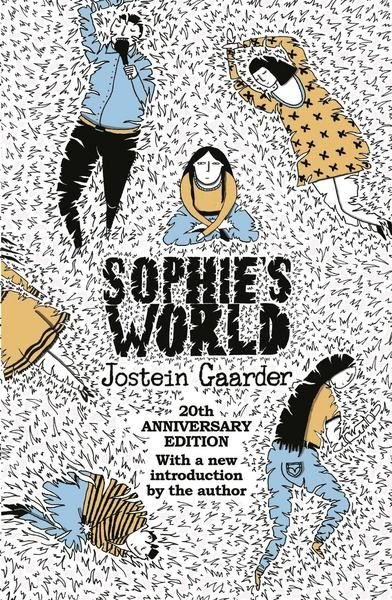
Why Read Sophie’s World?
Sophie’s World is a genuinely extraordinary achievement — a novel that has introduced more readers to the history of Western philosophy than any academic textbook, dressed up as a page-turning mystery in which a fourteen-year-old Norwegian girl discovers not only the full sweep of philosophical thought from the pre-Socratics to Sartre, but the unsettling truth about the nature of her own existence. Published in 1991 and translated into over sixty languages, it remains the best-selling Norwegian novel of all time and one of the most ambitious works of educational fiction ever written.
Sophie Amundsen is an ordinary fourteen-year-old living in Norway when she begins receiving mysterious letters — first two questions (“Who are you?” and “Where does the world come from?”), then a series of philosophical lessons from an anonymous teacher. What begins as an unconventional correspondence course through the history of philosophy — from Thales and the pre-Socratics through Plato, Aristotle, Descartes, Hume, Kant, Hegel, Marx, Darwin, Freud, and Sartre — gradually becomes something far stranger.
As two narrative threads converge, the novel performs a remarkable meta-fictional turn: Sophie and her teacher Alberto discover that they are characters in a book being written by a Norwegian major as a birthday gift for his daughter. The philosophical question of what it would mean to be aware of one’s own fictional existence becomes the novel’s final and most original philosophical contribution. In its ambition to combine the history of philosophy with a genuine narrative mystery and a meta-fictional puzzle, Sophie’s World has no real precedent and no real successor.
Who Should Read This
This is a book for anyone who has ever been curious about philosophy but found academic texts intimidating — it is the most accessible and enjoyable introduction to the history of Western philosophy ever written. Essential for students beginning their philosophical education, readers interested in how ideas develop across history, CAT/GRE aspirants building reading comprehension in philosophical narrative, book club readers who want intellectual depth with narrative pleasure, and anyone who has wondered “Who am I?” and “Where does the world come from?”
Key Takeaways from Sophie’s World
The ability to wonder — to look at familiar things as if seeing them for the first time — is the beginning of all philosophy. Most people live deep in the rabbit’s fur, comfortable and incurious; philosophers are those who climb toward the tip of the hair to look out at the magician. Genuine astonishment at existence is the philosophical impulse itself.
The history of philosophy is not a collection of opinions but a developing conversation — each thinker responding to, building on, or refuting those who came before. Descartes cannot be understood without Plato; Kant cannot be understood without Hume. Ideas have genealogies, and understanding a philosophical position means understanding what question it was answering.
The novel’s meta-fictional twist — in which Sophie and Alberto discover they are characters in a book — is not merely a narrative trick but a genuine philosophical argument. It forces the reader to ask: what is the difference between Sophie’s fictional existence and our own? The question of what constitutes “real” existence is one the novel raises and refuses to resolve.
Philosophy is not a luxury for academics but a practical necessity for anyone who wants to think clearly about who they are. Gaarder demonstrates this by making Sophie — an ordinary teenager with no intellectual pretension — capable of genuine philosophical engagement when given the right interlocutor and the right questions. Philosophy is what ordinary thinking becomes when taken seriously.
Sophie’s World Plot Summary
The novel opens with Sophie Amundsen returning home from school to find two mysterious letters in her mailbox — one containing the question “Who are you?” and the other “Where does the world come from?” She has no idea who sent them, but she finds herself unable to stop thinking about the questions. The next day she finds a short course on the earliest Greek philosophers — Thales, Anaximander, Parmenides, Heraclitus — and so begins her education.
Her teacher reveals himself gradually: Alberto Knox, an enigmatic philosopher who guides Sophie through the entire history of Western philosophy. Each meeting — in person, by letter, or by video — covers the next chapter in the story of ideas: Socrates and the Sophists, Plato’s theory of Forms, Aristotle’s empiricism, the Hellenistic schools, the rise of Christianity and medieval scholasticism, Descartes’ radical doubt, Locke and Hume’s empiricism, Kant’s synthesis, the Romantics, Hegel’s dialectic, Marx’s materialism, Darwin’s evolution, Freud’s unconscious, and finally the existentialists — Sartre above all.
Running alongside Sophie’s philosophical education is a second, stranger narrative. Sophie begins receiving postcards addressed to a girl named Hilde Møller Knag from her father — a United Nations major stationed in Lebanon — which seem to know things about Sophie’s life that no stranger should know. Alberto Knox confirms Sophie’s growing suspicion: they are fictional characters, created by Major Knag as the narrative through which he is teaching Hilde philosophy. The book Sophie is living in is the book the reader is reading.
In the novel’s extraordinary final section, Sophie and Alberto — aware of their fictional status — attempt to escape from Major Knag’s narrative control. Their escape into a kind of philosophical no-man’s land — neither fully inside the novel nor outside it — is the most daring and most philosophically suggestive conclusion the novel could have chosen. The final pages belong to Hilde, reading her father’s completed book — and to the reader, left to wonder at which level of reality they themselves exist.
Sophie’s World Characters
Each character in Sophie’s World operates at a different level of reality, making the cast as philosophically significant as it is narratively compelling.
A fourteen-year-old Norwegian girl of sharp, naturally curious mind whose encounter with philosophical questions transforms her understanding of the world and of herself. Her questions are the reader’s questions; her genuine intellectual excitement as she encounters each philosopher is contagious. Her gradual discovery of her own fictional status is handled with extraordinary psychological credibility.
The enigmatic philosopher who guides Sophie through the entire history of Western philosophy. Warm, pedagogically brilliant, and capable of making the most abstract ideas vivid through analogy. He is fully aware of his fictional status from relatively early in the novel — his philosophical education has given him the tools to perceive what Sophie gradually comes to understand.
The Norwegian teenager for whom Major Knag has written the book that contains Sophie and Alberto. Hilde exists at one level of reality above Sophie — she can read about Sophie but Sophie cannot directly perceive her. Her growing unease at her father’s power over Sophie and Alberto’s lives gives the meta-fictional layer genuine emotional weight.
Hilde’s father, a United Nations officer in Lebanon, who has written the novel containing Sophie and Alberto as a philosophical birthday gift for his daughter. He is the “God” of Sophie’s world — the author whose will determines everything that happens to her — and his relationship to his characters raises the novel’s central philosophical question about creator and creation.
The novel’s most radical structural move is to imply that Gaarder stands in the same relationship to Major Knag as Major Knag stands to Sophie and Alberto. If Sophie can become aware of Major Knag’s narrative, the novel asks whether Major Knag — and by extension, the reader — might similarly be a character in a narrative they cannot perceive. Gaarder never appears in the text but is the invisible author of everything the reader experiences.
The entire history of Western philosophy passes through the novel — Socrates, Plato, Descartes, Kant, and many others. Each is rendered as a human being responding to specific historical circumstances and specific philosophical problems: Socrates as a man who walked Athens asking questions; Descartes as a man who locked himself in a room to doubt everything; Kant as a man who never left his hometown but transformed the entire course of philosophical thought.
Major Themes
Gaarder weaves several interconnected themes throughout Sophie’s World, each connecting the narrative to the philosophical ideas it contains.
The novel’s most fundamental argument — made explicitly in Alberto’s very first letters and enacted throughout — is that the philosophical impulse is simply the sustained refusal to take existence for granted. Sophie’s transformation is not from ignorance to knowledge but from incuriosity to astonishment: she learns to see the familiar as strange, to ask questions about things everyone else has stopped questioning, and to sit with uncertainty rather than reaching for comfortable answers.
One of the novel’s greatest pedagogical achievements is its demonstration that the history of philosophy is not a sequence of unrelated opinions but a developing argument. The Platonic Forms answer Heraclitus’s problem of flux; Aristotle’s empiricism corrects Plato’s idealism; Descartes’ radical doubt responds to the collapse of medieval certainty; Kant synthesizes the rationalism and empiricism that have been at war since Descartes. Ideas have genealogies.
The novel’s most philosophically original contribution is its sustained meditation on what it means to be a fictional character — and, by extension, on the nature of reality itself. Sophie and Alberto’s discovery of their fictional status raises questions the novel refuses to answer: Is their experience of thinking, feeling, and wondering less real because it exists in a book? Is Hilde’s experience more real? And what would it mean for the reader to exist at a higher narrative level still?
Sophie’s philosophical education is not a process of memorising information but of being fundamentally changed by encountering ideas. She does not simply learn what Plato thought about Forms — she finds herself thinking differently about everything she sees, questioning assumptions she has never questioned, experiencing the world as stranger and more wondrous than she had previously allowed. Genuine education transforms the person who undergoes it, not merely their store of information.
Critical Analysis
A balanced assessment examining the remarkable achievements of Sophie’s World alongside its genuine limitations as both a novel and a philosophy introduction.
Gaarder’s ability to explain complex philosophical ideas accessibly without oversimplifying them is genuinely extraordinary — his analogies are fresh, his biographical sketches vivid, and his sequencing of the philosophical narrative creates genuine intellectual excitement across 518 pages.
The decision to embed the history of philosophy within a mystery narrative, and then to make the mystery hinge on philosophical questions about reality and existence, is a structural achievement of real originality — the form and the content are genuinely inseparable.
The novel never talks down to its reader or to Sophie — it presents genuinely difficult philosophical ideas with confidence that a motivated fourteen-year-old can engage with them. This confidence is itself a philosophical and pedagogical statement.
For much of the novel, Sophie functions more as a receptive surface for philosophical exposition than as a fully developed fictional character — her inner life and emotional responses are relatively thin compared to the richness of the philosophical content, making the novel more effective as intellectual experience than as conventional fiction.
The novel covers the pre-Socratics through Descartes with considerable depth, but Kant, Hegel, Marx, Darwin, Freud, and the existentialists — all in the novel’s final third — receive noticeably compressed treatment. A reader finishing the novel will have a much stronger grasp of ancient than of 19th and 20th century thought.
The novel raises its most interesting philosophical question — what would it mean to be aware of one’s fictional existence? — but its resolution is deliberately open-ended in ways that some readers find unsatisfying rather than productively ambiguous.
Literary & Cultural Impact
A Global Phenomenon: Sophie’s World was published in Norway in 1991 to immediate commercial and critical success. Its international reception — particularly after its English translation in 1994 — was extraordinary by any measure. It spent years on bestseller lists across Europe, the United States, and Asia; it has been translated into over sixty languages; and it remains the best-selling Norwegian novel of all time, with sales exceeding forty million copies worldwide. A German film adaptation was released in 1999. It has been adopted as a philosophy textbook in secondary schools across multiple countries and is used in introductory philosophy courses at universities worldwide.
A Gateway to Philosophy: As a work of popular philosophy, it has introduced millions of readers — most of them teenagers or adults with no academic background — to the history of Western thought in a form that generated genuine intellectual excitement rather than dutiful comprehension. There is a generation of readers across the world for whom their first experience of Plato, Descartes, or Kant came through Sophie’s World, and who subsequently pursued philosophy further as a result.
A Unique Literary Achievement: As a work of literary meta-fiction, it occupies a distinctive position — less sophisticated than the postmodern meta-fiction of Borges, Calvino, or Eco, but deploying similar structural ideas in the service of a genuinely philosophical rather than merely aesthetic argument. For competitive exam preparation, it is valuable intermediate-level reading that combines narrative fiction with philosophical argument in the same way that the most demanding CAT and GRE passages often do.
Love This Book? Master Every Book.
Stop struggling with reading comprehension. Our proven system transforms how you read—whether for CAT, GRE, GMAT, SAT, or personal growth.
Best Quotes from Sophie’s World
The only thing we require to be good philosophers is the faculty of wonder.
A lot of people experience the world with the same incredulity as when a magician pulls a rabbit out of a hat… Actually, we are the white rabbit being pulled out of the hat.
If you don’t know the past, you can’t understand the present and you can’t shape the future.
To know what you know and to know what you don’t know — that is real knowledge.
People who ask why the world exists, why there is something rather than nothing — these are the philosophers. And they will never stop asking, because there is no final answer.

Test Your Understanding
Think you’ve mastered Sophie’s World? Challenge yourself with 15 questions on themes, characters, and the philosophical ideas woven through the novel. Score 80%+ to prove your mastery.
Sophie’s World FAQ
What is Sophie’s World about?
Sophie’s World follows Sophie Amundsen, a fourteen-year-old Norwegian girl who begins receiving mysterious philosophical letters that take her through the entire history of Western philosophy — from the ancient Greeks to the existentialists. As her philosophical education deepens, she and her teacher Alberto Knox discover that they are fictional characters in a novel being written by a Norwegian major as a birthday gift for his daughter Hilde. The novel is simultaneously a history of philosophy, a mystery story, and a meta-fictional puzzle about the nature of reality and fictional existence.
Do I need a background in philosophy to enjoy Sophie’s World?
No — the novel is specifically designed for readers with no philosophical background, and it is one of the most effective introductions to philosophy for precisely this audience. Gaarder explains every concept from first principles, using analogies and examples rather than technical vocabulary. Readers who already know philosophy will find the explanations somewhat simplified but may appreciate encountering familiar ideas through fresh eyes. The book works well at both levels.
Is Sophie’s World a good introduction to philosophy?
It is the best single-volume introduction to the history of Western philosophy for general readers — engaging, accessible, and genuinely illuminating about how philosophical ideas develop in response to each other across time. Its limitations are that it is confined to the Western tradition, the later philosophers receive compressed treatment, and it presents the history of philosophy as more linear and less contested than academic philosophy would represent it. As a starting point before more serious reading, it is excellent; as a substitute for that reading, it is insufficient.
What is the significance of the meta-fictional twist?
The discovery that Sophie and Alberto are fictional characters is not merely a narrative surprise but the novel’s most philosophically original contribution. It forces the reader to ask: what distinguishes Sophie’s fictional existence from their own? If Sophie experiences thinking, feeling, and wondering, is her existence less real because it occurs in a book? The novel uses this question to make Descartes’ cogito (I think, therefore I am) apply to Sophie — and then asks whether the reader might similarly be a character in a larger narrative they cannot perceive.
How does Sophie’s World cover so much philosophy and still work as a novel?
Gaarder makes it work as a novel by embedding the philosophical content in a mystery narrative that generates genuine forward momentum, by making Sophie’s reactions to each philosopher emotionally credible, and by the meta-fictional payoff that connects all the philosophical questions to the plot. The compromise is that Sophie as a character is somewhat thinner than the philosophical content that passes through her. Readers who come primarily for the philosophy will find the fictional frame an inspired solution to the problem of how to make a history of ideas readable.








