

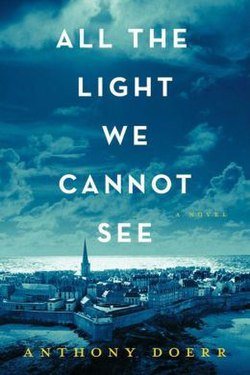
Why Read All the Light We Cannot See?
All the Light We Cannot See is one of the most formally ambitious and emotionally devastating war novels of the 21st century. Anthony Doerr spent ten years writing this Pulitzer Prize-winning story, and every sentence reflects that care — precise, imagistic, and almost unbearably beautiful. It is a novel that asks what it means to be good when history gives you no good choices.
The novel follows two parallel lives across the years leading up to and through World War II. Marie-Laure LeBlanc is a blind French girl who flees Paris with her father — a locksmith at the Museum of Natural History — carrying what may be a priceless and cursed diamond. Werner Pfennig is a white-haired German orphan whose extraordinary gift for radio engineering pulls him out of poverty and into the Hitler Youth and, ultimately, the Wehrmacht. Their paths converge in the medieval fortress city of Saint-Malo on the Brittany coast during the brutal summer of 1944, as Allied bombs begin to fall and the war enters its final, savage chapter.
Doerr structures the novel in short, cinematic chapters that alternate between timelines and perspectives, building an intricate mosaic that only fully reveals itself near the end. The prose is luminous — consistently ranked among the finest in contemporary American fiction — and the novel’s meditation on radio waves, invisible light, and the unseen forces that connect people gives it a philosophical depth that elevates it far above conventional war fiction. It is ultimately a novel about the parts of us that cannot be destroyed: curiosity, beauty, and the stubborn human impulse to reach out to another person across the dark.
Who Should Read This
This is a book for serious, patient readers who want war fiction that transcends genre — readers who believe a novel can be both a page-turner and a work of literary art. Essential reading for students of literature, competitive exam aspirants practicing advanced reading comprehension, history enthusiasts, and anyone drawn to novels that balance the particular and the universal.
Key Takeaways from All the Light We Cannot See
Radio — and by extension, technology — is morally neutral; what matters is who uses it and for what purpose. Werner’s gift for radio engineering is identical whether it serves Nazi intelligence or a French resistance broadcast. Can a skill be innocent when the system deploying it is not?
Blindness in the novel is both literal and metaphorical — most characters cannot see the full reality of what is happening around them. True sight, the novel suggests, requires moral courage, not just functioning eyes.
The cursed diamond, the Sea of Flames, functions as the novel’s central symbol: beauty that carries destruction wherever it goes. Doerr uses it to ask whether some things are simply too costly to possess, regardless of their magnificence.
Individual goodness is possible even inside catastrophic systems, but it carries an enormous price. Werner makes small, quiet choices to preserve his humanity, but the novel is honest about how insufficient these gestures are against the scale of historical evil — neither condemning nor fully absolving him.
All the Light We Cannot See Plot Summary
All the Light We Cannot See opens in August 1944, in the besieged city of Saint-Malo on the coast of occupied France, as American bombs fall on the last German holdouts. From this moment of crisis, the novel reaches backward in time — to 1934, to 1940, to 1942 — building two separate lives that are clearly moving toward a single point of collision.
Marie-Laure LeBlanc loses her sight at age six but is raised by her father, a tender and ingenious locksmith at the Muséum National d’Histoire Naturelle in Paris, to navigate the world through her other senses. He builds her elaborate scale models of their neighborhood so she can memorize the streets by touch. When the Germans occupy Paris in 1940, he flees with Marie-Laure to the fortified coastal city of Saint-Malo, home of her great-uncle Etienne — a reclusive veteran still traumatized by WWI — carrying what may be the Sea of Flames, a legendary blue diamond believed to curse its keeper with immortality and everyone around them with death.
Werner Pfennig grows up in a German orphanage with his younger sister Jutta, his extraordinary mind already restless and searching. He discovers a shortwave radio and teaches himself electronics by reverse-engineering it. This gift earns him a place at an elite Nazi training school, where his skills are weaponised: he is assigned to track resistance radio broadcasts across occupied Europe. Werner is not a true believer, but he is complicit — a boy who knows that the system rewarding him is monstrous and cannot find a way out.
In Saint-Malo, the threads tighten. Sergeant Major Reinhold von Rumpel — a dying, fanatical gemologist — has been tasked with recovering the Sea of Flames and is methodically hunting it down. Etienne has been secretly broadcasting coded resistance messages from a radio in his attic. Werner is sent to locate and silence clandestine transmitters in the city. Marie-Laure is alone in Etienne’s house as the bombs fall and von Rumpel closes in. The novel’s climax brings Werner and Marie-Laure together in a single charged encounter — brief, beautiful, and heartbreaking — before the war carries them in opposite directions.
The final section jumps to 1974 and beyond, following the survivors and their children, and delivering an epilogue of quiet, earned grace that does not soften what the war cost but insists on the persistence of connection across time and loss.
All the Light We Cannot See Characters
Two protagonists on opposite sides of the war, drawn toward each other by invisible forces — and surrounded by a cast rendered with equal moral complexity.
A blind French girl of remarkable courage and curiosity, raised to trust the world despite her inability to see it. She reads Braille editions of Jules Verne, maps cities with her fingertips, and eventually becomes a quiet hero of the resistance. Her interior life is one of the richest and most precisely rendered in contemporary fiction.
A white-haired German orphan of exceptional intelligence whose gift for radio engineering carries him from poverty to complicity in Nazi atrocities. Neither villain nor hero, but a boy shaped by a system designed to leave him no exit — the novel’s most morally complex and honest portrait.
A brilliant and devoted locksmith who raises Marie-Laure with extraordinary care, building scale models of their neighborhood so she can memorize it by touch. The novel’s purest moral figure, whose fate at the hands of the German occupation is one of its most quietly devastating turns.
Marie-Laure’s reclusive great-uncle in Saint-Malo, a WWI veteran whose agoraphobia has kept him housebound for decades. He gradually emerges from his shell under Marie-Laure’s influence and becomes a crucial figure in the local resistance, broadcasting from the hidden radio in his attic.
A dying German gemologist tasked with recovering the Sea of Flames for the Reich. Methodical, obsessive, and utterly without empathy, his pursuit of the diamond provides the thriller architecture beneath the novel’s literary ambitions and literalizes the theme of beauty corrupting those who seek to possess it.
Werner’s younger sister and moral mirror — the one person who consistently challenges him to see what he is becoming. Her postwar arc, in which she seeks to understand what her brother did and who he was, provides the novel’s final emotional reckoning.
Major Themes
Doerr’s themes are embedded in the novel’s very structure — its form enacts its argument about invisible forces, moral blindness, and the signals we send into the dark.
The novel’s title operates on multiple registers simultaneously. There is literal light — radio waves, bioluminescent sea creatures, the flames of bombs — and there is the “light we cannot see”: the invisible radio signals crossing Europe, the inner lives of strangers, the moral reality that most characters are trained not to perceive. Blindness in the novel is not Marie-Laure’s condition but the default human state, and the struggle toward genuine sight is the novel’s deepest subject.
Through Werner, Doerr constructs a searingly honest portrait of how ordinary people become instruments of atrocity — not through ideology but through incremental accommodation. Werner never believes in Nazism, yet he serves it effectively. The novel refuses to either condemn him simply or excuse him, making his story a case study in the mechanisms of complicity that remains urgently relevant.
Throughout the siege of Saint-Malo, characters encounter moments of extraordinary beauty — a snail’s shell, a radio broadcast of Debussy, the bioluminescence of the sea — that exist in defiance of the surrounding destruction. Doerr insists that beauty is not trivial under these conditions but essential: it is precisely what distinguishes a life worth living from mere survival.
Radio is the novel’s central metaphor for human connection: an invisible signal transmitted into the dark, with no certainty of being received. The book’s structure itself enacts this — two lives broadcasting toward each other across hundreds of pages, connecting briefly and incompletely before moving apart again. Doerr asks whether connection, even brief and imperfect, is sufficient to justify everything it costs.
Critical Analysis
A balanced assessment examining both the novel’s extraordinary achievements and the tensions its ambition creates.
Doerr’s sentences are among the finest in contemporary American fiction — precise, imagistic, and perfectly calibrated to the novel’s themes of light, perception, and invisibility, making the reading experience itself a form of argument.
The alternating short chapters and non-linear timeline create sustained narrative tension while gradually deepening character — a structure that rewards rereading and demands careful attention on first read.
The novel refuses the comfortable war-fiction binary of heroic Allies and monstrous Germans, presenting instead a spectrum of accommodation, courage, and failure that feels historically and psychologically true.
The lyrical prose style, while beautiful, can create a certain aesthetic remove from the horror of events — some readers find the writing too elegant for the brutality it describes, a tension the novel never fully resolves.
Several characters in the novel’s expansive cast — particularly the boys at Werner’s training school — receive too little space to become fully realized, functioning more as thematic markers than people.
The mechanics by which Werner and Marie-Laure’s paths cross in Saint-Malo require significant coincidence, and readers attuned to narrative architecture may find the plot’s resolution slightly contrived relative to the ambition of its setup.
Literary & Cultural Impact
Pulitzer Prize and Global Reach: All the Light We Cannot See won the Pulitzer Prize for Fiction and the Andrew Carnegie Medal for Excellence in Fiction in 2015, cementing Anthony Doerr’s place among the foremost American novelists of his generation. It spent over three years on the New York Times bestseller list and has sold more than fifteen million copies worldwide. Netflix adapted the novel into a four-part miniseries in 2023.
Standing Apart from Its Contemporaries: The novel arrived at a moment when WWII fiction was experiencing a renaissance, but it distinguished itself through its formal ambition and its refusal of consolation. Where many war novels offer redemption through heroism, this one offers something more uncomfortable: the suggestion that goodness under totalitarianism is almost always insufficient, that survival carries moral cost, and that the light that persists after catastrophe is real but small.
For Competitive Exam Preparation: The novel is exceptional RC material at the advanced level. Its short chapters, dense with imagery and thematic layering, demand precisely the kind of active, inferential reading that GRE and CAT passages reward. Questions on tone, metaphor, narrative perspective, and authorial intent all find rich practice ground here, making it one of the most pedagogically valuable novels on the Readlite list.
Love This Book? Master Every Book.
Stop struggling with reading comprehension. Our proven system transforms how you read—whether for CAT, GRE, GMAT, SAT, or personal growth.
Best Quotes from All the Light We Cannot See
Open your eyes and see what you can with them before they close forever.
We all come into existence as a single cell, smaller than a breath of dust. Multiplying, and for a time we live and are able to love one another, and then we fall away.
Don’t you want to be alive before you die?
To shut your eyes is to guess nothing of blindness. Beneath your world of skies and faces and buildings exists a rawer and older world, a place where surface planes disintegrate and sounds ribbon in shoals through the air.
Time is a slippery thing: lose hold of it once, and its string might sail out of your hands forever.


Test Your Understanding
Think you’ve mastered All the Light We Cannot See? Challenge yourself with 15 questions on themes, characters, and key takeaways. Score 80%+ to prove your mastery.
All the Light We Cannot See FAQ
What is All the Light We Cannot See about?
The novel follows two young people during World War II — Marie-Laure, a blind French girl, and Werner, a German orphan with exceptional skill in radio engineering — whose lives converge in the besieged city of Saint-Malo in 1944. It is a story about survival, complicity, beauty, and the invisible connections that bind people across impossible distances.
Is All the Light We Cannot See difficult to read?
The novel is rated Advanced in reading level. While the individual chapters are short and the plot is engaging, the non-linear structure, dense prose style, and thematic complexity require patient, active reading. It is best suited to readers comfortable with literary fiction and willing to piece together a narrative that reveals itself gradually over hundreds of pages.
What are the main themes of the novel?
The novel’s central themes are light and blindness as metaphors for moral perception, complicity under totalitarianism, the persistence of beauty amid destruction, and human connection across vast distances. The radio is the novel’s master symbol, representing both the reach of propaganda and the possibility of genuine, freely given human contact.
What does the Sea of Flames diamond represent?
The Sea of Flames is a legendary blue diamond said to make its keeper immortal while bringing suffering to all around them. In the novel, it functions as a symbol of beauty that corrupts through the desire to possess it — and represents the way institutions and empires treat irreplaceable things as possessions to be acquired and controlled.
Why does All the Light We Cannot See still matter today?
The novel’s portrayal of ordinary complicity — how intelligent, decent people can serve monstrous systems without ever becoming monsters themselves — speaks directly to contemporary anxieties about institutions, ideology, and moral responsibility. Werner’s story is a portrait of how incrementally reasonable choices accumulate into catastrophic outcomes, a dynamic that feels urgently relevant in any era of political polarization and institutional failure.








