

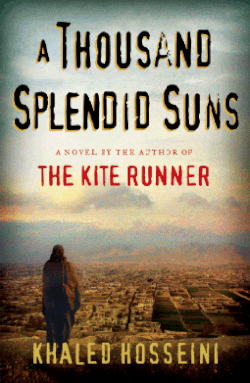
Why Read A Thousand Splendid Suns?
A Thousand Splendid Suns is Khaled Hosseini’s answer to the central criticism of The Kite Runner — that its Afghan women were peripheral, underwritten, and denied the interiority afforded its male characters. It is a novel of deliberate correction and extraordinary emotional force: two women from opposite ends of Afghan society, bound together by a marriage neither chose, surviving a world systematically designed to break them. It is not a comfortable book. It is an important one.
The novel follows two women across thirty years of Afghanistan’s most catastrophic history. Mariam is an illegitimate child married off at fifteen to Rasheed, a Kabul shoemaker twice her age. Eighteen years later, Laila — the educated, loved daughter of a progressive schoolteacher — loses her family to a rocket attack and, with nowhere to turn, accepts Rasheed’s offer of marriage. What begins as rivalry between two wives in one abusive household becomes, with time and shared suffering, one of the most profound friendships in contemporary fiction — a bond that costs everything and sustains everything simultaneously.
Hosseini sets this intimacy against the full sweep of Afghanistan’s modern catastrophe: the Soviet invasion, the Mujahideen civil war, the Taliban’s rise to power. These are not background events — they directly determine what Mariam and Laila can do, where they can go, whether they can work or be educated or appear in public without a male guardian. The novel insists that political history is women’s bodies, and it makes that argument with devastating specificity.
Who Should Read This
This novel is essential for any reader serious about understanding both Afghan history and the literature of female endurance. CAT and GRE candidates will find it exceptionally rich for tone, character psychology, and the relationship between historical context and individual agency — questions the novel poses with unusual directness. Beyond exam preparation, it speaks to anyone concerned with gender, power, and what women have built for each other in conditions designed to prevent their solidarity.
Key Takeaways from A Thousand Splendid Suns
Female solidarity is not spontaneous — it is built, slowly and painfully, from shared suffering. Mariam and Laila begin as rivals in Rasheed’s household. Their friendship emerges not from natural affinity but from the recognition that they are both trapped by the same architecture of control, and that only together do they constitute anything stronger than what contains them.
Domestic abuse is not a private matter — it is a political condition enabled by law, custom, and institutional indifference. Rasheed’s violence is not aberrant in Taliban-era Kabul; it is legally protected, socially normalised, and structurally guaranteed by a system that removes women’s legal standing, freedom of movement, and access to any external authority.
Education is not merely an opportunity — it is a form of personhood that power systems understand as a threat. Laila’s father’s insistence on educating his daughter is the novel’s most quietly radical act. What education gives Laila is not just knowledge but a self that cannot be entirely confiscated — an interior resource that survives even when everything exterior is taken.
Endurance is an active, not a passive, condition. Both women make choices — constrained, costly, sometimes fatal — that refuse the complete surrender the world demands of them. Mariam’s final act is the most extreme expression of this: she chooses how her story ends rather than allowing Rasheed to end it for her. That choice, made from within total powerlessness, is the novel’s definition of courage.
A Thousand Splendid Suns Plot Summary
The novel opens with Mariam, five years old, sitting in the kolba — the small hut outside Herat where she lives with her mother Nana, the discarded mistress of Jalil, a wealthy merchant who fathered Mariam and refuses to acknowledge her publicly. Mariam’s childhood is shaped by two relationships: her mother’s bitter, controlling love, which teaches her she is worthless to the world, and her idealised love for Jalil, who visits once a week and tells her she is his favourite. When Mariam, at fifteen, walks uninvited to Jalil’s mansion and is left outside his gate all night, she returns home to find Nana has hanged herself. Jalil arranges her marriage to Rasheed, a shoemaker in Kabul, a widower in his forties.
The marriage begins with surface decency and ends, after Mariam’s string of miscarriages, in sustained domestic violence that settles into the household’s permanent climate. The years pass. The Soviet invasion comes. The Mujahideen fight the Soviets and then each other. Kabul — once a city where women could work, study, and wear what they chose — begins to contract under the daily reality of rocket attacks from rival factions.
Into this world comes Laila, a girl from the same neighbourhood, raised by her schoolteacher father Babi to believe in education and her own potential. Her childhood friend and first love, Tariq, leaves with his family for Pakistan as the city deteriorates. Before he goes, they sleep together. Weeks later, a rocket kills both of Laila’s parents. Rasheed finds her in the rubble, takes her in, and — presenting her with a fabricated report that Tariq has been killed — proposes marriage. Pregnant, orphaned, and without resources, Laila accepts.
The household’s second act is the slow transformation of Mariam and Laila from rivals to allies. Rasheed, who initially favours Laila as the younger wife and the mother of a son, eventually turns his violence on her as readily as on Mariam. It is Laila who first extends something toward Mariam — who sees in the older woman not a threat but a fellow prisoner. Their friendship deepens across shared privations: the Taliban’s arrival, the closure of girls’ schools, the requirement of the burqa, the prohibition on women appearing in public without a male guardian. Laila’s secret — that her daughter Aziza is Tariq’s child, not Rasheed’s — becomes one of the bonds they protect together.
The novel’s climax arrives when Rasheed, learning of Laila’s contact with Tariq — who is alive and has found her — attempts to strangle her. Mariam kills him with a shovel. She does it calmly, deliberately, knowing exactly what it means: a Taliban court, a death sentence, public execution. She refuses Laila’s plan for them to flee together. “This is my doing,” she tells Laila. “It’s mine. Let me do this for you.” She walks to her execution thinking of her life, and finds — in the final moments — not despair but a kind of peace: she has mattered to someone. That, she understands, is everything.
Laila escapes to Pakistan with Tariq and the children, then returns to a post-Taliban Kabul to work rebuilding the orphanage where Aziza was housed during the Taliban years. The novel closes not with happiness but with something more durable: purpose, continuity, the sense that Mariam’s sacrifice has been honoured not by grief but by work. A city is rebuilding. A woman is part of the rebuilding. A story is passing from one generation to the next.
A Thousand Splendid Suns Characters
Hosseini’s six principal characters map the full range of Afghan society — across class, generation, and gender — with each figure illuminating a different dimension of the system the novel interrogates.
The novel’s moral heart — a woman taught from birth that she is illegitimate, unwanted, and worth less than the circumstances of her conception. What Hosseini traces with extraordinary care is the slow, painful construction of a self beneath those conditions: a self that turns out, in the novel’s final pages, to be capable of both love and choice at the highest possible cost. She begins as a victim of every system that contains her and ends as the author of the novel’s most consequential act.
Everything Mariam was not permitted to be: educated, loved, given a sense of her own potential by a father who believed in it. Her tragedy is that this formation — this interior resource — is precisely what makes Rasheed’s household more intolerable for her than for Mariam, who never expected anything different. Her survival is Mariam’s gift, and she spends the novel’s final section trying to be worthy of it.
Not a monster in the operatic sense — something more disturbing: a man entirely ordinary within his cultural context, whose abuse is enabled at every level by the society around him. He is not evil by exception; he is dangerous by design. The Taliban does not create him — it simply amplifies and sanctifies what was already there. Hosseini renders him without the comfort of making him uniquely villainous.
The novel’s study in the violence of comfortable cowardice. He loves Mariam — genuinely, in his limited way — but never enough to risk the social standing that acknowledging her would cost him. His weekly visits give Mariam just enough warmth to sustain hope that he will eventually choose her, and he never does. His letter, arriving after Mariam’s death, is the novel’s most painful moment of too-late accountability.
The novel’s figure of loyal, secular love — a one-legged boy who never treated Laila as less than his equal and who finds her again across decades and borders. He is the proof that the world Rasheed represents is not the only possible world. His return is the novel’s turning point, and the lie of his death is Rasheed’s most calculatedly cruel act.
The novel’s most complex minor figure — a woman whose life has been destroyed by Jalil’s abandonment and who transmits that destruction to her daughter in the form of a worldview so bleak it constitutes its own form of abuse. She is not wrong about the world, exactly. She is wrong about Mariam — too consumed by her own wound to see her daughter’s potential. Her death is an act of punishment as much as despair, and the novel is honest about both.
Major Themes
Hosseini’s thematic argument is inseparable from its historical grounding — every theme is made concrete through specific political conditions and specific women’s bodies.
The friendship between Mariam and Laila is the novel’s central argument: that women building bonds of loyalty and mutual protection in conditions designed to prevent such bonds is not merely personal but constitutes a form of resistance to the systems that would isolate and therefore dominate them. Their solidarity does not save them from loss — it cannot. But it changes the quality of everything they endure and ultimately enables the act that breaks the cycle.
Hosseini’s most sustained argument is that Afghanistan’s political catastrophes were not abstract events — they were experienced directly in the contraction of women’s physical freedom: the closing of schools, the requirement of the burqa, the prohibition on public movement without a male guardian, the removal of legal standing. Each political shift in the novel is measured in what Mariam and Laila can no longer do, see, or be. The personal and the political are not parallel here — they are the same thing.
Mariam is told from birth that she is a harami — a word that means both illegitimate and sinful, as if her existence were itself an offence. This inherited shame is the novel’s first prison, more confining than any physical constraint Rasheed later imposes. The novel’s deepest argument is about the refusal of that inherited shame: Mariam’s final act is precisely the rejection of the identity the world assigned her and the assumption of the identity she chose — someone who mattered, someone who loved, someone who acted.
The novel refuses to romanticise survival. Both women endure things that survival requires — humiliations, compromises, silences — and Hosseini is honest about the cost of each. Agency in this novel is never free; it is always paid for, and the price is calibrated with brutal accuracy. Mariam’s final agency — the only fully autonomous choice the novel allows her — costs her life. Hosseini does not pretend this is a bargain; he insists it is a choice, and that the distinction matters enormously.
Critical Analysis
A balanced assessment of the novel’s formal ambition and its honestly acknowledged limitations.
Telling the story through two women from different generations and class backgrounds allows Hosseini to map Afghan women’s experience across social divisions without reducing either character to a type. Their convergence in Rasheed’s household makes the structural argument that no class position insulates Afghan women from patriarchal violence under the Taliban.
The novel’s integration of thirty years of Afghan political history into two women’s lives is its greatest structural achievement. The history never functions as exposition — it functions as weather, as the changing conditions under which the characters must live. This is the most effective technique for making political history emotionally real.
The novel’s climax — Mariam’s decision to kill Rasheed and accept the consequences so that Laila can live — is one of contemporary fiction’s most powerful scenes precisely because it is entirely character-driven. It does not feel like a plot requirement; it feels like the inevitable expression of everything Mariam has become. Hosseini earns it completely.
While rendering Rasheed as systemically rather than individually monstrous is analytically correct, it leaves him with less psychological complexity than the novel’s two protagonists. His villainy, while never cartoonish, is so consistent that it forecloses the discomfort of a portrait of a man capable of both ordinary decency and systematic cruelty.
The novel’s second half moves faster and with less emotional accumulation than Mariam’s opening section. Some readers find Laila’s voice less fully inhabited than Mariam’s, her suffering rendered with slightly less granular specificity. The asymmetry is not crippling but it is detectable.
The novel’s closing section — Laila’s return to Kabul, her work in the orphanage, the sense of a city rebuilding — is brighter in register than the darkness that precedes it. For some readers this brightness is earned; for others it sits uneasily against the Taliban-era sections, as if Hosseini steps back from his own most harrowing argument.
Literary & Cultural Impact
Immediate Success: A Thousand Splendid Suns was published in May 2007 and debuted at number one on the New York Times bestseller list, selling over four million copies in its first year and being translated into more than forty languages. Critics who had praised The Kite Runner while noting its marginalisation of women largely agreed that the second novel was the more formally ambitious and the more politically complete work.
Historical Urgency: The novel arrived while Afghanistan was six years into the American-led intervention following September 11, and the status of Afghan women was a live policy debate in every capital involved in the conflict. Hosseini’s novel did not resolve those debates, but it gave them a human face and a specific moral weight that policy language cannot produce. It has been used in university curricula across gender studies, political science, and literature departments as a primary text for discussions of patriarchal violence and women’s resistance.
Prophetic Witness: The novel’s full significance crystallised in August 2021, when the Taliban retook control of Afghanistan following the American withdrawal. The closing of girls’ schools, the banning of women from public life, the reimposition of the entire architecture of gendered control replayed the novel’s Taliban-era sections with an accuracy that was not coincidental — the Taliban had not changed. A Thousand Splendid Suns became, in that moment, not historical fiction but prophetic witness. The women it portrays are not figures of the past. They are figures of the present, making the same constrained, defiant choices under the same conditions.
Love This Book? Master Every Book.
Stop struggling with reading comprehension. Our proven system transforms how you read—whether for CAT, GRE, GMAT, SAT, or personal growth.
Best Quotes from A Thousand Splendid Suns
A man’s heart is a wretched, wretched thing, Mariam. It isn’t like a mother’s womb. It won’t bleed. It won’t stretch to make room for you.
One could not count the moons that shimmer on her roofs, or the thousand splendid suns that hide behind her walls.
Learn this now and learn it well, my daughter: like a compass needle that points north, a man’s accusing finger always finds a woman. Always.
Behind every trial and sorrow that He makes us shoulder, God has a reason.
This is my doing. It’s mine. Let me do this for you.


Test Your Understanding
Think you’ve mastered A Thousand Splendid Suns? Challenge yourself with 15 questions on themes, characters, and key takeaways. Score 80%+ to prove your mastery.
A Thousand Splendid Suns FAQ
What is A Thousand Splendid Suns about?
It follows two Afghan women — Mariam, an illegitimate child from rural Herat, and Laila, an educated girl from Kabul — who are forced by circumstance into marriage with the same abusive man, Rasheed. Set across thirty years of Afghanistan’s most turbulent history — from the Soviet invasion through the Taliban’s rise and fall — it is a story of female endurance, solidarity, and the costs of resistance in a world structurally designed to break women.
Is it useful for competitive exam preparation like CAT or GRE?
Very much so. The novel offers exceptional material for tone analysis, character psychology, and the relationship between political context and individual agency. Hosseini’s dual narrative structure — alternating between two protagonists across different time periods — is the kind of complex construction that RC questions reward careful readers for tracking. The prose is accessible without being simplistic.
What are the main themes?
The central themes are female solidarity as political resistance, political history experienced through women’s bodies and freedoms, the inheritance and refusal of shame, and the relationship between endurance and agency in conditions of near-total powerlessness. These themes are not delivered abstractly — they are embedded in specific, physical, historically grounded detail.
How does this novel relate to The Kite Runner?
Both novels are set in Afghanistan and share Hosseini’s characteristic historical sweep and emotional directness. A Thousand Splendid Suns is explicitly a corrective to The Kite Runner’s relative marginalisation of female characters — it foregrounds women, centres their interior lives, and makes the political history of Afghanistan visible specifically through its effects on women’s freedoms. The two novels are companion pieces that together offer a more complete portrait of Afghanistan than either does alone.
Why does the novel matter more urgently after 2021?
The Taliban’s retaking of Afghanistan in August 2021 replayed the novel’s Taliban-era sections with horrifying fidelity — girls’ schools closing, women banned from public life, the entire architecture of gendered control reimposed. Readers who encountered the novel before 2021 returned to it recognising not historical fiction but current events. The women Hosseini portrays are not figures of the past. They are figures of the present, making the same constrained, defiant choices under the same conditions.








