
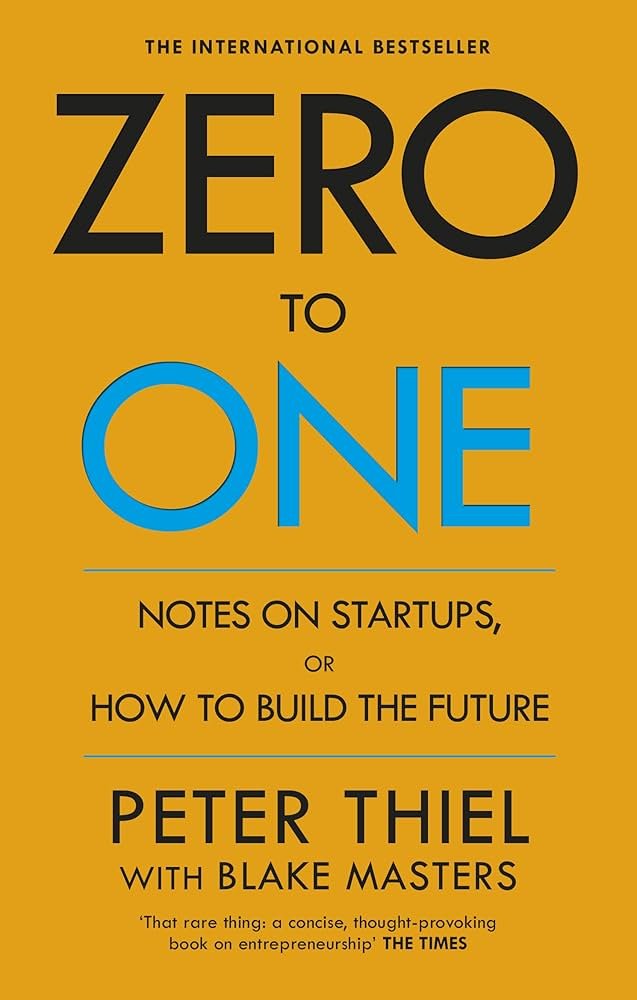
Why Read Zero to One?
Zero to One is the most intellectually provocative business book of the past decade. Peter Thiel — PayPal co-founder, early Facebook investor, and contrarian thinker — argues that the entire conventional wisdom about competition, innovation, and startups is wrong, and that building something genuinely new is both rarer and more valuable than anything else a business can do.
The book originated as notes from a Stanford lecture series Thiel delivered on startups, compiled by student Blake Masters. Its central thesis is captured in the title: going from “zero to one” means creating something new that didn’t exist before; going from “one to n” means copying something that already works and scaling it. Thiel argues that the world needs more zero-to-one companies — true monopolies built on genuine innovation — and that the startup obsession with competition is economically irrational and philosophically confused.
What makes Zero to One unusual in the crowded business book genre is its willingness to argue counterintuitively and at a philosophical level. Thiel doesn’t give you a framework for executing better — he challenges you to question whether the thing you’re executing on is worth doing at all. For exam aspirants, the book models dense argumentative writing with strong, falsifiable claims, making it excellent practice for critical reasoning sections alongside its direct relevance to business and entrepreneurship topics.
Who Should Read This
This book is essential for anyone thinking seriously about entrepreneurship, technology, or the future of business. It rewards readers who are willing to question received wisdom and engage with ideas that are deliberately provocative. Particularly valuable for MBA aspirants, startup founders, business students, and anyone preparing for CAT or GMAT verbal and analytical sections where business strategy passages appear regularly.
Key Takeaways from Zero to One
The most important business question is: “What valuable company is nobody building?” Going from zero to one — creating something genuinely new — is exponentially more valuable than going from one to n (copying and improving what already exists). Most businesses compete in the second category; the greatest fortunes are built in the first.
Thiel’s most provocative claim is that competition is for losers. Truly successful companies don’t compete — they build monopolies by creating products so superior in some dimension that competition becomes irrelevant. The obsession with competition in business school and startup culture is a confusion of means and ends; the goal is profit, and monopoly maximizes it.
Every successful company is built on a secret — a truth about the world that most people don’t see or don’t believe. Founders who build great companies ask: “What important truth do very few people agree with me on?” The answer points toward untapped opportunities that competitors haven’t recognized and markets that don’t yet exist.
The founding moment and the founding team are disproportionately determinative of a company’s destiny. Thiel argues that decisions made at the zero-to-one stage — about mission, culture, equity splits, and co-founder relationships — cast long shadows over everything that follows. Getting them wrong is rarely recoverable; getting them right is compounding.
Key Ideas in Zero to One
Thiel opens with the observation that we live in an era of technological stagnation disguised as innovation. Smartphones and social networks have improved our lives incrementally, but the fundamental technologies underpinning civilization — energy, transportation, food production, medicine — have barely advanced in decades. The world needs vertical progress (doing new things) more than horizontal progress (doing more of the same things). Startups are the vehicles most likely to produce vertical progress because they are the only organizations small enough to move fast and iconoclastic enough to think differently.
The book’s most influential argument is the monopoly thesis. Thiel distinguishes between two kinds of business: perfect competitors, who compete fiercely for thin margins and tell themselves stories about “disruption” and “differentiation”; and monopolists, who dominate a market so completely that competition becomes irrelevant. Google, for example, is a monopoly — it captures over 90% of search advertising. But it describes itself as competing in the broader “technology industry” to avoid regulatory attention. Thiel argues that monopoly is not just economically superior but ethically legitimate when it comes from genuinely creating value rather than extracting it.
A central concept is the Power Law — the idea that in venture capital, startups, and indeed life, outcomes are not normally distributed. A small number of investments, decisions, or people produce the vast majority of value. This has profound implications for how founders should think about their markets (dominate one niche completely rather than competing broadly), how investors should build portfolios (a single outlier will dwarf all other returns), and how individuals should make career choices (what you do matters enormously more than how well you do it).
Thiel closes with meditations on the importance of having a definite, optimistic view of the future. He distinguishes four attitudes: definite optimism (we know what the future should look like and we’ll build it — the attitude of great founders), indefinite optimism (things will get better but we have no idea how — the attitude of contemporary finance), definite pessimism (we know the future is bad so we must prepare — China’s technocratic approach), and indefinite pessimism (we’re doomed but don’t know why — declinism). Thiel argues that indefinite optimism is the dominant and most dangerous worldview in Silicon Valley and finance today.
Core Frameworks
Thiel presents several powerful frameworks for thinking about startups, innovation, and the future.
Purpose: Distinguishes genuine innovation from incremental improvement or globalization. “Zero to one” describes creating something that didn’t exist — a new technology, a new market, a new category. “One to n” describes copying and scaling something that already works. Thiel argues that horizontal (one to n) progress is easier and more common, but vertical (zero to one) progress is what drives civilization forward and creates the most durable value.
Purpose: Reframes monopoly from an economic evil to a business ideal worth pursuing. Thiel argues that all great companies are monopolies in some sense — they are so good at what they do that no competitor can seriously challenge them. Monopoly is achieved not through predatory pricing but through superior technology, network effects, economies of scale, or branding. The goal of any startup should be to build toward monopoly by starting in a small market and expanding outward.
Purpose: Provides a method for identifying non-obvious startup opportunities. Thiel argues that great companies are built on “secrets” — truths that are true but not yet widely believed or acted upon. He distinguishes secrets about nature (empirical facts not yet discovered) from secrets about people (things most people don’t say but believe). Founders should systematically ask what important things are true that most people disagree with or haven’t noticed.
Purpose: Explains why outcomes in startups, venture capital, and careers are radically unequal. In power-law distributions, the top outcome doesn’t just beat the others — it dwarfs them. In a VC portfolio, one investment typically returns more than all others combined. This means investors should concentrate on finding outliers, not diversifying broadly; founders should dominate one market rather than spread across many; and individuals should focus on being excellent at one important thing.
Purpose: Categorizes how individuals and societies relate to progress and planning. Thiel maps two axes — optimism/pessimism and definite/indefinite — to produce four worldviews. Definite optimists plan and build (the Apollo-era U.S.); indefinite optimists hope for improvement without a plan (contemporary finance); definite pessimists prepare for a known bad future (China); indefinite pessimists expect decline without knowing why (European declinism). Thiel argues great founders are definitively optimistic — they have a specific vision and work backward from it.
Purpose: Challenges the startup obsession with being first to market. Thiel argues that “first mover advantage” is overrated — what matters is being the last mover, the company that makes the final significant improvement in a category and then enjoys monopoly profits for years or decades. Being first means nothing if a later entrant supersedes you. The question is not “Can we get there first?” but “Can we build something that dominates for the long term?”
Key Arguments
Thiel’s book is built on several counterintuitive, strongly-argued positions.
Thiel’s most counterintuitive argument is that competition — celebrated in economics textbooks and business schools — actually destroys value. In perfectly competitive markets, no one earns lasting profit; price equals marginal cost and margins vanish. The goal of a great business is to escape competition entirely by building a product or service that is genuinely different and better in a specific dimension. Companies that are obsessed with beating competitors have already lost the plot — they should be obsessed with creating something that makes competition irrelevant.
Contrary to the startup mantra of “go big,” Thiel argues that the best strategy is to dominate a small market first, then expand. Amazon started with books — not all retail. PayPal started with eBay power sellers — not all payments. Facebook started with Harvard — not all social networking. By achieving monopoly in a small, specific market, a company builds the foundation, the cash flow, and the product credibility to expand into adjacent markets from a position of strength rather than desperation.
Thiel draws a sharp distinction that most business writing conflates. Globalization is horizontal progress — taking what works somewhere and replicating it everywhere. Technology is vertical progress — inventing something new. Developing countries grow primarily through globalization (adopting technologies already developed elsewhere); rich countries must rely primarily on technology for growth because they have already adopted most of what’s available. The policy and business implications of this distinction are significant and largely ignored.
Thiel’s cultural argument — that contemporary Western society has replaced definite plans with probabilistic hedging — is his most philosophical. He observes that finance (diversify everything, bet on the market), law (keep options open, avoid commitment), and even personal development (“build skills for an uncertain future”) all embody indefinite thinking. He contrasts this with the definiteness of great founders, engineers, and builders — people who bet on a specific vision of the future and work relentlessly to make it real. Indefinite optimism, he argues, is the comfortable delusion of a civilization that has stopped believing it can control its destiny.
Critical Analysis
A balanced assessment examining both the book’s strengths and limitations.
Thiel makes specific, falsifiable, contrarian claims — a rarity in business writing dominated by safe platitudes — and argues for them rigorously, making the book genuinely stimulating even when you disagree.
Unlike most business books, Zero to One operates at the level of ideas, connecting startup strategy to epistemology, political philosophy, and the theory of history, giving readers frameworks that extend well beyond entrepreneurship.
At 224 pages, the book covers an enormous amount of intellectual ground without padding — each chapter is dense with argument, making it one of the most efficient reads in the business genre.
The book draws heavily on the experience of a small number of extraordinarily successful Silicon Valley companies (PayPal, Facebook, SpaceX, Tesla), which may not generalize to most industries, geographies, or founder circumstances.
Thiel’s vision of progress is largely built around contrarian geniuses with definite plans — a model that leaves little room for collaborative, incremental, or democratically-organized innovation, which drives much of the world’s actual progress.
The book’s political and economic assumptions — libertarian, techno-utopian, skeptical of competition and regulation — are embedded rather than argued, and readers who don’t share them may find the prescriptions less compelling than the diagnostics.
Literary & Cultural Impact
Defining the 2010s Startup Era: Zero to One became the defining business book of the 2010s startup era. Published in 2014, it arrived as Silicon Valley’s cultural influence was at its zenith, and it gave that culture a philosophical vocabulary — monopoly, secrets, power law, definite optimism — that shaped how a generation of founders and investors thought about what they were doing. Y Combinator, Andreessen Horowitz, and virtually every major accelerator and venture firm has cited it as required reading. It remains the most widely assigned business book at top MBA programs globally.
Shaping Silicon Valley Culture: The book’s influence extends beyond its specific prescriptions. Thiel’s insistence on asking “what important truth do very few people agree with you on?” became a standard interview question in Silicon Valley, a shorthand for intellectual seriousness about contrarian thinking. His critique of competition reshaped how startup founders pitch — away from “we’re better than X” toward “we’re building something X can’t replicate.” The monopoly framing has influenced antitrust debates about whether Google, Amazon, and Facebook are monopolies in Thiel’s positive sense or in the regulatory sense.
Value for Exam Aspirants: For exam aspirants, Zero to One is a model of disciplined argumentative writing. Thiel states a thesis clearly, provides evidence and case studies, anticipates objections, and draws conclusions — the exact structure tested in GMAT Critical Reasoning and CAT Reading Comprehension. The book’s business content is also directly relevant to MBA interview preparation, group discussion rounds, and business case analysis. Reading it analytically — tracking claims, evidence, and assumptions — is productive exam preparation in itself.
Love This Book? Master Every Book.
Stop struggling with reading comprehension. Our proven system transforms how you read—whether for CAT, GRE, GMAT, SAT, or personal growth.
Best Quotes from Zero to One
Every moment in business happens only once. The next Bill Gates will not build an operating system. The next Larry Page or Sergey Brin won’t make a search engine.
Competition is for losers. If you want to create and capture lasting value, don’t build an undifferentiated commodity business.
The most contrarian thing of all is not to oppose the crowd but to think for yourself.
A startup is the largest group of people you can convince of a plan to build a different future.
Brilliant thinking is rare, but courage is in even shorter supply than genius.
Test Your Understanding
Think you’ve mastered Zero to One? Challenge yourself with 15 questions on frameworks, arguments, and key takeaways. Score 80%+ to prove your mastery.
Zero to One FAQ
What is Zero to One about?
Zero to One is Peter Thiel’s argument that genuine innovation — creating something entirely new — is more valuable and more important than incremental improvement. The book covers monopoly theory, startup strategy, the power law, and how great founders think about the future, drawing on Thiel’s experience co-founding PayPal and investing in Facebook and other breakthrough companies.
How difficult is Zero to One to read?
It is rated Intermediate — well-written and accessible, but intellectually demanding in that it makes strong, counterintuitive arguments that require active engagement. At 224 pages it is one of the shorter major business books, readable in a single focused sitting. Suitable for motivated undergraduates through senior professionals.
What are the key concepts in Zero to One?
The book’s core concepts include the zero-to-one vs. one-to-n distinction, the monopoly thesis, the power law, the importance of secrets, the last mover advantage, and Thiel’s four attitudes toward the future (definite/indefinite optimism and pessimism). Each concept challenges a mainstream assumption in business or economics.
What does Thiel mean by “competition is for losers”?
Thiel argues that in perfectly competitive markets, companies earn no lasting profit — prices are driven to cost and no one gets rich. The goal of a great business should be to escape competition by building a product so good in a specific dimension that rivals become irrelevant. Companies that obsess over beating competitors have accepted a losing game; great companies define their own market and then own it.
Why should I read Zero to One today?
The book’s core questions — What are you building that no one else is building? What secret do you believe that others don’t? Are you competing or creating? — are as relevant as ever for entrepreneurs, investors, and anyone thinking about their career or organization’s direction. In an era of AI, climate technology, and biotech, the need for genuine zero-to-one thinking has never been greater.








