
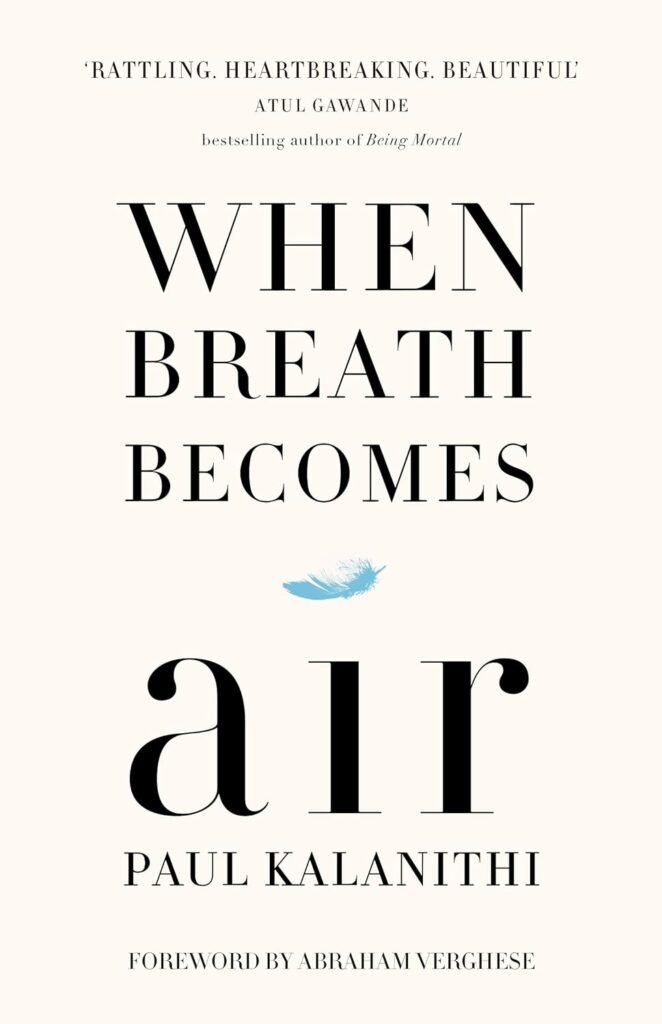
When Breath Becomes Air
Watch Prashant Sir break down the key ideas, themes, and philosophy in Kalanithi’s extraordinary meditation on mortality and meaning.
Why Read When Breath Becomes Air?
When Breath Becomes Air is the memoir of Paul Kalanithi — neurosurgeon, literary scholar, husband, and father — written in the final months of his life after a diagnosis of stage IV lung cancer at thirty-six. It is 228 pages in which a man who has spent his life at the intersection of medicine, literature, and philosophy attempts to answer the questions his dying has made urgent — what makes a life meaningful, what a doctor owes a patient at the boundary of life and death, and what remains when you can no longer be the person you had planned to become.
The book is divided into two parts. The first — “In Perfect Health I Begin” — covers Kalanithi’s early life, his dual passion for literature and medicine, his long journey through medical school and neurosurgery residency, and the specific intellectual and ethical questions that neurosurgery raised for him about the relationship between brain and self. The second — “Cease Not Till Death” — covers the period after his diagnosis, written while he was still able to work as a surgeon, then as a patient, and finally as a dying man who knew he would not finish the book he was writing.
The book is completed by an epilogue written by his wife, Lucy Kalanithi, after his death in March 2015 — an epilogue that is itself among the most moving pieces of medical writing published in the decade. What distinguishes the memoir from the literature of illness narratives is Kalanithi’s specific intellectual formation: he came to medicine from literature, and brought to both the questions that each discipline asks of the other. The memoir is not merely a story about dying; it is a sustained philosophical inquiry into what dying reveals about living.
Who Should Read This
This is essential reading for anyone confronting the questions that illness, death, and the limits of human life raise — which, eventually, is everyone. CAT and MBA candidates preparing for personal interviews about purpose, meaning, and what you value beyond professional success will find in Kalanithi’s account a model of how to hold those questions with the seriousness and specificity they deserve. Beyond preparation, it belongs on the reading list of every medical student, every person navigating serious illness, and every reader willing to sit with the question the memoir asks: what do you do when the future you had planned is no longer available to you?
Key Takeaways from When Breath Becomes Air
The relationship between brain and self is medicine’s most profound question. Kalanithi chose neurosurgery precisely because it is the discipline in which this question is most acutely present — every operation is simultaneously a technical intervention and a potential alteration of the self that inhabits the brain.
The question of what makes a life meaningful can only be answered in the specific, daily choices about how to spend the time that remains. Kalanithi’s diagnosis produced not a revelation but a practical problem: given that the future I planned is unavailable, what do I do with the time I have?
A physician’s primary obligation is not to prolong life but to help a patient understand what a life worth living looks like for them. Kalanithi’s account of his own medical care is the most personal available illustration of what patient-centred medicine looks like from inside the patient’s experience.
Writing is not the record of a life already understood — it is the instrument through which the understanding is achieved. Kalanithi wrote the memoir because writing was how he was working out what he needed to say, confronting his dying and making it meaningful in the act of articulating it.
Key Ideas in When Breath Becomes Air
The memoir’s intellectual architecture rests on a specific premise that Kalanithi states early: that he came to medicine from literature because he was pursuing the same questions through different instruments. Literature asks what makes a human life meaningful; medicine — specifically neurosurgery — asks what the physical substrate of that meaning is. The two questions converge most acutely at the boundary of life and death, which is where a neurosurgeon spends most of their professional life and where Kalanithi, after his diagnosis, found himself as a patient.
The first half’s account of neurosurgery residency is the memoir’s most operationally specific and most instructive about the ethical and intellectual demands of medicine at its most consequential. Kalanithi describes operations in which a millimetre’s difference in the placement of a surgical instrument determines whether a patient retains the ability to speak or to be the person they were before. These are not merely technical decisions; they are decisions about identity — about what constitutes a life worth preserving, and what a physician owes a patient who cannot articulate their own values in the moment of crisis.
The diagnosis and its aftermath are the memoir’s most psychologically precise sections. Kalanithi’s account of what it means to know too much is one of the most honest available renderings of the physician-patient experience. The physician’s knowledge of what the diagnosis means does not provide comfort; it removes the specific mercy of ignorance while providing no compensating resource except the ability to make more informed decisions about less time. His navigation of this double consciousness — knowing as a doctor what he is experiencing as a patient — is the memoir’s most distinctive contribution.
The writing section — the specific account of how and why he wrote the memoir — is the book’s most self-aware passage. Kalanithi did not write because he had achieved philosophical resolution; he wrote because writing was the instrument through which he was seeking it. The memoir is not a polished retrospective account of a completed journey; it is the record of an inquiry in progress. It ends mid-sentence, with his daughter present and his conclusion unwritten. Lucy’s epilogue does not complete Paul’s argument; it adds another perspective to an inquiry that was always going to remain open.
Key Themes in When Breath Becomes Air
Five interlocking themes run through the memoir, each examining a different dimension of the relationship between mortality, meaning, and the examined life.
Core Arguments
Four arguments distinguish When Breath Becomes Air as philosophy and medical ethics, not merely personal memoir.
Kalanithi’s most sustained argument is about the nature of medical practice at its most consequential. The technical skills of a neurosurgeon are the precondition for medical practice, not its essence. The essence is the philosophical capacity to help a patient understand what constitutes a life worth living for them — and to make medical decisions that serve that understanding rather than merely the technical imperative to preserve biological function. This argument, grounded in Kalanithi’s specific surgical experience, is one of the most precise available statements of what patient-centred medicine actually requires.
Kalanithi does not argue — as popular inspiration narratives typically do — that facing death produced a revelation about life’s meaning. He argues something more specific and more honest: that facing death clarified the question of meaning by removing the specific deferral mechanisms that make the question temporarily avoidable in ordinary life. Most people avoid asking what makes their life meaningful by filling time with activities that feel purposeful without requiring that the question be directly confronted. Terminal illness removes the deferral option. What remains, when you cannot defer, is the question itself — and the specific answer that each person must construct for themselves.
One of the memoir’s most original contributions to medical literature is its account of the specific experience of being a physician who becomes a patient. The double consciousness this produces — knowing as a doctor what the diagnosis means, and experiencing as a patient what it feels like — is neither purely a resource nor purely a burden: it removes the mercy of ignorance while providing the capacity for more informed decision-making. Kalanithi’s account of navigating this double consciousness is the most personal and most precise available account of what the physician-patient experience actually involves.
The memoir’s most self-referential and most important argument is about the relationship between writing and understanding. Kalanithi did not write the memoir because he had already achieved the understanding it documents; he wrote it because writing was the specific practice through which he was attempting to achieve that understanding. This is an argument about the nature of literary activity more broadly: that writing is not the record of a life already understood but the instrument through which understanding is sought — that the discipline of precise language is itself a form of thinking, and that thinking in this form is a way of confronting what cannot be confronted without it.
Critical Analysis
A balanced assessment of a memoir widely considered the finest piece of writing in this database — and of the genuine limitations its circumstances imposed.
Kalanithi’s background in English literature is present in every sentence — not as ornamentation but as the specific discipline of finding the right word for the right experience. The prose does not strain for effect; its power comes from the precision with which it observes specific experiences, and from the specific deployment of literary and philosophical references his formation made available to him. This is the best-written book in the Memoir section of this database.
The memoir does not pretend to achieve the philosophical resolution it is seeking. Kalanithi acknowledges, explicitly and repeatedly, that he does not know whether the life he is living has the meaning he hopes it has, that the questions he is pursuing may not be answerable, and that the comfort he is seeking may not be available. This refusal to produce resolution where resolution is not available is the memoir’s most intellectually credible quality.
The epilogue Paul’s wife Lucy wrote after his death is one of the most important sections of the book — not merely as a completion of the narrative but as an independent perspective on the same experience. Her account of Paul’s final months, her grief, and her continuing life in the absence he left is both personally extraordinary and philosophically significant. The book is more complete for its incompleteness — for the gap that the epilogue marks but does not fill.
The memoir’s extraordinary literary quality is inseparable from the specific formation that produced it — years of literary education and a particular intellectual confidence in the value of articulate reflection. This formation is not universally available, and readers from different backgrounds may find the memoir’s mode of engaging with mortality — through literary allusion, philosophical precision, and the discipline of prose — more alien than illuminating. It is a model of one way of confronting dying, most fully available to readers who share some version of the formation that produced it.
The memoir’s most honest quality — its refusal to produce false resolution — is also, for some readers, its most frustrating one. The second part is visibly less complete than the first: the prose is more fragmented, the argument less fully developed, the conclusions more tentative. This is appropriate to the circumstances of its composition — Kalanithi was dying as he wrote — but readers expecting the sustained intellectual argument of the first part may find the second part’s incompleteness difficult to engage with.
At 228 pages, the memoir is shorter than the questions it raises deserve — not because Kalanithi did not have more to say, but because he ran out of time before he could say it. It is a beginning, a promissory note for a full account that was never written, and readers looking for the completeness of a fully developed argument will need to supplement it with the broader literature on medicine, mortality, and meaning that Kalanithi’s own bibliography pointed toward.
Impact & Influence
Reception: When Breath Becomes Air was published in January 2016, ten months after Paul Kalanithi’s death, and immediately became one of the most critically celebrated non-fiction books of the year — debuting at number one on the New York Times bestseller list, selling over a million copies in its first year, and receiving near-universal critical acclaim. It has since been translated into over 40 languages and sold over 3 million copies worldwide. It won the Carnegie Medal for Excellence in Non-Fiction (2017) and was named one of the best books of the year by virtually every major literary publication.
Impact on Medical Culture: The memoir became required reading in medical schools and residency programmes across the United States and internationally — not primarily for its clinical content but for its account of what medicine requires at its most philosophically demanding, and what it means to be a physician who has also been a patient. It contributed significantly to the ongoing conversation about end-of-life care, advance directives, and the specific obligation of physicians to help patients understand what constitutes a life worth living for them — translating policy conversations into personal terms that reached a much wider audience.
Refusing the Inspiration Narrative: In a moment when the self-help genre was saturated with inspirational narratives about living your best life, When Breath Becomes Air offered something different: an account of a specific life confronting its own ending without the specific rescue of discovery, recovery, or triumph. Its refusal to resolve into inspiration — its insistence on remaining an open inquiry rather than a concluded argument — gave it a credibility and a staying power that most inspirational memoir cannot achieve.
Lucy’s Advocacy: Lucy Kalanithi’s subsequent public advocacy for end-of-life care and advance directive legislation extended the memoir’s impact into policy domains. She has spoken widely about what patients need from physicians at the end of life, what families need from medical institutions, and what the culture needs from medicine in its account of what dying involves — making the memoir’s personal argument a foundation for practical advocacy.
Indian Context: The memoir carries specific resonances in the Indian medical and social context: the challenges of end-of-life care in a system where physician-patient communication is often asymmetric; the cultural and religious frameworks through which dying is understood; and the specific experience of the first-generation professional who has achieved the success their family aspired to and must now confront its limits. The questions the memoir asks are not culturally specific, though the answers Kalanithi found drew on a specific literary and philosophical tradition. Readers from different traditions will find the questions more transferable than the specific answers.
Love This Book? Master Every Book.
Stop struggling with reading comprehension. Our proven system transforms how you read—whether for CAT, GRE, GMAT, SAT, or personal growth.
Best Quotes from When Breath Becomes Air
I began to realize that coming face to face with my own mortality, in a sense, had changed both nothing and everything.
The physician’s duty is not to stave off death or return patients to their old lives, but to take into our arms a patient and family whose lives have disintegrated and work until they can stand back up and face, and make sense of, their own existence.
What makes life meaningful enough to go on living?
You can’t ever reach perfection, but you can believe in an asymptote toward which you are ceaselessly striving.
I was searching for a vocabulary with which to make sense of death. I found it in the literary tradition, in the great works of poets and novelists who had grappled with the same questions.
If You Liked This, Try…
No books found.
Test Your Understanding
Think you’ve mastered When Breath Becomes Air? Challenge yourself with 15 questions on key themes, philosophy, and Kalanithi’s core arguments. Score 80%+ to prove your mastery.
When Breath Becomes Air FAQ
What is When Breath Becomes Air about?
It is the memoir of Paul Kalanithi — neurosurgeon and literary scholar — written in the final months of his life after a diagnosis of stage IV lung cancer at thirty-six. The first part covers his formation as a physician and his development of the specific philosophical questions that neurosurgery raised for him about the relationship between brain and self, life and death, and the physician’s obligations at the boundary. The second part covers the period after his diagnosis — his return to surgery, his decision to write the memoir, and the specific confrontation with his own mortality that his dying produced. The book is completed by an epilogue written by his wife Lucy after his death.
Is it useful for MBA and CAT preparation?
Yes — particularly for personal interview questions about purpose, meaning, what you value beyond professional success, and what you would do if your plans were suddenly unavailable to you. Kalanithi’s account of how he decided what to do with the time he had — his specific answers to the question “given that the future I planned is gone, what do I do now?” — provides a model of how to hold these questions with the seriousness and specificity they deserve in a PI context.
What is the book’s most important philosophical argument?
That the question of what makes a life meaningful cannot be answered in the abstract — it can only be answered in the specific, daily choices about how to spend the time that remains. Kalanithi’s confrontation with his mortality did not produce a philosophical revelation; it produced a practical problem: given finite time and unavailable futures, what do I do? His answers — he returned to surgery, he wrote the memoir, he became a father — are not prescriptions for anyone else but demonstrations of the specific kind of clarity that the awareness of death can produce when it is confronted honestly rather than deferred indefinitely.
What does the memoir say about the doctor-patient relationship?
That a physician’s deepest obligation at the boundary of life and death is not to preserve biological function but to help a patient understand what constitutes a life worth living for them — and to navigate medical decisions in light of that understanding. This requires a physician who can ask the right questions, hold space for the patient’s specific values, and resist the institutional pressure to treat every illness as a problem to be solved regardless of whether solving it serves the patient’s conception of a meaningful life. Kalanithi’s account of his own medical care — moving from physician to patient — is the most personal available illustration of what this obligation looks like from both sides of the relationship.
How does When Breath Becomes Air compare to Tuesdays with Morrie as a book about dying?
Both are accounts of people confronting death with unusual clarity. The key differences are in intellectual register and form. Tuesdays with Morrie is a dialogue — Albom’s questions, Morrie’s teachings, the student-professor relationship as the book’s structural spine — more accessible and more practically prescriptive. When Breath Becomes Air is a soliloquy — one person’s sustained interior inquiry, more literary and more philosophically demanding. Both are essential; they address the same questions from different intellectual angles, and together they constitute a more complete account of what confronting mortality honestly requires than either provides alone.








