
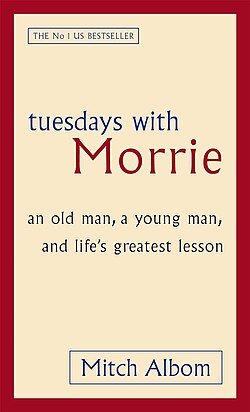
Tuesdays with Morrie
Watch Prashant Sir break down Mitch Albom’s memoir — fourteen Tuesday conversations with a dying professor, and the specific lessons about love, death, and what matters that most of us spend our lives avoiding.
Why Read Tuesdays with Morrie?
Tuesdays with Morrie is among the most widely read memoirs of the past three decades — not because it is technically accomplished, though it is, but because it does something very few books attempt and fewer achieve: it uses one man’s dying as a lens through which to examine how the rest of us are living. Mitch Albom’s account of his Tuesday visits to his former sociology professor, Morrie Schwartz, during the final months of Morrie’s battle with ALS is not a book about death. It is a book about the specific ways in which a dying man’s clarity exposes the specific blindnesses of a living one — and by extension, of most of us.
In 1979, Mitch Albom graduated from Brandeis University and made a promise to his favourite professor, Morrie Schwartz, that he would stay in touch. He did not keep that promise. Sixteen years later — working as a sports journalist in Detroit, professionally successful and vaguely dissatisfied — he happened to see Morrie on television and learned his former professor was dying of ALS. Albom flew to Boston, reconnected with Morrie, and began visiting him every Tuesday. Morrie had fourteen Tuesdays left.
The book’s structure alternates between Albom’s present-tense visits and his past-tense recollections of his own life since graduation — the choices he made, the values he absorbed from the culture around him, the slow drift away from what he had once believed mattered. This alternating structure makes Morrie’s wisdom not merely inspirational but diagnostic — a measure of the distance between how Albom has been living and how he might have lived, and by implication, a measure of the same distance in the reader’s own life.
Who Should Read This
This is among the most accessible books in the database and among the most emotionally immediate. MBA and CAT candidates preparing for personal interview questions about values, purpose, and what matters beyond professional success will find in Morrie’s teachings a set of perspectives that are simultaneously philosophically serious and conversationally accessible. Beyond preparation, it is a book for anyone who has ever felt the gap between how they are spending their time and what they genuinely value — which, with sufficient honesty, is most people.
Key Takeaways from Tuesdays with Morrie
The culture we absorb tells us what to want — and most of what it tells us is wrong. Morrie’s most consistent teaching is that the values promoted by modern consumer and professional culture are not false but insufficient. The work of a conscious life is to examine which of your values you chose and which were handed to you, and to have the courage to live by the former.
Death is the teacher most people refuse to study until the examination is upon them. Morrie’s practice of treating each day as if it might be his last is not morbid — it is clarifying. The awareness of death does not diminish life; it illuminates it, stripping away trivial urgencies and revealing the few things that genuinely matter: love, connection, meaning, and the specific people in your specific life.
Love is the only rational response to the human condition — and withholding it, for whatever reason, is the most consistent source of regret that dying people report. Morrie has watched people die and his conclusion is that the capacity to love and be loved is the only metric that holds up under the scrutiny of a deathbed. Everything else — achievement, wealth, status — fades. Love does not.
Detachment is not indifference — it is the ability to feel an emotion fully and then let it go. Morrie’s concept of detachment is one of the book’s most practically applicable teachings: you experience the fear, the grief, the anger completely, and then you step back from it. The alternative — either suppressing the emotion or being overwhelmed by it — produces neither peace nor wisdom. Detachment produces both.
Key Ideas in Tuesdays with Morrie
The book’s most important structural decision is what Albom does not do: he does not turn Morrie into a saint or a sage whose wisdom is beyond ordinary human reach. He presents Morrie as a man who is frightened of dying, who has bad days, who sometimes needs his body cleaned and his tears wiped — and who, in the middle of all of that, has thought more carefully about what matters than most people will in a lifetime of comfort. The combination of vulnerability and clarity is what gives Morrie’s teaching its authority: these are not the abstract conclusions of a philosopher in a library but the tested convictions of a man who is living — and dying — by them.
The book is organised around the “last class” metaphor: Morrie’s final course, with Albom as his only student, covering the syllabus of a life. The topics are announced each Tuesday — love, work, community, family, ageing, forgiveness, death — and each is addressed through conversation rather than lecture. Morrie does not lecture; he dialogues, and Albom’s questions — often the questions of a person who has absorbed the culture’s values and is beginning to doubt them — are as important to the book’s argument as Morrie’s answers.
Albom’s self-portrait is the book’s most undervalued element. He is not a passive recipient of wisdom; he is a man who has spent sixteen years building exactly the kind of life Morrie most consistently questions — professionally driven, financially focused, relationship-neglecting, promise-forgetting. His recollections of his own choices, intercut with Morrie’s teachings, function as a running self-examination that the reader is invited to conduct in parallel. The book works not because Morrie is wise (though he is) but because Albom is honest about how far he has drifted — and because that drift is recognisable.
The final teaching — on death itself — is the book’s most concentrated passage. Morrie is not certain about what comes after; he is certain about what has mattered during. The conversation about death is, characteristically, a conversation about life — about what it would look like if lived as if the end were always visible, if the people around you were always understood to be temporary gifts rather than permanent fixtures. Morrie’s own death, when it comes at the book’s end, is the completion of a life that had become an argument for how to live.
Morrie’s Key Teachings
Across fourteen Tuesdays, Morrie addresses six subjects — culture, death, love, ageing, forgiveness, and work — each a chapter in the “last class” he is conducting for his only remaining student, and each a lens through which the reader is invited to examine their own life.
Core Arguments
Albom advances four interconnected arguments — about the dying man as the most reliable teacher of the living, about the gap between knowing and living, about love as epistemology rather than mere ethics, and about the inadequacy of cultural values — each grounding the memoir’s emotional power in a more rigorous intellectual framework than its accessibility might suggest.
The book’s central structural argument is that a person who is dying has access to a clarity about what matters that the living — wrapped in the urgencies, distractions, and ego-investments of daily life — typically cannot achieve. Morrie’s authority does not come from expertise or credential; it comes from the specific vantage point of someone who can no longer defer the essential questions. The dying strip away the non-essential with a thoroughness that the living rarely manage — and what remains, in Morrie’s case, is an argument about how to live that is made more compelling by the fact that he is simultaneously demonstrating it.
Albom’s self-portrait is the book’s most honest contribution. He knows, intellectually, what Morrie is teaching him. He has known it, in some form, since his years at Brandeis. The gap between knowing what matters and structuring your life around it is the book’s central subject — and Albom’s honesty about the size of that gap in his own life is what prevents the book from becoming inspirational wallpaper. The reader’s recognition of the same gap in their own life is what makes the book something more than a moving story about a dying man.
Morrie’s teaching on love is not merely an ethical position — “be kind to others” — but an epistemological one: you cannot fully understand your own life without love as the framework through which you examine it. The questions “Was I loved?” and “Did I love?” are, in Morrie’s frame, the questions that retrospectively organise a life into meaning or meaninglessness. This is not a religious claim; it is a phenomenological one — the observation that the experiences people most consistently describe as their life’s most significant are experiences of love, connection, and genuine presence with another person.
Morrie’s most consistent teaching — that the values promoted by modern consumer and achievement culture are insufficient rather than false — is one of the most important distinctions the book makes. He is not anti-success; he is anti-default: anti the unexamined adoption of the culture’s agenda as your own. The question is not whether to pursue achievement but whether the achievement you pursue is in service of a life you have actually chosen or a life the culture has chosen for you. Most people, he argues, never ask the question — and discover the answer only when it is too late to change it.
Critical Analysis
A balanced assessment examining the book’s alternating structure, the completeness of Albom’s portrait of Morrie, and its accessibility without shallowness, alongside the inherent constraints of memoir reliability, the limits of Morrie’s specific situation as a universal model, and the ever-present risk of sentimentality in material this emotionally charged.
Albom’s formal decision to intercut the Tuesday visits with retrospective accounts of his own post-graduation choices is the book’s most important literary achievement. It prevents Morrie’s teachings from floating free of context and makes them continuously diagnostic — each teaching is immediately measured against the specific life choices of the person receiving it. This structure transforms a memoir about someone else into a mirror held up to the reader.
Albom’s portrait of Morrie is the book’s most significant strength: he does not sanitise him. Morrie is frightened of dying, has vanity, sometimes needs to be reminded of his own teachings by the life he is living. This humanising specificity is what gives the book’s wisdom its authority — these are the conclusions of a complete, flawed, fully alive person, not the aphorisms of a constructed sage.
The book is written at a level of simplicity that makes it accessible to almost any reader — and contains a level of philosophical seriousness that rewards return reading. The teachings on detachment, on creating your own culture, and on the relationship between death-awareness and life-quality are genuinely sophisticated ideas, delivered in language so clear that their depth is easy to underestimate.
The book is Albom’s reconstruction of conversations recorded over fourteen Tuesdays — shaped, compressed, and narratively arranged. Morrie’s voice, however authentic it feels, is Albom’s reconstruction of Morrie’s voice. The book is emotionally true; its factual precision is that of memoir, not journalism. This is not a critique of the book’s integrity — it is a reminder of the genre’s inherent constraints.
Morrie’s teachings are the product of one man’s specific life — educated, professionally secure for much of his life, supported by a loving family, experiencing a disease that allowed him time and clarity to prepare for death. His wisdom is genuine but not universally applicable without translation: the person whose life has not provided baseline conditions of security and time for reflection may find some teachings harder to access than the book implies.
The book operates very close to the border between earned emotion and sentimentality — and some readers will find it crosses that border. The Tuesday structure, the deathbed wisdom, the reconciliation between professor and student are all emotionally potent elements that Albom handles with more restraint than the genre typically produces. But the risk of sentimentality is inherent to the material and readers alert to it will notice its presence.
Literary & Cultural Impact
A Publishing Phenomenon: Tuesdays with Morrie was published in August 1997, initially with a print run of 20,000 copies. Within months it was on the New York Times bestseller list, where it would remain for over four years — one of the longest runs in the list’s history for a non-fiction memoir. It has since sold over 14 million copies in the United States alone and over 17 million worldwide, been translated into more than 45 languages, and been adapted into a television film starring Jack Lemmon and Hank Azaria that won multiple Emmy Awards.
A Cultural Mirror: The book emerged at a specific cultural moment — the late 1990s, when the longest economic expansion in American history was producing a generation of professionals who were materially successful and spiritually dissatisfied in numbers large enough to constitute a cultural phenomenon. Morrie’s diagnosis of the culture — that it promotes values that fill a life without filling the person living it — resonated with a readership that had achieved what the culture said they should want and discovered it was not enough. The book was, in this sense, not merely a memoir but a cultural mirror: its success was partly a measure of how widely the gap it described was felt.
Educational Adoption: The book’s educational adoption has been substantial. It is taught in secondary schools and universities across the United States and internationally, included in business ethics and leadership curricula for the conversations it provokes about purpose, values, and what success actually means. In the Indian educational context, it has been adopted into English literature syllabi and used in personal development and value education programmes — its simplicity of language combined with depth of content making it unusually suitable for readers at varying levels of English proficiency.
Morrie as Cultural Figure: Morrie Schwartz himself — whose Brandeis sociology lectures had been partly broadcast on Nightline before his death — has become a minor cultural figure in his own right: the professor who taught his last and most important class while dying, and whose student had the honesty and craft to record what was said and give it to the world. Albom went on to write several more books in a similar vein, but none matched the specific intimacy and authority of Tuesdays with Morrie, which derived its power from the specific reality of Morrie Schwartz — a person who actually existed, actually said these things, and actually died.
Love This Book? Master Every Book.
Stop struggling with reading comprehension. Our proven system transforms how you read—whether for CAT, GRE, GMAT, SAT, or personal growth.
Best Quotes from Tuesdays with Morrie
The truth is, once you learn how to die, you learn how to live.
So many people walk around with a meaningless life. They seem half-asleep, even when they’re busy doing things they think are important. This is because they’re chasing the wrong things.
Love each other or die.
Accept what you are able to do and what you are not able to do. Accept the past as past, without denying it or discarding it. Learn to forgive yourself and to forgive others.
The most important thing in life is to learn how to give out love, and to let it come in.
Test Your Understanding
Think you’ve mastered Tuesdays with Morrie? Challenge yourself with 15 questions on Morrie’s six key teachings, the alternating structure, the gap between knowing and living, and why one dying professor’s clarity has moved 17 million readers. Score 80%+ to prove your mastery.
Tuesdays with Morrie FAQ
What is Tuesdays with Morrie about?
It is Mitch Albom’s memoir of fourteen Tuesday visits to his former Brandeis sociology professor, Morrie Schwartz, during the final months of Morrie’s terminal illness from ALS. Each visit becomes a conversation — about love, work, community, family, ageing, forgiveness, and death — that Albom records and shapes into a book. It is simultaneously a portrait of a remarkable person dying with clarity and grace and a self-examination by his former student of how far he has drifted from the values he once held.
Is it useful for MBA and CAT preparation?
Yes — specifically for personal interview preparation. Questions about values, purpose, work-life balance, what success means beyond professional achievement, and what you regret or would change about your choices so far are standard MBA PI territory. Morrie’s teachings provide a set of perspectives on these questions that are philosophically serious enough to anchor a sophisticated answer and accessible enough to express naturally in conversation. The book also provides the kind of human depth that distinguishes personal interview answers that are merely competent from those that are genuinely memorable.
What are the main lessons in the book?
The central lessons are: examine the values the culture has handed you and choose your own consciously; cultivate the awareness of death as a clarifying rather than a morbid practice; recognise love as the only metric that holds up under the scrutiny of a deathbed; understand ageing as growth rather than decline; practise forgiveness — of others and yourself — before it is too late; and ask honestly whether the work you are doing is connected to something you genuinely value or whether it is the performance of productivity in service of a life the culture chose for you.
How does the book use Albom’s life as a counterpoint to Morrie’s teachings?
This is the book’s most important structural feature. Albom does not present himself as a neutral observer of Morrie’s wisdom; he presents himself as a man whose post-graduation choices — professional focus at the expense of relationships, the absorption of the culture’s success metrics, the broken promise to stay in touch — represent exactly what Morrie most consistently questions. The alternating structure makes Morrie’s teachings continuously diagnostic: each teaching is measured against the specific life of the person receiving it, and the reader is invited to conduct the same measurement in their own life.
Is the book primarily about death or about life?
About life — specifically, about the specific ways that the awareness of death clarifies it. Morrie is dying throughout the book, and the book does not flinch from the physical reality of that process. But every conversation about death is a conversation about life: about what to prioritise, what to let go of, what to say before it is too late, and how to live so that the end, when it comes, is the completion of a life chosen rather than the interruption of one deferred. The book’s central argument is that most people live as if they have unlimited time, and that the quality of their lives would be transformed by the recognition that they do not.








