
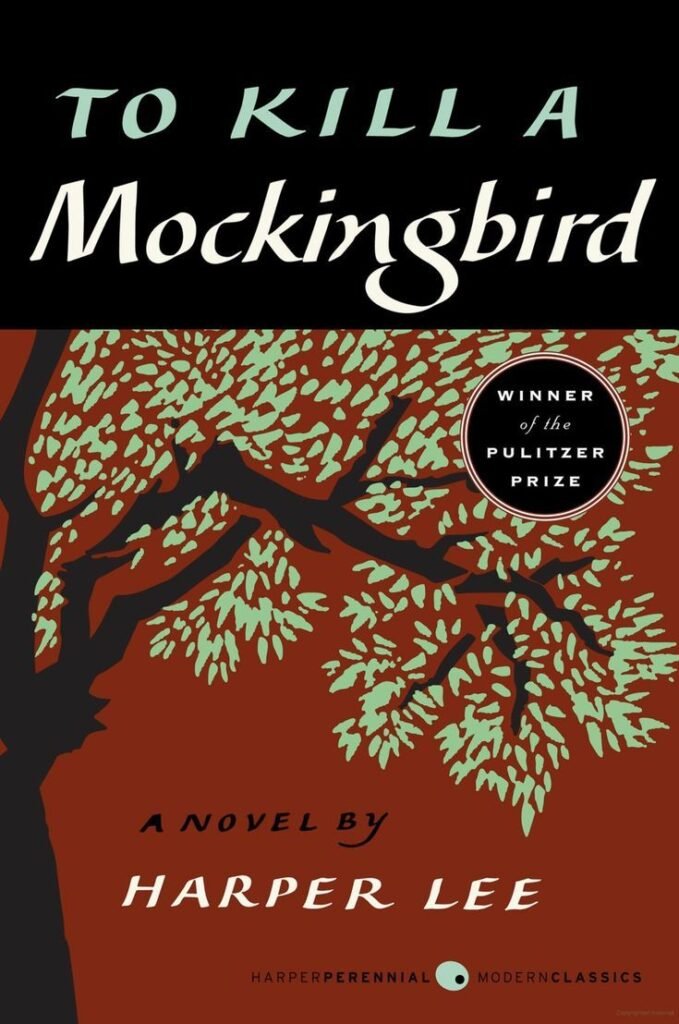
Why Read To Kill a Mockingbird?
To Kill a Mockingbird is not simply a novel about a trial — it is a sustained moral education delivered through the eyes of a child, and that innocence is precisely what makes it devastating. Harper Lee understood that the most effective way to expose the violence of prejudice was to place an uncorrupted observer in its midst. The result is one of the most quietly radical novels ever written in the English language.
Set in the fictional town of Maycomb, Alabama, during the Great Depression, the novel follows six-year-old Scout Finch as she navigates childhood, neighbourhood mysteries, and the trial of Tom Robinson — a Black man falsely accused of raping a white woman. Her father, Atticus Finch, a principled lawyer, agrees to defend Tom knowing the verdict is foregone in a segregated society. What unfolds is not a courtroom drama but a moral reckoning with the nature of courage, empathy, and the complicity of silence.
The novel’s enduring power lies in its deceptively simple structure. Lee never lets the reader feel safe in their outrage — Maycomb’s townsfolk are not monsters but ordinary people shaped by fear and custom. This is its most uncomfortable truth: injustice thrives not through exceptional evil, but through ordinary cowardice. Sixty-five years after publication, that truth has lost none of its urgency.
Who Should Read This
This novel is essential for anyone building their understanding of literary narrative, moral philosophy, or American social history. Students preparing for CAT/GRE/GMAT will find it invaluable for reading comprehension practice — the prose is structurally rich, emotionally layered, and frequently tested. Beyond exam prep, it is the ideal book for young adults confronting questions of fairness and identity, educators, legal professionals, and anyone who believes storytelling can change how we see the world.
Key Takeaways from To Kill a Mockingbird
Courage is not the absence of fear — it is acting rightly despite knowing you will lose. Atticus Finch does not defend Tom Robinson because he expects to win. He defends him because the alternative is moral surrender, and that distinction defines the entire novel’s ethical core.
Empathy is an act of imagination, not sentiment. Atticus’s defining instruction to Scout — to climb into someone’s skin and walk around in it — is the novel’s central claim: true understanding requires deliberate, effortful perspective-taking, not just sympathy from a comfortable distance.
Legal justice and social justice are not the same thing. Tom Robinson’s trial reveals how a system designed for fairness can be weaponised by prejudice when the community that operates it refuses accountability. The courtroom becomes a mirror of society’s failures, not a corrective to them.
Innocence, once lost, cannot be restored — only honoured. The mockingbird metaphor captures the novel’s most painful insight: some people, like Tom Robinson and Boo Radley, are destroyed simply by existing in a world that cannot accommodate their gentleness. To protect them is the only moral response.
To Kill a Mockingbird Plot Summary
To Kill a Mockingbird is narrated by Jean Louise “Scout” Finch, who looks back on three formative years of her childhood in Maycomb, Alabama, a sleepy, insular town where “a day was twenty-four hours long but seemed longer.” Scout lives with her widowed father Atticus, a lawyer of quiet integrity, and her elder brother Jem. Their summers are largely ruled by their friendship with Dill Harris, a boy who visits his aunt next door, and their shared obsession with Boo Radley — the mysterious, reclusive neighbour who has not been seen in years and whom Maycomb’s gossip has turned into a figure of dread.
The first half of the novel moves at the pace of childhood itself — episodic, sensory, full of small incidents that seem unconnected but are in fact carefully accumulating. Scout starts school and is immediately at odds with her teacher’s methods. Jem and Scout discover gifts left in the knothole of a tree outside the Radley property. Their father is called upon to shoot a rabid dog in the street, revealing a sharpshooter’s skill he never boasted of. These scenes are not detours — they are building a portrait of Atticus as a man of quiet, unfussy competence and principle.
The novel pivots sharply when Atticus is appointed to defend Tom Robinson, a Black farmhand charged with the rape of Mayella Ewell, the daughter of Maycomb’s most degraded white family. The accusation is almost certainly false — the evidence points overwhelmingly to Mayella’s abusive father Bob Ewell as the source of her injuries — but the social architecture of Maycomb makes a fair verdict nearly impossible. Scout and Jem watch from the “Coloured balcony” as their father systematically dismantles the prosecution’s case, only to watch the all-white jury convict Tom anyway. The experience is Scout and Jem’s first collision with the world’s capacity for deliberate, institutionalised cruelty.
The novel’s final section resolves the Boo Radley mystery in a way that ties all of Lee’s themes together. Bob Ewell, humiliated by Atticus’s courtroom exposure of his lies, attacks Scout and Jem on Halloween night. It is Boo Radley who intervenes, saving the children and killing Ewell. Sheriff Heck Tate makes the quiet decision to rule Ewell’s death an accident — protecting Boo from the public attention that would destroy him. In Scout’s final, luminous moment of understanding, she stands on Boo’s porch and sees the neighbourhood through his eyes for the first time. The circle of empathy closes.
To Kill a Mockingbird Characters
Each character embodies a distinct moral position in the drama of Maycomb’s reckoning with justice and prejudice.
Six years old at the story’s opening, Scout is fierce, literal-minded, and allergic to injustice. Her gradual, painful education in the limits of fairness is the novel’s emotional engine.
A widowed lawyer who treats his children as rational beings capable of understanding hard truths. He defends Tom Robinson not because he is naïve about the outcome but because he cannot teach his children that doing the right thing is contingent on winning.
A kind, hardworking Black man convicted not by evidence but by the colour of his skin. His dignity throughout the trial crystallises the novel’s argument about structural racism with more power than any polemic could achieve.
Turned into a monster by Maycomb’s gossip, Boo is in reality a profoundly gentle, damaged man who expresses his care for Scout and Jem through secret gifts and, finally, physical protection. He is the novel’s most direct embodiment of the mockingbird metaphor.
The embodiment of resentful, weaponised ignorance. He falsely accuses Tom Robinson and, when Atticus exposes his lies in court, plots revenge against Finch’s children.
The Finches’ Black housekeeper holds authority in the household while navigating rigid racial codes outside it. Through her, Scout gains her first real understanding that people lead layered, code-switching lives.
Major Themes
Harper Lee weaves several interlocking themes through Maycomb’s moral landscape.
The trial of Tom Robinson is the novel’s axis. Racial prejudice in Maycomb is not aberrant but structural — upheld by laws, enforced by social pressure, and sustained by the silence of people who know better. Atticus’s courage lies not in defeating the system but in refusing to participate in its dishonesty.
The novel’s title comes from Atticus’s instruction that it is a sin to kill a mockingbird — a creature that does nothing but make music. This maps onto Tom Robinson and Boo Radley, both harmed by a society that cannot tolerate their gentleness.
Harper Lee proposes empathy not as a feeling but as a disciplined act of imagination: the effort to genuinely inhabit another’s perspective before judging. It is the one virtue Lee presents as learnable rather than innate.
Maycomb’s social order is meticulously stratified. The Ewells deploy their racial privilege as the only social capital available to them — showing how poverty and class shame can calcify into cruelty when a society offers its most vulnerable nothing except someone to look down upon.
Critical Analysis
A balanced assessment examining both the novel’s literary strengths and its acknowledged limitations.
Scout’s first-person child narration is one of literature’s most precise instruments — she reports what she sees without adult rationalisation, forcing the reader to draw conclusions the narrator herself has not yet reached.
Lee resists authorial intrusion. The injustice speaks entirely through character and event, which makes it far more devastating than any editorial flourish would achieve.
Even as the novel condemns racism unambiguously, it populates Maycomb with people who are neither wholly good nor wholly evil, making its social portrait genuinely three-dimensional.
Atticus Finch has been critiqued as a “white saviour” construction — a figure whose heroism is framed primarily through what it costs him rather than what it does or fails to do for Tom Robinson and Maycomb’s Black community.
Despite Tom Robinson being the moral centre of the trial, the novel is told almost entirely from white perspectives. Black characters are rendered with less interiority than the novel’s white figures.
The final resolution — Boo’s intervention, Ewell’s death, the sheriff’s quiet cover-up — has been described as too tidy, allowing Maycomb to avoid any real institutional reckoning. The evil is removed, but the system that produced it remains intact.
Literary & Cultural Impact
Awards and Reach: To Kill a Mockingbird won the Pulitzer Prize in 1961 and was adapted into an Academy Award-winning film in 1962 with Gregory Peck’s portrayal of Atticus becoming an iconic rendering of moral decency. The novel has sold more than 45 million copies worldwide and remains one of the most widely taught — and most frequently banned — texts in American schools.
Cultural Influence: Atticus Finch became a touchstone for legal ethics for decades. The phrase “climb into someone’s skin and walk around in it” entered common usage as shorthand for empathetic reasoning. In 2006, British librarians voted it the novel that best captures “the spirit of a human being.”
Critical Reassessment: More recently, scholars have interrogated the Atticus myth — asking whether the novel’s framing of racial justice through the prism of white moral courage inadvertently centres the wrong characters in the struggle for Black dignity. These debates are not a diminishment of the novel but evidence of its continuing vitality. Books that no longer generate argument have ceased to live. To Kill a Mockingbird is emphatically still alive.
Love This Book? Master Every Book.
Stop struggling with reading comprehension. Our proven system transforms how you read—whether for CAT, GRE, GMAT, SAT, or personal growth.
Best Quotes from To Kill a Mockingbird
You never really understand a person until you consider things from his point of view… until you climb into his skin and walk around in it.
I wanted you to see what real courage is, instead of getting the idea that courage is a man with a gun in his hand. It’s when you know you’re licked before you begin, but you begin anyway and see it through no matter what.
Mockingbirds don’t do one thing except make music for us to enjoy. They don’t eat up people’s gardens, don’t nest in corn cribs, they don’t do one thing but sing their hearts out for us.
The one thing that doesn’t abide by majority rule is a person’s conscience.
I think there’s just one kind of folks. Folks.
Test Your Understanding
Think you’ve mastered To Kill a Mockingbird? Challenge yourself with 15 questions on themes, characters, and key takeaways. Score 80%+ to prove your mastery.
To Kill a Mockingbird FAQ
What is To Kill a Mockingbird about?
The novel follows Scout Finch, a young girl in Depression-era Alabama, as her father Atticus — a principled lawyer — defends Tom Robinson, a Black man falsely accused of raping a white woman. It is simultaneously a coming-of-age story, a courtroom drama, and a moral indictment of racial injustice in the American South.
Is it suitable for competitive exam preparation?
Yes — it is one of the most frequently referenced texts in RC passages for CAT, GRE, and GMAT. Its prose is rich in tone, irony, and narrative structure, making it excellent practice for inference-based and author-purpose questions. The reading level is Intermediate, making it accessible without being simplistic.
What are the main themes of the novel?
The central themes are racial injustice and the failure of legal systems, moral courage under social pressure, the loss of innocence, empathy as an ethical practice, and the relationship between class shame and prejudice. These themes are layered and interlocking rather than presented separately.
Who is Boo Radley and why does he matter?
Boo Radley is the reclusive neighbour whom Maycomb’s gossip has mythologised into a monster. He is in fact a gentle, damaged man who secretly befriends Scout and Jem through gifts in a tree knothole and ultimately saves their lives. He represents the novel’s mockingbird metaphor most directly — an innocent creature destroyed by a society unable to accommodate what it cannot understand.
Why is this novel still relevant today?
The novel’s argument — that structural injustice persists not through exceptional evil but through ordinary cowardice and complicity — applies with precise accuracy to contemporary debates about race, justice, and institutional accountability. Its insistence that empathy must be practised rather than merely professed makes it as instructive now as it was in 1960.








