
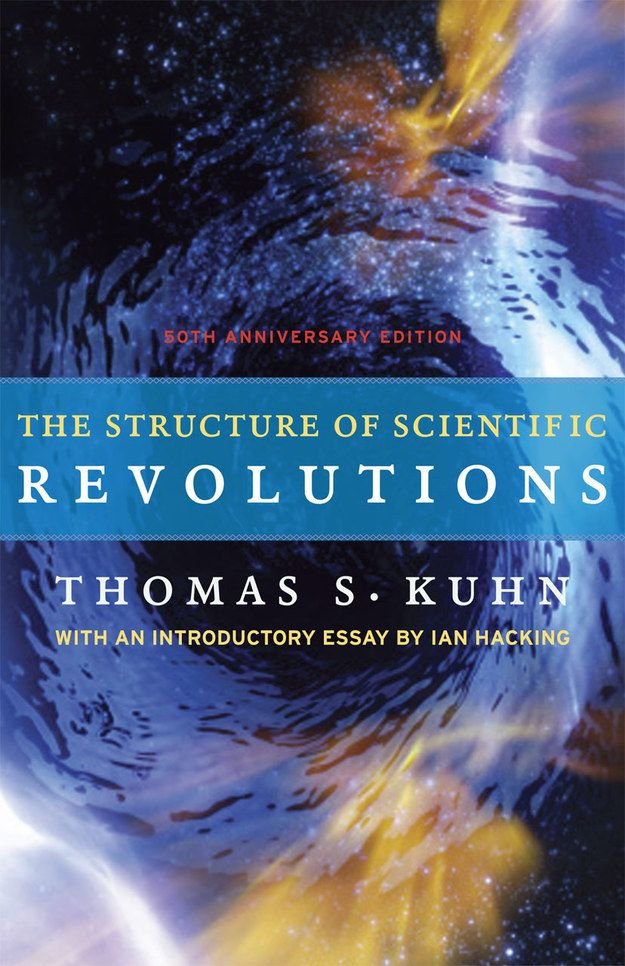
Why Read The Structure of Scientific Revolutions?
The Structure of Scientific Revolutions is one of the most cited academic books of the 20th century and one of the most consequential works of philosophy ever written about science. Thomas Kuhn — a physicist turned historian of science — demolished the comfortable assumption that science advances by steady accumulation of knowledge and replaced it with a far more disturbing and accurate picture: science progresses through periodic, violent revolutions in which one entire framework for understanding reality is overthrown and replaced by another, incommensurable one.
Published in 1962 as part of the International Encyclopedia of Unified Science, the book introduced the concept of the “paradigm” — a framework of assumptions, exemplary problems, and methods that a scientific community shares and within which normal scientific work takes place — and showed that paradigms do not yield to contrary evidence gradually or rationally but are defended tenaciously until accumulated anomalies produce a crisis that makes replacement unavoidable. The shift from one paradigm to another — a “paradigm shift” — is not a logical deduction but something closer to a religious conversion: a gestalt switch in which the entire world of the scientist is restructured.
The book gave the world a vocabulary — paradigm, paradigm shift, normal science, scientific revolution, incommensurability — that has since migrated far beyond philosophy of science into business, politics, technology, and everyday intellectual discourse. For Master-level competitive exam aspirants, it represents the most intellectually demanding non-fiction text on the reading list: its argument is dense, its implications are radical, and it requires sustained engagement with the philosophy of knowledge, the sociology of scientific communities, and the history of science simultaneously.
Who Should Read This
The Structure of Scientific Revolutions is essential for anyone serious about understanding how knowledge actually advances — scientists, philosophers, historians, educators, and anyone who has wondered why paradigm shifts are so rare, so disruptive, and so total when they occur. Particularly valuable for Master-level CAT and GRE aspirants preparing for the most demanding analytical RC passages, for PhD and research students across disciplines, and for MBA and policy candidates who want the deepest possible framework for thinking about innovation, disruption, and institutional change.
Key Takeaways from The Structure of Scientific Revolutions
Normal science is puzzle-solving within an accepted paradigm — the vast majority of scientific work consists not of challenging fundamental assumptions but of applying an accepted framework to increasingly detailed problems. Normal science is enormously productive, but it systematically suppresses novelty and resists challenges to its foundations, which is precisely what makes paradigm shifts so rare and so violent when they occur.
Paradigm shifts are not triggered by evidence alone. Anomalies accumulate for years or decades before a crisis emerges, and even then the paradigm is not abandoned until a credible alternative exists. A theory is never falsified by contrary evidence alone; it is replaced by a better theory. The logical positivist picture of science as steadily self-correcting through experiment is, Kuhn argues, empirically false as a description of how science actually works.
Paradigms are incommensurable — scientists working within different paradigms do not merely disagree about facts but inhabit different worlds, using the same words with different meanings, perceiving different things in the same data, and asking different questions. This incommensurability means that paradigm disputes cannot be resolved by purely rational argument; they involve persuasion that is more sociological than logical.
Scientific progress is not cumulative in the way we assume. The history of science is not a straight line from ignorance to truth but a series of ruptures in which old knowledge is not merely supplemented but partially discarded. After a paradigm shift, some of what was “known” is no longer true, some problems that were important become trivial, and some phenomena that were invisible become central. Progress happens — but not in a straight line, and not without loss.
Key Ideas in The Structure of Scientific Revolutions
Kuhn begins by challenging the received view of science — the picture most people absorb from textbooks and popular science: a steady accumulation of facts, theories, and discoveries, each building on the last in an orderly progression toward complete understanding. He argues that this picture, however useful pedagogically, is historically false. The actual history of science, examined carefully, shows something very different: long periods of stability punctuated by relatively sudden, total revolutions in which entire frameworks of understanding are replaced.
The book’s analytical engine is the concept of the paradigm — a term Kuhn uses in multiple senses but that essentially means the shared framework of assumptions, exemplary solved problems, methods, standards, and values that defines a scientific community at a given time. A paradigm does not merely tell scientists what to think; it tells them what questions are worth asking, what counts as a good answer, and what data are relevant. Scientists within a paradigm are not free to question its foundations — doing so is not even recognized as a scientific activity but is regarded as philosophical confusion or incompetence.
Normal science — the term Kuhn uses for the scientific work that occupies most scientists most of the time — is the activity of solving puzzles within an accepted paradigm. It is enormously productive: the paradigm tells scientists where to look, what tools to use, and what a solution should look like, which is why science within a stable paradigm advances so rapidly. But normal science is also systematically conservative: it actively suppresses novelty, dismisses anomalies that resist explanation as problems to be solved later, and interprets contrary evidence as errors in the experiment rather than challenges to the framework.
The transition from normal science to revolution passes through crisis — a period in which anomalies have accumulated to the point where the scientific community can no longer ignore them, the paradigm begins to visibly loosen, and competing proposals begin to appear. Crisis is not a logical state but a psychological and sociological one: the community loses confidence, foundational questions re-emerge, and speculative thinking becomes acceptable. The resolution of crisis is the paradigm shift: not a logical deduction from evidence but a gestalt switch — a sudden reorganization of the entire field around a new set of assumptions, exemplary problems, and standards. Scientists who experience it describe it as seeing the world differently, not merely knowing more about it.
Core Frameworks
Kuhn’s argument rests on six interlocking frameworks — each one a precisely defined conceptual tool for understanding a different dimension of how scientific knowledge is organized, sustained, and ultimately overturned.
A paradigm is the shared framework — of assumptions, exemplary problems (the “exemplars” of the second edition), methods, standards, and values — within which a scientific community operates. It determines what questions are legitimate, what counts as a solution, and what data are relevant. Crucially, a paradigm is not a theory that could be straightforwardly tested and refuted; it is a pre-theoretical framework that makes specific theories possible and that scientists cannot step outside without ceasing to do normal science in that field.
Normal science is “puzzle-solving” — applying the tools, methods, and assumptions of the accepted paradigm to increasingly detailed and specialized problems. It is not boring or trivial; it requires great skill and produces genuine knowledge. But it is explicitly not foundational — normal scientists do not challenge their paradigm’s core assumptions, and anomalies that resist explanation are set aside as problems to be solved later rather than treated as challenges to the framework itself.
Anomalies are observations that the paradigm cannot explain and that resist the normal puzzle-solving process. A single anomaly does not threaten a paradigm; the community’s default assumption is that it will eventually be resolved within the existing framework. Crisis emerges when anomalies accumulate, when particularly fundamental anomalies resist sustained effort, or when anomalies strike at the heart of the paradigm’s most cherished predictions. Crisis makes foundational questioning legitimate and opens space for revolutionary proposals.
A paradigm shift is not a logical deduction from evidence — no accumulation of anomalies can strictly refute a paradigm. Rather, it occurs when the scientific community makes a gestalt switch: a reorganization of perception in which the new paradigm suddenly “fits” in a way that cannot be fully articulated logically. Kuhn compares it to suddenly seeing the duck in the duck-rabbit figure: the same elements, reorganized into a completely different whole. The transition involves persuasion, community conversion, and generational change as much as logical argument.
Two paradigms are incommensurable when their proponents cannot fully translate each other’s core concepts, standards, or problems into a common language. The concepts they use pick out different phenomena, ask different questions, and operate within different logical spaces. This means the debate between paradigms cannot be adjudicated by a neutral authority using shared standards — because the dispute is partly about what the standards should be. Resolution comes through persuasion, institutional change, and generational replacement rather than logical demonstration.
Scientific paradigms are transmitted primarily through education — specifically through scientific textbooks that present the current paradigm as the natural, inevitable product of historical progress, systematically omitting the historical record of how the paradigm actually triumphed. This pedagogical function is essential to normal science but systematically distorts the community’s self-understanding. Understanding how paradigms actually change requires bypassing the textbook version of scientific history entirely.
Core Arguments
Kuhn advances four interlocking arguments — against falsificationism, against cumulative history, against purely intellectual accounts of scientific change, and about the genuine costs of paradigm replacement — that together constitute his radical re-description of how science actually works.
Kuhn’s most direct philosophical target is Karl Popper’s falsificationism — the view that science advances by formulating bold theories and attempting to falsify them, discarding those that fail the test. Kuhn argues that this picture, while normatively attractive, is descriptively false: scientists do not abandon their paradigms when confronted with contrary evidence. They reinterpret the evidence as experimental error, adjust peripheral auxiliary assumptions, or simply set the anomaly aside. A paradigm is never falsified by evidence alone; it requires a viable replacement, and the transition involves processes (persuasion, community conversion, generational change) that are not purely logical.
The standard picture of scientific history shows a straight line of progress from error to truth, with each generation knowing more than the last. Kuhn argues that this picture is a retrospective construction, not a historical description. After a paradigm shift, textbooks are rewritten to make the new paradigm look like the inevitable culmination of everything that came before, systematically obscuring the genuine discontinuities, the real costs (lost knowledge, abandoned questions, discarded phenomena), and the non-rational factors (rhetoric, institutional power, generational replacement) that determined which paradigm prevailed.
One of the book’s most controversial arguments is that the resolution of paradigm conflicts involves sociological processes — the conversion of scientific communities, the retirement or death of older scientists committed to the old paradigm, the training of new scientists within the new framework — as much as it involves purely intellectual ones. This does not mean that scientific truth is merely a social construction; Kuhn is explicit that paradigms succeed because they are more effective at solving puzzles. But the transition between paradigms involves human factors that the traditional philosophical picture of science fails to capture.
One of Kuhn’s most philosophically disturbing claims is that paradigm shifts involve genuine loss as well as gain. Questions that were central to the old paradigm become trivial or unintelligible; phenomena that the old paradigm successfully described may be temporarily neglected or abandoned; knowledge that was considered established may be discarded as incompatible with the new framework. This means that the history of science cannot be written as pure accumulation — something is always left behind, and the things left behind are not always wrong.
Critical Analysis
A balanced assessment of the most cited academic book of the 20th century — examining its extraordinary conceptual achievements alongside the genuine philosophical tensions it leaves unresolved.
Unlike most philosophy of science, which proceeds by logical analysis of idealized examples, Kuhn builds his argument from detailed historical case studies — the Copernican revolution, Lavoisier’s chemistry, the development of quantum mechanics — giving the framework an empirical specificity that purely logical accounts lack.
The book introduced concepts — paradigm, paradigm shift, normal science, incommensurability, scientific revolution — that proved productive far beyond their original context, generating decades of philosophical debate and practical application in fields from sociology of science to innovation management.
By taking seriously the sociological, psychological, and historical dimensions of scientific change, Kuhn produced a picture of how science actually works that is far richer and more honest than the idealized logical reconstructions of the logical positivists — and that has been substantially vindicated by subsequent history and philosophy of science.
Critics, most notably Margaret Masterman, identified over twenty distinct senses in which Kuhn uses “paradigm” in the first edition — an ambiguity that significantly complicates assessment of his central claims and led Kuhn himself to substantially revise and clarify the concept in the postscript to the second edition (1970).
The incommensurability thesis and the sociological account of paradigm transitions have been read — by critics including Imre Lakatos and Israel Scheffler — as implying scientific relativism: that no paradigm is objectively better than another, only differently situated within a community’s practices. Kuhn repeatedly denied this implication, but his argument does not fully resolve the tension.
Kuhn himself acknowledged uncertainty about whether his framework applies to disciplines — economics, sociology, psychology, political science — that lack the clearly defined paradigms, puzzle-solving norms, and community consensus that characterize mature natural sciences. The widespread application of “paradigm shift” to social science and business contexts may involve more metaphorical borrowing than genuine structural analogy.
Legacy & Cultural Impact
The Most Cited Academic Book of the 20th Century: The Structure of Scientific Revolutions is the most cited academic book of the 20th century across all disciplines — a distinction that reflects both its intellectual quality and the extraordinary range of fields in which its concepts proved applicable. Published as a monograph in a philosophy of science series, it became within a decade a touchstone in history of science, philosophy, sociology, and eventually in management studies, technology policy, and popular intellectual culture. The phrase “paradigm shift” — introduced by Kuhn as a precise technical term — became one of the most widely used (and most widely abused) expressions in the English language, deployed to describe everything from genuine intellectual revolutions to minor product updates.
A Generation of Philosophical Responses: The book’s philosophical impact was immediate and lasting. It displaced logical positivism as the dominant philosophy of science and generated a generation of responses — Lakatos’s research programmes, Feyerabend’s anarchic epistemology, Laudan’s problem-solving model — each attempting to preserve what was valuable in Kuhn’s account while addressing its perceived relativistic implications. The field of Science and Technology Studies (STS), which examines scientific knowledge as a social and cultural phenomenon, owes its existence substantially to Kuhn’s demonstration that the sociology of scientific communities is philosophically relevant, not merely sociologically interesting.
The Most Demanding and Most Rewarding Book for Master-Level Aspirants: For Master-level competitive exam aspirants, The Structure of Scientific Revolutions is the most philosophically demanding book on the reading list and the one that most directly prepares readers for the highest-difficulty analytical RC passages in CAT and GRE — those involving dense argument about the nature of knowledge, the philosophy of science, or the sociology of institutions. Its concepts (paradigm, normal science, incommensurability, scientific revolution) appear with increasing frequency in high-difficulty exam passages as science policy, innovation studies, and epistemology grow in public prominence. Engaging with it at the level of genuine comprehension is the most demanding and most rewarding analytical reading exercise on the list.
Love This Book? Master Every Book.
Stop struggling with reading comprehension. Our proven system transforms how you read—whether for CAT, GRE, GMAT, SAT, or personal growth.
Best Quotes from The Structure of Scientific Revolutions
Normal science does not aim at novelties of fact or theory and, when successful, finds none.
The transfer of allegiance from paradigm to paradigm is a conversion experience that cannot be forced.
In science, as in the playing card experiment, novelty emerges only with difficulty, manifested by resistance, against a background provided by expectation.
The history of science, seen from this perspective, is not a process of accretion. It is a succession of tradition-bound periods punctuated by non-cumulative breaks.
Led by a new paradigm, scientists adopt new instruments and look in new places. Even more important, during revolutions scientists see new and different things when looking with familiar instruments in places they have looked before.


Test Your Understanding
Think you’ve mastered The Structure of Scientific Revolutions? Challenge yourself with 15 questions on Kuhn’s frameworks, arguments, and the philosophy of scientific change. Score 80%+ to prove your mastery.
The Structure of Scientific Revolutions FAQ
What is The Structure of Scientific Revolutions about?
Kuhn argues that science does not progress by steady accumulation of knowledge but through periodic revolutions in which one entire framework of understanding — a “paradigm” — is replaced by another. Most scientific work is “normal science”: puzzle-solving within an accepted paradigm. When anomalies accumulate that the paradigm cannot explain, a crisis emerges, eventually resolved by a paradigm shift — a non-cumulative revolution that restructures the entire field. The book introduced the concepts of paradigm, normal science, scientific revolution, and incommensurability, all of which have become standard intellectual vocabulary.
How difficult is The Structure of Scientific Revolutions to read?
It is rated Master — philosophically dense, historically detailed, and conceptually demanding. At 264 pages it is shorter than other Master-level books on the list, but the density of argument per page is exceptionally high. Readers with some background in philosophy, history of science, or epistemology will find it challenging but manageable; complete beginners should expect to read slowly and revisit key passages. The payoff — a genuinely transformed understanding of how knowledge advances — is proportionate to the effort.
What is a paradigm in Kuhn’s sense?
In Kuhn’s usage, a paradigm is the shared framework — of assumptions, exemplary solved problems, methods, standards, and values — within which a scientific community operates. It determines what questions are worth asking, what counts as a good answer, and what data are relevant. Crucially, a paradigm is not simply a theory; it is the pre-theoretical framework that makes specific theories possible and that scientists cannot step outside without ceasing to practise normal science in their field.
What is incommensurability?
Incommensurability is Kuhn’s term for the relationship between successive paradigms: they cannot be fully translated into each other’s terms because they use the same words with different meanings, perceive different things in the same data, and operate within different logical and evaluative frameworks. This means that paradigm disputes cannot be resolved by a neutral arbiter using shared standards — because the dispute is partly about what the standards should be. Resolution comes through persuasion, institutional change, and the generational replacement of scientists trained within the old paradigm.
Why is The Structure of Scientific Revolutions still important today?
Because the questions it raises — how does knowledge actually advance, what role do communities and institutions play in that advance, is scientific progress cumulative or revolutionary, can different frameworks be compared — are as live today as in 1962, and its concepts (paradigm shift, normal science, incommensurability) have proven applicable far beyond their original context. In an era of rapid technological change, AI-driven disruption of established disciplines, and intense debate about scientific consensus and authority, Kuhn’s framework for understanding how knowledge communities work and change is more relevant than ever.








