
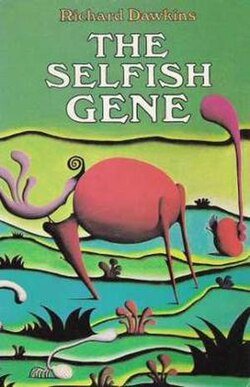
Why Read The Selfish Gene?
The Selfish Gene is the most conceptually transformative popular science book published since Darwin’s On the Origin of Species — a work that did not discover new facts about evolution but permanently changed the conceptual framework through which biology understands it, by shifting the unit of natural selection from the organism to the gene. Published in 1976, it has sold over a million copies, been named the most influential science book ever written in multiple surveys, and introduced to public consciousness not only a new way of understanding evolution but an entirely new concept — the “meme” — that has become one of the defining terms of digital culture.
The book’s central argument is deceptively simple: natural selection does not act primarily on individual organisms, groups, or species, but on genes — the self-replicating units of genetic information that use organisms as vehicles for their own propagation. From the gene’s perspective (a metaphor Dawkins is careful to qualify as such), individual organisms are survival machines — elaborate biological robots constructed by genes to carry them through time. This perspective transforms what evolution is understood to be optimising, with radical consequences for how we explain the evolution of altruism, cooperation, sexual reproduction, ageing, and ultimately human culture itself.
The book was written as an accessible synthesis of gene-centred evolutionary theory developed in technical papers by W.D. Hamilton, George C. Williams, Robert Trivers, and John Maynard Smith. Dawkins’s achievement was to synthesise these technical developments into a unified conceptual framework and to communicate it with a rhetorical clarity and biological richness that transformed public understanding of evolutionary theory.
Who Should Read This
This is a book for anyone who wants to understand what evolution by natural selection actually is and what it actually explains — not the simplified textbook version in which organisms compete for survival, but the gene-centred view that explains the evolution of altruism, cooperation, deception, sex, ageing, and conflict within families. Essential for advanced science students who want the most influential popular synthesis of gene-centred evolutionary theory; students of biology, psychology, and social science who want the theoretical foundation of evolutionary approaches to behaviour; CAT/GRE aspirants who need advanced-level conceptual biology prose; and any reader who has wondered how natural selection produces both the ruthlessness of predation and the selflessness of parental love.
Key Takeaways from The Selfish Gene
Natural selection acts primarily on genes — the self-replicating units of genetic information — not on individual organisms, groups, or species. Organisms are best understood as survival machines built by genes to carry them through time. This gene-centred perspective transforms what we understand evolution to be optimising, with radical consequences for the evolution of behaviour.
Altruism evolves readily when the beneficiary shares genes with the actor (kin selection: Hamilton’s rule states altruism evolves when cost to actor < benefit × genetic relatedness) and through reciprocal altruism among non-relatives. The apparent paradox of altruism dissolves when selection is viewed at the level of the gene rather than the organism.
The “extended phenotype” — the principle that the effects of genes extend beyond the organism to influence the wider world — is one of the book’s most original concepts. A beaver’s dam, a cuckoo’s manipulation of its host’s behaviour, a bowerbird’s elaborate construction: the world is shaped by genetic competition at scales far beyond the individual organism.
The meme — defined by Dawkins as a unit of cultural information that propagates by copying from mind to mind — is the book’s most culturally influential concept and its most speculative. Cultural evolution might be understood as an analogue of genetic evolution, with memes as the self-replicating units subject to selection, mutation, and differential propagation.
Key Ideas in The Selfish Gene
The book’s central argument begins with the origin of life — the emergence of the first self-replicating molecules in the primordial soup — as the starting point for understanding what evolution is. The key property of these original replicators was not life in any complex sense but the capacity to make copies of themselves. Once self-replication existed, competition between replicating variants began automatically: variants that copied more accurately, more rapidly, or more durably proliferated at the expense of those that did not. Natural selection is not a theory about organisms competing for survival; it is a theory about self-replicating information competing for persistence and proliferation.
The conceptual heart of the book is the argument that genes — the modern replicators — are the units on which natural selection primarily acts, because genes are what are copied across generations while organisms are not. When a parent reproduces, their genome is not copied whole — it is recombined and partially transmitted. The genes that persist are those that built organisms successful at reproduction, and the gene-centred perspective asks: what properties would a gene need to have to be good at persisting? The answer — building organisms that are effective survival machines — generates the entire theory of organismal design through natural selection.
The chapters on altruism are the most practically important in the book. Hamilton’s concept of inclusive fitness — that an organism’s evolutionary success is measured not just by its own reproduction but by the reproduction of relatives, weighted by genetic relatedness — explains why parents sacrifice for children, why siblings sometimes cooperate and sometimes compete, and why the degree of relatedness in animal societies correlates with the degree of cooperative behaviour. Hamilton’s rule — altruism evolves when cost to actor < benefit to recipient × relatedness — is one of the most elegant and productive equations in the history of biology.
The meme chapter is the book’s most controversial and most culturally generative. Dawkins proposed that just as genes are the self-replicating units of biological information, memes might be the self-replicating units of cultural information subject to an analogous selection process. Ideas, melodies, fashions, and religious beliefs propagate by copying from mind to mind; those better at copying — more catchy, more memorable, more emotionally compelling — proliferate at the expense of those that are not. Whether this analogy is scientifically productive or merely metaphorical has been debated since 1976, but the concept proved enormously generative.
Core Frameworks in The Selfish Gene
Dawkins develops six interlocking frameworks that together constitute the gene-centred view of evolution — the most influential conceptual synthesis in the history of popular science.
The argument begins with the logic of replication: once self-replicating molecules existed, competition between variants began automatically, with more accurate, more durable, and more proliferating replicators increasing in frequency at the expense of others. In modern organisms, genes are the replicators — the entities actually copied across generations — while organisms are the vehicles that genes construct to carry them. This perspective does not deny that organisms exist or matter; it reframes what natural selection is “trying” to maximise. From the gene’s eye view, a gene that builds organisms good at reproducing will spread; a gene that builds organisms which sacrifice themselves for relatives will spread if the benefit to shared genes in those relatives exceeds the cost. The gene-centred perspective thus transforms altruism from an embarrassment for evolutionary theory into one of its most powerful explanatory tools.
W.D. Hamilton’s concept of inclusive fitness — the principle that an organism’s evolutionary success includes its effect on the reproduction of relatives, weighted by their degree of genetic relatedness — provides the mathematical framework. Hamilton’s rule states that altruism evolves when the benefit to the recipient (B) multiplied by the degree of genetic relatedness between actor and recipient (r) exceeds the cost to the actor (C): rB > C. From the gene’s perspective, a gene for altruism can spread if it helps copies of itself in relatives to survive and reproduce. This simple rule explains the evolution of parental care, sibling cooperation, the extraordinary sociality of bees, wasps, and ants, and the precise limits of altruism — why it declines with genetic distance.
An evolutionarily stable strategy (ESS) is a strategy that, when adopted by most members of a population, cannot be invaded by any alternative strategy — because any rare mutant adopting the alternative would do worse than the majority. The ESS concept transforms the question of animal behaviour from “what is the optimal strategy?” to “what strategy would be stable across evolutionary time?” The famous Hawk-Dove game shows how populations can stabilise at mixtures of strategies — some individuals always escalating conflict, others always retreating — because the ESS is a mixed strategy that no mutant can improve on. Tit-for-tat (cooperate on the first move, then copy the opponent’s previous move) turns out to be an ESS for repeated-game interactions, explaining how cooperation between non-relatives can evolve through reciprocal altruism.
Reciprocal altruism — the strategy of cooperating with those who have previously cooperated with you and refusing to cooperate with those who have cheated — can evolve in populations of individuals who interact repeatedly and can recognise and remember each other. The key conditions are: the possibility of repeated interaction (so that the future value of cooperation can be cashed in), the ability to identify and remember individuals, and the ability to condition behaviour on the other’s history. When these conditions are met, cooperators can do better than defectors in the long run, even though each individual is acting in its genetic self-interest. Robert Axelrod’s computer tournaments, described in the book, showed that tit-for-tat was the most successful strategy in iterated Prisoner’s Dilemma competitions, providing a clean demonstration of how cooperation can emerge from self-interest.
The conventional phenotype is the set of physical and behavioural characteristics that a gene influences in the organism that carries it. The extended phenotype is the full set of effects that a gene has on the world — including effects on other organisms and on the physical environment. A beaver’s dam is the extended phenotype of beaver genes affecting dam-building behaviour; a cuckoo chick’s distinctive call is the extended phenotype of cuckoo genes manipulating the host parent’s feeding behaviour; the elaborate structures built by male bowerbirds are the extended phenotypes of genes in both the male (which determines construction behaviour) and the female (which determines aesthetic preferences). The extended phenotype concept connects the gene-centred view of evolution to the full range of ways in which genes interact with the world beyond individual organisms.
Dawkins observes that cultural transmission — the copying of ideas, behaviours, fashions, and beliefs from person to person — shares the key properties of genetic transmission: self-replication, heredity (transmitted units resemble their parents), and variation (copying is imperfect, generating variants). If cultural variants that are better at propagating through minds — more memorable, more emotionally compelling, more useful — spread at the expense of less propagable variants, then something analogous to natural selection operates on cultural information. The question of whether this analogy is scientifically productive — whether memes are real, discrete, heritable units subject to measurable selection — remains contested. Dawkins himself was careful to present the concept speculatively; Susan Blackmore’s The Meme Machine (1999) provides the most rigorous scientific development.
Core Arguments
Four arguments give the book its scientific originality and its enduring philosophical significance.
The book’s central scientific argument — that natural selection acts primarily at the level of the gene rather than the organism, group, or species — is presented as both more accurate and more explanatorily powerful than its alternatives. The organism-level view cannot explain the evolution of altruism without invoking group selection (which Dawkins, following Williams and Maynard Smith, argues is generally weak and rarely effective). The gene-level view explains altruism naturally and precisely through Hamilton’s rule. The argument is not primarily empirical but conceptual: the gene-centred view provides a framework that is simultaneously more precise, more parsimonious, and more explanatorily productive than its alternatives.
The book’s most philosophically consequential argument is that what appears to be genuine altruism at the organism level — parental sacrifice, sibling cooperation, reciprocal help between friends — is genetic self-interest at the gene level. This does not mean that altruism is “really” selfish in any morally significant sense — genes do not have interests or intentions, and the organisms that express altruistic behaviour may do so genuinely and unconditionally. But the evolutionary origin of altruistic tendencies is genetic self-interest, and the circumstances under which altruism evolves are precisely predicted by the logic of genetic relatedness and reciprocity. Dawkins is careful to note that this evolutionary explanation does not determine how humans should behave.
One of the book’s most important and most frequently overlooked arguments — made in the concluding pages — is that human beings are uniquely capable of acting against their genetic programming. Genes build organisms through evolutionary processes that operated over millions of years, instilling behavioural tendencies optimised for ancestral environments. But humans, with large brains and a capacity for foresight, deliberation, and cultural learning, can understand their genetic programming and choose to act against it. Contraception is the paradigm example: it represents the deliberate defeat of the reproductive imperatives that genes “want” to promote. As Dawkins concludes: “We are built as gene machines… but we have the power to turn against our creators.”
The meme chapter’s central argument is that human cultural evolution — the spread of ideas, technologies, religious beliefs, and behavioural practices through imitation and teaching — operates on principles analogous to genetic evolution, and that understanding it as such is both scientifically productive and practically important. The observation that cultural information spreads through populations in ways that can be analysed in evolutionary terms — asking which cultural variants are better or worse at propagating and why — has been productive in anthropology, cognitive science, and cultural studies. The argument that cultural evolution is to some extent independent of genetic evolution — that memes can spread because they are good at spreading, rather than because they benefit the genes of the people who carry them — is the basis for understanding religious belief, ideology, and cultural norms in evolutionary terms.
Critical Analysis
A balanced assessment of the most conceptually influential popular science book of the 20th century — its genuine achievements and its real limitations.
Dawkins’s prose is the clearest in the history of popular science writing — precise without being technical, rich with analogy and example, and never condescending. The gene-centred view of evolution is genuinely counterintuitive, and communicating it to readers without scientific background requires both conceptual precision and rhetorical skill that Dawkins deploys with extraordinary consistency.
The book’s synthesis of Hamilton’s kin selection theory, Trivers’s reciprocal altruism and parental investment theory, and Maynard Smith’s evolutionary game theory into a single gene-centred framework transformed the landscape of behavioural biology and established the theoretical foundations of what became evolutionary psychology. This synthesis was not just popularisation — it was genuine intellectual integration.
Whatever its scientific status, the concept of the meme has been extraordinarily generative — in cognitive science, cultural studies, the philosophy of religion, and popular culture. It introduced a way of thinking about cultural transmission that had not previously existed in accessible form, and its cultural influence has been immense.
The gene-centred view is the most explanatorily productive framework available for understanding the evolution of behaviour — but it is a framework, not an exclusive scientific truth. Dawkins sometimes writes as if organism-level and group-level descriptions of evolution are simply wrong rather than alternative descriptions at different levels. Philosophers of biology like Elliott Sober and David Sloan Wilson have made substantive arguments for multi-level selection that the book’s framing does not fully engage.
The meme concept is explicitly speculative in the original book, but it has often been received as if it were as well-established as the kin selection theory that precedes it. Unlike genes, memes are not discrete, countable, or reliably measurable units, and the selection pressures acting on them are difficult to identify with the precision that genetic selection theory requires.
The molecular genetics of 1976 — before the genomics revolution, before epigenetics, before the discovery of the extent of non-coding DNA — is significantly more complex today. The book’s treatment of genes as discrete, well-defined units of inheritance has been complicated by the discovery that many traits are influenced by complex networks of interacting genetic and non-genetic factors.
Impact & Legacy
Publishing Landmark: The Selfish Gene was published in 1976 and has never been out of print. A 30th anniversary edition (2006) and a 40th anniversary edition (2016) both appeared with new introductions by Dawkins reflecting on the book’s reception and the subsequent development of its ideas. It has sold over a million copies, been translated into twenty-five languages, and been named the most influential science book of all time in multiple surveys, including a Royal Institution poll in 2017. It is consistently cited alongside Darwin’s On the Origin of Species and Watson and Crick’s paper on the structure of DNA as one of the most important texts in the history of biology.
Scientific Impact: The book’s scientific impact was to make the gene-centred view of evolution the dominant framework in behavioural biology and evolutionary psychology. Hamilton’s rule, reciprocal altruism, and evolutionary game theory — all synthesised and made accessible by the book — became the foundational theoretical toolkit of sociobiology and its successor disciplines. The theoretical framework the book established underlies the entire field of evolutionary psychology and continues to generate empirical research programs in animal behaviour, social behaviour, and cultural evolution.
Cultural Impact: The book’s cultural impact is more difficult to measure but clearly enormous. The meme concept alone has had an influence on cultural discourse far beyond what any single scientific concept from a popular science book could reasonably be expected to achieve. The phrase “selfish gene” entered the cultural vocabulary as a shorthand for a particular — often oversimplified — view of evolution that Dawkins spent the succeeding decades arguing was a misreading. The book’s influence on the public understanding of evolution, on the philosophy of religion, and on human self-understanding as products of natural selection has been immense.
For Competitive Exam Preparation: The Selfish Gene is advanced-level reading comprehension in conceptual science prose. Its consistent movement between abstract theoretical principles and concrete biological examples, its use of analogy and thought experiment to make counterintuitive ideas accessible, and its habit of drawing philosophical implications from scientific arguments all provide direct practice for the analytical reading skills — tracking complex argumentation, identifying premises and their implications, evaluating the scope of a claim — that the most demanding CAT and GRE science passages require.
Love This Book? Master Every Book.
Stop struggling with reading comprehension. Our proven system transforms how you read—whether for CAT, GRE, GMAT, SAT, or personal growth.
Best Quotes from The Selfish Gene
We are survival machines — robot vehicles blindly programmed to preserve the selfish molecules known as genes.
Let us try to teach generosity and altruism, because we are born selfish.
We are built as gene machines and cultured as meme machines, but we have the power to turn against our creators.
A gene for altruistic behaviour means any gene that influences the development of nervous systems in such a way as to make them behave altruistically.
The total amount of suffering per year in the natural world is beyond all decent contemplation. During the minute it takes me to compose this sentence, thousands of animals are being eaten alive; others are running for their lives, whimpering with fear; others are being slowly devoured from within by rasping parasites.


Test Your Understanding
Think you’ve mastered The Selfish Gene? Challenge yourself with 15 questions on kin selection, evolutionarily stable strategies, the meme concept, and Dawkins’s core arguments. Score 80%+ to prove your mastery.
The Selfish Gene FAQ
Does “selfish gene” mean that genes make us behave selfishly?
No — and this is the most persistent and most important misreading of the book. The “selfishness” of genes is metaphorical, not literal: it means that genes behave as if they were trying to maximise their own propagation — as if they had interests, even though they do not. A gene that caused its carrier to behave altruistically toward relatives would spread, and is therefore “selfish” in the evolutionary sense. This metaphorical selfishness of genes is entirely consistent with organisms expressing genuinely altruistic behaviour. Dawkins is explicit and emphatic about this: the last chapter makes it clear that we are capable of genuinely kind, cooperative, and altruistic behaviour, and that understanding the evolutionary origins of our behavioural tendencies does not determine how we should behave.
What is kin selection and how does it explain altruism?
Kin selection is the evolutionary process by which genes for altruistic behaviour spread because the altruism benefits individuals who carry the same genes. The key insight is that natural selection is not about individual organisms reproducing but about genes propagating — and a gene can propagate both through the direct reproduction of its carrier and through the reproduction of relatives who carry copies of the same gene. Hamilton’s rule formalises this: a gene for altruism will spread if the cost to the carrier (C) is less than the benefit to the recipient (B) multiplied by the probability that the recipient carries the same gene due to common descent (r, the coefficient of relatedness). Between siblings, r = 0.5; between cousins, r = 0.125. This rule predicts precisely when altruism will and will not evolve, and it has been empirically confirmed across a vast range of animal species.
What is an evolutionarily stable strategy and why does it matter?
An evolutionarily stable strategy (ESS) is a strategy that, when adopted by most members of a population, cannot be invaded by any alternative strategy — because any mutant adopting a different strategy would do worse than the majority. The ESS concept matters because it answers the question “what strategy will evolution produce?” without requiring the assumption that individuals are consciously optimising: evolution produces ESS strategies because any population not at an ESS is vulnerable to invasion by mutants with better strategies. For understanding animal behaviour, the ESS framework predicts the evolution of aggression, display, cooperation, deception, and parental care with a precision that simple optimality arguments cannot achieve.
What is the relationship between The Selfish Gene and The Extended Phenotype?
The Extended Phenotype (1982) is Dawkins’s more technical follow-up, intended for a more specialist audience and developing the most original concept in The Selfish Gene — the extension of phenotypic effects beyond the body of the organism — into a full theoretical framework. If The Selfish Gene argues that genes are the units of selection and organisms are their vehicles, The Extended Phenotype argues that the distinction between organism and environment is less fundamental than it appears: genes influence the world far beyond the bodies of the organisms that carry them. Dawkins has said he regards The Extended Phenotype as his most important scientific contribution; The Selfish Gene is his most important popular contribution. Readers who want the fullest scientific development of the gene-centred view should read both.
How does The Selfish Gene relate to other biology and science books on the Readlite list?
The Selfish Gene provides the theoretical foundation of evolutionary biology that complements and extends the broader scientific literacy provided by A Short History of Nearly Everything (Bryson). Bryson’s book covers the history and scope of all the natural sciences, including a substantial section on evolution; Dawkins provides the theoretical depth on the specific mechanism of natural selection and the gene-centred framework. The Gene (Siddhartha Mukherjee) provides the molecular biology and history of genetics that gives the specific molecular machinery through which genes actually operate — the richness that Dawkins’s more theoretical account does not cover. For students of psychology and human behaviour, The Selfish Gene’s account of kin selection, reciprocal altruism, and evolutionary game theory provides the evolutionary foundations for the behavioural patterns that Thinking, Fast and Slow (Kahneman) documents from an experimental perspective.








