
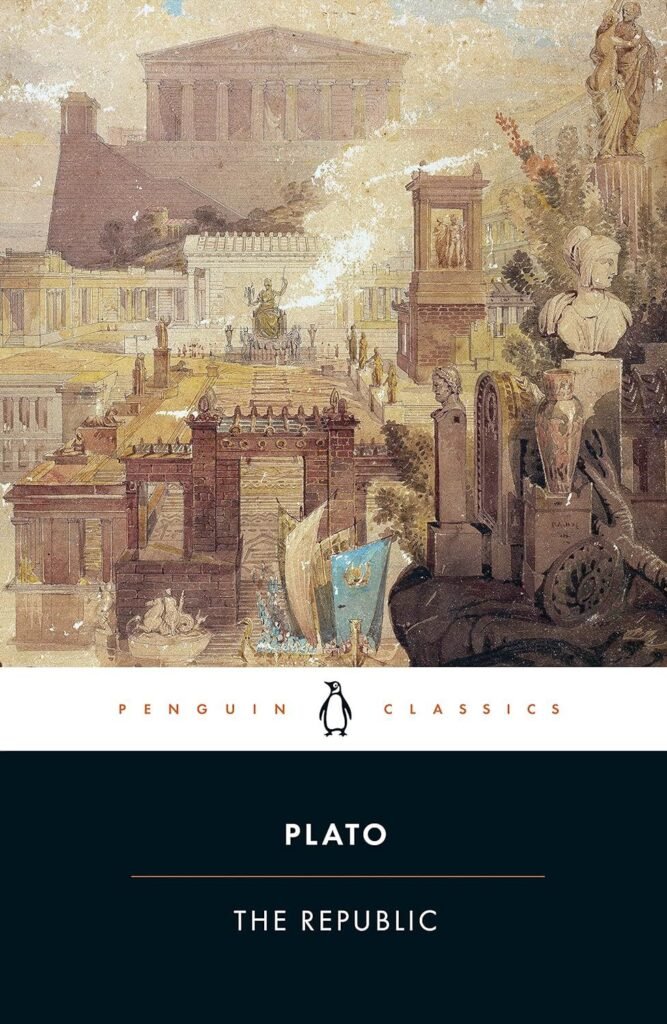
Why Read The Republic?
The Republic is the most important work of philosophy in the Western tradition — the text from which political theory, educational philosophy, epistemology, and the philosophy of art all draw their founding questions. Alfred North Whitehead’s famous observation that the entire history of Western philosophy is “a series of footnotes to Plato” is nowhere more true than here. To read The Republic is not merely to encounter ancient thought — it is to find the source of arguments that are still being made, refuted, and remade in political theory, ethics, and philosophy of mind today.
The Republic is a Socratic dialogue in ten books, set in the Piraeus district of Athens at the house of Cephalus. The question that launches it is deceptively simple: what is justice? To answer it, Socrates — speaking through Plato — constructs an entire imaginary city-state, the Kallipolis, arguing that justice in the individual soul and justice in the political community are structurally analogous and can be understood together. The resulting work encompasses a theory of the soul, a theory of knowledge (the famous Allegory of the Cave), a philosophy of education, a political taxonomy of regimes from aristocracy to tyranny, a theory of art and its dangers, and a vision of the philosopher-king as the only legitimate ruler.
The dialogue form is both the text’s greatest strength and its most significant challenge. The most famous passages — the Allegory of the Cave, the Ship of State, the Myth of Er — are embedded in sustained philosophical argument that requires careful reading to follow. But the reward is extraordinary: The Republic is a text that has never been fully refuted and never been fully accepted, and every serious reader emerges from it with genuinely new questions about justice, knowledge, power, and what it means to live well.
Who Should Read This
This is a book for readers who want to understand where the fundamental arguments of Western civilisation come from — who want to read philosophy at its source rather than in its many subsequent elaborations and critiques. Essential for advanced students of philosophy, political theory, and literature; CAT/GRE/GMAT aspirants who need to master dense argumentative philosophical prose; and anyone who wants to understand the intellectual foundations of Western political thought.
Key Takeaways from The Republic
Justice is not a rule imposed from outside but a condition of internal order — in the soul, reason governing spirit and appetite; in the city, each class performing its proper function. This structural definition of justice as harmony rather than fairness remains a live option in political philosophy today.
The philosopher-king argument — that only those who genuinely know the Good are fit to rule — is simultaneously the most coherent argument for meritocratic governance and the most dangerous, because it licenses any regime that can claim superior knowledge to override those it governs.
The Allegory of the Cave — prisoners mistaking shadows for reality, with the philosopher as the one who escapes into the light — is the foundational image of Western epistemology. Every theory of education, enlightenment, and intellectual liberation since has engaged with this image.
Plato’s analysis of political decline — from aristocracy through timocracy, oligarchy, and democracy to tyranny — traces each regime’s collapse to internal psychological dynamics. Democracy collapses into tyranny precisely through the excess of its defining virtue: freedom.
Key Ideas in The Republic
The Republic opens at the house of Cephalus, where Socrates and his interlocutors begin examining the question of justice. After rejecting several preliminary definitions — justice as paying debts (Cephalus), as helping friends and harming enemies (Polemarchus), as the advantage of the stronger (Thrasymachus) — Socrates proposes to examine justice on a larger scale by constructing an imaginary ideal city, arguing that the city and the soul are structurally analogous. What justice is in the city, it is also in the soul.
The ideal city — the Kallipolis — is organised into three classes: the philosopher-rulers (guardians), the military class (auxiliaries), and the producing class (farmers, craftsmen, merchants). Each class corresponds to a part of the soul: reason, spirit, and appetite respectively. Justice in the city is the condition in which each class performs its proper function without encroaching on the others; justice in the soul is the condition in which reason governs with spirit’s assistance and appetite’s compliance.
The theory of knowledge developed across Books V–VII culminates in the Allegory of the Cave and the Simile of the Divided Line. Plato distinguishes between the visible realm (accessible through perception) and the intelligible realm (accessible through reason). The Form of the Good — the highest object of philosophical knowledge — is what the philosopher-ruler must grasp before being qualified to govern. This Theory of the Forms is the metaphysical foundation of the entire political argument.
Books VIII and IX offer the analysis of political decline: the five regimes (aristocracy, timocracy, oligarchy, democracy, tyranny) and their corresponding soul-types, with each degeneration explained as the consequence of the dominant class’s defining values overreaching into vice. Book X closes with a critique of poetry and the arts and the Myth of Er — a vision of the afterlife that gives the entire argument its ultimate moral stakes.
Core Frameworks in The Republic
Plato builds his argument on six interlocking philosophical frameworks that together constitute the architecture of The Republic.
The soul is divided into reason (philosophical understanding and governance), spirit (ambition, honor, and emotional energy), and appetite (bodily desires). A just person has reason governing, with spirit as its ally and appetite in its proper place — mirroring the three-class structure of the ideal city.
Genuine knowledge has as its objects the eternal, unchanging Forms — abstract universals of which physical things are imperfect copies. The Form of the Good is the highest Form. Only the philosopher who grasps the Good is qualified to govern — making this metaphysical claim the foundation of the entire political argument.
Prisoners chained in a cave since birth see only shadows and mistake them for reality. One escapes into the sunlight, gradually comes to see real objects and the sun itself (the Form of the Good). Returning to free the others, he is blinded and disbelieved. The allegory maps the philosopher’s epistemological journey and political situation.
Four cognitive states correspond to four levels of objects: imagination (shadows and reflections), belief (physical objects), thinking (mathematical objects via hypotheses), and understanding (Forms grasped through pure reason). Only the fourth level constitutes genuine knowledge.
Five regime-types in descending order: aristocracy (rule by the philosophically wise), timocracy (rule by honor-seekers), oligarchy (rule by the wealth-obsessed), democracy (rule by freedom-lovers), and tyranny (rule by the desire-enslaved). Each degenerates into the next when its defining value is pursued to excess.
Plato proposes that citizens be told a founding myth — the “Myth of the Metals” — according to which God mixed gold into the souls of rulers, silver into auxiliaries, and bronze into producers. This deliberate state deception sustains the class structure without requiring philosophical understanding from all citizens, and is one of the most controversial proposals in political philosophy.
Core Arguments
Four major arguments run through The Republic, each as provocative and contested today as when Plato first formulated them.
Plato shifts the question of justice from the external (what rules should I follow?) to the internal (what is the right ordering of my soul?). A just person is one whose reason governs their desires — who does not need to be constrained because they are internally ordered. This internalization of justice makes it a matter of psychological health rather than social compliance, and remains one of the most powerful frameworks in moral philosophy.
The philosopher-king argument rests on an analogy with expertise: just as we want a skilled physician rather than a popular vote to determine our medical treatment, we should want a genuinely wise person rather than a majority vote to govern the community. Logically coherent but politically explosive, this argument has been deeply influential on both authoritarian and progressive political theory throughout history.
Plato’s analysis of democracy — written by a citizen who watched his teacher Socrates executed by democratic vote — argues that its defining virtue is self-undermining. The society that treats all preferences as equally valid produces individuals who cannot prioritise, and from the resulting chaos the strongman emerges who promises order. This argument has been cited in every era of democratic crisis since.
Plato’s critique of poetry and art in Book X argues that art imitates appearances (already one step removed from reality) and appeals to appetite and spirit rather than reason, reinforcing emotional responses rather than cultivating rational judgement. This argument established the terms of the debate about art’s moral function that continues through Aristotle’s defense of tragedy and contemporary debates about media effects.
Critical Analysis
A balanced assessment examining the extraordinary intellectual achievement of The Republic alongside its genuine philosophical and political difficulties.
The Republic simultaneously establishes the central problems of political philosophy, epistemology, philosophy of mind, and aesthetics — a breadth of intellectual achievement that no subsequent single work has matched.
Plato’s use of Socratic dialogue allows arguments to develop through genuine dialectical pressure — interlocutors push back, raise objections, and force refinements in ways that expose vulnerabilities more honestly than a treatise would allow.
The Allegory of the Cave, the Ship of State, the Myth of Er — these images capture genuine philosophical problems in forms that survive translation across cultural contexts and millennia, losing nothing essential in the transit.
The ideal city Plato constructs is, by any modern standard, a totalitarian state — censorship of art, strict class hierarchy, prohibition of private family life for the guardian class, and governance by an unelected philosophical elite. Readers must grapple with the fact that its most rigorous arguments lead to deeply troubling political conclusions.
Socrates’ interlocutors are often implausibly compliant — accepting conclusions that require much stronger objections — and the dialogue form occasionally allows Plato to elide genuine difficulties through rhetorical momentum rather than genuine resolution.
The Republic assumes rather than argues for the existence of the Forms — the metaphysical foundation of the entire political argument is not established within the text but taken as given. Readers unconvinced that abstract universals have a higher reality than physical particulars will find the central argument built on an undefended premise.
Literary & Cultural Impact
The Most Influential Text in Western Intellectual Culture: The Republic’s direct impact on political thought runs through the entire tradition: Aristotle’s Politics is an extended engagement with and critique of Platonic political philosophy; Augustine’s City of God adapts the structure of the Kallipolis for Christian theology; More’s Utopia, Rousseau’s Social Contract, and Marx’s communist vision all engage — consciously or not — with the Platonic project of imagining a perfectly just community. The philosopher-king argument specifically has been invoked to justify everything from Enlightenment technocracy to 20th-century authoritarian planning.
Epistemology and Philosophy of Mind: The Allegory of the Cave and the Theory of Forms established the distinction between appearance and reality, opinion and knowledge, that has structured Western philosophy from Aristotle through Descartes, Kant, and into contemporary analytic and continental philosophy. The question of whether there are mind-independent abstract objects — mathematical entities, universals, moral facts — is still actively debated, and every position in that debate is defined in relation to Plato’s original formulation.
For Competitive Exam Preparation: The Republic is the most demanding philosophical text on the Readlite list. Its argumentative density, dialectical structure, and the gap between what Socrates appears to be saying and what Plato intends require precisely the kind of active, inferential reading that the hardest GRE and CAT passages demand. Familiarity with its central arguments — justice as internal order, the philosopher-king, the Cave — is directly useful as these ideas appear frequently as the conceptual basis for exam reading passages in philosophy and political theory.
Love This Book? Master Every Book.
Stop struggling with reading comprehension. Our proven system transforms how you read—whether for CAT, GRE, GMAT, SAT, or personal growth.
Best Quotes from The Republic
The price good men pay for indifference to public affairs is to be ruled by evil men.
The heaviest penalty for declining to rule is to be ruled by someone inferior to yourself.
Ignorance is the root and stem of every evil.
Wise men speak because they have something to say; fools because they have to say something.
We can easily forgive a child who is afraid of the dark; the real tragedy of life is when men are afraid of the light.
Test Your Understanding
Think you’ve mastered The Republic? Challenge yourself with 15 questions on key arguments, the Allegory of the Cave, and Plato’s political philosophy. Score 80%+ to prove your mastery.
The Republic FAQ
What is The Republic about?
The Republic is a Socratic dialogue in which Plato, writing through the character of Socrates, attempts to define justice by constructing an imaginary ideal city-state. In doing so, the text develops a comprehensive theory of the soul, a political taxonomy of regime-types from aristocracy to tyranny, a theory of knowledge culminating in the Allegory of the Cave, a philosophy of education, a critique of art and poetry, and a vision of the philosopher-king as the only legitimate ruler. It is simultaneously a work of political philosophy, epistemology, psychology, and ethics.
Is The Republic difficult to read?
The text is rated Advanced and is genuinely demanding — not primarily because of its vocabulary but because of its argumentative density and dialectical structure. Plato’s arguments develop through question and answer across ten books, with significant digressions and returns, and the most important moves are sometimes made quietly rather than announced. A good translation and a willingness to read slowly, re-reading key passages, are essential. Many readers find it helpful to read alongside a commentary.
Why does Plato expel the poets from his ideal city?
Plato argues in Book X that poetry and art imitate appearances (already one step removed from reality) rather than engaging with truth, and that they appeal to the emotional and appetitive parts of the soul rather than reason. In doing so, they reinforce the very parts of the psyche that philosophy tries to discipline. In the ideal city, where rational governance is the goal, art that excites emotion and bypasses reason is therefore dangerous to the social order. Aristotle’s defense of tragedy in the Poetics is a direct response to this argument.
Which translation of The Republic is recommended?
For general readers, G.M.A. Grube’s translation revised by C.D.C. Reeve (Hackett Publishing) is widely recommended as the most readable while remaining philosophically accurate. Allan Bloom’s translation (Basic Books) is more literal and includes an extensive interpretive essay. Robin Waterfield’s translation (Oxford World’s Classics) is excellent for readers who want strong introductory material. The Benjamin Jowett translation (19th century) is freely available online but its Victorian prose style can obscure Plato’s directness.
Why does The Republic matter today?
The Republic matters today because it poses questions about justice, governance, knowledge, and the good life that have not been definitively answered. Plato’s critique of democracy — that freedom without wisdom produces chaos that invites tyranny — is as uncomfortable and as relevant as it has ever been. His argument about who should govern, and who gets to certify that knowledge, sits at the center of contemporary debates about expertise, technocracy, and democratic legitimacy. And the Allegory of the Cave remains the most powerful single image for the experience of intellectual awakening and the social resistance it provokes.








