
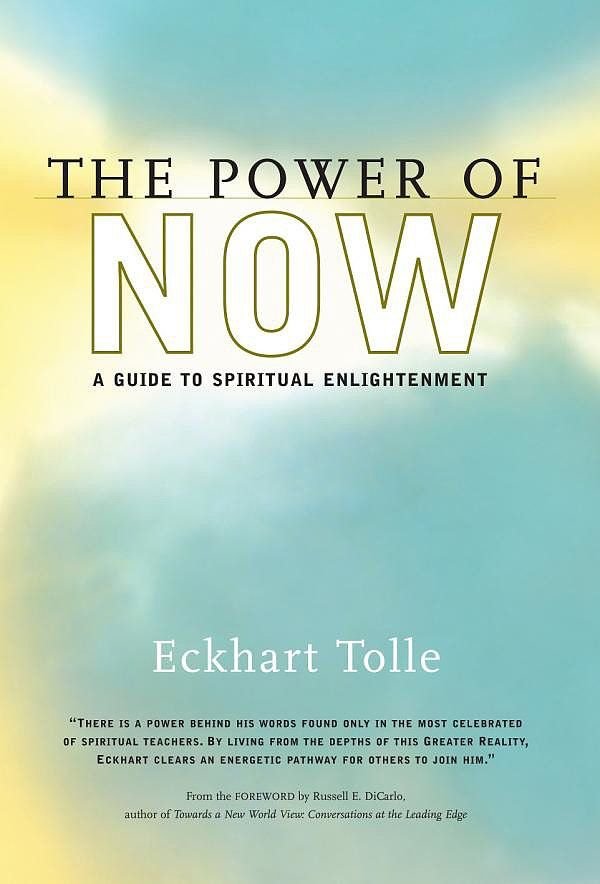
The Power of Now
Watch Prashant Sir break down Tolle’s most radical idea — that you are not your thoughts, that the present moment is the only place life actually occurs, and why this ancient teaching has transformed millions of modern lives.
Why Read The Power of Now?
The Power of Now is the most unusual book in the self-help genre — unusual because it does not offer techniques to improve your life but a fundamental shift in how you experience it. Eckhart Tolle’s central claim is not that you need better habits, clearer goals, or more productive routines. It is that almost all human suffering is self-generated by a mind that cannot stop thinking about the past or the future — and that the liberation from that suffering is available, completely and immediately, in the present moment. This is an ancient idea. Tolle’s achievement was to make it accessible to a modern secular audience without diluting its radical implications.
The book emerged from Tolle’s own experience of a spontaneous psychological transformation at twenty-nine, when acute depression and despair suddenly dissolved into profound peace. Drawing on Zen Buddhism, Advaita Vedanta, Christian mysticism, and contemporary psychology, he distilled his understanding into a teaching structured as dialogue — Tolle posing questions a reader might ask and answering them, moving progressively deeper into the experience and practice of presence.
The book’s central argument is that the human mind, left to its own devices, runs an almost continuous commentary on experience — judging, planning, remembering, anticipating — and that most people identify so completely with this commentary that they mistake it for who they are. The antidote is not to silence the mind through effort but to recognise that you are the awareness behind the thoughts, not the thoughts themselves. That recognition, even momentary, is what Tolle calls presence.
Who Should Read This
This book is for anyone who has experienced the gap between knowing what would make them happy and being able to rest in that knowledge. CAT and MBA candidates navigating the psychological pressures of high-stakes preparation — the anxiety, comparison with peers, oscillation between confidence and despair — will find in Tolle a framework for understanding those states without being controlled by them. Beyond preparation, it is essential for anyone exploring mindfulness, meditation, or the philosophy of consciousness, and for any reader willing to sit with an idea that is simultaneously simple to state and genuinely difficult to practise.
Key Takeaways from The Power of Now
You are not your thoughts — you are the awareness that observes them. Most human suffering is produced by identifying completely with the stream of thought — taking every worry, every self-critical narrative, every anxious projection as a direct report on reality. The moment you observe a thought rather than merely having it, you have already created the space that is the beginning of freedom.
Psychological time — the mind’s habit of living in past regret or future anxiety — is the primary source of human unhappiness. The present moment is the only place where life actually occurs. To live primarily in psychological time — experiencing the present as merely a means to a future outcome — is to miss the only moment you will ever actually inhabit.
Pain is inevitable; suffering is a choice — specifically, the choice to resist what is. Tolle distinguishes between pain (the unavoidable response to difficult events) and suffering (the additional layer of mental resistance that compounds pain into something far more corrosive). Suffering is produced not by the event but by the mind’s refusal to accept it, and the practice of presence dissolves suffering without requiring the painful event to change.
The “pain-body” — the accumulated emotional pain that lives in the body and feeds on negative thinking — explains why intelligent people cannot simply think their way out of recurring emotional patterns. The pain-body activates negative thinking to sustain itself and cannot be dissolved through more thinking — only through present-moment awareness that observes it without judgment until it releases its hold.
Key Ideas in The Power of Now
Tolle begins with autobiography — the night he woke at three in the morning with the thought “I cannot live with myself any longer” and suddenly noticed something: the thought implied two entities — the “I” that could not live, and the “myself” that was being lived with. If there are two, which one is real? That question — simple to the point of appearing trivial — opened a gap in his identification with his own thinking, and in that gap something fundamental shifted. He describes waking the following morning with a sense of profound peace that he spent the following years attempting to understand and communicate.
The book’s first and most important concept is the thinking mind as distinct from consciousness. Most people are so thoroughly identified with the continuous stream of thoughts in their heads that they cannot conceive of themselves as existing independently of that stream. “I think, therefore I am” — Descartes’s foundational claim — is, in Tolle’s framework, the description of a problem rather than a solution. The identification of the self with the thinking mind is the root condition of human psychological suffering — because the thinking mind, left to its own devices, compulsively generates problems and conflicts that exist nowhere except in its own commentary.
The solution Tolle proposes is not to improve, discipline, or silence the thinking mind — it is to recognise yourself as the awareness behind the mind. The present moment — experienced through sensory attention, the feeling of your own breathing, the simple fact of being alive in this specific moment — is not a thought. It is the awareness within which thoughts occur. When you rest attention in the present moment rather than in the mind’s commentary about the present moment, you discover a stillness that the thinking mind cannot produce and cannot disturb. This is what Tolle means by presence, and it is the book’s central practice.
The concept of psychological time is the book’s most analytically precise contribution. Clock time — the time required to make an appointment, complete a project, plan for the future — is necessary and functional. Psychological time — the mind’s habit of living in the past through regret and memory, and in the future through anticipation and worry — is almost entirely dysfunctional. The mind that uses the present moment only as a means to a future end is the mind that never actually arrives. It is always heading somewhere, planning the next thing, recalling the last, and the present — the only place where experience actually occurs — is perpetually passed through rather than inhabited.
Core Frameworks in The Power of Now
Tolle builds five interlocking frameworks — from the foundational mind-awareness distinction through psychological time, the pain-body, surrender, and the inner body — each pointing toward the same recognition from a different angle and together constituting a complete map of present-moment practice for a contemporary reader.
Core Arguments
Tolle advances four interconnected arguments — about the mind as master versus tool, about suffering as resistance rather than circumstance, about the present as the only point of access to genuine power, and about the relationship between presence and emotion — each illuminating the central teaching from a different direction.
Tolle’s central philosophical argument is that the relationship most people have with their thinking mind is inverted — the mind, which should be a tool used consciously for specific purposes, has become the master, running continuously and generating an experience of reality that is largely a mental construction rather than direct experience. The liberation Tolle describes is not the achievement of a better mental state — it is the recognition that you are not your mental state, and that the awareness within which mental states occur is stable, peaceful, and unaffected by their content. This is not a new idea — it is the core of most contemplative traditions — but Tolle articulates it in language accessible to people with no prior exposure to those traditions, which is why the book reached an audience that had never engaged with Zen or Vedanta.
Tolle’s most psychologically sophisticated argument concerns the relationship between events and suffering. He does not claim that difficult events are not difficult — loss, pain, failure, and grief are real. His argument is that the suffering produced by difficult events is amplified — often to a degree that dwarfs the event itself — by the mind’s resistance to those events: the insistence that they should not be happening, the narrative of victimhood and injustice, the perpetual revisiting of the past to find where it went wrong. Accepting present-moment reality — “this is what is happening” — does not mean pretending it is good; it means removing the additional suffering that resistance produces, leaving only the irreducible pain of the event itself, which is almost always more bearable than the mind’s commentary on it.
Tolle’s most counter-intuitive argument concerns effectiveness. Most people assume that concern about the future — planning, worrying, anticipating — produces better outcomes than present-moment presence. Tolle argues the opposite: the quality of action taken from a state of present-moment awareness is consistently higher than the quality of action taken from a state of mental time-travel, because presence brings clarity, creativity, and full attention to the task, while psychological time brings anxiety, distortion, and the contamination of past patterns. The person who is fully present makes better decisions, builds better relationships, and produces better work — not because they are more disciplined but because they are actually here.
Tolle distinguishes between feelings — which arise from present-moment experience and pass naturally when allowed to — and emotions — which are thoughts plus physical sensations, often generated by the mind’s time-travel rather than by actual present events. Most human emotional suffering is not a response to what is actually happening but to what the mind is saying about what is happening, or what it predicts will happen, or what it remembers having happened. Presence does not eliminate feeling — it often deepens genuine feeling by removing the mind’s interference. What it eliminates is the compulsive, cyclical emotional suffering produced by thought-generated narrative — the kind that keeps people awake at 3 AM rehearsing conversations that have not yet happened.
Critical Analysis
A balanced assessment examining the book’s conceptual accessibility, the effectiveness of its dialogue format, and the practical utility of the pain-body concept alongside the privilege of stillness problem, its repetitive structure, and the inherent unfalsifiability of its experiential claims.
Tolle manages to communicate teachings that are genuinely ancient and philosophically deep in language that requires no prior exposure to contemplative traditions. The Zen concept of present-moment awareness, the Advaita Vedanta teaching of witness consciousness, the Christian mystical tradition of the eternal now — all are present in the book, distilled into language that a contemporary secular reader can engage without cultural or religious translation.
The book’s question-and-answer structure is one of its most effective formal choices. By anticipating and responding to the objections and confusions the material predictably generates — “But I need to think about the future,” “Isn’t acceptance the same as resignation?” — Tolle makes the book self-correcting in a way that a conventional expository text cannot be. The format also mirrors the contemplative teacher-student relationship that the book’s content describes.
Whatever its precise metaphysical status, the pain-body concept is one of the most practically useful frameworks in the book for explaining why emotional suffering often operates independently of rational understanding. The observation that we cannot think our way out of emotional patterns that are not primarily cognitive is psychologically accurate and clinically supported by contemporary trauma research, even if Tolle’s framework is not itself clinical.
Tolle’s prescription — be present, accept what is, release resistance — is more accessible to people with baseline safety, physical comfort, and psychological stability than to those navigating genuine structural deprivation, trauma, or oppression. The teaching that suffering is primarily produced by mental resistance rather than circumstances is psychologically sophisticated in many contexts and insufficient in others. The book does not engage with this limitation.
The book’s dialogue format, while effective, produces significant repetition — the same core insights articulated in slightly different language across multiple chapters. Readers who grasp the central teaching early may find the later chapters redundant. The book is best approached non-linearly, spending time with the sections that resonate and moving past those that do not.
The book’s central claims about the nature of consciousness and the relationship between awareness and thought are not empirically testable in the conventional sense. This means the reader’s relationship to the book is necessarily one of resonance and practice rather than evidence and argument. Readers who require the latter will find the book unsatisfying; those willing to test its claims through direct experience will often find them accurate.
Literary & Cultural Impact
From Self-Published to Global Phenomenon: The Power of Now was initially self-published in Canada in 1997, rejected by every major publisher on the grounds that it was too spiritual for a secular audience and too secular for a spiritual one. It sold slowly through word of mouth until 2000, when Oprah Winfrey cited it as one of the most important books she had ever read. Within months it had become an international bestseller — eventually selling over 8 million copies in English and over 20 million in more than 30 languages, translated into 52 languages. It remained on the New York Times bestseller list for years.
The Mainstreaming of Mindfulness: The book’s cultural impact extended well beyond the self-help genre. It contributed significantly to the mainstreaming of mindfulness — the practice of present-moment awareness — in Western culture during the 2000s, a mainstreaming that eventually produced the clinical mindfulness tradition (Jon Kabat-Zinn’s MBSR programme), the corporate mindfulness industry, and the proliferation of meditation apps. Tolle did not create mindfulness — he communicated an ancient teaching to a contemporary audience — but his book was one of the primary vehicles through which that teaching reached millions who would not have encountered it through traditional religious or contemplative channels.
A New Earth and the Oprah Phenomenon: A New Earth (2005), Tolle’s follow-up, sold even more copies after Oprah selected it for her book club in 2008 and conducted an online reading group that attracted 35 million viewers — at the time the largest such event in internet history. Tolle became one of the most widely read spiritual teachers in the world, regularly appearing on lists of the most influential people in spiritual and self-help culture.
The Vocabulary It Provided: The book’s most significant long-term contribution may be the conceptual vocabulary it provided for experiences that many people had but no mainstream language to describe: the sense that one’s own thinking mind is a source of suffering rather than a resource, the recognition of awareness as distinct from thought, the specific relief of dropping out of psychological time into present-moment experience. For many readers, The Power of Now provided the first coherent explanation of why practices like meditation, yoga, and contemplative prayer had the effects they had — and why those effects could not be produced by the thinking mind alone, however disciplined or well-intentioned.
Love This Book? Master Every Book.
Stop struggling with reading comprehension. Our proven system transforms how you read—whether for CAT, GRE, GMAT, SAT, or personal growth.
Best Quotes from The Power of Now
Realize deeply that the present moment is all you ever have. Make the Now the primary focus of your life.
The primary cause of unhappiness is never the situation but your thoughts about it.
You find peace not by rearranging the circumstances of your life, but by realising who you are at the deepest level.
Wherever you are, be there totally. If you find your here and now intolerable and it makes you unhappy, you have three choices: remove yourself from the situation, change it, or accept it totally.
The mind is a superb instrument if used rightly. Used wrongly, however, it becomes very destructive. To put it more accurately, it is not so much that you use your mind wrongly — you usually don’t use it at all. It uses you.
Test Your Understanding
Think you’ve mastered The Power of Now? Challenge yourself with 15 questions on the thinking mind vs. awareness, psychological time, the pain-body, surrender and acceptance, and the inner body practice. Score 80%+ to prove your mastery.
The Power of Now FAQ
What is The Power of Now about?
It argues that almost all human psychological suffering is generated by a thinking mind that cannot stop living in the past or the future — and that the liberation from that suffering is available, completely and immediately, in the present moment. The book teaches the distinction between the thinking mind and the awareness behind those thoughts — and argues that recognising yourself as the latter rather than the former is the fundamental shift that produces lasting psychological peace.
Is it useful for competitive exam preparation like CAT or GRE?
Not as a preparation methodology — but as a framework for managing the psychological pressures that preparation generates, it is directly applicable. The anxiety, comparison, and oscillation between confidence and despair that characterise competitive preparation are all products of the thinking mind’s time-travel: living in imagined future scenarios rather than in the present task. The ability to return attention to the work at hand — to study from presence rather than from anxiety — is both more effective and more sustainable than study conducted in a state of chronic psychological pressure.
What are the main ideas in the book?
The central ideas are: the distinction between the thinking mind and the awareness that observes it; psychological time as the primary source of human suffering; the pain-body as the accumulation of unresolved emotional pain that feeds on negative thinking; surrender and acceptance as the active, conscious non-resistance to present-moment reality; and the inner body as an immediately accessible anchor for present-moment awareness. These ideas are presented not as a system to be understood but as a teaching to be experienced — the book’s value is in its capacity to produce direct recognition rather than intellectual agreement.
Is the book spiritual or secular?
Both and neither. Tolle draws on Zen Buddhism, Advaita Vedanta, Christian mysticism, and contemporary psychology without being exclusively any of these. The book does not require belief in any religion, metaphysical system, or concept of God — its claims can be tested through direct experience rather than through faith. At the same time, it is not secular in the scientific-materialist sense — it makes claims about the nature of consciousness that are not reducible to neuroscience. It occupies the space that contemplative traditions have always occupied: beyond conventional religion, beyond conventional secularism, pointing toward an experience that neither framework fully captures.
Why does the book have both passionate advocates and strong critics?
Because it makes a claim that is simultaneously very simple and very radical: that the primary source of human suffering is the thinking mind itself, and that liberation is available in the present moment. For readers who encounter this as a recognition — a description of something they have already glimpsed — the book is transformative. For readers who approach it as an intellectual argument to be evaluated, the circular, experiential quality of its claims can feel unsatisfying or unfalsifiable. The book is for anyone willing to test its claims through direct experience rather than through logical analysis — and that is precisely the subset of readers who tend to find it most useful.








