
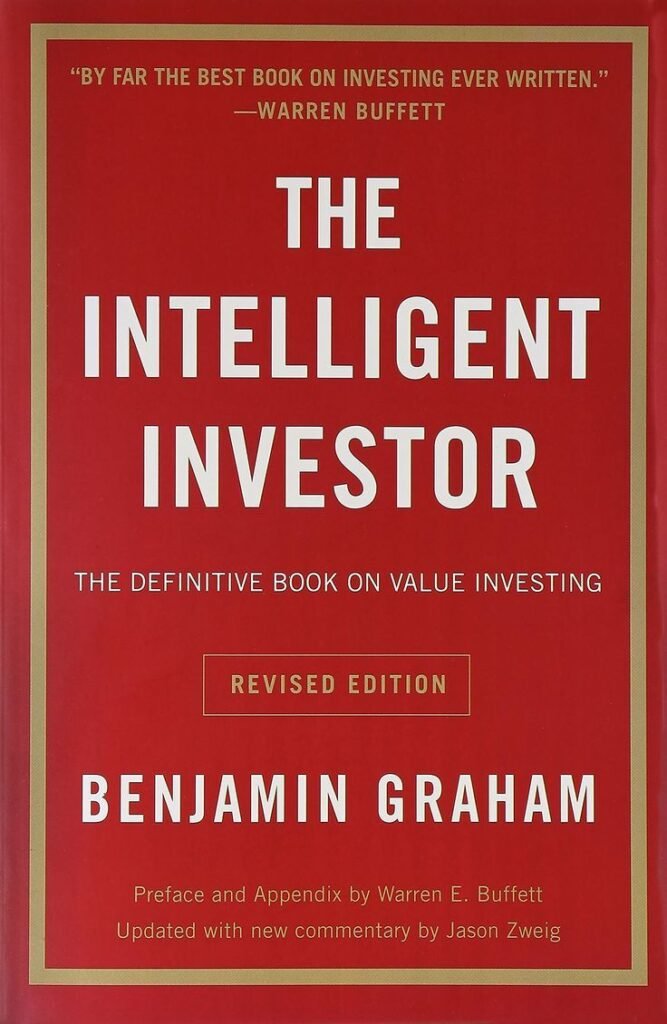
Why Read The Intelligent Investor?
The Intelligent Investor is the most important book ever written about investing for the individual. Benjamin Graham — economist, professor, and the father of value investing — spent a career demonstrating that the stock market is not a machine for generating wealth but a machine for transferring it from the impatient to the patient, and this book is the distillation of that lifetime’s work into a framework that has never been superseded.
First published in 1949 and revised through four editions, the book’s central argument is deceptively simple: the intelligent investor is not one who correctly predicts the future, but one who insists on a margin of safety, distinguishes between investment and speculation, and maintains emotional discipline in the face of market irrationality. Graham’s framework — built on the concepts of Mr. Market, intrinsic value, and the margin of safety — gave Warren Buffett, the world’s most successful investor, his entire intellectual foundation. Buffett has called it “by far the best book on investing ever written.”
What makes the book both demanding and rewarding is that Graham refuses to make investing simple. He insists that it is an activity requiring intellectual rigor, emotional self-awareness, and genuine business understanding — not tips, not charts, not the latest market narrative. For competitive exam aspirants, the book is valuable not only for its financial content (economics and finance passages appear regularly in CAT and GMAT RC sections) but as a model of sustained analytical argument built on evidence, qualification, and honest acknowledgment of uncertainty.
Who Should Read This
The Intelligent Investor is essential for anyone who invests, plans to invest, or wants to understand how financial markets actually work as opposed to how they are popularly portrayed. It is particularly valuable for MBA and finance students, for CAT and GMAT aspirants encountering economics and financial reasoning passages, and for any serious reader who wants to understand the intellectual foundation of the world’s most successful investment philosophy. Best read with Jason Zweig’s updated commentary (the 2003 revised edition), which connects Graham’s principles to contemporary market events.
Key Takeaways from The Intelligent Investor
The most important distinction in investing is between investment and speculation. An investment operation is one which, upon thorough analysis, promises safety of principal and an adequate return; everything else is speculation. Most of what retail investors do — buying stocks because they’ve been going up, following tips, trading on news — is speculation dressed in investment’s clothing, and the difference matters enormously over time.
Mr. Market is Graham’s most enduring metaphor: imagine a business partner who shows up every day offering to buy your shares or sell you his, at prices that swing wildly based on his emotional state. The intelligent investor uses Mr. Market rather than following him — buying when his prices are irrationally low and ignoring him when they are irrationally high. The market is a servant, not a guide.
The margin of safety is the central principle of intelligent investing: never pay a price for an asset that doesn’t leave substantial room for error in your analysis, in the business’s performance, or in market conditions. Buying a dollar’s worth of value for fifty cents means that even if you’re wrong about the business, wrong about the timing, or wrong about the market, you may still come out intact.
Emotional discipline is the investor’s most critical skill — more important than intelligence, more important than analytical ability, more important than market knowledge. Graham demonstrates that the primary reason individual investors underperform is not lack of information but the inability to control fear and greed: buying at peaks because everyone else is excited, selling at troughs because everyone else is panicking.
Key Ideas in The Intelligent Investor
Graham opens by drawing the sharpest possible line between investment and speculation — a distinction he considers foundational and that most financial commentary deliberately blurs. An investment is grounded in analysis, provides safety of principal, and offers an adequate return. Speculation is everything else: buying on the hope of price appreciation, trading on momentum, following the crowd into fashionable sectors. Graham is not moralistic about speculation — he acknowledges that speculative profits are possible — but insists that the speculator must know what they are doing, and that most people who think they are investing are in fact speculating without knowing it.
The book’s intellectual architecture rests on three interlocking concepts. Intrinsic value is the actual worth of a business, determined by its assets, earnings power, dividends, and prospects — a number that exists independently of whatever price the market currently assigns to it. Mr. Market is Graham’s parable for the stock market as a whole: an emotionally volatile business partner whose daily price offers should be used opportunistically rather than followed slavishly. Margin of safety is the gap between intrinsic value and purchase price — the cushion that protects the investor when their analysis proves imperfect, which it inevitably will.
Graham distinguishes between two types of intelligent investors: the defensive investor, who seeks primarily to avoid serious mistakes and significant losses and is willing to accept adequate returns in exchange for minimal effort and anxiety; and the enterprising investor, who is willing and able to devote serious time and energy to security analysis and can expect a better-than-average return as compensation. Most individual investors should be defensive investors — but many convince themselves they are enterprising investors and expose themselves to risks they cannot properly evaluate.
The book’s later sections — on stock selection, bond selection, portfolio policy, and the analysis of financial statements — are technically demanding and in some particulars dated. But the underlying analytical principles — look for earnings stability, adequate financial strength, a history of dividends, and a price-to-earnings ratio that leaves room for error — have been validated repeatedly by the track records of investors who followed them, most famously Warren Buffett, who studied under Graham at Columbia Business School.
Core Frameworks
Graham builds his entire investment philosophy on six interlocking frameworks — each one a practical tool for making decisions in an uncertain, emotionally driven market.
Graham defines investment as an operation that, upon thorough analysis, promises safety of principal and an adequate return. Anything that fails to meet all three criteria — thorough analysis, safety of principal, adequate return — is speculation. This framework immediately classifies most popular market activity (momentum trading, IPO chasing, speculative buying) as speculation, regardless of how it is labeled, and forces the investor to be honest about what they are actually doing.
Graham asks the reader to imagine owning a share in a private business with a partner named Mr. Market, who appears every day with an offer to buy your interest or sell you his — at prices that vary wildly based on his mood. When Mr. Market is euphoric, his prices are high; when he is despairing, his prices are low. The intelligent investor uses these price swings rather than being guided by them: buy from Mr. Market when he is irrationally depressed, sell to him when he is irrationally exuberant, and ignore him the rest of the time.
No analysis of a business is perfectly accurate; no forecast of the future is reliable; no market prediction is trustworthy. The margin of safety is the cushion between an asset’s intrinsic value and the price paid for it — the gap that allows the investor to be wrong about specific assumptions and still come out intact. The larger the margin of safety, the more errors in judgment or prediction can be absorbed without permanent loss of capital. Graham presents this as the single most important concept in intelligent investing.
The defensive investor seeks primarily to avoid serious mistakes and preserve capital, accepting average returns in exchange for minimum effort — typically achieved through a simple portfolio of high-grade bonds and diversified common stocks. The enterprising investor devotes significant time to security analysis and expects better-than-average returns as compensation. Graham insists that most people should be defensive investors, and that the primary mistake of amateur investors is to think they are enterprising when they are not.
Intrinsic value is what a business is actually worth — based on its assets, earnings power, dividends, growth prospects, and management quality — independent of the current market price. When the market price of a stock falls significantly below its intrinsic value (due to Mr. Market’s irrationality, temporary difficulties, or general panic), an investment opportunity with a margin of safety exists. The central activity of value investing is the disciplined analysis required to estimate intrinsic value accurately enough to identify these gaps.
Graham recommends specific quantitative criteria for defensive stock selection: adequate company size, strong financial condition (current ratio above 2, long-term debt not exceeding working capital), earnings stability (no deficit in the past ten years), an uninterrupted dividend record of at least twenty years, earnings growth, a moderate price-to-earnings ratio (not more than 15x average three-year earnings), and a moderate price-to-assets ratio. Together these criteria create a systematic filter that identifies companies selling below intrinsic value with a margin of safety built in.
Core Arguments
Graham builds four sustained arguments — empirical, psychological, macroeconomic, and epistemological — that together explain why intelligent investing is both possible and rare.
Graham’s foundational empirical argument — supported by decades of market data — is that stock prices regularly diverge from intrinsic business value, sometimes dramatically and for extended periods. This divergence occurs because markets are driven by fear, greed, fashion, and narrative in the short term, even though they tend to converge toward value in the long term. The investor who understands this distinction can profit from it; the investor who believes market price equals fair value at all times will consistently overpay at peaks and panic at troughs.
One of the book’s most psychologically sophisticated arguments is that investment performance is undermined not primarily by bad information or analytical error but by emotional self-sabotage. Graham documents how individual investors systematically buy at market peaks (when prices are high and euphoria is contagious) and sell at market troughs (when prices are low and panic is overwhelming) — precisely the opposite of rational behavior. The solution is not more information or better analysis but the construction of rules, habits, and commitments that override emotional impulses at the moments when they are most powerful.
Graham devotes significant attention to the risk of inflation — the systematic erosion of purchasing power that affects both bonds (whose fixed returns lose real value as prices rise) and stocks (which provide partial but imperfect protection). He argues that a mixed portfolio of stocks and bonds, rebalanced mechanically rather than based on market views, is the most reliable approach for most investors to manage this risk over long periods. This argument — written in the 1940s and 1970s — has been repeatedly vindicated by subsequent inflationary episodes.
The book’s deepest investment argument is epistemological: the long-term earning power and asset value of a well-understood business can be estimated with reasonable accuracy; the short-term direction of the stock market cannot. This asymmetry has a practical implication — focus analytical energy on understanding businesses rather than predicting markets, and set a purchase price (incorporating a margin of safety) that makes the analysis work even if the market moves in the wrong direction for years. This is the intellectual foundation of the “buy and hold” approach to value investing that Buffett has practised for seven decades.
Critical Analysis
A balanced assessment of the most influential investment book ever written — examining its extraordinary intellectual achievements alongside its genuine limitations.
The book provides the most rigorous and complete theoretical framework for intelligent investing ever assembled in popular form — every major concept in value investing (margin of safety, Mr. Market, intrinsic value, the investment/speculation distinction) originates here and has been validated by the track records of investors who followed it.
Unlike most investment books, which promise superior returns through superior analysis, Graham is unflinching about the psychological difficulty of investing intelligently — acknowledging that emotional discipline is harder than analytical ability and that most investors, including sophisticated ones, routinely fail to maintain it.
The specific securities Graham discusses are dated, but the principles — buy below intrinsic value, insist on a margin of safety, ignore Mr. Market’s mood swings, match strategy to temperament — have been validated across every market cycle from the Great Depression to the 2020 pandemic crash.
Written primarily in the 1940s through 1970s, the specific market examples, securities, and quantitative thresholds Graham discusses reflect a very different market environment — lower valuations, simpler financial instruments, less institutional dominance — and require translation for contemporary application.
The book assumes comfort with financial statements, accounting concepts, and basic securities analysis — readers without this background will find the middle sections opaque without supplementary reading, making it less accessible than its reputation suggests.
Graham’s framework is calibrated for capital preservation and adequate returns, not wealth maximization. Investors who followed it strictly would have avoided many great growth stocks (Amazon, Google, Apple at various points) because their prices never offered the margin of safety Graham required — pointing to a genuine tension between value discipline and participation in transformational business growth.
Legacy & Cultural Impact
The Book That Made Warren Buffett: The Intelligent Investor is the most influential investment book ever written — a claim that its most famous admirer, Warren Buffett, has made explicitly and repeatedly. Buffett read it at nineteen, studied under Graham at Columbia, worked for Graham’s investment partnership, and has described the book’s framework as the intellectual foundation of his entire career. The world’s most successful investor, with a 60-year track record that has no parallel in financial history, credits this book as his primary source. That is an endorsement without equal in any field.
The Foundation of Value Investing: The book’s influence extends far beyond Buffett. The entire tradition of value investing — practised by investors including Charlie Munger, Seth Klarman, Joel Greenblatt, and thousands of others — traces its lineage directly to Graham’s framework. The concept of the margin of safety has become the closest thing to a universal principle in serious investment practice. Mr. Market has become standard vocabulary for anyone discussing the psychology of market participation. Graham’s distinction between investment and speculation, though routinely ignored in practice, provides the critical framework that every subsequent serious investment writer has built on or argued with.
Relevance for Exam Aspirants and MBA Candidates: For competitive exam aspirants, The Intelligent Investor serves multiple purposes. Finance and economics passages in CAT and GMAT reading comprehension frequently involve concepts — market efficiency, intrinsic value, risk and return, behavioral finance — that Graham’s framework illuminates directly. MBA candidates who can discuss Graham’s ideas fluently in finance interviews and personal statements demonstrate a seriousness about the field that most applicants, who know Buffett’s name but not his intellectual sources, cannot match. Reading it is an investment in intellectual capital with a compounding return.
Love This Book? Master Every Book.
Stop struggling with reading comprehension. Our proven system transforms how you read—whether for CAT, GRE, GMAT, SAT, or personal growth.
Best Quotes from The Intelligent Investor
The intelligent investor is a realist who sells to optimists and buys from pessimists.
The investor’s chief problem — and even his worst enemy — is likely to be himself.
In the short run, the market is a voting machine but in the long run, it is a weighing machine.
The margin of safety is always dependent on the price paid. It will be large at one price, small at some higher price, nonexistent at some still higher price.
Investing isn’t about beating others at their game. It’s about controlling yourself at your own game.


Test Your Understanding
Think you’ve mastered The Intelligent Investor? Challenge yourself with 15 questions on Graham’s frameworks, core principles, and key arguments. Score 80%+ to prove your mastery.
The Intelligent Investor FAQ
What is The Intelligent Investor about?
The Intelligent Investor is Benjamin Graham’s definitive guide to the philosophy and practice of value investing — the approach to financial markets that prioritizes buying undervalued assets with a margin of safety over speculating on price movements. Its central arguments are that the market is regularly irrational (Mr. Market), that intrinsic business value can be estimated independently of market price, and that emotional discipline is the investor’s most important skill.
How difficult is The Intelligent Investor to read?
It is rated Advanced — conceptually demanding, technically detailed in places, and written with the assumption that the reader is prepared to think carefully about financial concepts. The 2003 revised edition, with commentary by Jason Zweig, is significantly more accessible because Zweig translates Graham’s examples into contemporary equivalents. Readers without any background in financial statements will want to supplement with introductory accounting reading before tackling the middle sections.
What is the margin of safety?
The margin of safety is Graham’s central investing principle: the difference between an asset’s estimated intrinsic value and the price paid for it. Buying a business worth ₹100 for ₹60 provides a 40% margin of safety — meaning the analysis can be substantially wrong and the investor can still come out intact. The larger the margin of safety, the more errors the investor can absorb. Graham presents it as the single most important concept in intelligent investing and the primary defense against uncertainty and analytical error.
What is the Mr. Market metaphor?
Mr. Market is Graham’s parable for the stock market: imagine a business partner who shows up every day with a price at which he’ll buy your shares or sell you his. His prices swing wildly based on his emotional state — irrationally high when he’s euphoric, irrationally low when he’s despairing. The intelligent investor uses Mr. Market’s emotional extremes rather than being guided by them, buying when his prices are irrationally depressed and selling when they are irrationally elevated. The market is a tool, not an authority.
Why should I read The Intelligent Investor today?
Because the psychological and philosophical errors Graham describes — buying on euphoria, selling on panic, confusing speculation with investment, ignoring intrinsic value in favour of price momentum — are as common and as costly today as they were in 1949. The specific market conditions have changed; the human tendencies that produce irrational market behavior have not. Every major market bubble and crash since Graham wrote — the dot-com crash, the 2008 financial crisis, the 2021 speculative frenzy — has confirmed his framework.








