
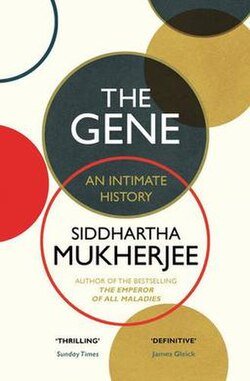
Why Read The Gene: An Intimate History?
The Gene: An Intimate History is the most complete and most humanly engaging account of the history and science of genetics ever written for a general audience — a 608-page narrative tracing the concept of the gene from Gregor Mendel’s pea plant experiments through Watson and Crick’s double helix, the Human Genome Project, and CRISPR-Cas9, all against the deeply personal backdrop of Mukherjee’s own family’s history of severe mental illness.
Siddhartha Mukherjee is an oncologist, cancer biologist, and Pulitzer Prize-winning science writer whose previous book The Emperor of All Maladies: A Biography of Cancer established him as one of the most important science writers of his generation. The Gene is both more scientifically comprehensive and more personally intimate than its predecessor — organised as a chronological narrative of specific people, experiments, and conceptual breakthroughs, interrupted at crucial moments by personal reflections on what the science means for his own family and for the choices genetic knowledge now forces on individuals and societies.
The book’s range is extraordinary: it covers Mendel’s laws of inheritance, the eugenics catastrophe, the discovery of DNA’s structure, the genetic code, the molecular biology revolution, the Human Genome Project, epigenetics, and CRISPR. At every stage, Mukherjee asks not only “how did we discover this?” but “what does it mean?” — for medicine, for identity, for the concept of the self, and for the ethics of human intervention in the genetic substrate of life.
Who Should Read This
This is a book for anyone who wants to understand what the gene is, how we discovered it, and what our growing power to read and rewrite the genetic code means for human beings and human society. Essential for advanced science and biology students who want the most comprehensive narrative history of genetics, medical students and healthcare professionals seeking the scientific and ethical context for genomic medicine, CAT/GRE aspirants who need advanced-level science narrative prose, and any thoughtful reader who recognises that the genetics revolution is transforming medicine, agriculture, and the concept of human identity.
Key Takeaways from The Gene
The gene is not a simple blueprint for a trait — there is no single gene “for” intelligence, sexual orientation, or schizophrenia. A gene is a DNA sequence encoding a protein whose effects depend on which other genes are active, what developmental stage the organism is in, and what environmental signals it has received. The gap between “having a gene” and “expressing a trait” contains most of the complexity of biological development.
The history of genetics is inseparable from the history of eugenics. American programs forcibly sterilised tens of thousands of people deemed “unfit”; Nazi race science drew explicitly on these precedents to justify mass murder. This history is not a cautionary tale about misuse by bad actors — it is a warning that the science and the misapplication were intertwined from the beginning, demanding permanent ethical vigilance.
CRISPR-Cas9, developed between 2012 and 2015 by Jennifer Doudna, Emmanuelle Charpentier, and Feng Zhang, has transformed biology by making it possible to edit specific sequences in any genome with unprecedented precision, speed, and affordability. The ability to correct disease-causing mutations — and potentially to edit human embryos — represents the most significant expansion of human power over the biological substrate of life since the discovery of DNA’s structure.
Mental illness has a significant genetic component, but the genetics are extraordinarily complex — dozens to hundreds of variants, each contributing a small risk increment, interact with developmental and environmental factors. The genes associated with schizophrenia are often the same genes that confer cognitive creativity when expressed differently. Genetic selection against mental illness involves genuine trade-offs between preventing suffering and eliminating human diversity.
Key Ideas in The Gene
The book opens not with Mendel’s monastery but with Mukherjee’s own family — specifically, his visits to two relatives in Calcutta who suffered from severe mental illness (one diagnosed with schizophrenia, one with bipolar disorder), and the questions these visits raised for him as both a scientist and a family member: What is the nature of the genetic inheritance at work in his family? What would it mean to carry the potential for a condition you cannot observe in yourself? What would it mean to know — or to eliminate — that genetic risk? This personal opening is not decoration but the book’s emotional and ethical core: it is why the history that follows is not merely intellectual but urgent.
The Mendel chapters are among the most precise popular accounts of the foundation experiments of genetics. Mendel’s insight — that inherited traits are transmitted as discrete units that do not blend or dilute but remain intact through generations, appearing and disappearing in predictable ratios — was revolutionary precisely because it was counterintuitive. His results, published in 1866, were ignored for thirty-five years before being rediscovered simultaneously by three different biologists in 1900.
The Watson-Crick-Franklin chapter is handled with careful balance: acknowledging Watson and Crick’s intellectual achievement in deducing the double helix structure, the critical importance of Rosalind Franklin’s X-ray crystallography data (particularly the famous Photo 51), and the contested question of how Watson and Crick gained access to Franklin’s data without her knowledge or consent. Mukherjee gives the Franklin controversy more weight than Watson’s own account and more nuance than purely revisionist accounts.
The eugenics chapters are the book’s most important and most disturbing. Mukherjee documents American eugenics programs — the forced sterilisation laws, the Buck v. Bell Supreme Court decision (1927) — and the explicit connections between American eugenics and Nazi race science. The argument is not that genetics leads inevitably to eugenics, but that the history cannot be understood without acknowledging how thoroughly the two were intertwined in the first half of the 20th century.
Core Frameworks in The Gene
Mukherjee builds his history of genetics on six interlocking frameworks — from Mendel’s foundational experiments to CRISPR’s ethical challenges — that together constitute the most complete account of how we came to understand the molecular basis of heredity.
Core Arguments
Mukherjee advances four interconnected arguments — about genetic determinism, the relationship between science and eugenics, post-genomic complexity, and the ethical obligations created by CRISPR — that together constitute the book’s moral and intellectual vision.
The book’s central argument is that the gene is simultaneously the most explanatory concept in biology and the most dangerous, because its power to explain has been consistently overestimated in ways that have caused serious harm. From eugenics to genetic determinism to the misleading popular genetics of genes “for” intelligence or sexual orientation, the gap between what genes actually do (encode proteins whose effects depend on developmental and environmental context) and what they are popularly believed to do (determine traits directly and inevitably) has generated dangerous misconceptions. Understanding the gene accurately — including its complexity and context-dependence — is not just scientifically important but ethically essential.
One of the book’s most important and most uncomfortable arguments is that eugenics was not a fringe misapplication of genetics by a few bad actors but a mainstream scientific project endorsed by leading geneticists, funded by major philanthropic institutions, and applied in law by democratic governments — and that the Nazi application of eugenic principles was not an aberration but an amplification of practices already established in the United States. This history demands not just acknowledgment but ongoing vigilance: every significant expansion of genetic power creates new opportunities for the replication of eugenic logic in new forms.
The Human Genome Project was expected to produce a map of genes explaining most of human biology and disease; what it produced was a map of extraordinary complexity that has made simple genetic determinism impossible to sustain. The small number of genes, the vast regulatory complexity, the importance of epigenetics, the polygenic architecture of most complex traits, and the pervasive gene-environment interaction have all shown that the relationship between genotype and phenotype is far more complex than early molecular genetics assumed. This complexity is not discouraging but illuminating: it shows that the gene is not a blueprint but an instruction set whose execution depends entirely on the context in which it operates.
The book’s most practically urgent argument is that the expansion of human power to edit the genetic substrate of life creates ethical obligations requiring the engagement of society at large — not just the scientific community. The specific questions — Should germline editing be permitted for severe genetic diseases? For genetic risk factors? For non-disease traits? Who decides, and on what basis? — cannot be answered by genetic science alone, because they involve values about human flourishing, the rights of future persons, and the definition of disease that extend beyond what science can determine. The He Jiankui case demonstrates what happens when that public engagement is absent.
Critical Analysis
A balanced assessment examining the book’s extraordinary strengths as a work of science narrative alongside the genuine demands it places on readers and the limitations of its most recent sections.
The book’s most distinctive and effective feature is the interweaving of genetics history with Mukherjee’s personal family history of mental illness. This integration gives every scientific development its human weight and stakes, and grounds the ethical arguments in specific human experiences rather than abstract principles. No other history of genetics available to a general audience achieves this combination of scientific rigour and personal urgency.
At 608 pages, The Gene is the most comprehensive account of the history of genetics available to general readers — covering the full arc from Mendel’s monastery to CRISPR with a depth of historical and scientific detail that no shorter account can match. Mukherjee’s research is meticulous, his primary sources are extensive, and his characterisation of the scientists involved gives the history a human texture that purely technical accounts lack.
The book’s engagement with the ethical implications of genetic knowledge — from eugenics to CRISPR embryo editing — is the most rigorous available in popular science writing. Mukherjee does not give easy answers but frames the questions with sufficient precision and historical grounding that readers can engage with them seriously rather than superficially.
At 608 pages and 12 hours of reading, The Gene is a significant commitment, and the depth of historical detail in the earlier sections can feel slow for readers whose primary interest is in contemporary genomics and CRISPR. The book rewards the commitment, but readers should be prepared for a sustained investment.
The interruptions of the scientific narrative with personal reflections are among the book’s most powerful moments — but they can also disrupt the narrative momentum for readers engaged with the scientific history. The integration is skillful but not always seamless.
The most recent science — CRISPR, epigenetics, the post-genomic landscape — is covered with less depth than the historical material, partly because it is more rapidly evolving and harder to present in settled narrative form. Readers who want the fullest account of CRISPR’s development and ethical implications will need to supplement with more recent reading.
Literary & Cultural Impact
Recognition and Reception: The Gene: An Intimate History was published in May 2016 and was immediately recognised as a landmark of popular science writing — a National Book Critics Circle Award finalist, a New York Times Notable Book, and a bestseller in the United States, United Kingdom, and India. It received the PEN/E.O. Wilson Literary Science Writing Award in 2017 and was adapted as a PBS documentary series in 2020. It has sold over a million copies and been translated into over twenty languages.
Public Engagement with Genetics: Published in the year the CRISPR revolution was becoming widely known, the book provided the historical and ethical context for public engagement with gene editing at precisely the moment when that engagement was most needed. Its account of the eugenics movement and its connections to Nazi race science — presented alongside the CRISPR revolution — gave readers the historical grounding to understand why the ethical stakes of gene editing are so high and why institutional safeguards matter.
Mukherjee’s Position as Science Writer: The Gene consolidated Mukherjee’s position as the most important science writer of his generation — the successor to Stephen Jay Gould and Lewis Thomas as a scientist who writes with literary ambition about the deepest questions in biology. His combination of scientific authority (MD from Harvard Medical School, DPhil from Oxford, practising oncologist at Columbia) and literary skill (Pulitzer Prize for The Emperor of All Maladies) makes him uniquely equipped to write about genetics with both accuracy and human depth.
For Exam Preparation: The Gene is advanced-level reading comprehension in science narrative prose of the highest quality. Its consistent movement between historical narrative, scientific explanation, personal reflection, and ethical argument provides practice for the most demanding form of analytical reading that CAT and GRE passages require: tracking a complex multi-level argument, distinguishing the evidential from the argumentative, and evaluating ethical claims that depend on scientific premises.
Love This Book? Master Every Book.
Stop struggling with reading comprehension. Our proven system transforms how you read—whether for CAT, GRE, GMAT, SAT, or personal growth.
Best Quotes from The Gene
Genes, after all, do not merely specify proteins. They specify the possibility of a self.
We have discovered the grammar of heredity, but we are only beginning to understand its language.
The history of the gene is inextricably linked with the history of eugenics — the attempt to use genetic knowledge to improve the human race. We cannot understand one without the other.
A genome is not a blueprint for an organism. It is an instruction manual for making proteins whose actions in context produce an organism.
The question is not whether we will edit human genes, but whether we will do so wisely.



Test Your Understanding
Think you’ve mastered The Gene? Challenge yourself with 15 questions on Mendel’s laws, the double helix, the eugenics catastrophe, CRISPR, and the post-genomic landscape. Score 80%+ to prove your mastery.
The Gene FAQ
What is the difference between a gene, a genome, and DNA?
DNA (deoxyribonucleic acid) is the molecule that carries genetic information — a long chain of four chemical units (nucleotides: adenine, thymine, guanine, and cytosine) whose sequence encodes the instructions for making proteins. A gene is a specific functional segment of DNA encoding a specific protein or RNA molecule. The genome is the complete DNA content of an organism — the full set of all genes and all non-coding sequences, organised into chromosomes. The human genome contains approximately 3 billion base pairs of DNA, organised into 23 pairs of chromosomes, encoding approximately 20,000–25,000 protein-coding genes along with a much larger amount of regulatory DNA, non-coding RNA genes, and sequences of still-unclear function. Understanding these distinctions is essential for following contemporary discussions of genetics, genomics, and gene editing.
What is epigenetics and why does it matter?
Epigenetics refers to heritable changes in gene expression — which genes are turned on and which are turned off — that do not involve changes in the DNA sequence itself. The mechanisms include DNA methylation (the addition of methyl groups to specific bases, generally silencing gene expression), histone modification (chemical modifications of the proteins around which DNA is wound, affecting how accessible it is to the cellular reading machinery), and non-coding RNA regulation. Epigenetic marks can be influenced by environmental factors such as diet and stress, and can in some cases be transmitted to offspring. Epigenetics explains how different cell types (neurons, liver cells, muscle cells) can have the same DNA but radically different structures and functions, and it complicates simple genetic determinism by showing that the same DNA sequence can have very different effects depending on its epigenetic state.
How does The Gene handle the controversy over Rosalind Franklin’s contribution to the discovery of DNA’s structure?
Mukherjee handles the Franklin controversy with more care and balance than most popular accounts. He acknowledges Watson and Crick’s intellectual achievement while giving full weight to Rosalind Franklin’s contribution: her X-ray crystallography produced the structural data — particularly Photo 51 — that was critical to Watson and Crick’s model. He documents that Watson and Crick gained access to Franklin’s data through Max Perutz without her knowledge, and that Franklin was not informed her data had been shared. He does not adjudicate definitively whether this constitutes scientific theft, but he gives the question the weight it deserves and presents Franklin’s work with the respect that Watson’s memoir famously denied her.
What is CRISPR and should we be worried about it?
CRISPR-Cas9 is a gene-editing technology derived from a bacterial immune system that allows scientists to cut any specific sequence in any genome with unprecedented precision. It has already transformed research biology and is producing the first clinical successes in gene therapy for diseases like sickle cell anaemia and beta-thalassaemia. Whether to be worried depends on which applications are being considered. Somatic gene therapy — editing a living patient’s cells to treat a disease — is straightforwardly beneficial when it works. Germline editing — editing human embryos to create heritable changes passed to all descendants — raises far more serious ethical questions about consent (future persons cannot consent to being edited), genetic diversity, equity of access, and the definition of disease. Mukherjee’s answer is that CRISPR requires sustained public ethical engagement — and the He Jiankui case demonstrates what happens when that engagement is absent.
How does The Gene relate to The Selfish Gene and The Emperor of All Maladies on the Readlite list?
The three books provide complementary perspectives on the biology of heredity and disease. The Selfish Gene (Dawkins) provides the evolutionary theory of gene-centred natural selection — the argument for why genes are the units of selection and what this means for the evolution of organisms and behaviour. The Gene (Mukherjee) provides the molecular biology and history of genetics — how the gene was discovered, what it is at the molecular level, and what our growing power to read and edit it means. The Emperor of All Maladies (Mukherjee’s previous book) provides the oncology application — how cancer is understood as a disease of genetic mutation. The recommended reading sequence for the deepest understanding is The Selfish Gene first (for evolutionary context), then The Gene (for molecular history and ethics), then The Emperor of All Maladies (for medical application).








