
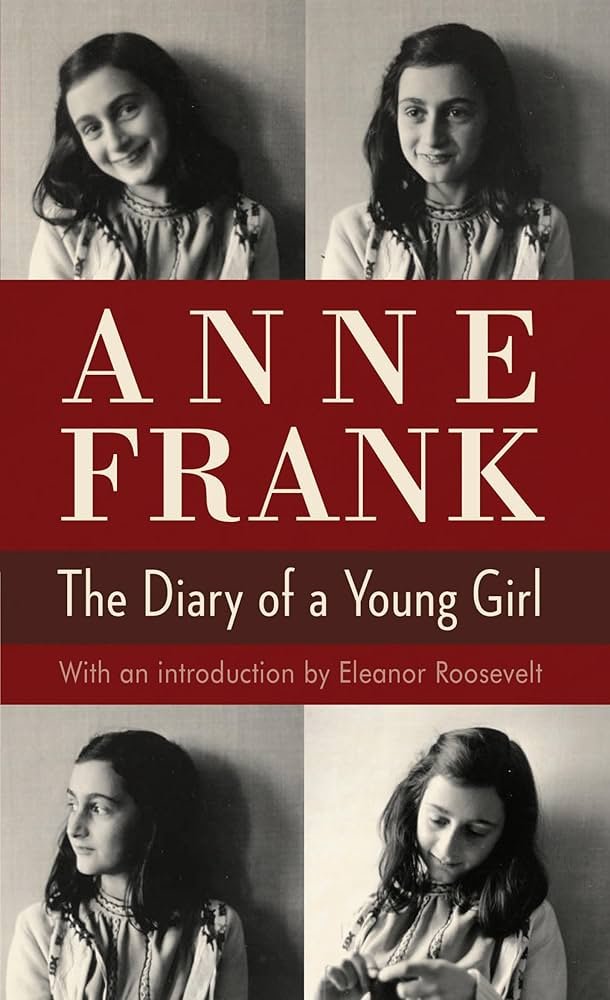
Why Read The Diary of a Young Girl?
The Diary of a Young Girl is the most widely read personal document of the Holocaust and one of the most widely read books in human history — a work that has sold over thirty million copies, been translated into more than seventy languages, and introduced the abstract horror of the Holocaust to millions of readers through the irreplaceable specificity of a single human voice. Anne Frank began her diary on her thirteenth birthday, 12 June 1942, three weeks before her family went into hiding; she wrote her last entry on 1 August 1944, three days before the annex was raided by the Gestapo. She died in Bergen-Belsen concentration camp in February or March 1945, at fifteen or sixteen years old, weeks before the camp was liberated.
The diary is not a record of the Holocaust’s atrocities — Anne Frank, writing in hiding, knew relatively little of what was happening in the camps — but an extraordinarily vivid record of a young person’s inner life under conditions of extreme confinement and mortal danger. Anne writes about her relationships with her mother (tense and often painful), her father (tender and deeply formative), her developing romantic feelings for Peter Van Pels, her ambitions to be a writer after the war, her philosophical reflections on human nature and the possibility of goodness in a world producing such systematic evil.
What makes the diary extraordinary is not primarily its historical significance — though that is immense — but Anne Frank herself: her intelligence, her self-awareness, her wit, her capacity for joy and irritation and love and rage in conditions that might be expected to produce only numbness and despair. The diary is a testament to the resilience of the human spirit not as an abstraction but as a specific, living, irreplaceable personality — which is why its ending, delivered not in the diary itself but in the reader’s knowledge of what happened after the last entry, is among the most devastating in all of literature.
Who Should Read This
A book for every reader — but particularly for young readers encountering the Holocaust for the first time, for whom Anne Frank’s diary provides the most accessible, most humanizing, and most morally illuminating entry point to this history. Essential for students at all levels encountering the Holocaust; CAT/GRE aspirants building elementary-level literary nonfiction reading comprehension; teachers and educators seeking the most effective primary source for Holocaust education; and any reader who wants to encounter history through an individual human voice rather than through institutional narrative.
Key Takeaways from The Diary of a Young Girl
Anne Frank was an extraordinary writer — not merely a diarist recording events but a literary voice of unusual intelligence, wit, and self-awareness who revised her own diary entries with the conscious intention of publication after the war. Her father Otto, the diary’s first editor, had to make difficult choices about what to publish and what to omit from a daughter he had known as a living person rather than a historical subject. The diary we read is not raw private writing but a crafted literary document — which makes it both more and less than it appears.
The Holocaust was not an abstraction or a historical inevitability — it was a sequence of specific decisions, bureaucratic processes, and human acts that destroyed specific human beings who had specific names, families, ambitions, and inner lives. Anne Frank’s diary makes this truth viscerally real in a way that statistics, institutional history, and even survivor testimony cannot always achieve: it gives the Holocaust a face and a voice that the reader knows and loves before knowing the ending, making the loss impossible to receive as an abstraction.
Human consciousness — the capacity for hope, love, irritation, philosophical reflection, romantic longing, literary ambition, and moral questioning — persists even under conditions of extreme confinement and mortal danger. Anne Frank’s diary is a record of an inner life that refused to be entirely defined by its circumstances — that continued to grow, to question, to love, and to aspire even while its author knew that the world outside her hiding place was systematically destroying people like her. This resilience is not heroic in the conventional sense — it is simply human, and that is what makes it extraordinary.
Anne Frank wrote that she still believed, in spite of everything, that people were good at heart. This belief — expressed by a Jewish teenager in hiding from a regime whose explicit purpose was her destruction — is among the most morally complex statements in modern literature. Whether it represents naivety, resilience, or a deliberate philosophical choice in the face of evidence that might justify the opposite conclusion has been debated for eight decades. Its power lies precisely in the tension it maintains between what Anne knew and what she chose to believe.
Key Ideas in The Diary of a Young Girl
The diary covers the period from 12 June 1942, when Anne received it as a birthday gift, to 1 August 1944, her last entry. The Frank family — Otto, Edith, Margot, and Anne — went into hiding on 6 July 1942, following a summons for Margot to report for labour deployment that the family understood to mean deportation and almost certain death. They were joined in the Secret Annex — a concealed set of rooms above Otto Frank’s business at 263 Prinsengracht, Amsterdam — by the Van Pels family and later by Fritz Pfeffer, a dentist. Eight people lived in these sealed rooms for two years and one month, dependent on a small group of non-Jewish employees who brought food, news, and companionship at considerable personal risk.
Anne began the diary in the conventional mode of private journaling, addressing entries to an imaginary friend she named “Kitty.” But as early as 1944 — after hearing a radio broadcast in which the Dutch education minister in exile called for people to preserve documents of wartime experience — she began revising her original entries with the explicit intention of publication after the war. She rewrote and edited many entries, combining the rawness of private diary with the craft of a writer who understood that her words might have a life beyond their immediate occasion. The resulting text is a layered document — simultaneously private confession and conscious literary composition — which is one reason it sustains close reading in a way that purely private diary writing rarely does.
The diary’s most significant relationships are Anne’s with her father (Otto is the person she trusts most and who, she writes, understands her best), with her mother (whom she criticizes with a frankness that became controversial when the full unedited diary was published in the 1990s), and with Peter Van Pels (toward whom she develops a complex romantic attachment that she eventually comes to see, with characteristic self-awareness, as partly a response to loneliness rather than genuine love). The relationship with her mother is the diary’s most uncomfortable and most humanly honest thread — Anne’s adolescent alienation from Edith Frank, and the guilt that awareness of this alienation produces, is one of the diary’s most psychologically truthful passages.
The diary ends not with a dramatic entry but with characteristic introspection. Anne’s final entry, dated 1 August 1944, reflects on the contradiction she feels between her outer self (cheerful, confident, flippant) and her inner self (serious, idealistic, vulnerable) — the gap between the persona she shows the world and the person she knows herself to be. Three days later, on 4 August, the Gestapo raided the annex. Of the eight people in hiding, only Otto Frank survived. Anne and her sister Margot died in Bergen-Belsen in February or March 1945, weeks before the camp’s liberation.
Core Frameworks in The Diary of a Young Girl
Six analytical frameworks illuminate what the diary is, what it documents, and why it has endured — from its literary construction as a document through the inner life under constraint, adolescent development, the Holocaust as individual experience, the moral complexity of hope, and the extraordinary courage of the helpers.
Anne Frank began her diary as private writing addressed to an imaginary friend (“Kitty”) but revised it, from early 1944, with the explicit intention of publication after the war. The result is a layered document in which private confession and literary craft are intertwined. Otto Frank, the first editor, made further selections and omissions — removing some of Anne’s most critical passages about her mother and some explicitly sexual content — motivated partly by discretion and partly by the desire to present his daughter in the most dignified light. The Definitive Edition published in 1991 restored most of the omitted material. Readers should be aware that the diary they read is not raw private writing but a multiply-edited document shaped by Anne’s own literary intentions and her father’s editorial choices.
The physical constraints of life in the Secret Annex were extreme: eight people in a few small rooms for over two years, forbidden to make any sound during business hours, unable to open windows or use running water at certain times, entirely dependent on helpers for food and news, and living with the constant knowledge that discovery meant death. Under these conditions, Anne’s diary documents the persistence of all the normal contents of adolescent inner life — romantic longing, intellectual curiosity, family conflict, friendship, ambition, philosophical questioning — as well as the specifically heightened awareness that comes from knowing one’s life to be in constant danger. The diary makes visible what extreme circumstances do to ordinary human consciousness: not simply traumatize it, but intensify it, focus it, and in some ways clarify it.
Anne Frank was thirteen when she began her diary and fifteen when she stopped writing — the period of life most intensely devoted to the formation of identity and the questioning of authority. The diary records her developing disagreements with her mother (and her guilt about those disagreements), her romantic feelings for Peter Van Pels (and her eventual recognition that those feelings were partly a response to loneliness), her intellectual ambitions (she wanted to be a writer and journalist), her philosophical reflections on human nature, and her growing self-awareness about the gap between her public persona and her inner self. These are universal adolescent experiences — made simultaneously more intense and more poignant by the circumstances in which they unfold.
The Holocaust’s scale — six million Jewish people killed, millions more from other persecuted groups — produces a number that is impossible to grasp as human experience. The diary’s power is to make this impossible number partially graspable by providing one specific human being — with a name, a personality, a voice, relationships, ambitions, and fears — whose destruction the reader can experience as a personal loss rather than a statistical abstraction. This is not the only way to understand the Holocaust, and it has limitations (it focuses on a single, relatively privileged Western European Jewish experience rather than the Eastern European experience that constituted the majority of victims) — but it is the most accessible and most humanizing entry point to the history, which is why the diary has been the most widely used Holocaust education text for eight decades.
Anne Frank wrote on 15 July 1944 — less than three weeks before the annex was raided — that despite everything she still believed that people were good at heart. This statement has been variously interpreted: as a teenager’s naivety about the evil she was facing; as a conscious philosophical choice to maintain hope in the face of evidence that might justify despair; as a statement about the majority of people rather than the perpetrators of genocide; and as a reflection of the specifically Jewish tradition of affirming life even in conditions of its systematic negation. The moral complexity of the statement — the fact that it cannot be simply affirmed or simply dismissed — is itself a measure of Anne Frank’s unusual philosophical maturity. The reader who is moved by the diary and then learns its ending is forced to ask: does what happened to Anne Frank confirm or refute her belief in human goodness?
The eight people in the Secret Annex survived as long as they did because of the sustained courage of a small group of Otto Frank’s employees — Miep Gies, Bep Voskuijl, Johannes Kleiman, and Victor Kugler — who brought food, news, books, and companionship to the annex at daily personal risk. Any of them could have been arrested and deported for what they were doing; they all knew this and continued. Miep Gies, who survived the war, found Anne’s diaries after the raid and preserved them; she later said that she had not read them, out of respect for Anne’s privacy, until after Otto Frank had read and published them. The helpers are not peripheral to the diary’s story but central to it — their courage is the reason the diary exists.
Core Arguments
The diary makes four interconnected implicit arguments about history, human consciousness, and the relationship between individual experience and collective atrocity — arguments that have given it lasting significance beyond its historical moment.
The diary’s most important implicit argument is that the scale of historical atrocity — a number so large it resists comprehension — can be made humanly real through individual experience. Six million is a number that cannot be grieved; Anne Frank can be. This is not a failure of historical imagination but a feature of human psychology: we are constitutionally better equipped to understand and respond to individual experience than to statistical aggregates. The diary exploits this feature of human consciousness to make the Holocaust accessible to readers who would be numbed by the numbers alone — and this accessibility is the reason it has been the most effective Holocaust education document ever created.
The diary’s second great argument — implicit in its persistent engagement with the normal contents of adolescent inner life — is that the experiences of adolescence (the formation of identity, the questioning of parental authority, the first experience of romantic feeling, the development of intellectual ambition) are so fundamental to human development that they persist even under conditions of extreme constraint and mortal danger. This universality is the diary’s most powerful humanizing strategy: the reader who recognizes their own adolescent experience in Anne’s reflections cannot treat her as simply a Holocaust victim, a historical symbol, or a representative of a persecuted people — they are forced to recognize her as a specific human being, irreducibly individual, irreducibly like themselves.
Anne Frank’s diary is evidence for the argument that the historical record of mass atrocity is incomplete without the human record of individual experience, and that the function of diary, memoir, and personal testimony in history is not merely supplementary but essential. The institutional history of the Holocaust — the Wannsee Conference, the railway schedules, the camp records — is necessary but insufficient; the human history — what it felt like, from the inside, to live inside this institutional machinery of destruction — requires a different kind of document and a different kind of reading. Anne Frank’s diary is the most important example of this kind of document in the history of the 20th century.
The diary’s most fundamental historiographical argument is that the ordinary human person, in all their specific complexity, is history’s true subject. The institutional history of the Holocaust tells us how the machinery of genocide worked; the demographic history tells us how many people it killed; the political history tells us how it was organized and who was responsible. Anne Frank’s diary tells us what it cost — in the specific, irreplaceable terms of one human life that was not a statistic, not a representative, not a symbol, but a particular human being with a particular voice that we know and lose. This is the argument that has made the diary one of the most widely read books in human history.
Critical Analysis
A balanced assessment of a document that has introduced the Holocaust to more readers than any other single text — its irreplaceable achievements and the limitations that honest engagement with it requires acknowledging.
Anne Frank’s literary voice — intelligent, witty, self-critical, honest, funny, and capable of philosophical depth unusual for a fifteen-year-old — is the diary’s greatest strength and the reason it has endured for eight decades. It is not the voice of a saint or a symbol; it is the voice of a specific, complicated human being, and that specificity is what makes the diary irreplaceable. No other Holocaust document gives a reader the sustained, intimate relationship with a specific personality that this one does — and it is that relationship that makes the ending devastating rather than merely sad.
The diary documents an unusually rich range of adolescent inner experience — intellectual, emotional, romantic, philosophical, interpersonal — that gives it a depth and complexity unusual in diary writing. Anne Frank was not only recording events but developing as a writer and as a thinker, and the diary records this development with unusual self-awareness. The gap between the diary’s first entries (lively, social, relatively unguarded) and its final entries (philosophically serious, psychologically searching, and characterized by remarkable maturity) documents the development of an extraordinary mind under extraordinary conditions.
For more than eight decades, the diary has been the most effective single document for introducing the Holocaust to readers who have no prior knowledge of it — because it makes the abstract horror of genocide concretely human in a way that no other document achieves. This educational power is inseparable from the specific quality of Anne Frank’s voice and personality: it is because readers come to know and care about Anne as a person that the ending works as it does, making the Holocaust’s cost real rather than statistical.
Anne Frank’s family was a middle-class Western European Jewish family with connections, resources, and a support network that the majority of the Holocaust’s victims did not have. The experience of Jewish people in Eastern Europe — particularly in Poland, where the majority of the six million were murdered — was typically more immediate, more brutal, and far less protected than what the Secret Annex provided. Using the diary as the primary frame for understanding the Holocaust risks producing a skewed picture of what most victims experienced. It should be read alongside other testimonies — particularly those from Eastern European survivors — for a fuller account.
The diary that most readers encounter is not a single authentic document but the product of multiple editorial hands — Anne’s own revisions, Otto Frank’s selections and omissions, and the restoration of omitted material in the 1991 Definitive Edition. Readers who encounter the diary as an unmediated private document are missing an important dimension of its construction. The fact that Anne was deliberately writing for publication — and that her father made specific choices about what to include and exclude — does not diminish the diary but makes it a more complex document than the “raw private writing” that popular understanding often assumes.
The “people are good at heart” passage is so widely quoted that it is often encountered without the context that makes it meaningful — the specific conditions under which it was written, the awareness of those conditions that Anne possessed, and the ending that the reader knows but Anne did not. Encountered without this context, the quotation becomes a platitude; encountered with it, it becomes one of the most morally complex statements in modern literature. The risk of decontextualized quotation is greatest with the passages that are most memorable — which is a reason to read the diary rather than its most famous excerpts.
Impact & Legacy
One of the Most Widely Read Books in Human History: The Diary of a Young Girl was first published in Dutch in 1947 as Het Achterhuis (“The Secret Annex”), edited by Otto Frank from the manuscripts Miep Gies had preserved. It was translated into German and French in 1950, into English in 1952, and has since been translated into over seventy languages and sold more than thirty million copies. It was adapted for the stage in 1955 (winning the Pulitzer Prize for Drama) and for film in 1959. The Anne Frank House in Amsterdam — the building that contained the Secret Annex, preserved as a museum — receives over one million visitors annually.
Unparalleled Impact on Holocaust Education: The book’s impact on Holocaust education has been unparalleled. It has been the primary entry point for generations of readers — particularly young readers — to the history of the Holocaust, humanizing a historical catastrophe that numbers and institutional history alone cannot make emotionally real. UNESCO has included the diary in its Memory of the World Register — its list of documents of outstanding universal significance.
Sustained Scholarly and Editorial Attention: The diary has been the subject of sustained scholarly and editorial attention. Anne Frank’s original manuscripts are held by the Anne Frank House in Amsterdam; the scholarly analysis of her writing process — particularly the evidence that she was deliberately revising her diary for publication — has added a literary dimension to the historical document that enriches its significance. The complete unedited Definitive Edition (1991) restored the material Otto Frank had omitted and gave readers a fuller, more complex picture of Anne Frank’s inner life, including her most critical assessments of her mother and the explicitly personal passages Otto had removed.
Position Within the Readlite History Series: The Diary of a Young Girl fits within the Readlite history series as the most personal and most accessible document of the 20th century’s defining catastrophe. Where A People’s History of the United States (B71) uses history from below as a methodological principle, Anne Frank’s diary performs that principle in its most literal form — a single human voice speaking from the most extreme margins of historical visibility. Read alongside Night (Wiesel) for the concentration camp experience and Man’s Search for Meaning (Frankl) for the philosophical framework, the three books constitute the most complete personal account of the Holocaust available in the Readlite list.
For Exam Preparation: The Diary of a Young Girl is elementary-level literary nonfiction that rewards close reading at any level. Its combination of personal voice, historical context, and philosophical reflection provides practice for the reading comprehension skills — inference from tone and context, identification of the author’s perspective and purpose, evaluation of implicit as well as explicit meaning — that CAT and GRE passages test. The diary’s prose is accessible; the thinking behind it is not simple.
Love This Book? Master Every Book.
Stop struggling with reading comprehension. Our proven system transforms how you read—whether for CAT, GRE, GMAT, SAT, or personal growth.
Best Quotes from The Diary of a Young Girl
I want to go on living even after my death.
Despite everything, I believe that people are really good at heart.
How wonderful it is that nobody need wait a single moment before starting to improve the world.
I keep my ideals, because in spite of everything I still believe that people are truly good at heart.
Writing in a diary is a really strange experience for someone like me. Not only because I’ve never written anything before, but also because it seems to me that later on neither I nor anyone else will be interested in the musings of a thirteen-year-old schoolgirl.
Test Your Understanding
Think you’ve mastered The Diary of a Young Girl? Challenge yourself with 15 questions on the diary’s literary construction, the Secret Annex years, the “people are good at heart” passage, the role of the helpers, and the difference between the standard and Definitive editions. Score 80%+ to prove your mastery.
The Diary of a Young Girl FAQ
How much of the diary was actually written by Anne Frank?
More than most readers realize, but also differently than most readers assume. Anne Frank wrote in her diary almost daily from June 1942 to August 1944 — the original diary entries (which she called “version a”) were written as they happened. From early 1944, after hearing the Dutch minister of education’s radio broadcast calling for the preservation of wartime documents, she began rewriting and editing her entries on loose sheets of paper (“version b”) with the explicit intention of publication after the war. The diary that Otto Frank published in 1947 was edited from both versions, with significant omissions. The 1991 Definitive Edition restored most of the omitted material, giving the most complete picture of both what Anne wrote and how she was consciously shaping her writing as a literary document.
Why is the “people are good at heart” passage so significant?
The passage — written on 15 July 1944, less than three weeks before the annex was raided — is significant for what it affirms and for the conditions under which it was affirmed. Anne Frank was a Jewish teenager in hiding from a regime whose explicit purpose was her destruction, writing in a sealed annex while aware that millions of people like her were being systematically killed. Her declaration that she still believed in the goodness of people was not made in ignorance of evil but in the face of it. Whether this represents naivety, philosophical courage, or a deliberate choice to maintain the conditions of psychological survival in impossible circumstances has been debated for eight decades — and the fact that it cannot be simply resolved is part of what makes it one of the most morally serious statements in modern literature. The ending that the reader knows but Anne did not gives the passage its devastating retrospective weight.
How should young readers approach this book?
Young readers — particularly those encountering the Holocaust for the first time — will find the diary most accessible if they approach it as the record of a specific person rather than as a historical document about an event. Anne Frank is a companion, not a symbol; the diary is most powerful when read as the record of a person you come to know before you know the ending. Teachers and parents who introduce the diary should be prepared to provide historical context — particularly about what happened after the last entry, and about the broader history of the Holocaust that Anne’s diary necessarily cannot document — but should not front-load this context in ways that prevent the reader from experiencing the relationship with Anne that the diary creates before the ending delivers its full weight.
What is the difference between the standard edition and the Definitive Edition?
The standard edition of the diary — the version most commonly used in schools — is based on Otto Frank’s 1947 edited text, which omitted material he considered too private, too painful, or inappropriate for a young audience. The omitted material included some of Anne’s most critical assessments of her mother, some explicitly sexual passages about her own developing body and sexuality, and some passages that Otto Frank felt showed Anne in an unflattering light. The 1991 Definitive Edition, published after Otto Frank’s death and authorized by the Anne Frank Foundation, restored virtually all the omitted material. Adult readers who want the fullest and most honest picture of Anne Frank’s inner life should read the Definitive Edition; the standard edition remains appropriate for younger readers and those seeking the most accessible version.
How does The Diary of a Young Girl relate to Night and Man’s Search for Meaning on the Readlite list?
All three books are first-person accounts of Jewish experience under Nazi persecution, but they address very different aspects of that experience and are appropriate for different readers and different purposes. The Diary of a Young Girl is the most accessible — written by a teenager in hiding, before deportation, in a voice that is intimately personal and primarily concerned with inner life rather than atrocity. Night (Elie Wiesel) documents the concentration camp experience directly — deportation, arrival at Auschwitz, the death of Wiesel’s father, the systematic destruction of human dignity and faith — in prose that is deliberately stark and stripped of literary elaboration. Man’s Search for Meaning (Viktor Frankl) draws on the concentration camp experience to develop a philosophical and psychological framework (logotherapy) for understanding human response to extreme suffering. The three books together constitute the Readlite list’s most complete personal account of the Holocaust — Anne Frank for the experience before the camps, Wiesel for the experience within them, and Frankl for the philosophical framework for understanding what both document.








