
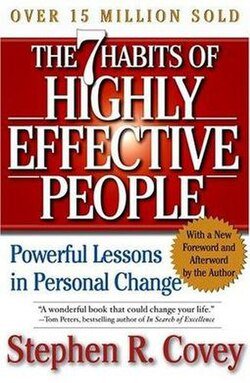
The 7 Habits of Highly Effective People
Watch Prashant Sir break down Covey’s complete framework — the maturity continuum, the Private Victory, the Public Victory, and why this book is built on character rather than technique.
Why Read The 7 Habits of Highly Effective People?
The 7 Habits of Highly Effective People is the bestselling self-help book of the twentieth century — and the one most likely to survive the twenty-first. Stephen Covey’s achievement was to write a book that the genre had been trying to write for decades without knowing it: a framework for personal effectiveness grounded not in personality techniques and social tactics but in fundamental principles of character. The book argues that effectiveness is not a set of behaviours to be performed but a function of who you genuinely are — and that sustainable effectiveness requires aligning your values, actions, and relationships with principles that Covey argues are objective, universal, and non-negotiable.
Covey opens with what he calls the “Character Ethic” versus the “Personality Ethic” — his diagnosis of why most self-improvement literature fails. Books built on the Personality Ethic offer techniques for social influence and behavioural habits that produce results without requiring fundamental change in the person applying them. Covey argues these approaches work in the short term and fail in the long term — because people sense the gap between the technique and the person behind it. The Character Ethic holds that effectiveness flows from integrity, and that the only sustainable source of social influence is a self that others can trust completely.
The seven habits are organised across a maturity continuum: from dependence through independence to interdependence. Habits 1–3 address the Private Victory — internal self-mastery. Habits 4–6 address the Public Victory — trust-based relationships and collaboration. Habit 7 is the renewal that sustains all the others. The architecture is not arbitrary: each habit is built on the foundation of the preceding ones, and the sequence is essential to understanding why the system works.
Who Should Read This
This is the single book most likely to appear on any list of recommended reading for MBA candidates, competitive exam aspirants, and serious professionals. CAT and MBA candidates will find it invaluable for GD/PI preparation: virtually every question about personal effectiveness, leadership philosophy, time management, conflict resolution, and interpersonal communication can be addressed more rigorously using Covey’s framework. Beyond preparation, it is the book that people most consistently report having life-changing effects when read at the right moment — and that most people who read it once wish they had read earlier.
Key Takeaways from The 7 Habits
Effectiveness begins inside, not outside. Most productivity literature focuses on external behaviours — what to do and when. Covey argues that sustainable effectiveness requires internal alignment first: your values must be clarified, your mission defined, and your daily priorities must flow from your deepest commitments rather than from urgent external demands. Technique applied to a misaligned self produces short-term results and long-term emptiness.
The gap between stimulus and response is where human freedom lives — and where character is built or abandoned. Between any stimulus and any response there is a space, and in that space lies the power to choose. Proactivity is not optimism; it is the disciplined exercise of that choice, the refusal to allow circumstances or emotional reactions to determine your actions. This is the foundation on which every other habit depends.
Urgency is not importance — and confusing them is the single most common cause of an effective person living an ineffective life. Covey’s Time Management Matrix shows that most people systematically neglect Quadrant II (important but not urgent) — where relationship-building, strategic thinking, personal development, and prevention all live. Managing Quadrant II is what separates highly effective people from merely busy ones.
Win/Win is not a compromise — it is a fundamentally different way of conceiving human interaction. Most people default to Win/Lose or Lose/Win. Covey argues that genuine Win/Win — solutions that fully satisfy both parties’ deep interests — requires a level of character, trust, and creative thinking that most people have not developed. It is not splitting the difference; it is finding a third alternative that neither party could have conceived alone.
Key Ideas in The 7 Habits
Covey’s opening framework — the Character Ethic versus the Personality Ethic — is the book’s most important intellectual move. He observes that the self-improvement literature of the twentieth century’s first half focused primarily on character: integrity, humility, fidelity, temperance, courage, justice. The literature of the second half shifted to personality: how to present yourself, how to influence people, how to build a positive mental attitude. The Personality Ethic produces techniques; the Character Ethic produces a self. Covey’s argument is not that technique is useless but that technique built on an insufficient foundation of character will always fail the tests that matter most: the long-term trust of people who know you well, the integrity of decisions made when no one is watching, and the coherence between what you say you value and how you actually live.
The concept of paradigms is the book’s second major framework. A paradigm is a mental map — the lens through which we see and interpret reality. Covey argues that most interpersonal and organisational problems are not problems of behaviour but problems of perception: people are operating from different paradigms and interpreting the same reality differently. A paradigm shift — the sudden or gradual change in how you fundamentally see something — is more powerful than any behavioural change, because paradigms determine behaviour. Covey illustrates this with the “young woman / old woman” optical illusion: the same image, seen differently by two people, produces completely different descriptions of objective reality.
The maturity continuum is the book’s organising architecture. Dependence — “you take care of me, it’s your fault” — is the paradigm of the emotionally undeveloped. Independence — “I can do it myself, I am responsible” — is the goal of much personal development literature and an important stage. But Covey argues that independence is not the highest state: interdependence is. An interdependent person can choose to work with others from a position of genuine self-sufficiency, contributing their strengths without dependency as a limitation. The first three habits build independence; the next three extend it into interdependence.
The concept of the Emotional Bank Account is the book’s most practically actionable framework for relationship management. Every relationship involves an emotional bank account, and every interaction either makes a deposit — through keeping promises, small kindnesses, honesty, apology — or a withdrawal. High-trust relationships have large positive balances that can absorb occasional withdrawals without significant damage. Effectiveness in relationships is largely a function of the cumulative balance in the emotional bank account, and most relationship failures are failures of consistent small deposits rather than single large withdrawals.
The Seven Habits Explained
Each of the seven habits is both a principle and a practice — grounded in character, sequenced deliberately, and building on the one before. Together they constitute a complete system for moving from dependence through independence to interdependence.
Core Arguments
Covey advances four interconnected arguments — about the character-technique distinction, the inside-out paradigm, interdependence as the highest human development stage, and the objective nature of principles — each with direct implications for why this framework is more demanding and more durable than most personal development literature.
Covey’s foundational argument is that sustainable effectiveness cannot be produced by technique alone — that technique applied without character is detectable, creates distrust, and eventually fails the tests that matter. The most persuasive communication strategy deployed by a person whose values are genuinely different from the ones they express will be seen through — perhaps not immediately, but inevitably. The long game of effectiveness — the kind that builds careers, sustains marriages, and creates organisations that outlast their founders — requires that your techniques be backed by a self that others can trust completely. This is not idealism; it is a practical claim about what works over time versus what works in the short term.
Conventional personal development literature focuses on what to do — habits to adopt, techniques to deploy, behaviours to perform. Covey’s argument is that this is the wrong starting point. Effectiveness begins inside — with clarity of values, integrity of character, and alignment between what you believe and how you live — and works outward from there. The inside-out paradigm does not dismiss skill and technique; it insists that technique flows from character rather than substituting for it. The sequence matters: Private Victory precedes Public Victory not as a moral requirement but as a practical one — you cannot consistently produce the Public Victory behaviours from a deficient Private Victory foundation, regardless of how well you understand them.
Most personal development literature treats independence as the goal — the self-made person who needs no one. Covey’s maturity continuum argues that independence is a necessary stage but not the highest one. Interdependence — the ability to choose to work with others from a position of genuine self-sufficiency — produces outcomes that no independent person can achieve alone. Synergy — the idea that the whole can be genuinely greater than the sum of its parts — is only available to people who have achieved sufficient independence that their collaboration is a genuine choice rather than a compensatory dependency. The implication is that building others’ independence, rather than maintaining their dependence, is the mark of genuinely effective leadership and genuinely effective parenting.
Covey’s most philosophically significant claim is that the principles underlying the seven habits — integrity, fairness, human dignity, service, quality, potential — are not cultural preferences or religious beliefs but objective features of reality that verify themselves through their consequences. Organisations and individuals that operate against these principles pay specific, predictable costs. Trust broken by dishonesty deteriorates; relationships corroded by Win/Lose thinking eventually fail; people treated as means rather than ends will eventually withdraw their genuine commitment. The principles are not idealistic; they are empirical. Whether or not one accepts Covey’s philosophical grounding, the practical observation — that violations of these principles produce predictable costs over time — is both verifiable and widely confirmed by experience.
Critical Analysis
A balanced assessment examining the book’s architectural coherence, principle-based durability, and the Quadrant II framework alongside its cultural-religious context, the knowing-doing gap it leaves largely unaddressed, and its considerable length.
The seven habits are not a list — they are a system, and the sequence is essential. The Private Victory habits must precede the Public Victory habits because you cannot consistently practise Win/Win, empathic listening, or genuine synergy from a foundation of reactive dependence. The architecture is the book’s most important intellectual contribution: it explains not just what to do but in what order and why the order matters.
The book’s most durable quality is that it grounds every habit in a principle rather than a technique. This means the habits can be adapted across cultures, contexts, and roles without losing their essential content. Most self-help books do not survive cultural translation; this one does — which is why it has been equally influential in corporate boardrooms, military academies, and secondary school classrooms.
Covey’s Quadrant II framework is arguably the most practically useful contribution in the book — a tool for diagnosing how you actually spend your time and identifying the specific category (important but not urgent) that produces long-term results but is systematically crowded out by urgency. Its simplicity, visual clarity, and diagnostic precision make it immediately applicable in a way that few frameworks manage.
Covey was a devout member of the Church of Jesus Christ of Latter-day Saints, and the book’s philosophical framework — particularly the claim that principles are universal and objective — reflects a specific cultural and religious formation. The principle-centred philosophy is largely practically valid, but its claim to objectivity is more culturally specific than Covey acknowledges. Readers from different philosophical traditions will find some grounding assumptions require translation.
The habits are easy to understand and genuinely difficult to practise consistently — particularly Habits 4 and 5, which require levels of ego subordination and genuine listening that run counter to most people’s trained instincts. The book is better at making the case for each habit than at providing specific practice methodology that would help readers close the knowing-doing gap. Covey’s follow-up works address this, but the original leaves significant implementation work to the reader.
At 432 pages, the book contains more elaboration of each habit than most readers require. The core framework is intellectually complete within the first hundred pages; the subsequent sections provide valuable illustration but also considerable repetition. Many readers find the book more effective re-read selectively by habit than read linearly in full.
Literary & Cultural Impact
40 Million Copies and Counting: The 7 Habits of Highly Effective People was published in 1989 and has since sold over 40 million copies in more than 40 languages — making it one of the bestselling non-fiction books in history. Time magazine named it one of the 25 most influential management books of all time. It consistently tops surveys of the most influential business books among CEOs and senior executives globally. Former US Presidents Clinton and Obama have cited it. Covey himself was named one of Time’s 25 Most Influential Americans in 1996.
Institutional Adoption at Scale: The book’s institutional influence has been extraordinary. Covey’s FranklinCovey organisation — built around the seven habits framework — became one of the world’s largest management training organisations, delivering programmes to Fortune 500 companies, government agencies, educational institutions, and military organisations across more than 150 countries. The Time Management Matrix became standard curriculum in MBA programmes and corporate training worldwide. The emotional bank account metaphor entered everyday professional vocabulary.
The Technique-Without-Foundation Problem: The book spawned a substantial self-help industry built on its foundations — and a considerable critical literature examining its limitations. The most serious critique is the gap between the framework’s ambition — character development, paradigm shifts, genuine interdependence — and the training industry’s tendency to reduce the habits to technique, process, and worksheet. Covey himself was aware of this risk and addressed it repeatedly. The most durable version of the critique is that organisations can teach the seven habits without the philosophical foundation — the principle-centred character ethic — that makes them more than behavioural techniques, producing exactly the Personality Ethic outcome the book was designed to transcend.
Resonance in the Indian Context: The framework for moving from dependence through independence to interdependence maps directly onto the challenges of the Indian professional — the navigation of family obligation, institutional hierarchy, and individual aspiration; the specific tensions of competitive exam culture’s emphasis on individual performance versus the cooperative demands of professional and family life; and the particular importance, in a relationship-dense culture, of the emotional bank account concept and the habit of seeking first to understand. The book is not culturally Indian, but its principles translate with minimal loss — which is why it remains, after three and a half decades, the self-help book most consistently recommended for MBA and competitive exam preparation across the subcontinent.
Love This Book? Master Every Book.
Stop struggling with reading comprehension. Our proven system transforms how you read—whether for CAT, GRE, GMAT, SAT, or personal growth.
Best Quotes from The 7 Habits
Most people do not listen with the intent to understand; they listen with the intent to reply.
The key is not to prioritise what’s on your schedule, but to schedule your priorities.
Between stimulus and response there is a space. In that space is our power to choose our response. In our response lies our growth and our freedom.
You can’t talk your way out of a problem you behaved your way into.
I am not a product of my circumstances. I am a product of my decisions.
Test Your Understanding
Think you’ve mastered The 7 Habits? Challenge yourself with 15 questions on the maturity continuum, the Time Management Matrix, the Private Victory, Win/Win thinking, and empathic listening. Score 80%+ to prove your mastery.
The 7 Habits FAQ
What is The 7 Habits of Highly Effective People about?
It is a framework for personal and interpersonal effectiveness built on the premise that sustainable effectiveness flows from character rather than technique. The seven habits are organised as a maturity continuum from dependence through independence to interdependence: the first three (Be Proactive, Begin with the End in Mind, Put First Things First) build the Private Victory of self-mastery; the next three (Think Win/Win, Seek First to Understand, Synergise) build the Public Victory of genuine collaboration; and the seventh (Sharpen the Saw) sustains all the others through continuous renewal.
Is it useful for MBA and CAT preparation?
Indispensable. Virtually every question in an MBA interview about personal effectiveness, leadership philosophy, time management, conflict resolution, interpersonal communication, or teamwork can be addressed more rigorously using Covey’s framework than without it. The Time Management Matrix is directly applicable to any question about prioritisation; the emotional bank account to any question about trust and relationships; Win/Win thinking to any question about negotiation or conflict; and the proactivity framework to any question about initiative and responsibility.
What is the most important of the seven habits?
Covey would argue that the sequence makes this question unanswerable — each habit builds on the preceding ones. That said, Habit 1 (Be Proactive) is foundational in the deepest sense: without the exercise of genuine agency — the recognition that you choose your response regardless of circumstances — none of the other habits can be consistently practised. And Habit 5 (Seek First to Understand) is arguably the single most immediately applicable and most consistently violated habit in professional life.
What is the difference between the Private Victory and the Public Victory?
The Private Victory (Habits 1–3) refers to the internal work of building self-mastery, personal integrity, and the ability to manage your own energy, priorities, and commitments — the precondition for genuine independence. The Public Victory (Habits 4–6) refers to the work of building effective relationships and collaborative outcomes. Covey’s critical point is that the Public Victory genuinely requires the Private Victory as its foundation: you cannot consistently practise Win/Win, empathic listening, or synergy from a base of reactive dependence.
How does The 7 Habits differ from most self-help books?
Most self-help books are built on the Personality Ethic — they offer techniques, strategies, and behavioural changes that produce results without requiring fundamental change in the person applying them. The 7 Habits is built on the Character Ethic — it argues that sustainable effectiveness requires internal alignment between values, commitments, and behaviour, and that technique applied without character will always fail the tests that matter most. This distinction explains both why the book is more demanding than most self-help and why it has endured while most of its genre has been forgotten.








