
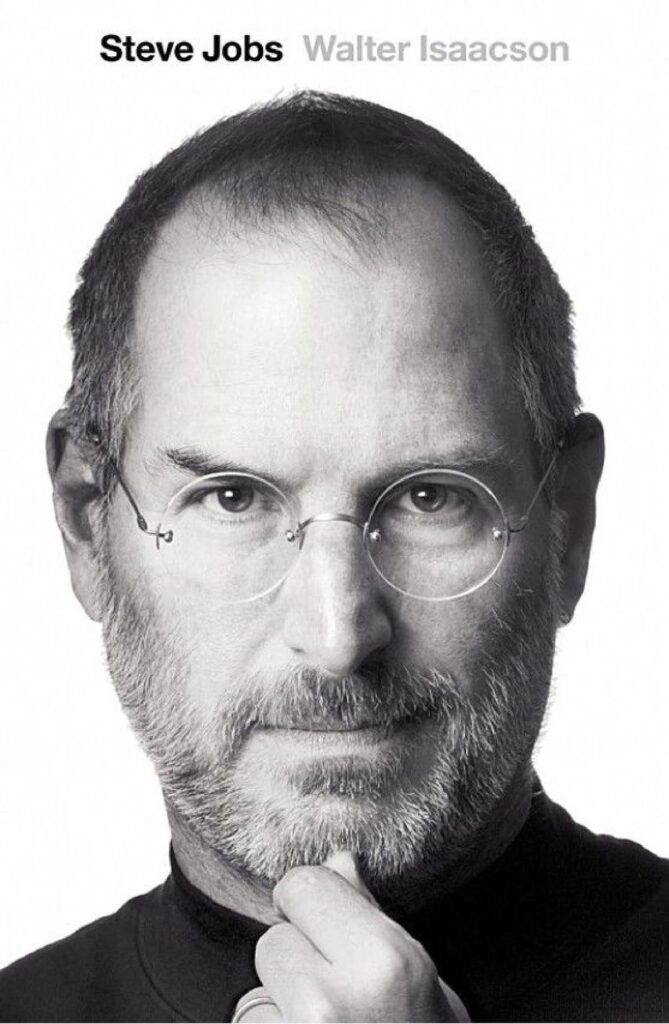
Why Read Steve Jobs?
Steve Jobs is not a hagiography — it is one of the most psychologically honest portraits of a transformative genius ever written. Walter Isaacson, granted unprecedented access by Jobs himself in the final years of his life, produced a biography that is simultaneously a history of the personal computer revolution, a study in creative leadership, and an unflinching examination of what it costs — and what it produces — to be driven by an uncompromising vision of perfection.
Drawing on over forty interviews with Jobs and more than a hundred with his family, friends, colleagues, and adversaries, Isaacson traces the arc from Jobs’s adoption and unconventional California upbringing through the founding of Apple, his exile and return, and the extraordinary second act that produced the iMac, iPod, iTunes, iPhone, and iPad. The biography does not sanitize — Jobs emerges as brilliant, cruel, inspiring, manipulative, visionary, and petty, sometimes in the same paragraph — and this honesty is precisely what makes the book essential.
What distinguishes this biography from most business storytelling is its insistence on connecting Jobs’s personality to his products. The obsessive attention to the inside of a computer’s case (even when no user would ever see it), the fury at rounded corners that weren’t round enough, the refusal to put on-off switches on devices — these are not anecdotes about eccentricity but data points in a coherent theory of how deeply held aesthetic and philosophical convictions translate into world-changing products.
Who Should Read This
This book is essential for anyone interested in entrepreneurship, design, technology, leadership, or the creative process at the highest level. It is equally valuable as a cautionary tale about the human costs of perfectionism and the damage an unchecked ego inflicts on those nearby. Particularly recommended for MBA aspirants preparing for GD-PI rounds on leadership and innovation, and for readers building the stamina and analytical reading habits needed for CAT, GMAT, and GRE verbal sections.
Key Takeaways from Steve Jobs
Jobs’s defining conviction was that technology and the humanities must intersect. He saw himself not as a technologist but as an artist who happened to work in technology — someone standing at the crossroads of Silicon Valley and the counterculture. This conviction drove every Apple product: objects that were not merely functional but beautiful, intuitive, and emotionally resonant.
Jobs possessed what colleagues called a “Reality Distortion Field” — an extraordinary ability to convince people (and sometimes himself) that the impossible was achievable and that impossible timelines were reasonable. This was both his greatest leadership asset and his most destructive personal trait, producing miracles and casualties in roughly equal measure.
Jobs understood that deciding what not to build was as important as deciding what to build. His most consequential decisions at Apple were acts of elimination — killing product lines, refusing to add buttons, removing features that distracted from the core experience. This radical focus, exercised with dictatorial confidence, is what separated Apple’s products from every competitor’s.
Jobs’s story is ultimately about the indispensability of the second act. Fired from Apple in 1985, he founded NeXT, acquired Pixar, and spent twelve years in the wilderness — years that, in retrospect, provided the experiences, failures, and perspective that made his return to Apple in 1997 and everything that followed possible. The exile was not a detour; it was essential preparation.
Key Ideas in Steve Jobs
Isaacson structures the biography chronologically but with thematic density — each phase of Jobs’s life illuminates a different facet of his character and method. The early chapters establish the foundations: Jobs’s adoption, his idiosyncratic upbringing in the orchards of Silicon Valley, his encounter with the counterculture and Zen Buddhism at Reed College, and his early partnership with Steve Wozniak. These years establish the two convictions that never left him — that great products require the marriage of technical excellence and aesthetic beauty, and that the rules that constrain ordinary people need not apply to those with sufficient vision and will.
The founding and early years of Apple (1976–1985) demonstrate Jobs’s extraordinary gift for product vision and his catastrophic limitations as a manager. The creation of the original Macintosh — built by a team Jobs simultaneously inspired and terrorized — captures the central paradox of his leadership: that his cruelty and his genius were not separate phenomena but expressions of the same underlying intensity. The board’s decision to remove him from operational control in 1985, engineered by the CEO Jobs himself had recruited, is one of business history’s great ironies.
The middle section — covering NeXT, Pixar, and the wilderness years — is the biography’s most underappreciated section. NeXT failed commercially but produced the operating system that would become the foundation of modern macOS and iOS. Pixar, acquired as an afterthought, became the most successful animation studio in history and made Jobs a billionaire before Apple ever recovered. These years showed that Jobs could learn, adapt, and grow — that the exile, painful as it was, produced a leader of far greater range and self-awareness than the one who had been fired.
The return to Apple (1997–2011) is where the story achieves its full magnitude. In fourteen years, Jobs oversaw the creation of five industries — digital music, the modern smartphone, the tablet computer, digital retail, and streaming media — while simultaneously rescuing Apple from near-bankruptcy and building it into the world’s most valuable company. Isaacson traces how each product (iMac, iPod, iTunes, iPhone, iPad) emerged from Jobs’s obsessions, and how the organizational and cultural systems he built at Apple — end-to-end integration, secrecy, the emphasis on saying no — were as important as any individual product decision.
Key Figures
The people around Jobs — partners, rivals, and subordinates — are as central to the biography as Jobs himself, each illuminating a different dimension of his character and legacy.
Wozniak represents the counterpoint to Jobs — genuinely humble, technically gifted, and motivated by the joy of engineering rather than the desire to change the world. His partnership with Jobs illustrates that transformative companies require both the visionary and the engineer, and that Jobs’s genius lay in recognizing and harnessing technical talent he himself did not possess.
Recruited by Jobs with the famous line “Do you want to sell sugared water for the rest of your life?” Sculley became the biography’s central cautionary tale about Jobs’s catastrophic tendency to idealize people before turning on them — a dynamic that ended with Jobs’s own removal from Apple in 1985.
Ive is arguably the most important relationship in the second half of the biography. Their partnership — Jobs’s vision and Ive’s execution — produced the physical form of every Apple product from the iMac through the iPhone. Ive gave Jobs what he could not produce alone: a world-class design capability that matched his philosophical convictions about the union of beauty and function.
The Gates-Jobs relationship — competitive, respectful, and deeply ambivalent — threads through the entire biography. Their contrasting philosophies (openness vs. integration; software vs. hardware; accessibility vs. elegance) defined two competing visions of personal computing that shaped the industry for forty years.
The Pixar years reveal a side of Jobs the Apple story tends to obscure: his capacity to stay in the background, support creative talent without micromanaging it, and exercise the patience his Apple work rarely required. Their accounts show a man who had learned the difference between inspiring a creative culture and strangling it.
Cook appears as the operational counterweight to Jobs’s creative intensity — the person who built the supply chain, manufacturing relationships, and organizational systems that allowed Jobs’s product visions to reach hundreds of millions of people. His selection as successor reflects Jobs’s eventual recognition that operational excellence was as essential to Apple’s mission as design genius.
Core Arguments
Isaacson weaves four sustained arguments through the biography — about design, creativity, leadership, and the future of innovation — that give the book its intellectual weight beyond its narrative drive.
One of the biography’s recurring arguments — not just Isaacson’s but Jobs’s own, stated explicitly and enacted through every Apple product — is that end-to-end control of hardware, software, and services produces a superior consumer experience to the open, modular approach favored by Microsoft, Google, and the broader technology industry. Jobs was willing to sacrifice market share for this integration, and the iPhone’s success suggests he was right at the consumer level even if wrong at the enterprise level.
The biography consistently argues that Jobs’s most creative acts were acts of subtraction — the courage to remove features, kill products, and refuse complexity that every market research study and business case would have supported including. The original Mac had no cursor keys; the first iMac had no floppy drive; the first iPhone had no physical keyboard. Each omission was controversial; each proved visionary. Knowing what to leave out requires more confidence than knowing what to put in.
The biography explicitly refuses to separate Jobs’s personal cruelty — the public humiliations, the denial of paternity, the crying fits and explosions — from his professional genius. Isaacson’s implicit argument is that these were expressions of the same underlying trait: an absolute refusal to accept the ordinary. This makes the book a genuinely difficult moral object — it neither endorses Jobs’s behavior nor pretends that his products could have been what they were without the intensity that produced both.
Jobs returned to this theme repeatedly in his final years — most famously in the closing slide of every major Apple product announcement, which showed a street sign at the intersection of Technology and Liberal Arts. His argument was that the companies and individuals who will define the next era of innovation are not pure technologists or pure humanists but people who can think in both registers simultaneously — a conviction that has become one of the most cited frameworks in discussions of 21st-century education and entrepreneurship.
Critical Analysis
A balanced assessment of Isaacson’s biography — examining what it achieves brilliantly and where it falls short.
Isaacson’s forty-plus interviews with Jobs himself, conducted over two years, give the biography an intimacy and directness that no subsequent account can replicate — Jobs spoke with unusual candor about his failures, his personality, and his philosophy.
At 656 pages the book never drags — Isaacson is a gifted storyteller who structures the chronology to maintain tension, and the sheer drama of Apple’s rise, fall, and resurrection provides a narrative engine that keeps the reader engaged throughout.
The biography’s refusal to either lionize or condemn Jobs — presenting his cruelty and his genius with equal specificity — is both its most challenging quality and its most enduring value. It trusts the reader to form their own judgment, which is rare in business biography.
Despite Isaacson’s evident effort at balance, the fact that Jobs requested and cooperated with the biography inevitably shapes it — critics have noted that Jobs’s own framing of events sometimes goes unchallenged, and that key figures who had falling-outs with Jobs are given less generous treatment.
Readers seeking deep technical analysis of Apple’s engineering and design decisions will find the biography somewhat superficial — Isaacson is primarily a narrative writer rather than a technologist, and the product stories are more impressionistic than analytical.
The biography ends essentially with Jobs’s death in October 2011, leaving the question of whether his legacy — the culture, the products, the philosophy — survived his departure largely unaddressed. A reader wanting to understand Apple’s subsequent trajectory will need to look elsewhere.
Legacy & Cultural Impact
A Publishing Phenomenon: Steve Jobs was one of the fastest-selling biographies in publishing history. Released on October 24, 2011 — three weeks after Jobs’s death — it sold over a million copies in its first week and has since sold more than ten million copies worldwide. It arrived at a moment of extraordinary public grief and curiosity about the man behind the devices that had transformed how hundreds of millions of people worked, communicated, and consumed culture, and it remains the definitive account of his life and work.
Influence on Entrepreneurship Culture: The book’s influence on how entrepreneurship and leadership are discussed has been substantial. The concept of the “Reality Distortion Field” — popularized by Isaacson’s account though coined earlier by Apple engineer Bud Tribble — entered mainstream business vocabulary as shorthand for the kind of inspirational intensity that bends teams toward apparently impossible goals. The biography’s portrait of Jobs as a leader who combined aesthetic perfectionism with strategic ruthlessness shaped a generation of founder mythology, for better and worse.
Relevance for MBA and Exam Aspirants: Jobs is one of the most frequently referenced figures in MBA personal statements, GD-PI rounds, and leadership discussions — and having read the biography rather than relying on secondhand summaries gives candidates a depth of perspective that interviewers notice immediately. The book’s analytical narrative style — presenting evidence, drawing inferences, connecting personality to outcome — is also excellent preparation for the dense business and social science passages that appear in CAT and GMAT reading comprehension sections.
Love This Book? Master Every Book.
Stop struggling with reading comprehension. Our proven system transforms how you read—whether for CAT, GRE, GMAT, SAT, or personal growth.
Best Quotes from Steve Jobs
Creativity is just connecting things. When you ask creative people how they did something, they feel a little guilty because they didn’t really do it, they just saw something.
The people who are crazy enough to think they can change the world are the ones who do.
I want to put a ding in the universe.
It’s not the consumers’ job to know what they want.
Remembering that you are going to die is the best way I know to avoid the trap of thinking you have something to lose.



Test Your Understanding
Think you’ve mastered Steve Jobs? Challenge yourself with 15 questions on key ideas, leadership lessons, and the biography’s core arguments. Score 80%+ to prove your mastery.
Steve Jobs FAQ
What is the Steve Jobs biography about?
Written by Walter Isaacson with Jobs’s full cooperation, the biography covers Jobs’s entire life — from his adoption and Silicon Valley upbringing through the founding of Apple, his firing and exile, his years at NeXT and Pixar, and his extraordinary return to Apple that produced the iMac, iPod, iPhone, and iPad. It is simultaneously a business history, a leadership study, and an unflinching psychological portrait of one of the most influential figures of the 20th and 21st centuries.
How difficult is the Steve Jobs biography to read?
It is rated Intermediate — Isaacson writes accessibly and with strong narrative drive, making 656 pages move faster than the page count suggests. No specialized technical knowledge is required; the book is written for a general educated reader. Readers comfortable with long-form non-fiction and business narrative will find it engaging throughout.
What are the key themes in the Steve Jobs biography?
The book’s central themes are the relationship between personality and creativity, the philosophy of integrated design, the cost and value of perfectionism, the importance of the intersection between technology and the humanities, the nature of transformative leadership, and what Jobs’s story reveals about the culture of Silicon Valley and American innovation more broadly.
Was Steve Jobs a good person?
Isaacson’s biography does not answer this question — and that is part of its greatness. Jobs is presented with all his contradictions intact: a man who created objects of extraordinary beauty and utility while treating many of the people around him with cruelty, dishonesty, and contempt. The biography asks readers to hold both truths simultaneously and draw their own conclusions about what they mean.
Why should I read the Steve Jobs biography today?
Because the questions it raises — about how great products are built, what leadership actually requires, whether the ends justify the means, and what it means for technology companies to have values — are more relevant today than when it was published. Apple, under Jobs’s influence, shaped the architecture of modern digital life; understanding how it was built and at what cost is essential context for anyone living in that world.








