
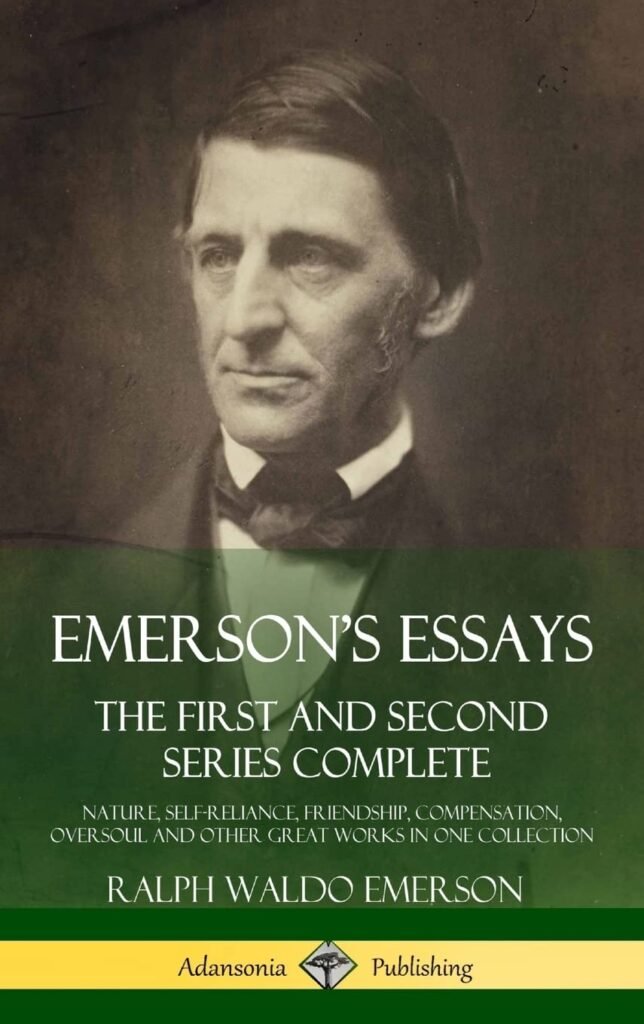

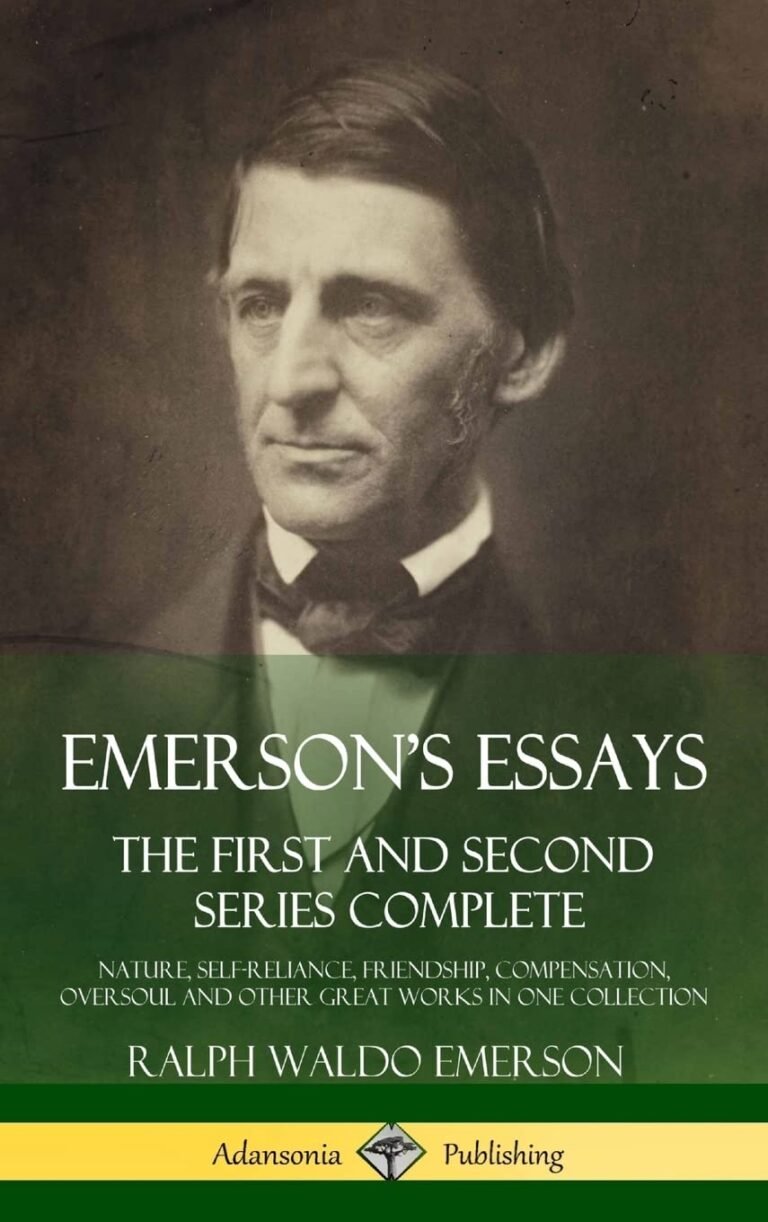
Self-Reliance and Other Essays
Watch Prashant Sir break down Emerson’s key ideas, his aphoristic style, and why this foundational text of American individualism still challenges readers two centuries later.
Why Read Self-Reliance and Other Essays?
Ralph Waldo Emerson was a Massachusetts minister who resigned his pulpit in 1832 because he could no longer administer communion in good conscience, then spent the next four decades as the most influential thinker in America. His essays — collected from his lectures — shaped how a young, restless nation thought about the self, nature, God, fate, and the purpose of a human life. For readers willing to engage on his terms, these essays are among the most energising texts in the English language.
The title essay, “Self-Reliance” (1841), is the centrepiece: a full-throated demand that each person trust their own mind, resist conformity, refuse the tyranny of consistency, and live from the inside out rather than the outside in. Around it are gathered essays on compensation, circles, the over-soul, intellect, art, nature, and friendship — each a sustained meditation on a single large idea.
Emerson belongs to the movement known as Transcendentalism, which held that the individual human being has direct access to a deeper truth — call it God, nature, the universal soul — that no institution, no church, no government can mediate or replace. That idea, transmitted through two centuries of American culture, echoes in every entrepreneur who trusts her instinct over the consensus, every artist who refuses to repeat a successful formula, every student who argues with the teacher rather than simply copying notes.
Who Should Read This
This collection is for readers who are ready to be challenged — not by complexity alone, but by ideas that are genuinely difficult to live by. It is essential reading for anyone interested in philosophy, American literature, or the intellectual foundations of modern individualism. For competitive exam aspirants, it is a rich training ground for RC passages on philosophy and society — and the aphoristic style is a direct model for the precision that exam essays reward.
Key Takeaways from Self-Reliance and Other Essays
Self-reliance is not arrogance — it is the courage to trust your own perception over social pressure. A person who knows everything that has been thought before but cannot think an original thought has gained information and lost themselves.
Changing your mind when you learn better is not weakness. Defending a wrong position merely to seem consistent is a kind of cowardice masquerading as integrity. Emerson’s famous line — that a foolish consistency is the hobgoblin of little minds — is a demand for intellectual honesty.
The universe maintains a hidden compensatory balance. Every advantage carries a corresponding cost; every loss contains a concealed gain. This structural equilibrium resonates across Stoic, Hindu, and modern psychological thought — one of Emerson’s most cross-culturally relevant ideas.
Every boundary we draw around knowledge or identity will eventually be enclosed by a larger circle. Every truth, once established, becomes the starting point for a new and larger truth. The person willing to have their circle expanded is the person who is genuinely alive.
Key Ideas in Self-Reliance and Other Essays
The title essay opens with a deceptively simple instruction: trust yourself. Behind that instruction is a complete philosophy. Emerson argues that every person has, in their moments of genuine instinct and intuition, access to a deeper truth than anything they can learn from books, traditions, or the approval of others. The tragedy of most human lives, he suggests, is that people suppress that inner voice in favour of conformity — and call the suppression virtue.
One of the collection’s most famous arguments concerns consistency. Emerson holds that insisting on never contradicting yourself — on maintaining a perfectly coherent position across time — is a way of letting your past imprison your present. You grow. You learn. Your views change. A person who cannot change their mind is not admirably consistent; they are stuck. Defending a wrong position to seem consistent is not integrity — it is a kind of cowardice.
The essay “Compensation” argues that the universe maintains a hidden equilibrium — that every advantage carries a corresponding disadvantage, every loss a concealed gain. This is not naive optimism; it is Emerson’s attempt to describe a structural feature of existence that resonates with Stoic philosophy, Hindu thought on karma, and modern psychology’s understanding of how adversity builds resilience.
“Circles” develops the collection’s central image: every boundary we draw around knowledge, identity, or possibility will eventually be enclosed by a larger circle. Every truth, once established, becomes the starting point for a new and larger truth. This is an essay about growth as an inescapable feature of reality — and about the anxiety and exhilaration that come with it. The person willing to have their circle expanded is the person who is alive.
Key Themes in Self-Reliance and Other Essays
Five interlocking themes run through the collection, each a different dimension of Emerson’s central argument about the primacy of the individual and the direct access of the self to universal truth.
Core Arguments
Four arguments run through Emerson’s essays, each one building the philosophical case for the authority of the individual self against the claims of tradition, institution, and social conformity.
Emerson’s most fundamental argument is that every person has an inner authority — conscience, intuition, original genius — that is more reliable than the external authority of tradition, fashion, or social pressure. Institutions — churches, governments, schools — derive their legitimacy from the individuals who compose them; when they become obstacles to individual perception rather than aids to it, they lose their claim on us. A life of genuine achievement requires the courage to trust that inner voice, even when it leads you into apparent contradiction or isolation. This is not a comfortable argument, and Emerson does not pretend it is.
Emerson argues that the social pressure to conform — to believe what our neighbours believe, to hold the opinions expected of someone in our position, to be consistent with what we have previously said — is the most powerful and most insidious obstacle to genuine thinking. The person who conforms to opinion does not merely hold wrong views; they have surrendered the faculty by which they could correct those views. This is why conformity, for Emerson, is not merely a social inconvenience but a spiritual failure — a betrayal of the specific human capacity that makes any kind of truth-seeking possible.
One of the most important and most frequently misunderstood aspects of Emerson’s argument is that his individualism is not solipsism. He is not arguing that each person should do whatever they want without regard for others. He is arguing that the deepest self — the self that has been stripped of social conditioning, conformity, and the need for approval — opens not onto mere personal preference but onto something universal and shared. The Over-Soul is not the individual ego; it is the reality the individual ego glimpses when it stops performing for an audience and starts genuinely attending.
Emerson’s individualism was formulated without adequate attention to the ways in which some individuals begin from positions of deep structural disadvantage. His freedom to “trust himself” was grounded in the considerable privileges of a white, educated, nineteenth-century American man. The “self-reliance” he described presupposes a material situation — freedom from enslavement, from grinding poverty, from the specific social restrictions placed on women — that was not available to most of the people living in America in 1841. The ideas are powerful, but they should be read with awareness of what they assumed without examining. Knowing this critique, and being able to state it clearly alongside the positive argument, marks intellectual maturity.
Critical Analysis
A balanced assessment of a collection that is simultaneously one of the most energising and one of the most demanding in this database.
Emerson is one of the most quotable writers in English precisely because he thinks in aphorisms. His essays are dense with compressed arguments — single sentences that contain entire philosophical positions. The density means that the ratio of insight to page count is exceptional: even a single paragraph, read carefully, can reorient a whole way of thinking. This is a rare quality and the primary reason the essays have remained in continuous reading for nearly two centuries.
The supplementary essays — “Compensation,” “Circles,” and “The Over-Soul” in particular — deepen and complicate the central argument of “Self-Reliance” in ways that make the whole greater than any individual part. Read in sequence, they constitute a comprehensive philosophical worldview expressed through meditation rather than systematic argument — and that is itself one of Emerson’s most important formal contributions.
The questions Emerson raises — how much of what I believe is genuinely mine? how much have I borrowed from social pressure? what would I think if no one was watching? — are not historical questions. They are live questions for any person in any culture, and they are especially live in contexts where social conformity is strongly rewarded and individual deviation strongly punished. Emerson’s framework gives these questions a language and a philosophical seriousness they do not always receive.
Emerson’s individualism was formulated without adequate attention to the ways in which some individuals begin from positions of deep structural disadvantage. His freedom to “trust himself” presupposed material and social conditions — freedom from enslavement, from poverty, from the specific restrictions placed on women — that were not available to most people living in America in 1841. The ideas are powerful, but they require this contextualisation to be read with full intellectual honesty.
Emerson’s essays do not have a clear thesis-body-conclusion structure. They accumulate meaning through the repetition and variation of a central image or idea — a method that is beautiful when it works but can be disorienting for readers expecting a linear argument. Readers approaching him expecting the clarity of Adichie or the systematic rigour of Kahneman will be frustrated. This is a book for active, patient engagement — not passive absorption.
Some of Emerson’s specific references and framings carry the distance of almost two centuries. His religious language — the Over-Soul, the universal soul, the divine — requires translation for secular readers; his cultural references require contextualisation that editions without good introductions do not always supply. The ideas themselves travel well; the packaging requires some adjustment.
Impact & Influence
The Foundational Text of American Individualism: Emerson’s essays, first published in 1841 and 1844, shaped how America thought about the self for the rest of the nineteenth century and well into the twentieth. His direct students and intellectual descendants include Henry David Thoreau (who took the ideas of “Self-Reliance” and lived them in a cabin by Walden Pond), Walt Whitman (who wrote Emerson a rapturous letter of thanks after reading the essays), Friedrich Nietzsche (who read Emerson closely and whose concept of the Übermensch shares important structural features with Emersonian self-reliance), and William James (whose Pragmatism extends Emerson’s anti-conformist epistemology into philosophy of science).
The Cultural Reach: The ideas Emerson articulated have become so thoroughly embedded in American — and increasingly global — culture that most people hold versions of them without knowing their source. The valorisation of the entrepreneur who bets against consensus, the admiration for the artist who refuses to repeat a successful formula, the cultural preference for authenticity over conformity — all of these trace back, in significant part, to Emerson’s essays. Understanding the source is not merely historical; it gives you the most complete available account of why these values feel self-evidently correct in some cultural contexts and deeply suspect in others.
Value for Competitive Exam Preparation: Emerson’s essays are structurally similar to the philosophical and cultural commentary passages that appear in the hardest RC sections of CAT, GMAT, and GRE — dense, non-linear, packed with abstract ideas that must be tracked carefully. For GMAT Critical Reasoning, his arguments about authority versus individual judgment and tradition versus innovation are directly relevant territory. For GRE Issue Essays, his framework on individualism, nonconformity, and the individual’s relationship to society gives you a sophisticated position from which to argue or to push back. For UPSC, his ideas on self-reliance, character, and moral courage are directly applicable.
India-Specific Resonance: The tension between individual judgment and social conformity is extraordinarily live in Indian contexts — in career choices, marriage decisions, religious practice, and political opinion. Emerson’s framework gives you a language for thinking about this tension that is historically grounded and philosophically rigorous, while the critique of that framework — its class and structural blindness — gives you the intellectual honesty to apply it carefully rather than absolutely.
Love This Book? Master Every Book.
Stop struggling with reading comprehension. Our proven system transforms how you read—whether for CAT, GRE, GMAT, SAT, or personal growth.
Best Quotes from Self-Reliance and Other Essays
Nothing is at last sacred but the integrity of your own mind.
A foolish consistency is the hobgoblin of little minds, adored by little statesmen and philosophers and divines.
To be great is to be misunderstood.
Trust thyself: every heart vibrates to that iron string.
The soul is no traveller; the wise man stays at home.

Test Your Understanding
Think you’ve mastered Self-Reliance and Other Essays? Challenge yourself with 15 questions on Emerson’s key ideas, arguments, and the Transcendentalist tradition. Score 80%+ to prove your mastery.
Self-Reliance and Other Essays FAQ
What is Self-Reliance and Other Essays about?
It collects the best philosophical essays of Ralph Waldo Emerson — centred on the title essay “Self-Reliance” (1841), a full-throated demand that each person trust their own mind, resist conformity, and live from the inside out rather than the outside in. Around it are gathered essays on compensation (the hidden equilibrium of gains and losses), circles (the endless expansion of thought and identity), the over-soul (the universal consciousness that connects all individuals), intellect, art, friendship, and nature. Together they constitute the most complete expression of Transcendentalism — the philosophical movement that held that individuals have direct, unmediated access to truth, without requiring the intervention of any institution.
Is it useful for competitive exam preparation?
Yes — in several specific ways. Emerson’s essays are structurally similar to the philosophical and cultural commentary passages that appear in the hardest RC sections of CAT, GMAT, and GRE — dense, non-linear, and packed with abstract ideas that must be tracked carefully. For GMAT Critical Reasoning, his arguments about authority versus individual judgment and tradition versus innovation are directly relevant territory. For GRE Issue Essays, his framework on individualism, nonconformity, and the individual’s relationship to society gives you a sophisticated position from which to argue or push back. For UPSC, his framework on self-reliance, character, and moral courage is directly applicable.
What does “a foolish consistency is the hobgoblin of little minds” mean?
It means that insisting on never contradicting yourself — on maintaining a perfectly coherent position across time — is a way of letting your past imprison your present. Emerson’s point is not that all consistency is bad; it is that consistency with a past opinion you now see was wrong is a kind of intellectual cowardice. You grow, you learn, your views change — and a person who refuses to acknowledge this out of a desire to seem principled has confused stubbornness with integrity. The word “foolish” is the key: not all consistency is foolish, only the consistency that prevents genuine thought.
What is the over-soul?
Emerson’s term for the universal consciousness that underlies all individual human minds and connects them to one another and to nature. In the essay “The Over-Soul,” he argues that moments of deep inspiration, genuine prayer, or ecstatic joy are moments when the individual self touches this larger reality — when the boundary between the personal and the universal becomes temporarily permeable. This idea bridges Eastern and Western philosophy: it resonates with the Hindu concept of Brahman and with Platonic idealism, and it is the philosophical foundation for Transcendentalism’s claim that individuals have direct, unmediated access to truth.
What are the main criticisms of Emerson’s ideas?
The most important criticism is that his individualism was formulated without adequate attention to the ways in which some individuals begin from positions of deep structural disadvantage. His freedom to “trust himself” presupposed the material and social conditions — freedom from enslavement, from grinding poverty, from the specific restrictions placed on women — that were not available to most people living in America in 1841. This does not make his ideas worthless; it means they should be applied with awareness of what they assumed without examining. Knowing this critique, and being able to state it clearly alongside the positive argument, is essential for intellectual honesty when engaging with Emerson.








