
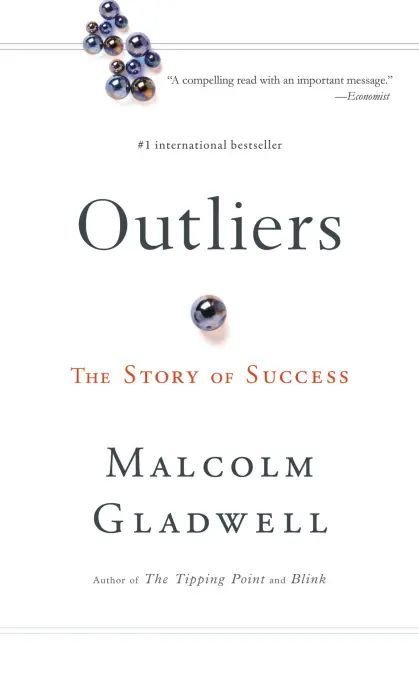
Outliers
Watch Prashant Sir break down the key arguments, case studies, and hidden lessons in Gladwell’s landmark book on success.
Why Read Outliers?
Outliers is the most counterintuitive mainstream book about success published in the past two decades — and the most useful corrective to the mythology of individual achievement that dominates most self-help literature. Malcolm Gladwell’s argument is not that talent, effort, and intelligence do not matter. It is that they are necessary but not sufficient, and that the conditions under which people develop — the era they were born into, the specific advantages they received, the cultural legacies they inherited — determine whether those qualities ever get the opportunity to produce the outcomes they might otherwise produce.
Gladwell structures Outliers around a series of case studies, each designed to reveal a hidden factor that conventional success narratives obscure: the disproportionate representation of January-born hockey players in elite Canadian leagues; the specific birth years that produced an unusual concentration of Silicon Valley giants (1953–1956); the 10,000-hour threshold for expertise development; the specific cultural legacy that makes Korean Air crash rates historically different from American ones; and the rice-paddy agriculture hypothesis about why Asian students tend to outperform in mathematics.
Each case study is a story about the same underlying argument: that what looks like individual excellence is almost always the intersection of individual ability with specific historical, cultural, and circumstantial advantages that the successful person did not choose and often does not acknowledge. This is not a book about fatalism — Gladwell does not argue that effort and ability are irrelevant. He argues that effort and ability, operating without the right conditions, will not produce the outcomes that effort and ability plus the right conditions can produce.
Who Should Read This
This is essential reading for anyone thinking seriously about achievement, preparation, and the relationship between individual effort and external circumstance. CAT and MBA candidates will find it directly applicable to GD/PI discussions about success, meritocracy, education policy, and the relationship between privilege and achievement. Beyond preparation, it is required reading for policy makers, educators, and anyone who has ever wondered why some communities and cultures consistently produce exceptional performers in specific domains.
Key Takeaways from Outliers
When you are born matters as much as what you are born with. Extraordinary achievement requires extraordinary opportunity — and extraordinary opportunity is often a function of when, not just who, you are.
The 10,000-hour rule is not a prescription for effort; it is an observation about the hidden infrastructure of opportunity that makes elite practice possible. The Beatles and Bill Gates didn’t just work hard — they received access almost no one else had.
Cultural legacies — values and habits transmitted across generations — shape performance in ways that persist long after the original conditions that produced them have disappeared. This is not about genes; it is about inheritance of a different kind.
Meaningful work — complex, autonomous, and connecting effort to visible reward — produces the sustained engagement that looks, from outside, like exceptional talent. Sometimes exclusion from the wrong work is the condition of finding the right work.
Key Ideas in Outliers
Gladwell opens with the relative age effect in Canadian hockey — a finding so simple and so systematically ignored that it functions as the book’s thesis in miniature. Because Canadian youth hockey leagues use January 1 as their age-cutoff date, children born in January are almost a full year older — and therefore physically larger — than children born in December of the same selection year. The January-born children are selected for elite teams, receive better coaching and more practice hours, and develop into genuinely better hockey players by the time the relative age advantage has faded — not because they were born more talented but because a structural feature of the selection system converted a trivial birth-timing advantage into a developmental snowball that accumulated over years.
The 10,000-hour rule — derived from Anders Ericsson’s research on expert performance — is the book’s most widely cited finding and its most misunderstood one. The claim is not that 10,000 hours of any practice produces expertise; it is that 10,000 hours of deliberate, high-quality practice is the consistent threshold observed in the developmental histories of world-class performers. Gladwell’s specific contribution is to ask: who gets the opportunity to accumulate 10,000 hours? The Beatles’ Hamburg residency was not a self-funded effort — it was an unusual opportunity that most aspiring musicians never received. The 10,000-hour rule does not diminish effort; it contextualises it.
The cultural legacy argument concerns the degree to which performance differences between groups are explained not by innate differences in ability but by specific historical and cultural patterns transmitted across generations. The rice-paddy agriculture hypothesis argues that the precision and labour intensity of wet rice cultivation in China produced a specific cultural relationship to hard work and persistence — a relationship transmitted through child-rearing practices long after the agricultural conditions that produced it have ceased to be relevant. This is not a claim about genetic differences; it is a claim about cultural inheritance.
The meaningful work argument examines the Jewish lawyers excluded from elite New York firms of the mid-twentieth century, who were forced to build practices in hostile takeover litigation — an area those firms considered beneath them. When that practice became the defining arena of corporate law in the 1970s and 1980s, those lawyers were ideally positioned. The exclusion that seemed like a disadvantage was also an exclusion from meaningless work, and an introduction to work that was not.
Key Case Studies in Outliers
Each case study in Outliers reveals a different hidden factor that conventional success narratives obscure.
Core Arguments in Outliers
Gladwell builds a systematic case that exceptional achievement is structural, not merely individual.
Drawing on sociologist Robert Merton’s concept — named after the biblical verse “unto everyone that hath shall be given” — Gladwell explains how small initial advantages compound over time into large outcome differences. The January-born hockey player, the child identified as gifted in third grade, the student whose parents can afford enrichment activities — each begins with an advantage that, through selection systems and differential investment, becomes self-reinforcing. The initial advantage did not make them exceptional; it gave them the conditions under which their capabilities could develop.
Gladwell’s most policy-relevant argument concerns the distribution of opportunity rather than the distribution of talent. Exceptional achievement requires not just the ability and willingness to accumulate 10,000 hours of deliberate practice but the specific circumstances — the school with the computer terminal, the Hamburg residency, the family stability that allows sustained focus — that make accumulating those hours possible. A society interested in maximising human potential must be as interested in the distribution of opportunity as in the identification of talent — because talent without opportunity produces nothing, while opportunity given to the merely capable can produce results that look like genius.
The book’s most intellectually ambitious argument holds that the specific values, habits, and assumptions that communities transmit to their children — about the relationship between effort and outcome, about deference and authority, about the value of persistence — shape performance in measurable ways that persist across generations. This argument challenges both the individual achievement narrative (your success is purely your own) and structural determinism (your background determines your outcome) — replacing both with a more complex picture in which cultural inheritance shapes the specific forms that effort and ability take.
Gladwell’s most culturally significant argument is the direct challenge to the mythology of the self-made person — the idea that exceptional achievement is primarily a story about exceptional individuals exercising exceptional effort and talent in the absence of structural advantage. This mythology is not merely inaccurate; it is actively harmful, because it teaches people that failure is purely a function of inadequate effort or talent rather than of inadequate opportunity, and that success is purely a function of individual virtue rather than of individual virtue plus specific circumstances. A society built on this mythology will systematically underinvest in the distribution of opportunity.
Critical Analysis
A balanced assessment examining both the book’s genuine contributions and its significant limitations.
Gladwell’s case studies are constructed with narrative skill that makes complex social science arguments genuinely gripping. The Canadian hockey statistics, the Bill Gates biography, the Beatles’ Hamburg residency — each is a complete, compelling story that carries its analytical weight invisibly.
The book’s most durable contribution is the shift it produces in how readers think about achievement — reframing exceptional performance as individual ability plus specific opportunity rather than individual ability alone. This reframe is both empirically more accurate and more policy-productive than the mythology it challenges.
The Matthew Effect, the 10,000-hour rule, the relative age effect, and the cultural legacy framework are each conceptually portable — applicable to new domains well beyond the specific cases Gladwell uses to introduce them. This portability marks a framework that has identified something genuinely structural about how advantage compounds.
Ericsson himself has criticised Gladwell’s rendering, arguing it obscures the critical distinction between deliberate practice and mere repetition. The 10,000-hour rule as popularly understood — that 10,000 hours of practice produces expertise — is false. The more accurate version requires deliberate practice under conditions many people never receive.
Gladwell’s case studies are compelling but selectively chosen to support his argument. The narrative structure creates a sense of systematic argument that the case study methodology does not fully support. Cases where the relative age effect did not matter, or where 10,000 hours did not produce expertise, are not examined. The book is suggestive and important but not as rigorously established as its confident prose implies.
By emphasising structural and circumstantial determinants of success, the book risks leaving readers with less agency than they started with — the sense that without the right circumstances, potential is limited in ways one cannot address. The book is better as a critique of attribution error than as a guide to what individuals should do in the absence of ideal circumstances.
Legacy & Cultural Impact
Commercial and Critical Reception: Outliers was published in November 2008 and immediately became one of the most discussed non-fiction books of the year, debuting at number one on the New York Times bestseller list and selling over 3 million copies in its first year. It has since been translated into more than 35 languages and sold over 5 million copies worldwide, confirming Gladwell’s status as the most commercially successful popular social scientist of his generation.
The 10,000-Hour Rule’s Cultural Reach: The 10,000-hour rule became one of the most widely cited ideas in discussions of talent development and expertise, entering the vocabulary of sports coaching, music education, business training, and self-help discourse. Anders Ericsson’s subsequent book Peak (2016) — a more rigorous treatment of the same research — was partly a response to the popular misunderstanding that Gladwell’s rendering had produced, and stands as an important complement for readers who want the full scientific picture.
Policy Impact: The relative age effect finding produced tangible policy responses in several countries — youth sports organisations in Canada, the UK, and elsewhere have experimented with age-banding systems that reduce the relative age disadvantage. Education researchers have used the framework to examine similar effects in school entry cutoffs and the identification of giftedness.
Relevance for Indian Readers: In the Indian educational context, the book’s most resonant arguments concern the relationship between coaching access, early identification, and the distribution of opportunity in competitive exam preparation. The observation that IIT and IIM graduates disproportionately come from urban, upper-middle-class, English-medium schooling backgrounds is an Indian expression of the Matthew Effect — not because students from these backgrounds are more talented but because they have received compounding advantages of better preparation, better coaching, and greater familiarity with the examination format. The book’s argument is not that merit is an illusion but that the conditions that allow merit to develop are not equally distributed.
Love This Book? Master Every Book.
Stop struggling with reading comprehension. Our proven system transforms how you read—whether for CAT, GRE, GMAT, SAT, or personal growth.
Best Quotes from Outliers
Achievement is talent plus preparation. The problem with this view is that the closer psychologists look at the careers of the gifted, the smaller the role innate talent seems to play and the bigger the role preparation seems to play.
It’s not enough to ask what successful people are like. It is only by asking where they are from that we can unravel the logic behind who succeeds and who doesn’t.
The people who stand before kings may look like they did it all themselves. But in fact they are invariably the beneficiaries of hidden advantages and extraordinary opportunities and cultural legacies that allow them to learn and work hard and make sense of the world in ways others cannot.
Practice isn’t the thing you do once you’re good. It’s the thing you do that makes you good.
We look at the young Bill Gates and marvel that our world allowed that thirteen-year-old to become a fabulously successful entrepreneur. But that’s the wrong lesson. Our world only allowed one thirteen-year-old unlimited access to a time-sharing terminal in 1968.
Test Your Understanding
Think you’ve mastered Outliers? Challenge yourself with 15 questions on key arguments, case studies, and takeaways. Score 80%+ to prove your mastery.
Outliers FAQ
What is Outliers about?
Outliers argues that exceptional achievement is not primarily the product of individual talent and effort but of specific circumstances: the era in which people are born, the opportunities they receive, the cultural legacies they inherit, and the compounding advantages that early selection systems create. Each chapter examines a different hidden factor that conventional success narratives obscure, building toward a systematic argument that the way societies distribute opportunity matters as much as the way individuals exercise effort.
Is Outliers useful for MBA and CAT preparation?
Yes — particularly for GD/PI discussions about meritocracy, success, privilege, and education policy. Gladwell’s framework provides specific, research-grounded analytical tools for questions that most candidates answer with generic statements about hard work and opportunity. The ability to deploy the Matthew Effect, the relative age effect, and the cultural legacy framework in a group discussion signals analytical sophistication that distinguishes serious candidates.
What is the 10,000-hour rule and is it accurate?
The 10,000-hour rule is Gladwell’s rendering of Anders Ericsson’s research finding that world-class expertise in most domains is associated with approximately 10,000 hours of deliberate practice. As popularly understood — that 10,000 hours of any practice produces expertise — it is not accurate: the quality and specificity of the practice matters as much as the volume. Ericsson’s own book Peak provides a more complete and more qualified version of the research.
What is the Matthew Effect?
The Matthew Effect — named after the biblical verse “unto everyone that hath shall be given” — is the social science concept that small initial advantages compound over time into large outcome differences through the operation of selection systems and differential investment. The January-born hockey player is selected for the elite team, receives better coaching, accumulates more practice hours, and becomes genuinely better — not because they were born more talented but because a trivial birth-timing advantage triggered a developmental snowball.
Does Outliers argue that individual effort doesn’t matter?
No — and this is the most common misreading of the book. Gladwell explicitly argues that talent, effort, and intelligence are necessary. His argument is that they are not sufficient — that they require the right circumstances to produce exceptional outcomes, and that those circumstances are not equally distributed. The implication is not fatalism but policy: if we are serious about maximising human potential, we must be as serious about distributing opportunity as we are about identifying and rewarding individual merit.








