
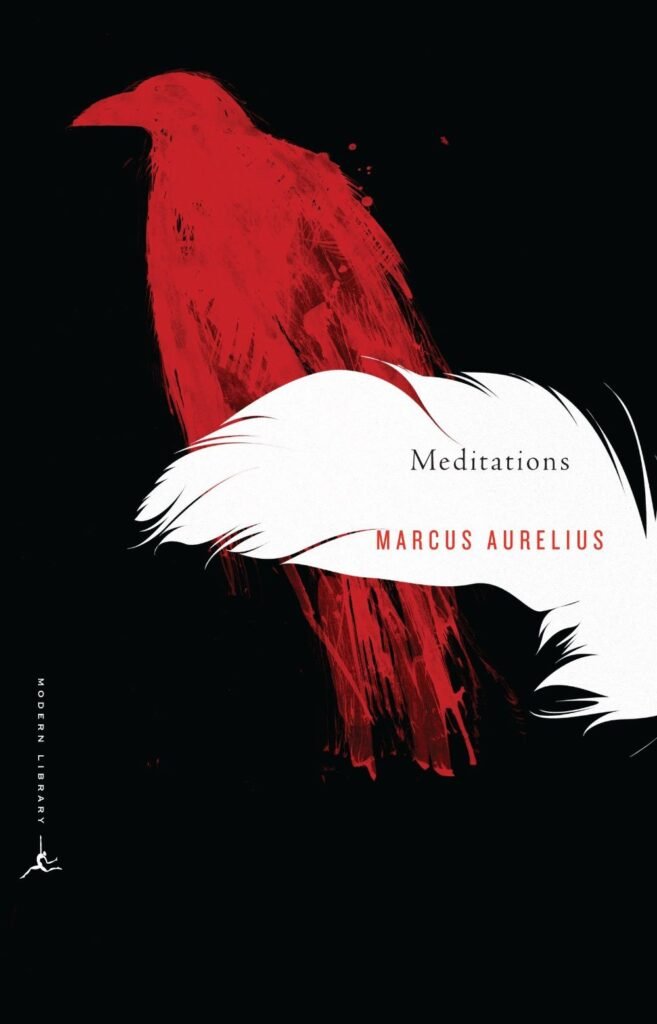
Why Read Meditations?
Meditations was never meant to be read. Marcus Aurelius — emperor of Rome, commander of its legions, ruler of the ancient world’s greatest empire — wrote these notes entirely for himself, as a private discipline of philosophical self-examination conducted during the exhausting final campaigns of his reign. That we can read them at all is a historical accident. That two thousand years later they remain among the most practically useful and emotionally resonant texts ever written is a testament to the timelessness of the Stoic project: learning to live well within the limits of what we can and cannot control.
The text consists of twelve books of personal reflections, maxims, meditations, and self-corrections, written in Greek during the campaigns of 170–180 CE, largely on the Danube frontier. There is no systematic argument, no intended audience, no rhetorical structure. What Marcus writes is a continuous practice: reminding himself, day after day, of the Stoic principles he has been taught and the man he is trying to be. He chastises his own anger, his vanity, his impatience with fools. He reminds himself that life is short, that fame is fleeting, that the opinions of others are not worth his peace of mind, that everything passes, that duty matters, that the moment before him is the only one that exists.
The power of Meditations is inseparable from its context. This is not a philosopher in his study — it is the most powerful man in the world reminding himself, repeatedly, that power is not the point. The contrast between Marcus’s external position and the humility, self-doubt, and genuine philosophical striving of his private notes creates one of the most affecting human documents in the Western canon.
Who Should Read This
This is a book for anyone who wants to think more clearly about what they can and cannot control — which is to say, for everyone. It is particularly valuable for readers under pressure: leaders, students, people navigating loss, failure, or uncertainty. Essential for CAT/GRE aspirants building reading comprehension in philosophical prose, students of leadership and ethics, and anyone seeking a framework for daily self-examination that has been tested across two millennia.
Key Takeaways from Meditations
The dichotomy of control — distinguishing between what is “up to us” and what is not — is the foundation of Stoic practice. Our judgements and responses are within our control; everything external is not. Freedom comes from wanting only what we can control.
Time is the Stoics’ master argument for focus. Marcus meditates on the brevity of life not to generate despair but urgency — if nothing external endures, the only worthwhile investment is in one’s own character and the quality of present actions.
Marcus’s cosmopolitanism — his insistence that all humans share a rational nature and are members of a single community — obliges us to act for the common good, resist treating others as instruments, and remember that even those who wrong us are capable of improvement.
Virtue is a practice, not a possession. Meditations is an honest portrait of what philosophical practice actually looks like: not a destination but a daily, imperfect discipline of returning to one’s values again and again.
Key Ideas in Meditations
Meditations does not advance a linear argument — it is a private philosophical journal, and its ideas appear, recur, and develop across twelve books in the way a practitioner returns to the same exercises because they need them. The central intellectual framework is Stoicism, developed by Zeno of Citium in Athens around 300 BCE and transmitted to Marcus primarily through the philosopher Epictetus.
The foundational Stoic idea in Meditations is the dichotomy of control: the radical distinction between what is “up to us” (our judgements, desires, aversions, and responses) and what is “not up to us” (everything external — health, wealth, reputation, other people, death). Marcus does not merely state this distinction — he applies it to the specific anxieties of his own life: the ingratitude of subordinates, the intrigues of the court, the exhaustion of military campaigns, the deaths of children.
A second major idea is the practice of memento mori — the active contemplation of death as a philosophical tool. For Marcus, remembering that you will die is not morbid but clarifying. It strips away the pretensions of status and the anxieties of reputation, redirecting attention toward what actually matters: the quality of one’s own character and the use of the present moment.
The third major idea is the view from above — a contemplative exercise in which Marcus zooms out to consider human affairs from the perspective of cosmic time and scale. Seen from this height, the disputes of the court and the ambitions of rivals reduce to their actual proportions. This is not nihilism — Marcus is deeply committed to duty and action — but a corrective to the inflation of local concerns that distorts judgement and generates unnecessary suffering.
Core Frameworks in Meditations
Marcus Aurelius returns to several interlocking Stoic frameworks throughout the twelve books of Meditations.
Divides all things into what is “up to us” (thoughts, judgements, desires, responses) and “not up to us” (externals). Stoic practice means wanting only what is in the first category and accepting everything in the second with equanimity.
The Discipline of Desire (what we want and fear), the Discipline of Action (how we behave toward others), and the Discipline of Assent (how we respond to impressions). Together these cover the full range of the interior life.
Using awareness of mortality as a philosophical tool. By making death vivid and present, the practitioner clears away the noise of status and reputation, and focuses on virtue and the present moment. Not despair — a technique for generating focus.
A contemplative zoom — imagining human affairs from the perspective of cosmic time and scale. From this vantage, local disputes reduce to their actual significance, revealing which concerns are worth energy and which are merely the noise of proximity.
Adding an implicit reservation to every goal: “I will do this, fate permitting.” Allows full engagement without attachment to results — maximum effort while accepting that outcomes are not fully within our control.
All rational beings share a common logos — a universal reason connecting them into a single community. This grounds cosmopolitanism, forgiveness of wrongdoers, and the obligation to act for the common good rather than personal advantage.
Core Arguments
Though Meditations is not a treatise, several recurring arguments run throughout Marcus’s reflections.
Marcus follows the Stoic tradition in arguing that virtue — practical wisdom, justice, courage, and temperance — is the only thing genuinely good in itself. Everything else is a “preferred indifferent”: worth pursuing when available, but not worth compromising virtue to obtain, and not worth distress when absent.
Most human distress is generated not by events themselves but by our judgements about events. “The pain is not due to the thing itself but to your estimate of it — and this you have the power to revoke at any moment.” This anticipates the central insight of cognitive behavioural therapy by nearly two millennia.
Difficult people are not problems to be avoided but occasions for the exercise of virtue — patience, compassion, justice, and equanimity. Marcus begins several entries by reminding himself that he will encounter “the meddling, the ungrateful, the violent, the treacherous” and that these encounters are precisely where philosophical practice is tested.
The past cannot be changed and the future cannot be controlled; the present moment is the only domain in which virtue can be exercised and duty performed. This is a rigorous philosophical position: the full weight of attention belongs to whatever is directly before us, not to regret about the past or anxiety about the future.
Critical Analysis
A balanced assessment of Meditations — examining its remarkable strengths alongside its genuine limitations.
Written for no audience, Meditations has a quality of unguarded honesty unmatched in philosophical literature — Marcus does not perform wisdom but struggles toward it.
Can be opened to any page and yield something directly applicable to a contemporary life — its concerns (anger, loss, ingratitude, mortality, distraction) have not aged because human psychology has not aged.
Written by the most powerful man in the world — not a monk or professor but an emperor on campaign — each maxim carries a weight and credibility that purely academic philosophy rarely achieves.
For readers seeking a structured philosophical work, Meditations is frustrating — it repeats itself, circles back, and advances no linear thesis. It must be read as a practice journal, not a treatise.
Written in Greek by a Latin-speaking emperor, the text has been translated dozens of times with significant variation in tone. The reading experience depends heavily on the translation chosen. Gregory Hays (Modern Library) is widely recommended for contemporary readers.
The entire framework rests on distinctly Stoic metaphysical commitments — the universal logos, the providential cosmos — that are not argued for in the text itself. Readers who cannot grant these premises will find the conclusions less compelling.
Literary & Cultural Impact
A Survivor of History: Meditations was not published in Marcus Aurelius’s lifetime — it survived only through manuscript transmission during the medieval period, first appearing in print in 1558. Despite this accidental preservation, it has been read continuously by rulers, soldiers, philosophers, and ordinary people for over four centuries of print history.
The Modern Stoicism Revival: The current popularity of Meditations exceeds anything in its long history of reception. It is regularly cited by military commanders (General James Mattis famously carried a copy throughout his deployments), athletes, and technology entrepreneurs as the most practically useful philosophical text they have read. Ryan Holiday’s work and Tim Ferriss’s advocacy have brought it to audiences that would never previously have encountered classical philosophy.
For Competitive Exam Preparation: Meditations is valuable intermediate-level philosophical prose. Its aphoristic, non-linear structure provides practice in reading for implicit argument rather than explicit thesis — precisely the kind of reading skill that CAT and GRE analytical passages demand. Its ideas frequently appear as the conceptual basis for RC passages on Stoicism and ancient philosophy.
Love This Book? Master Every Book.
Stop struggling with reading comprehension. Our proven system transforms how you read—whether for CAT, GRE, GMAT, SAT, or personal growth.
Best Quotes from Meditations
You have power over your mind, not outside events. Realize this, and you will find strength.
The impediment to action advances action. What stands in the way becomes the way.
Waste no more time arguing what a good man should be. Be one.
When you wake up in the morning, tell yourself: the people I deal with today will be meddling, ungrateful, arrogant, dishonest, jealous, and surly.
Loss is nothing else but change, and change is Nature’s delight.
Test Your Understanding
Think you’ve mastered Meditations? Challenge yourself with 15 questions on themes, frameworks, and key takeaways. Score 80%+ to prove your mastery.
Meditations FAQ
What is Meditations about?
Meditations is a private philosophical journal written by the Roman Emperor Marcus Aurelius during the military campaigns of his final decade. It consists of twelve books of personal reflections, reminders, and self-corrections based on Stoic philosophy — covering how to respond to anger, ingratitude, loss, and distraction; how to think about death and the brevity of life; and how to act virtuously in a position of enormous power. It was never intended for publication.
Is Meditations difficult to read?
At the intermediate level, Meditations is more accessible than most classical philosophy — it has no systematic argument to follow, and most entries are short enough to read in minutes. The main challenge is engagement rather than comprehension: because the text is non-linear and repetitive by design, it is best read slowly, a few entries at a time, as a daily practice rather than a text to be completed.
Which translation of Meditations is best?
For contemporary readers, the Gregory Hays translation (Modern Library, 2002) is widely considered the most readable — its English is modern, vivid, and captures the urgency of Marcus’s self-address. The Robin Hard translation (Oxford World’s Classics) is also excellent and more philosophically precise. The older George Long translation is freely available online but its Victorian English creates unnecessary distance from the text’s directness.
What is Stoicism and how does Meditations relate to it?
Stoicism is a school of ancient Greek philosophy founded by Zeno of Citium around 300 BCE, which teaches that virtue is the only true good and that human freedom consists entirely in the governance of one’s own mind. Meditations is the most personal and intimate expression of Stoic practice in the ancient canon — not a theoretical exposition but a practitioner’s journal, heavily influenced by the works of Epictetus.
Why does Meditations remain relevant today?
The core concerns of Meditations — how to respond to things we cannot control, how to maintain equanimity under pressure, how to treat difficult people with justice, how to act virtuously when virtue is costly — are not historical curiosities but permanent features of human experience. The fact that Marcus wrote from a position of supreme external power while struggling with the same interior difficulties as everyone else makes his reflections uniquely credible across every generation.








