
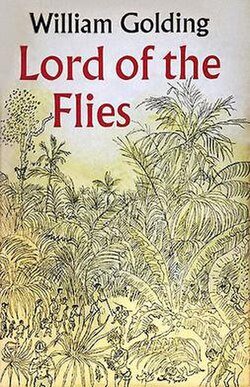
Why Read Lord of the Flies?
Lord of the Flies is one of the most disturbing and enduring works of 20th-century fiction — a novel that takes the most innocent premise imaginable (a group of British schoolboys stranded on a paradise island) and uses it to make one of the bleakest arguments in literature: that civilization is not humanity’s natural state but a fragile, artificial construction, and that beneath its surface the capacity for violence, tribalism, and brutality waits with remarkable patience to reassert itself.
Published in 1954 by Nobel laureate William Golding, the novel follows a group of boys evacuated from a wartime Britain who crash-land on an uninhabited tropical island. Without adults, without rules, and without the institutional scaffolding of civilization, they attempt to govern themselves — and fail, progressively and catastrophically, as fear, tribalism, and the intoxication of violence dismantle their fragile democratic experiment. Golding wrote the novel as a direct response to what he considered the naive optimism of R.M. Ballantyne’s The Coral Island (1857), in which similarly stranded boys behave with admirable virtue — and as a reflection on what he had witnessed in the Second World War.
The novel operates simultaneously as adventure story, psychological study, and philosophical allegory — exploring the relationship between order and chaos, reason and instinct, the individual and the group, the democratic and the authoritarian. For reading comprehension preparation, it offers dense literary symbolism, sustained thematic argument, and the kind of rich allegorical layering that appears in the most sophisticated literary fiction passages in CAT and GRE examinations.
Who Should Read This
Lord of the Flies is essential for anyone interested in human nature, political philosophy, and the conditions that make civilization possible — and for anyone preparing for literary fiction passages in competitive exams. Particularly valuable for CAT and GRE aspirants who need to engage with allegorical fiction and thematic analysis, for MBA candidates preparing discussions on leadership, group dynamics, and organizational culture, and for readers seeking a novel that is simultaneously immediate in its narrative power and inexhaustible in its thematic depth.
Key Takeaways from Lord of the Flies
Civilization is a performance, not a nature. Golding’s most fundamental argument is that the codes, institutions, and norms that make human society possible are not expressions of some innate human goodness but are learned, maintained, and sustained by effort — and that when the institutional supports are removed, the performance rapidly collapses. The boys do not become savage because they are exceptional; they become savage because the conditions that prevented savagery have been removed.
The psychology of tribalism can override individual morality with terrifying speed. The boys who participate in Simon’s killing are not individually evil; they are caught in the momentum of tribal ritual, group fear, and the intoxication of collective violence. Golding’s insight — that ordinary people, placed in specific group conditions, are capable of atrocities they would individually refuse — anticipates the social psychology research of Stanley Milgram and Philip Zimbardo by a decade.
Democratic order requires active, collective commitment — it does not maintain itself. Ralph’s conch-based democracy dissolves not because it is opposed by a more powerful force but because the boys gradually choose Jack’s immediacy, excitement, and protection over the effort that self-governance demands. The conch’s progressive loss of authority mirrors the progressive erosion of the boys’ willingness to prioritize long-term order over short-term fear and pleasure.
The “beast” the boys fear is not external but internal. Simon’s revelation — that the Lord of the Flies is not a creature on the mountain but the darkness within the boys themselves — is the novel’s central philosophical statement. The beast cannot be hunted, killed, or appeased because it is not an enemy outside the group but a capacity within every member of it. This is Golding’s most direct argument against the progressive optimism that evil is a product of circumstance rather than a feature of human nature.
Lord of the Flies Plot Summary
A plane evacuating British schoolboys during a nuclear war is shot down over a remote tropical island. The boys — ranging in age from six to twelve — find themselves alone, with no adults and no rules, on what appears to be a paradise: fruit, fresh water, a lagoon, and warm weather. The older boys Ralph and the overweight, intelligent Piggy discover a conch shell, whose blast summons the scattered survivors. Ralph is elected chief; he establishes the conch as the symbol of democratic order (whoever holds it has the right to speak) and sets up three priorities: shelters, fire for rescue, and maintaining discipline.
Almost immediately the tensions that will destroy the group begin to emerge. Jack Merridew, the leader of a choir turned hunting party, accepts the role of hunter with an intensity that gradually crowds out everything else. The signal fire — the one rational priority — goes out at the very moment a ship passes, because the hunters have let it die to pursue a pig. The confrontation between Ralph and Jack after this failure is the novel’s first crack: between the rational prioritization of rescue and the intoxicating immediacy of the hunt.
As weeks pass, fear becomes the island’s dominant force. The littluns are terrified of a “beast” — something lurking on the mountain. The older boys investigate and find nothing definitive, but the fear is not resolved by evidence; it is amplified by the darkness and the isolation. Jack exploits it brilliantly, offering the younger boys protection through tribal identity and the excitement of the hunt rather than the boring responsibilities of Ralph’s democracy. One by one, the boys migrate from Ralph’s diminishing group to Jack’s growing tribe, seduced by the painted faces, the meat, the ritual, and the security of belonging.
The novel’s three deaths mark its escalating horror. Simon — the visionary, Christ-like boy who alone understands that the beast is internal — is killed in a tribal frenzy when he stumbles out of the forest during a ritual dance; the boys, lost in collective violence, beat him to death believing he is the beast. Piggy — the voice of reason, rationality, and adult values — is deliberately killed when Roger, liberated by the tribe’s licence into pure sadism, levers a boulder that crushes him and destroys the conch simultaneously. Ralph alone survives, hunted across the island, saved only by the arrival of a naval officer who finds the boys at play in what he sees, initially, as an adventure — before the reality of what has happened registers on his face. The novel ends with Ralph weeping, for the first time, for the loss of innocence and the darkness of man’s heart.
Lord of the Flies Characters
Each character functions as both an individual and a philosophical position — together mapping the full spectrum of human responses to the collapse of institutional order.
Fair-haired, physically confident, and instinctively democratic, Ralph represents the values of civilization, governance, and rational prioritization. He understands intellectually what needs to be done — maintain the fire, build shelters, preserve order — but lacks the charismatic intensity and the willingness to exploit fear that would make his leadership stick. His gradual loss of authority, and his final terror as the hunted, is the novel’s structural tragedy: the defeat of reasonable governance by tribal excitement.
The leader of the choir who becomes the island’s chief hunter and ultimately its tyrant. Jack is not simply evil — he is a natural leader of a specific and recognizable kind: charismatic, decisive, physically dominant, and supremely skilled at exploiting fear to build tribal loyalty. His face paint is the novel’s most potent symbol: it allows him to shed the inhibitions of his civilized identity and give full expression to the violence beneath. He represents the authoritarian impulse in its most seductive form.
Asthmatic, overweight, and myopic, Piggy is the novel’s intellectual conscience — the boy who consistently thinks most clearly about what needs to be done and why. His glasses (which start the signal fire and are later stolen for Jack’s tribe) represent the power of rational intelligence; his death represents its defeat. He is also the novel’s primary victim of bullying, whose persistent exclusion is itself a microcosm of how civilized communities treat those who don’t fit.
Quiet, epileptic, and intensely attentive to the natural world, Simon is the novel’s most overtly Christ-like figure — he alone confronts the Lord of the Flies (the pig’s head on a stick), hears its voice articulating the truth about the beast’s internal nature, and is killed bringing that truth to the others. His death is the novel’s moral nadir: the visionary killed by the very community whose blindness he was trying to heal. Golding confirmed Simon was intended as a representation of the naturally good, spiritually aware human being that civilization’s collapse destroys first.
The most frightening figure in the novel precisely because he is the most consistent: from the beginning Roger shows an appetite for cruelty that the civilized context merely suppresses rather than eliminates. When Jack’s tribe removes the inhibitions of civilization, Roger does not need to be converted — he simply does what he always wanted to do. His deliberate killing of Piggy is the novel’s most coldly horrifying act, performed not in the frenzy of tribal ritual but with quiet, deliberate satisfaction.
The pig’s head mounted on a stick by Jack’s hunters as an offering to the beast — which becomes, in Simon’s feverish vision, an articulate voice telling him the truth he already knows: that the beast is the boys themselves, that it lives within them, and that it cannot be escaped by hunting or appeasement. The name “Lord of the Flies” is a translation of Beelzebub — one of the names of the devil — making explicit the theological dimension of Golding’s argument about the innate capacity for evil.
Major Themes
Golding weaves four interlocking philosophical themes through the novel — each illuminating a different dimension of his central argument about civilization, human nature, and the conditions that make ordered society possible.
The novel’s governing theme is that the order, restraint, and cooperation that make civilized life possible are not natural to human beings but are sustained by institutional and social structures that can be removed — by war, isolation, catastrophe, or simply the absence of adults. Without these structures, the boys do not revert to a neutral state of nature; they revert to tribalism, violence, and the domination of the strong over the weak. Golding’s argument is that civilization is an achievement that must be actively maintained, not a default that reasserts itself when obstacles are removed.
Lord of the Flies is one of literature’s most sustained examinations of how ordinary people come to commit atrocities. The boys who kill Simon and Piggy are not monsters — they are children who have been placed in specific conditions (fear, isolation, tribal identity, the intoxication of ritual) that systematically override individual moral inhibition. Golding’s insight anticipates by a decade the experimental findings of Milgram (on obedience to authority) and Zimbardo (on the situational determinants of violence) — the novel is, in this sense, a literary version of a social psychology experiment.
The progressive collapse of Ralph’s conch democracy is the novel’s political argument. Democracy requires its participants to accept short-term costs (effort, discipline, delayed gratification) for long-term benefits (safety, rescue, order). Jack offers the opposite: immediate excitement, protection through tribal belonging, and the gratification of violence. When fear is high and the institutional scaffolding is weak, Golding argues, the authoritarian offer is often more compelling than the democratic one — a conclusion that resonates far beyond the island.
The three deaths in the novel map onto three human faculties. Simon, the spiritually intuitive, is killed first — suggesting that in a civilizational crisis, visionary understanding is the first casualty. Piggy, the rational and intellectual, is killed second — reason survives longer than spirit but is ultimately crushed by power. Ralph, the political and social, survives — but only because an external authority arrives to save him. Golding’s hierarchy suggests that neither intelligence nor vision is sufficient protection against the darkness; only institutional power from outside can restore order once the collapse has begun.
Critical Analysis
A balanced assessment of one of the most successfully integrated allegories in English fiction — examining its extraordinary achievements alongside its genuine limitations of scope and vision.
Every element of the novel — the conch, the glasses, the signal fire, the face paint, the Lord of the Flies — carries precise symbolic weight that rewards close analysis without overwhelming the narrative, making it one of the most successfully integrated allegories in English fiction.
Despite its allegorical structure, the boys’ behaviour is psychologically convincing — the gradual erosion of democratic commitment, the exploitation of fear, the sociology of bullying and exclusion all feel true to the dynamics of groups under pressure in ways that purely schematic allegories do not.
The novel works as a thriller — the danger is real, the violence is shocking, and the pacing accelerates toward a genuinely terrifying climax — which means that its philosophical argument is delivered through an experience of genuine narrative engagement rather than didactic exposition.
The novel’s cast is entirely male, which limits both its sociological claims (would a group of girls have behaved differently? — a question explored directly in subsequent fiction) and its representational scope; the absence of female experience is a significant omission in a novel making claims about universal human nature.
The symbolic assignments are occasionally too neat — Simon as Christ figure, Piggy as reason, Ralph as democracy — in ways that make the characters feel less like individuals and more like philosophical positions wearing schoolboy faces, which reduces the novel’s emotional texture.
Golding’s vision offers essentially no path to a different outcome — given the same conditions, the same collapse seems inevitable, the same darkness unavoidable. This has been criticized as philosophically defeatist: it diagnoses the problem with devastating clarity but offers nothing in the way of structural or cultural resources for prevention.
Literary & Cultural Impact
From Rejection to Nobel Prize: Lord of the Flies was rejected by over twenty publishers before being accepted by Faber and Faber in 1954. It has since sold over 15 million copies, been translated into dozens of languages, and become one of the most widely taught novels in secondary schools and universities worldwide — a standard text in English literature curricula across Britain, the United States, Australia, and India. Golding was awarded the Nobel Prize in Literature in 1983, with the committee citing his novels for “illuminating the human condition in the world of today.”
A Cultural Framework for Understanding Savagery: The novel’s cultural influence has been substantial and diverse. It gave the culture a framework — boys descending into savagery, the beast within — that has been referenced, adapted, subverted, and reimagined in everything from The Hunger Games to reality television. The 1963 film adaptation by Peter Brook, shot in black and white with non-professional child actors, remains one of the most faithful and disturbing literary adaptations in cinema history.
Essential Preparation for Competitive Exams and MBA Interviews: For competitive exam aspirants, Lord of the Flies is one of the most analytically productive texts on the reading list for literary analysis questions. Its dense symbolism, clear thematic structure, and accessibility of narrative make it ideal for CAT and GRE passages that require readers to identify allegorical meaning, track thematic development, and analyse the relationship between specific literary choices and larger arguments. Its content — the psychology of group violence, the conditions for democratic failure, the social construction of the “beast” — is also directly relevant to GD topics on leadership, organizational culture, and human nature that appear in MBA selection processes.
Love This Book? Master Every Book.
Stop struggling with reading comprehension. Our proven system transforms how you read—whether for CAT, GRE, GMAT, SAT, or personal growth.
Best Quotes from Lord of the Flies
Maybe there is a beast… maybe it’s only us.
The thing is — fear can’t hurt you any more than a dream.
Ralph wept for the end of innocence, the darkness of man’s heart, and the fall through the air of the true, wise friend called Piggy.
We did everything adults would do. What went wrong?
The conch doesn’t count at the top of the mountain, so you said. I’m just saying what I think about what Ralph said. Nobody asked me, but I said it anyway.
Test Your Understanding
Think you’ve mastered Lord of the Flies? Challenge yourself with 15 questions on Golding’s characters, symbolism, themes, and the novel’s philosophical argument about civilization and human nature. Score 80%+ to prove your mastery.
Lord of the Flies FAQ
What is Lord of the Flies about?
A group of British schoolboys evacuated during a nuclear war crash-land on an uninhabited tropical island and attempt to govern themselves without adults. Their democratic experiment — led by the fair-haired Ralph, with the conch as the symbol of order — progressively collapses under the pressure of fear, tribalism, and the charismatic authoritarian leadership of Jack. Three boys die: Simon (killed in a tribal frenzy), Piggy (deliberately murdered), and nearly Ralph — rescued only by the arrival of a naval officer. The novel is an allegory about the fragility of civilization and the darkness within human nature.
Is Lord of the Flies difficult to read?
It is rated Intermediate — the prose is clear and the narrative moves quickly, making it one of the most readable novels on the list. The allegorical dimension rewards close reading but does not obstruct the adventure narrative for first-time readers. Most readers find it gripping rather than demanding, though the violence in the second half — particularly the deaths of Simon and Piggy — is genuinely disturbing.
What are the main themes in Lord of the Flies?
The central themes are the fragility of civilization and the conditions required to maintain it, the psychology of group violence and the situational determinants of evil, the vulnerability of democratic governance to authoritarian tribalism, the nature of the “beast” as an internal rather than external force, and the relationship between reason, vision, and power in organizing human communities.
What does the conch symbolize?
The conch shell is the novel’s primary symbol of democratic order and the rule of law — whoever holds it has the right to speak, regardless of age, strength, or status. Its progressive loss of authority as the novel develops mirrors the progressive erosion of the boys’ commitment to self-governance: first the conch’s rules are ignored, then it is physically stolen, and finally it is shattered by the same boulder that kills Piggy. The simultaneous destruction of the conch and Piggy represents the simultaneous destruction of order and the rational intelligence that sustained it.
Why is Lord of the Flies still taught and read today?
Because its central argument — that civilization is fragile, that the capacity for violence and tribalism exists in all human communities, and that specific conditions can unlock it with terrifying speed — has been confirmed rather than refuted by the history of the 20th and 21st centuries. Every episode of genocide, mob violence, or democratic collapse since 1954 has made the novel more rather than less relevant. It is also, in the most concentrated possible form, a preparation for thinking about the conditions that make healthy organizations, communities, and democracies possible.








