
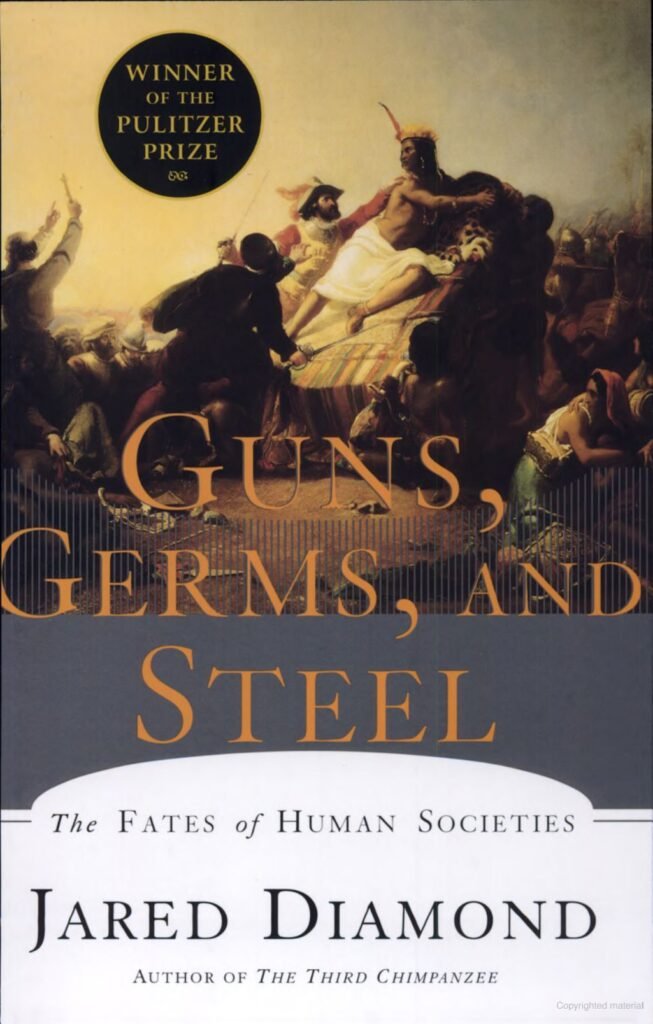
Why Read Guns, Germs, and Steel?
Guns, Germs, and Steel is the most consequential work of popular history written in the last thirty years — a Pulitzer Prize-winning synthesis of anthropology, archaeology, biology, linguistics, and history that answers one of the most important and most politically sensitive questions in the study of human civilization: why did some peoples conquer others, rather than the reverse? Jared Diamond’s answer — grounded in geography, biogeography, and the contingent historical consequences of where different human populations happened to settle — is both intellectually powerful and politically significant, because it provides a rigorous scientific refutation of racial and cultural superiority explanations for global inequality while demanding a thorough rethinking of how we explain the divergence of human civilizations.
The book’s central question is posed through a conversation Diamond had with Yali, a New Guinean politician who asked him directly: “Why is it that you white people developed so much cargo and brought it to New Guinea, but we black people had so little cargo of our own?” Diamond’s answer is that the root cause of this inequality is not biological — not racial or genetic differences in human intelligence or capacity — but geographical: specifically, the dramatically unequal distribution of domesticable plant and animal species across the world’s continents, and the axis orientation of those continents, which determined which human populations had access to the productive agriculture and domestic animals that enabled dense populations, specialized labour, state organization, and ultimately the guns, germs, and steel that allowed some civilizations to conquer others.
Organized in five parts, the book moves from the origins of human civilization through the domestication of plants and animals, the development of writing and technology, the spread of germs, and the comparative histories of specific civilizations — building a cumulative argument that the proximate causes of European conquest (superior weapons, epidemic disease, organized states) are themselves the product of ultimate causes rooted in geography and biology going back thirteen thousand years.
Who Should Read This
A book for serious students of history, anthropology, and civilization who want the most rigorous scientific account of why the world is as unequal as it is — and who want to engage with an argument that is simultaneously empirically ambitious, politically important, and intellectually contested. Essential for advanced students of history, anthropology, and development; policy professionals who want to understand the deep historical roots of contemporary inequality; CAT/GRE aspirants who need advanced-level comparative history prose; and anyone who has wondered why European civilization came to dominate the world rather than African, Asian, or Indigenous American civilization.
Key Takeaways from Guns, Germs, and Steel
The domestication of plants and animals — which began at different times and to dramatically different degrees on different continents — is the single most important proximate variable in explaining the differential development of human civilizations. Eurasian civilizations had access to the largest suite of domesticable large mammals (horses, cattle, pigs, sheep, goats) and the most productive domesticable grains on Earth. The Americas had almost none; Australia had none. This biological accident — not human intelligence or cultural superiority — is the foundation of Eurasian civilizational advantage.
Epidemic diseases — smallpox, measles, influenza, plague — were the single most powerful weapon of European conquest, killing vastly more indigenous people in the Americas, Australia, and Oceania than guns or steel. These diseases originated from close human contact with domestic animals in Eurasia. Indigenous populations had no prior exposure and therefore no evolved or acquired immunity. The asymmetry in disease immunity was not a weapon Europeans consciously deployed but a catastrophic consequence of biological history that preceded European expansion by millennia.
Continental axis orientation — east-west versus north-south — is a fundamental determinant of whether crops, animals, technologies, and ideas can spread across a continent. Eurasia’s predominantly east-west axis allowed domesticated crops and animals developed in the Fertile Crescent to spread rapidly across similar latitudes to Europe and Asia. The Americas’ and Africa’s predominantly north-south axes meant that domesticated crops had to cross dramatically different climate zones to spread, dramatically slowing the diffusion of agricultural knowledge and technology.
The proximate causes of European conquest — guns, steel weapons, ocean-going ships, political organization, and writing — are themselves the products of the ultimate geographic causes that gave Eurasian civilizations more time, more food surplus, more population density, more specialization, and more accumulated technological knowledge. Understanding the chain of causation from geography to agriculture to surplus to specialization to technology to conquest is essential for understanding why the modern world is organized as it is — and why the appropriate response is structural and historical analysis, not racial or cultural attribution.
Key Ideas in Guns, Germs, and Steel
The book’s opening argument is that explaining the current distribution of wealth and power in the world requires going back thirteen thousand years — to the end of the Pleistocene and the beginnings of agriculture — because the contemporary inequality between civilizations is the long-run consequence of differences in trajectory that began at that moment. Yali’s question is not answerable by reference to what happened in 1492 or even 1000 CE; it requires understanding why the civilizations that expanded globally in the past five centuries had developed the specific combination of agricultural surplus, population density, technological complexity, state organization, and disease immunity that enabled conquest — and why other civilizations had not.
Diamond’s answer begins with the domestication of plants and animals. Of the world’s approximately 200,000 wild plant species, only a few thousand are edible and only a few hundred have ever been domesticated. Of these, only about a dozen (wheat, barley, rice, maize, potato, sorghum, millet, sugar cane, sugar beet, soybean, oat, and rye) account for the majority of the world’s food production. The distribution of these plants across the world’s continents is dramatically unequal — and the distribution of domesticable large mammals is even more dramatic. Of the world’s approximately 148 species of large wild herbivores and omnivores, only 14 were ever domesticated, and all 14 are native to Eurasia and Africa. The Americas had only one domesticable large mammal (the llama/alpaca); Australia had none.
The axis orientation argument is one of Diamond’s most original contributions. He observes that the productivity of agriculture is determined largely by latitude — by the length of growing season, day length, and precipitation patterns — and that crops and animals developed for one latitude cannot simply be transplanted to very different latitudes without substantial adaptation. Eurasia’s east-west axis allowed crops domesticated in the Fertile Crescent to spread relatively easily to Europe and India, which share similar latitudes and seasonal patterns. The Americas’ and Africa’s north-south axes meant that domesticated crops had to cross climate zones in order to spread — which dramatically slowed the diffusion of agricultural knowledge and technology.
The disease argument is the book’s most sobering. Diamond documents that approximately 90% of the indigenous population of the Americas — tens of millions of people — died within a century of first European contact, primarily from epidemic diseases to which they had no prior exposure. This catastrophic mortality was not a deliberate weapon of genocide but a biological consequence of the asymmetry in disease history between Old and New World populations. Eurasian civilizations had been living in close contact with domestic animals for ten thousand years — developing, through this contact, a suite of epidemic diseases that killed millions but also, through natural selection, produced populations with at least partial immunity. Indigenous American populations, which had no comparable history of animal domestication, had no such immunity.
Core Frameworks in Guns, Germs, and Steel
Diamond builds his argument on six interlocking analytical frameworks — from the biogeography of domestication through the mechanics of axis orientation, disease asymmetry, technology accumulation, causal depth, and state formation — each one a distinct layer of the same cumulative explanation.
Domestication of plants and animals produced the agricultural surplus that enabled population growth, dense settlement, occupational specialization, political complexity, and accumulated technological knowledge. The precondition for domestication is the existence of species with the right biological characteristics — for plants, high caloric yield, ease of cultivation, and seed storage; for animals, herding behaviour, docile temperament, rapid growth, and reproductive flexibility in captivity. Of the 56 large-seeded grass species most valuable for agriculture, 32 are native to Eurasia; of the 14 domesticated large mammals, all are Eurasian or African. This distribution reflects biogeographical history rather than human choice or intelligence — and it gave Eurasian civilizations a multi-thousand-year head start in agricultural development that compounded into civilizational advantage over subsequent millennia.
Agricultural productivity is determined primarily by latitude, because latitude determines day length, growing season, and precipitation patterns — the conditions to which crops and animals are adapted. Eurasia’s predominantly east-west axis means that crops and animals can spread along similar latitudes without crossing climate zones — wheat developed in the Fertile Crescent could spread to Greece, Rome, and eventually Britain, all of which share broadly similar seasonal conditions. The Americas’ and Africa’s predominantly north-south axes mean that crops must cross dramatically different climate zones to spread beyond their origin region, dramatically slowing agricultural diffusion. Domesticated crops and animals spread approximately three times faster on an east-west axis than a north-south axis.
The most lethal human epidemic diseases — smallpox, measles, influenza, plague, tuberculosis, cholera — all originated from close human contact with domestic animals: smallpox from cattle; measles from cattle and dogs; influenza from pigs and birds; plague from rodents associated with agricultural grain storage. Eurasian civilizations’ ten-thousand-year history of close contact with domestic animals generated these diseases — which killed millions over this period but also, through natural selection, produced populations with partial immunity. Indigenous American populations, with their far more limited history of animal domestication, had no comparable disease history and therefore no comparable immunity. Estimates range from 50% to 95% population loss in the Americas within a century of contact.
Agricultural surplus — the ability to produce more food than subsistence requires — enables population growth and occupational specialization (craftspeople, soldiers, administrators, clergy) whose knowledge accumulates over generations. Writing, which appears to have been invented primarily as an administrative tool for managing agricultural surplus, enabled knowledge to be stored, transmitted, and accumulated across generations and across space in ways that oral tradition cannot match. Technology compounds: each innovation provides tools for the next. The trajectory from surplus to specialization to accumulated knowledge to writing to further technological development is the mechanism by which the initial agricultural advantage translated into the technological sophistication Diamond calls “guns, germs, and steel.”
The proximate causes of European conquest of the Americas — guns, steel weapons, ocean-going ships, writing, political organization, epidemic disease — are well documented historically. But explaining why these factors were available to Europeans and not to indigenous Americans requires a deeper level of causal analysis: the ultimate causes rooted in the differential distribution of domesticable species, continental axis orientation, and the biogeographical history of each continent. Diamond’s analytical move is to insist that the proximate causes are themselves the products of ultimate causes — that guns, germs, and steel are not brute facts about European civilization but historical consequences of geographic and biological contingencies going back thirteen thousand years. The distinction between proximate and ultimate causes is the most important analytical tool in the book.
Hunter-gatherer societies, constrained by the food supply available within foraging range, are limited in population density to roughly one person per square mile. Agricultural societies can sustain one hundred times this density or more, enabling the large populations that make complex social organization possible. Beyond population density, agricultural surplus enables the non-food-producing specialists — soldiers, administrators, craftspeople, priests, and kings — whose activities generate the political complexity, technological innovation, and organizational capacity that translate population advantage into military and political power. Diamond traces the specific historical mechanisms through which food production enabled state formation across Eurasia — and explains why the same mechanisms produced very different outcomes in regions with less productive agriculture or no domesticable large mammals.
Core Arguments
Diamond advances four interlocking arguments that together constitute a complete causal account of global inequality — from the political refutation of racial explanation through the defence of history as science, the logic of compounding initial differences, and the policy implications of deep historical causation.
The book’s central and most politically important argument is that the current global distribution of wealth and power — which broadly tracks the pattern of European conquest and colonization — is not the product of racial or cultural superiority but of the unequal geographic and biogeographical endowments of different continents. Eurasian civilizations did not conquer the Americas, Australia, and sub-Saharan Africa because Eurasian people were more intelligent, more industrious, or culturally more sophisticated; they did so because they had more domesticable plants and animals, better continental axis orientation for the diffusion of agriculture, and consequently more time to develop the population density, technological complexity, state organization, and disease immunity that military conquest required. This argument requires a complete explanation of the chain of causation from geography to conquest — and Diamond provides it.
Diamond explicitly defends the scientific status of history — the ability to make causal claims and test hypotheses about why things happened as they did — against the view that history is merely narrative, without the explanatory rigour of natural science. His method is comparative: if geographic factors explain civilizational development, then controlling for geography should allow prediction of civilizational trajectory — and Diamond systematically shows that the continents with the most productive agricultural endowments did develop the most complex civilizations, that the continents with east-west axes diffused agriculture faster than those with north-south axes, and that epidemic disease spread most catastrophically where disease immunity was least developed. History as a science of long-run contingency is both a methodological claim and a substantive one.
Diamond’s historical argument is an extended demonstration of how small initial differences in geographic endowment — the presence or absence of a few domesticable species, the orientation of a continental axis — can compound over thousands of years into dramatic civilizational divergences. The Fertile Crescent’s initial advantage in domesticable species was not large in absolute terms; the difference in axis orientation between Eurasia and the Americas is a matter of degrees. But these small initial differences, operating through the feedback loops of agricultural surplus, population growth, technological accumulation, and state formation over ten to thirteen thousand years, produced the dramatically unequal world of 1500 CE. This sensitivity to initial conditions is both the book’s most important historical insight and one of its most challenging arguments to evaluate empirically.
The book’s implicit policy argument — never stated as advocacy but logically entailed by the analysis — is that the contemporary inequality between rich and poor nations is not the product of current-day differences in effort, intelligence, or institutional quality but of historical processes set in motion thousands of years ago. If this is correct, the appropriate policy response to global inequality is not moral condemnation of poor-country governance (since the institutional differences between rich and poor countries are themselves largely the products of colonial and pre-colonial history) but structural assistance that addresses the legacy of historical disadvantage. This implication connects Diamond’s argument to the development economics debates addressed in Why Nations Fail and Naked Economics.
Critical Analysis
A balanced assessment of a book that changed how educated people think about global inequality — its genuine intellectual achievements and the limitations that the academic debate with Why Nations Fail most clearly exposes.
Diamond attempts to explain one of the most important questions in the history of human civilization — why the world is as unequal as it is — at the deepest causal level available. The attempt itself is extraordinary; the success is partial but substantial. No other popular book covers the same territory with comparable rigour, and the framework it provides for thinking about the deep historical roots of contemporary inequality has proven genuinely durable.
The book’s refutation of racial and cultural superiority explanations for global inequality is both intellectually important and practically consequential. By providing a rigorous alternative explanation grounded in geography and biology, it removes the intellectual foundation from a set of pernicious beliefs that continue to influence political discourse and policy. The political significance of this contribution is independent of any academic debates about the completeness of Diamond’s framework.
Diamond draws on anthropology, archaeology, biology, linguistics, genetics, and history in a synthesis that none of these disciplines could achieve alone. The integration of biogeography (why certain species existed where they did) with history (what happened when civilizations met) with epidemiology (how disease spread and killed) is genuinely original and genuinely illuminating — and reflects Diamond’s extraordinary range of scientific training across physiology, evolutionary biology, ecology, ornithology, and anthropology.
Acemoglu and Robinson’s critique — developed most fully in Why Nations Fail (B63 in the Readlite series) — is that Diamond’s geographic determinism cannot explain why some geographically similar regions developed very differently (why North Korea and South Korea, or Zimbabwe and Botswana) and why the reversal of fortune among colonized nations tracks institutional design rather than geography. Diamond acknowledges that institutions matter but does not integrate them adequately into his causal framework. The geographic and institutional explanations are complementary but Diamond’s book underweights the institutional side of the ledger.
Diamond’s framework best explains the distribution of civilizational advantage as of 1500 CE — the starting point of European global expansion. The subsequent five centuries of development, in which some historically disadvantaged regions have developed rapidly (South Korea, Japan, Singapore, Taiwan) while some historically advantaged regions have stagnated, are less well explained by the geographic factors Diamond emphasizes. The framework is most powerful as historical explanation; it is less complete as an account of contemporary development trajectories.
Diamond’s treatment of why Australia and New Guinea did not develop complex civilizations — primarily the absence of domesticable large mammals and the limited productivity of Australian flora — is the least convincing section of the book. The specific trajectory of Australian Aboriginal civilization, which developed sophisticated social and spiritual complexity without agricultural surplus, is not well served by the framework Diamond applies. It is the clearest example of the framework’s limits when applied to civilizations that do not fit the agricultural surplus model.
Impact & Legacy
Pulitzer Prize and Lasting Influence: Guns, Germs, and Steel was published in 1997 and won the Pulitzer Prize for General Non-Fiction in 1998, the Phi Beta Kappa Award in Science, and the Rhone-Poulenc Prize for Science Books. It sold over 1.5 million copies in its first decade, was adapted into a National Geographic documentary series in 2005, and has been translated into over thirty languages. It is now standard reading in undergraduate courses on world history, anthropology, development economics, and political science across the world — one of the most widely assigned academic-adjacent books in the social sciences.
Impact on Popular Historical Thinking: The book successfully displaced explicitly racial explanations for global inequality in mainstream intellectual discourse — providing a rigorous scientific alternative that has become the default framework in educated non-specialist thinking about why some civilizations conquered others. At the same time, its geographic determinism has been criticized by historians, anthropologists, and development economists who argue that it underweights the role of contingency, institutions, and human agency in shaping historical trajectories.
The Diamond vs. Acemoglu/Robinson Debate: The academic debate between Diamond’s geographic determinism and Acemoglu and Robinson’s institutional analysis (in Why Nations Fail, B63 in the Readlite series) is one of the most important ongoing debates in historical social science — and reading both books together provides the best available popular-level introduction to that debate. Neither framework is complete alone; together they provide the most rigorous available account of the deep historical roots of global inequality. Diamond’s geography is the starting condition; Acemoglu and Robinson’s institutions are the ongoing mechanism.
Position Within the Readlite History Series: Guns, Germs, and Steel fits within the Readlite history series as the deepest causal analysis of why civilizational development was unequal as of 1500 CE. Sapiens (Harari) provides the broadest narrative of the full human story; Why Nations Fail (B63) provides the institutional analysis that complements and critiques Diamond’s geographic framework; and A Short History of Nearly Everything (B68) provides the scientific foundation — the biology and geology — from which Diamond’s biogeographical argument draws. The recommended reading sequence is Sapiens first (broadest context), then Guns, Germs, and Steel (geographic causal framework), then Why Nations Fail (institutional analysis that complements and critiques Diamond).
For Exam Preparation: Guns, Germs, and Steel is among the most demanding reading comprehension texts on the Readlite list — a 480-page advanced-level comparative history that builds a complex multi-causal argument across multiple disciplines and multiple levels of historical analysis. Its consistent movement from specific cases (the conquest of the Incas, the domestication of the horse) to general principles (axis orientation, the disease multiplier) and back provides direct practice for the advanced analytical reading skills that the most challenging CAT and GRE passages require.
Love This Book? Master Every Book.
Stop struggling with reading comprehension. Our proven system transforms how you read—whether for CAT, GRE, GMAT, SAT, or personal growth.
Best Quotes from Guns, Germs, and Steel
History followed different courses for different peoples because of differences among peoples’ environments, not because of biological differences among peoples themselves.
The history of interactions among disparate peoples is what shaped the modern world through conquest, epidemics, and genocide.
Yali’s question is, Why did white people develop so much cargo and bring it to New Guinea, while we black people had so little cargo of our own?
We estimate that over the course of the Americas’ post-Columbian history, the number of Indians killed by the Old World germs vastly exceeded the number killed by the Old World guns and swords.
The striking differences between the long-term histories of peoples of the different continents have been due not to innate differences in the peoples themselves but to differences in their environments.



Test Your Understanding
Think you’ve mastered Guns, Germs, and Steel? Challenge yourself with 15 questions on the domestication differential, axis orientation, the disease multiplier, the proximate and ultimate causes framework, and the Diamond vs. Acemoglu/Robinson debate. Score 80%+ to prove your mastery.
Guns, Germs, and Steel FAQ
Is Guns, Germs, and Steel saying that some people are genetically inferior?
No — the book’s entire argument is the exact opposite. Diamond explicitly and repeatedly argues that there is no evidence for genetic differences in intelligence or capacity between human populations that would explain the differential development of civilizations. His argument is that the dramatic differences in civilizational development as of 1500 CE — and consequently the patterns of conquest, colonization, and contemporary global inequality — are the products of geographic and biogeographical differences between continents, not genetic or cultural differences between human populations. The book’s political purpose is precisely to provide a rigorous scientific refutation of racial explanations for global inequality — to show that the inequality can be fully explained by factors that have nothing to do with the biological characteristics of the people involved.
What is the “Fertile Crescent” and why does it matter so much?
The Fertile Crescent is the arc of land in the Middle East — covering parts of modern Israel, Palestine, Lebanon, Jordan, Syria, Turkey, Iraq, and Iran — that had the highest concentration of domesticable wild plant and animal species on Earth. It was the birthplace of agriculture (wheat and barley cultivation began there approximately 10,000 years ago) and animal domestication (goats and sheep approximately 11,000 years ago, cattle approximately 10,000 years ago, pigs approximately 9,000 years ago). Because the Fertile Crescent’s agricultural innovations could spread relatively easily along Eurasia’s east-west axis to Europe and Asia, and because they carried with them the disease reservoirs that would later devastate non-Eurasian populations, the Fertile Crescent’s unique biological endowment is the deepest root of Eurasian civilizational advantage.
How does Guns, Germs, and Steel relate to Why Nations Fail?
The two books address overlapping questions from different analytical starting points, and reading them together provides the most complete available account of why the world is organized as it is. Diamond asks: why did some civilizations develop the technological and organizational complexity that enabled conquest, rather than others? His answer is geographic — the unequal distribution of domesticable species and the differential effect of continental axis orientation. Acemoglu and Robinson ask: why do some nations prosper today while others remain poor, even when geographic endowments are similar? Their answer is institutional — the quality of political and economic institutions that distribute power and opportunity. The two frameworks are complementary rather than competing: geography explains the deep historical roots of civilizational divergence as of 1500 CE; institutions explain the more recent divergences and convergences that geographic factors alone cannot account for.
Why did germs kill more indigenous Americans than guns?
European epidemic diseases — particularly smallpox, measles, influenza, and plague — killed an estimated 50–95% of indigenous American populations within a century of first contact, vastly exceeding the mortality from direct violence. The mechanism was biological asymmetry: Eurasian populations had been living in close contact with domestic animals for ten thousand years, and the zoonotic diseases that originated from this contact had killed millions of Eurasians over this period but had also, through the brutal filter of natural selection, produced populations with at least partial immunity. Indigenous American populations had no comparable history of animal domestication, no prior exposure to these diseases, and therefore no immunity at all. When disease-carrying Europeans arrived, the resulting epidemics spread through populations with no immune resistance — often preceding European settlers by years, killing people who had never seen a European and who had no idea what was destroying them.
How should I read Guns, Germs, and Steel alongside Sapiens and Why Nations Fail on the Readlite list?
The three books together constitute the most comprehensive popular-level treatment of why the world is organized as it is and how it got that way. Sapiens provides the broadest narrative — the full story of Homo sapiens from the cognitive revolution 70,000 years ago to the present, with an emphasis on the cognitive and cultural developments that made humans uniquely capable of civilizational complexity. Guns, Germs, and Steel provides the deepest causal analysis of why civilizational development was unequal — why some populations had the geographic and biological advantages that translated into technological and military superiority. Why Nations Fail provides the institutional mechanism that explains why geographic advantages translated into specific political and economic outcomes — and why some historically disadvantaged regions have developed rapidly while some historically advantaged ones have stagnated. The recommended reading sequence is Sapiens first (broadest context), then Guns, Germs, and Steel (geographic causal framework), then Why Nations Fail (institutional analysis that complements and critiques Diamond).








